TL;DR
Stripe Billing leads AI subscription billing tools in 2026 for $25K to $5M monthly recurring volume. Smart Retries uses machine learning to recover declined payments and Stripe Radar scores fraud at authorization. Helcim wins below $50K when you want interchange-plus economics over an ML stack. Stax wins above $80K monthly because subscription-style processor pricing strips out the markup that makes Stripe's 2.9 percent plus 30 cents painful at scale. PayPal is the runner-up only for consumer-facing subscriptions where buyer trust at checkout drives conversion.
How we ranked
We weighted six criteria for operators running recurring revenue between $25K and $5M monthly.
- Effective rate at $250K monthly recurring volume on a typical SaaS card mix (60 percent rewards consumer, 30 percent debit, 10 percent commercial). Interchange pulled from Visa's published schedules and Mastercard's interchange tables.
- Machine-learning recovery: smart retry logic, account updater coverage, automated dunning, churn signals.
- Subscription primitives: proration, trials, metered or usage billing, scheduled price changes, quote-to-cash.
- Contract length and early termination fees from each provider's posted terms.
- Settlement speed (T+1 versus T+2). The Federal Reserve Payments Studies documents settlement timing patterns that affect working capital.
- Revenue recognition support (ASC 606, deferred revenue schedules) for finance teams closing monthly books.
Hardware lock-in is irrelevant for subscriptions, so it is excluded. Level 2 and 3 data support is folded into the rate calculation, which matters for B2B SaaS.
At a glance
Six providers worth comparing for subscription billing in 2026. Clover (POS-first) and Worldpay (no posted pricing) are excluded; both appear in our broader processor reviews.
| Provider | Headline pricing | Subscription primitives | AI recovery | Best for | Watch out for |
|---|---|---|---|---|---|
| Stripe Billing | 2.9% + $0.30 online; +0.5% Billing | Full (proration, trials, metered, 606) | Smart Retries, Radar | $25K to $1M SaaS | Rate at $1M+ volume |
| Helcim | IC + 0.50% + $0.25 online | Trials, proration, dunning | Rule-based retries | Sub-$1M operators | No native 606 |
| Stax | $99/mo + IC + $0.18 online | Recurring, dunning, account updater | Basic retry rules | $80K+ MRR | Thinner SDK ecosystem |
| Payment Depot | $79 to $199/mo + IC + $0.05 to $0.15 | None native | None native | $100K+ with Recurly or Chargebee | No bundled billing |
| PayPal | 3.49% + $0.49 standard; 2.59% Advanced | Subscriptions API | Smart Retry, Vault updater | Consumer subs (secondary) | Worst card rate |
| Square | 2.9% + $0.30 online; 3.5% + $0.15 keyed | Trials, proration | Fixed retries | In-person service subs | Not for B2B SaaS |
Stripe Billing
Stripe Billing sits on top of Stripe's flat-rate processing. The headline online rate is 2.9 percent plus 30 cents per successful card charge, per Stripe's posted pricing. Stripe Billing adds 0.5 percent on recurring charges, or 0.8 percent for the Scale plan that includes Stripe Revenue Recognition.
Smart Retries learns the best time to retry a declined card based on issuer behavior, a feature Stripe documents publicly. Account updater catches reissued cards before the next billing cycle. Stripe Radar scores authorization fraud using machine learning trained across the network.
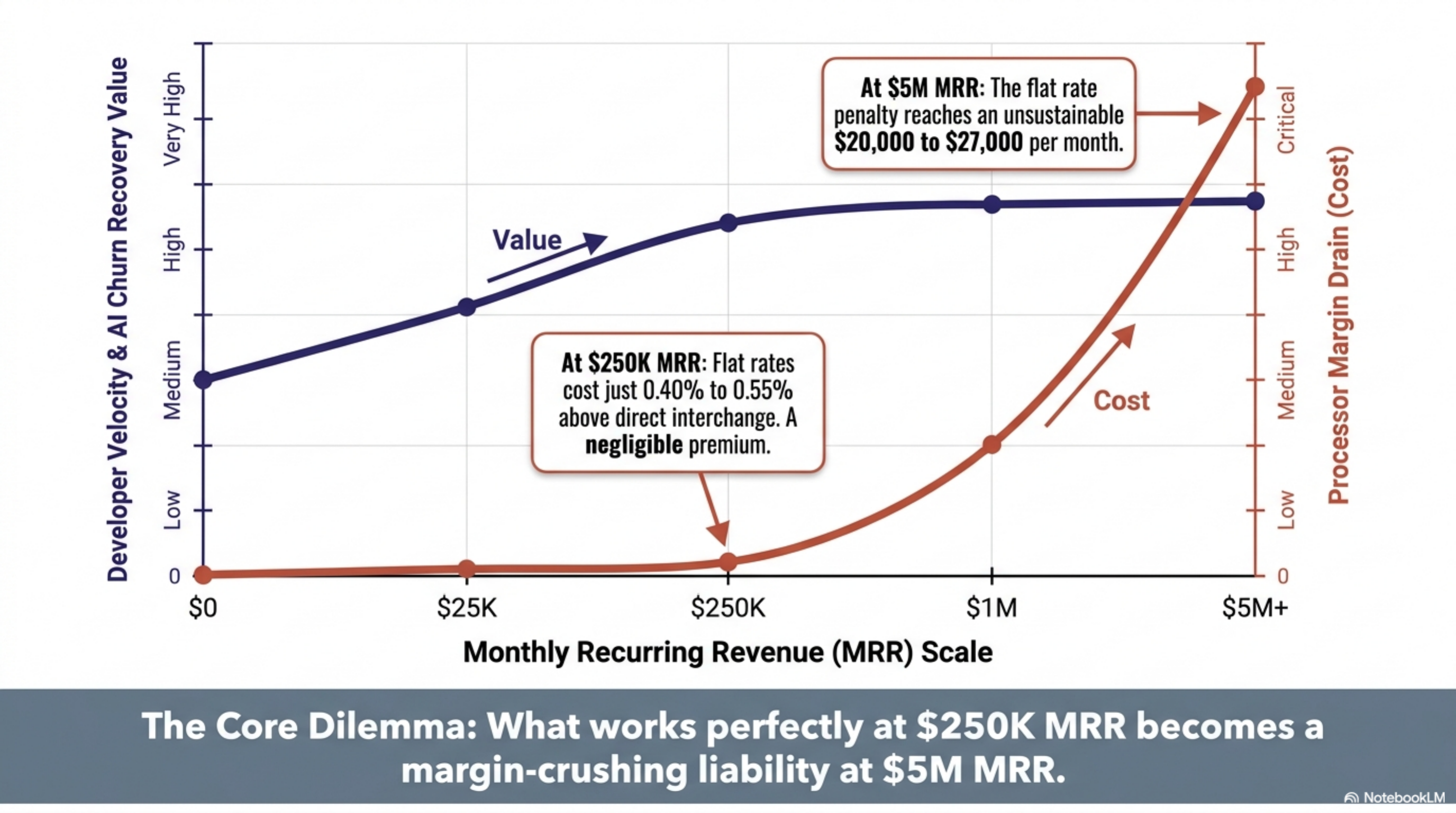
The cost: Stripe's flat 2.9 percent plus 30 cents runs 0.40 to 0.55 percent above interchange-plus at $250K monthly volume on a SaaS card mix. That gap widens as volume grows. At $5M monthly, the flat rate costs roughly $20K to $27K per month more than a Helcim or Stax setup.
Who it fits: API-first SaaS teams between $25K and $1M monthly that value engineering velocity and ML recovery over the rate. Who should avoid it: anyone above $2M monthly who has not negotiated custom pricing, which Stripe does offer above $80K monthly.
Helcim
Helcim runs interchange-plus pricing with automatic volume tiers. Online cards run interchange plus 0.50 percent plus 25 cents; in-person interchange plus 0.40 percent plus 8 cents, per Helcim's pricing page.
Helcim's recurring billing module supports trials, proration, metered usage, and customer-facing subscription pages. The platform sends automated dunning emails and lets customers update cards through a hosted portal. There is no machine-learning retry layer comparable to Stripe Smart Retries; retries follow rule-based schedules.
The math at $250K monthly: a typical SaaS card mix runs interchange around 1.85 percent. Add Helcim's 0.50 percent plus per-transaction fees and the effective rate lands near 2.45 percent. Compare that to Stripe's 2.9 percent plus 30 cents flat which clears about 3.0 percent at the same mix. Helcim saves a $250K subscription business roughly $1,375 per month, or $16,500 per year.
Who it fits: subscription operators below $1M monthly who want transparent pricing and a usable billing UI without an ML stack. Who should avoid it: teams that need fine-grained API control, complex usage-based billing logic, or revenue recognition that ties into NetSuite or Sage Intacct out of the box.
Stax
Stax charges $99 per month plus interchange plus 18 cents per online transaction, per Stax's pricing page. The membership model trades a fixed monthly fee for direct interchange pass-through with no percentage markup over interchange.
Break-even versus a flat 2.9 percent plus 30 cents card hits around $25K monthly volume. Above $80K monthly, Stax economics dominate every flat-rate platform. At $250K monthly recurring revenue, a SaaS operator pays roughly $99 plus interchange of 1.85 percent plus 18 cents per transaction, which clears about $5,100 monthly versus $7,500 on a Stripe flat rate. Annual savings around $29,000.
Stax's subscription module handles recurring schedules, proration, and dunning. AI features are limited to basic retry rules. Account updater is included.
Contract: 30-day cancellation with no early termination fee on the standard plan, per the company's posted terms.
Who it fits: SaaS or service operators above $80K monthly recurring volume who want subscription-style processor pricing and accept giving up Stripe's developer ergonomics. Who should avoid it: developer-led teams that need first-class APIs, webhooks, and SDK ecosystem coverage. Stax's API and partner integrations exist but are thinner than Stripe's documentation and tooling.
Payment Depot
Payment Depot charges $79 to $199 monthly plus interchange plus 5 to 15 cents per transaction, per Payment Depot's pricing page. Like Stax, the membership model passes interchange through directly with no percentage markup.
The model fits subscription billing well at the rate level. The catch: Payment Depot is a reseller of underlying processor platforms, not a billing platform itself. Subscription primitives, dunning, smart retries, and revenue recognition come from whichever gateway you pair (Authorize.net, NMI, or USAePay are common). You build the AI recovery stack yourself or pay a third-party billing layer like Recurly or Chargebee on top.
That layered architecture is fine if you already run a billing system and just want cheaper processing under it. It is painful if you want one bundled platform.
Who it fits: established subscription operators above $100K monthly who already use Recurly, Chargebee, or Zuora for billing logic and want the cheapest processing under it. Who should avoid it: early-stage SaaS teams that need an out-of-the-box billing platform with built-in dunning and retry logic.
PayPal
PayPal Subscriptions API supports recurring billing on PayPal's checkout. Standard card processing is 3.49 percent plus 49 cents and Advanced Card runs 2.59 percent plus 49 cents, per PayPal's posted business fees.
The pricing is the worst of the comparison set on cards. PayPal earns its place because consumer-facing subscriptions convert measurably higher when buyers can pay with a PayPal balance or linked bank account, removing card-entry friction. Nilson Report covers PayPal's checkout share and conversion data.
PayPal Smart Retry exists. Account updater is supported on Vault. Dunning automation is basic, with no machine-learning layer comparable to Stripe.
Who it fits: consumer subscription businesses (digital media, creator platforms, fitness apps) where checkout conversion lift offsets the higher card rate, deployed alongside a primary processor for non-PayPal cards. Who should avoid it: B2B SaaS where buyers expect Visa or Mastercard ACH-backed billing, and the 49-cent fixed fee crushes margins on small-ticket recurring charges (anything under $30 monthly).
Square
Square's Subscriptions tool runs on top of standard Square processing: 2.9 percent plus 30 cents online, 3.5 percent plus 15 cents keyed, per Square's pricing page.
Square Subscriptions handles trial periods, prorations, and customer-facing subscription pages. There is no machine-learning retry layer; retries follow a fixed schedule. Dunning is basic.
The product was built for in-person retail and food service, not for SaaS or B2B subscription billing. The subscription module is sufficient for boutique fitness studios, salon memberships, or in-person service plans. It is not sufficient for a software company processing tens of thousands of monthly invoices with usage tiers.
Who it fits: in-person service businesses adding a subscription layer (gym memberships, beauty memberships, recurring service plans). Who should avoid it: software, B2B, or any operator who needs API-driven billing logic, complex proration, or ML-based recovery.
Verdict
For $25K to $1M monthly recurring volume, Stripe Billing wins on the strength of Smart Retries, Stripe Radar, and the developer experience. The 0.40 to 0.55 percent rate premium versus interchange-plus is the cost of buying that ML stack and the engineering velocity that comes with it.
For $1M to $5M monthly recurring volume, Stax wins. The membership model strips out the percentage markup that makes Stripe's flat rate punitive at scale. At $5M monthly, the savings clear $20K per month, which funds an in-house billing engineer.
Helcim is the right pick below $50K monthly when you want transparent interchange-plus without a contract. PayPal earns a slot only as a secondary checkout option for consumer subscriptions where conversion lift justifies the higher card rate.