TL;DR
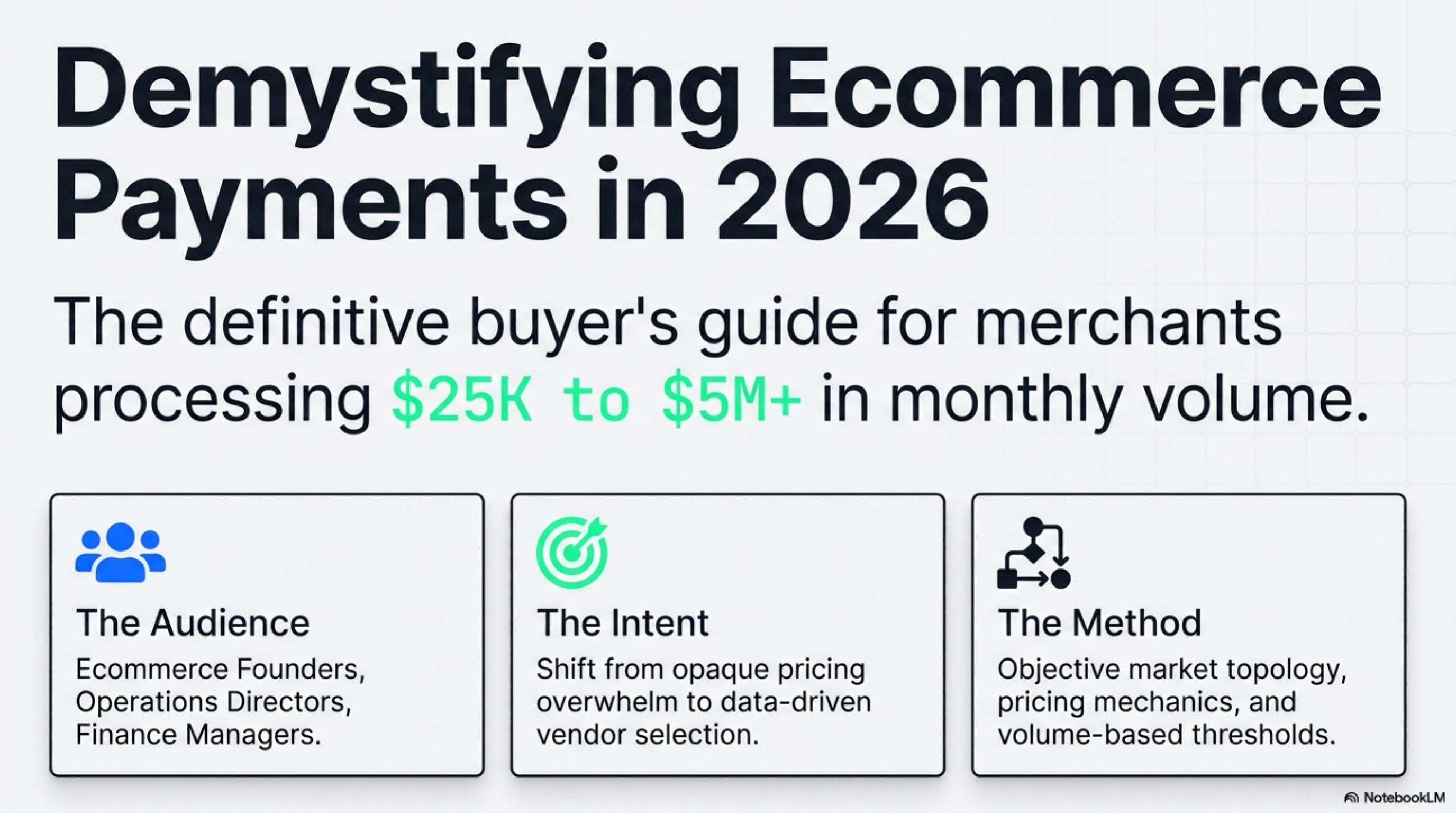
For ecommerce merchants between $25K and $5M monthly volume, Helcim wins on price transparency: interchange-plus 0.50% + $0.25 with no monthly fee and automatic volume tiers. Stripe wins for developer-heavy or global stacks. Stax wins above $80K monthly when the $99 subscription absorbs markup. Square and PayPal stay viable only under $10K monthly because flat-rate pricing stops penciling at scale. Worldpay and Clover are situational. The at-a-glance table below breaks it down by tier.
How we ranked
We scored each gateway against five operator-relevant criteria using each processor's public pricing page and the published interchange schedules from Visa and Mastercard.
- Effective rate at $250K monthly volume. A typical online card mix runs 60% rewards credit, 30% non-rewards, 10% debit, with blended interchange near 1.95%.
- Pricing model. Flat-rate, interchange-plus, or subscription. Each becomes optimal at a different volume tier.
- Contract and ETF. Month-to-month versus three-year lock-ins with $295 to $495 early termination fees.
- Settlement speed. Standard 1 to 2 business days versus instant deposit add-ons at 1.5 to 1.75% per transfer.
- Online feature set and lock-in. 3DS, hosted fields, network tokens, level 2/3 data for B2B, plus whether hardware is locked to a single processor.
At a glance
| Provider | Headline pricing | Contract | Settlement | Best for | Watch out for |
|---|---|---|---|---|---|
| Stripe | 2.9% + $0.30 online | Month-to-month | 2 days | Developers, marketplaces | Flat rate above $80K monthly |
| Square | 2.9% + $0.30 online; 2.6% + $0.10 in-person | Month-to-month | 1 day | Omnichannel under $50K | Aggressive fund holds |
| Helcim | IC + 0.50% + $0.25 online | None | 2 days | $25K to $1M monthly ecommerce | Business-hours support only |
| Stax | $99/mo + IC + $0.18 online | Month-to-month after year 1 | 1 to 2 days | $80K+ monthly with stable mix | Hardware sold separately |
| Payment Depot | $79 to $199/mo + IC + $0.05 to $0.15 | Month-to-month | 1 to 2 days | B2B and high-ticket above $100K | Per-transaction fee on small tickets |
| Clover | $14.95 to $54.95/mo + 2.3 to 3.5% | Plan-based | 1 day | Retail and food service POS | Hardware locked to Fiserv |
| PayPal | 3.49% + $0.49 standard; 2.59% + $0.49 advanced | Month-to-month | 1 to 3 days | Secondary checkout button | $0.49 fixed fee on small tickets |
| Worldpay | Custom IC + (contact sales) | 3 years typical | 1 day | $1M+ monthly with negotiation | 7 to 14 day setup, opaque pricing |
Stripe
Stripe charges 2.9% + $0.30 on standard online transactions, per its public pricing page. There is no monthly fee, no setup fee, and no contract. At $250K monthly volume on a 70/30 credit/debit mix, that flat rate sits roughly 0.55% above interchange-plus on the same card mix.
Stripe's value is the developer surface: hosted Checkout, Elements, Payment Intents API, Connect for marketplaces, and Radar for fraud. Settlement runs on a 2-day rolling schedule by default; instant payouts cost 1.5%.
Where it wins: developer-led teams, marketplaces, and international merchants who need to accept 135+ currencies and local payment methods without re-platforming.
Where it loses: U.S. merchants over $80K monthly volume who do not need the API depth. The flat rate compounds. A $100K monthly merchant on Stripe pays roughly $400 to $550 more per month than the same merchant on Helcim's interchange-plus schedule.
Square
Square's online rate is 2.9% + $0.30, matching Stripe's flat rate. Keyed transactions are 3.5% + $0.15. The free plan has no monthly fee; paid online plans add a software subscription on top, per the Square pricing page.
Square works when the same merchant takes payments in person and online. The card reader hardware, the POS, and the online store share inventory and customer data without integration work. Funding is next-day standard; instant deposit costs 1.75% per transfer.
Where it wins: omnichannel small businesses under $50K monthly, single-location retail, food service, and pop-ups that need a working checkout in 24 hours.
Where it loses: pure ecommerce merchants over $40K monthly, or any merchant where account stability matters. Square's risk team holds funds aggressively on chargebacks and ticket-size jumps, and there is no pre-underwriting for high-risk verticals.
Helcim
Helcim runs interchange-plus 0.50% + $0.25 online with no monthly fee, no setup fee, and no contract. Volume above $25K, $100K, and $500K monthly triggers automatic margin reductions that Helcim publishes on its pricing page.
At $250K monthly volume on a typical mix (1.95% blended interchange, consistent with Federal Reserve payments data), Helcim's all-in cost is roughly 2.45% plus fixed per-transaction fees. Stripe's flat 2.9% + $0.30 lands at roughly 2.95% all-in. Annualized gap: about $13,500.
Helcim's gateway includes hosted payment pages, a virtual terminal, level 2 data fields, ACH at 0.5% capped at $6, and recurring billing, all bundled. Settlement is 2 business days. Support is U.S. and Canada-based, weekday business hours.
Where it wins: U.S. and Canadian ecommerce merchants between $25K and $1M monthly volume who want transparent pricing without sales calls.
Where it loses: 24/7 critical support needs, or merchants needing same-country acquiring outside North America.
Stax
Stax charges a $99 monthly subscription plus interchange and a $0.18 per online transaction, per its pricing page. There is no percentage markup. At $50K monthly volume on a typical mix, total cost is roughly interchange (about $975) plus $99 plus per-transaction fees, landing near 2.10 to 2.25% effective.
The break-even versus Helcim's interchange-plus 0.50% is around $40K to $50K monthly volume. Below that, Helcim wins. Above $80K monthly, Stax saves $200 to $400 per month and that gap widens with volume.
Stax includes a payment dashboard, recurring billing, and ACH at 0.8%. Hardware is sold separately. Contract is month-to-month after the first year.
Where it wins: established ecommerce merchants between $80K and $500K monthly with predictable card mixes.
Where it loses: merchants under $40K monthly, or high-ticket B2B that needs level 3 data optimization. The flat per-transaction fee penalizes small tickets.
Payment Depot
Payment Depot is a wholesale-membership processor: $79 to $199 monthly plus interchange and a $0.05 to $0.15 per-transaction fee depending on tier, per its pricing page. It is now part of Stax Payments, which absorbed the brand in 2021.
The economics resemble Stax with smaller per-transaction overhead, suiting merchants with high-ticket low-frequency volume. At $200K monthly with average tickets above $200, Payment Depot's $0.10 per-transaction fee beats Stax's $0.18 by enough to justify the membership.
Setup takes 1 to 2 business days. Settlement is 1 to 2 days. Support is U.S.-based, weekdays.
Where it wins: B2B ecommerce, wholesale, and high-ticket retail above $100K monthly with average tickets over $150.
Where it loses: small-ticket high-frequency businesses (subscriptions under $25, digital goods, micro-SaaS). The flat per-transaction fee compounds, and a 2.9% flat rate may still come out cheaper.
Clover
Clover sells POS hardware tied to a payment-processing plan, with monthly software fees of $14.95 to $54.95 per location. Online rates are 3.5% + $0.10 keyed, with in-person rates from 2.3% to 2.6% + $0.10 depending on plan, per the Clover POS catalog. Hardware is locked to Fiserv's processing network, which means the device cannot be moved to another processor without re-flashing or reselling.
Clover's online checkout is a basic hosted page or plugin. Reporting is strong on in-person sales and weaker on ecommerce attribution. Settlement is next-day on most plans.
Where it wins: small retail and restaurant operators who want a turnkey hardware-plus-software bundle and accept payments mostly in person.
Where it loses: pure ecommerce. A 3.5% + $0.10 keyed rate makes Clover the most expensive option in this comparison for online-only merchants.
PayPal
PayPal's standard ecommerce rate is 3.49% + $0.49 on its branded checkout, dropping to 2.59% + $0.49 for advanced credit and debit card processing, per the PayPal business fee schedule. The $0.49 per-transaction fee is the highest in this comparison and disproportionately hurts small-ticket merchants.
The $0.49 fixed fee is independent of ticket size. On a $20 average ticket, that is 2.45% from the fee alone, on top of the percentage. Merchants with average tickets under $30 should not run PayPal Standard as the primary gateway.
PayPal still adds value at the checkout layer: the branded button drives a measurable conversion lift on certain verticals because consumers trust the wallet. Many merchants run PayPal as a secondary gateway alongside Stripe or Helcim, not the primary processor.
Settlement to a linked bank takes 1 to 3 business days. Funds can be held for 21 days on new accounts.
Where it wins: merchants who need PayPal-as-a-button next to a primary card gateway.
Where it loses: as a primary processor over $25K monthly. The flat-rate plus 49-cent per-transaction fee compounds badly on average tickets under $50.
Worldpay
Worldpay prices custom: interchange-plus margin negotiated per merchant, typically with a 3-year contract and an ETF up to 1% of remaining contract value. There is no public flat-rate on the Worldpay site.
For merchants over $1M monthly volume, Worldpay's pricing can drop below 0.10% over interchange. Below that, the negotiation room is weak and pricing comes in at 0.30 to 0.50% over interchange, often higher than Helcim's published rates without the negotiation hassle.
Setup is 7 to 14 business days because Worldpay underwrites manually.
Where it wins: merchants over $1M monthly who can negotiate, and high-risk verticals where boutique processors will not underwrite.
Where it loses: SMB and mid-market under $500K monthly. Slow setup and opaque pricing make it the wrong fit.
Verdict
For most U.S. ecommerce merchants between $25K and $1M monthly volume, Helcim is the cleanest answer. Interchange-plus 0.50% + $0.25, no monthly fee, no contract, automatic tiered discounts as you grow. The savings versus Stripe at $250K monthly volume hit roughly $13,500 per year on a typical card mix.
Stripe wins when the team is developer-heavy, the product is a marketplace or global SaaS, or the API depth justifies the 0.40 to 0.55% premium over interchange-plus.
Stax (or its sibling Payment Depot) wins above $80K monthly with a stable card mix. The subscription model erases per-percentage markup at scale.
Always ask for an itemized interchange statement before signing. If a processor only quotes a single effective rate, you cannot audit the markup against published Visa and Mastercard schedules.
Square wins for true omnichannel under $50K monthly. PayPal stays as a secondary button. Clover stays in-store-first. Worldpay only makes sense above $1M monthly with room to negotiate.