TL;DR
For independent auto repair, tire, and body shops running $50K to $250K in monthly card volume, Helcim wins on interchange-plus pricing with no monthly fee and automatic volume discounts. Stax pulls ahead above $80K monthly when the ticket mix can carry the $99 subscription. Square fits sub-$25K shops that need a free counter POS and a phone reader. Dealerships and multi-location chains should skip the round-up and negotiate IC++ directly with a custom acquirer.
How we ranked
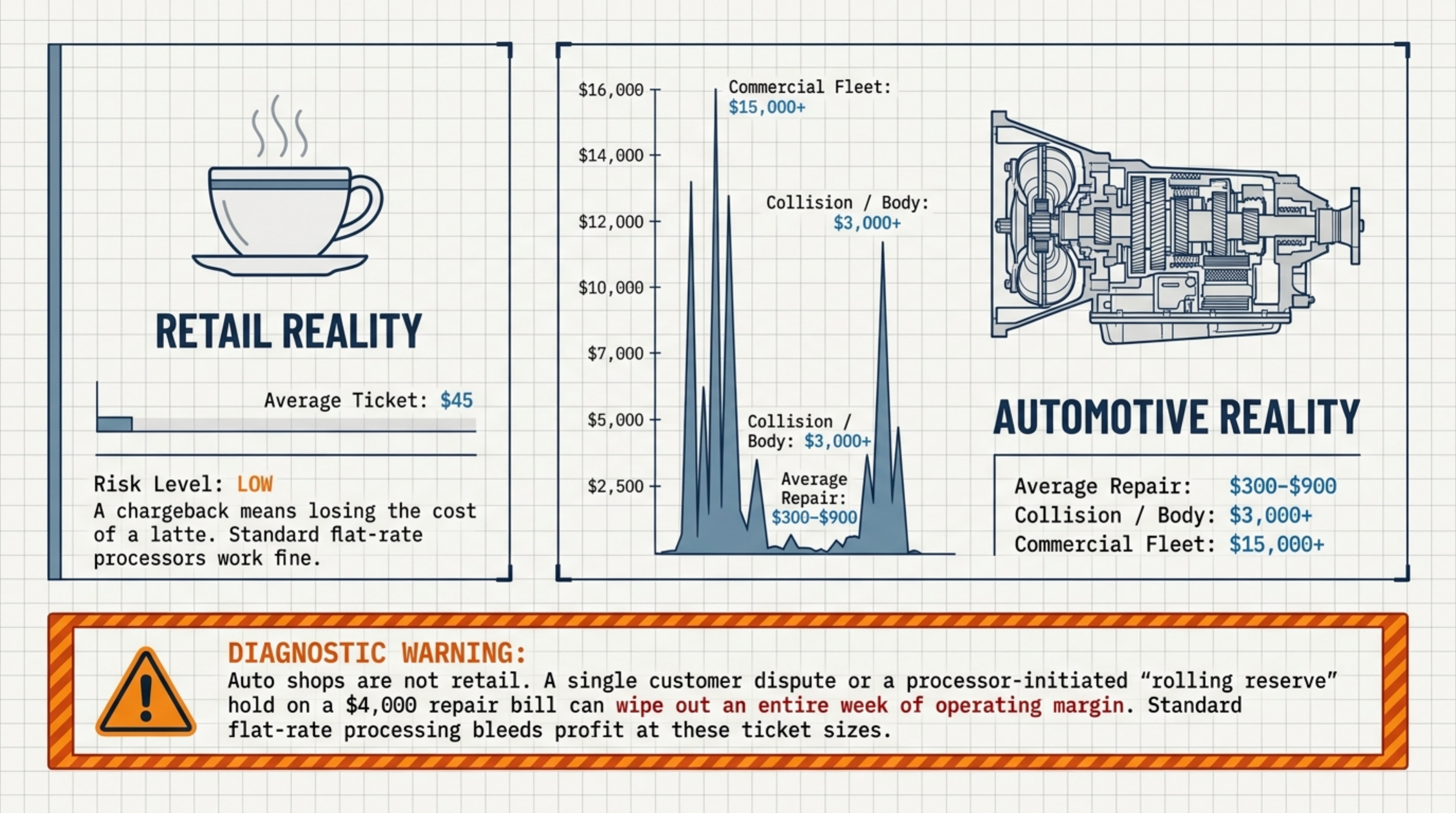
Automotive shops are not retail. The average repair ticket runs $300 to $900, body and collision tickets clear $3,000, and a fleet account can drop a $15K commercial card across a Tuesday afternoon. That mix changes which processor is cheapest. We scored each provider on six criteria:
- Effective rate at $150K monthly volume assuming 75 percent card-present, 15 percent keyed (phone authorizations), and 10 percent online deposits or parts sales.
- Contract length and early termination fee. Month-to-month beats a 36-month lease every time.
- Funding speed. Parts vendors want payment the same week the work is closed.
- Level 2 and Level 3 data support. Fleet, government, and corporate cards qualify for lower interchange when the processor passes line-item data, per the Visa interchange schedule and Mastercard interchange rates.
- Hardware and shop-management software integration. Tekmetric, Shopmonkey, AutoLeap, and Mitchell each have a short list of processors they support natively.
- Dispute SLA and reserve policy. A single chargeback on a $4,000 transmission rebuild can wipe a week of margin.
At a glance
Headline pricing pulled from each provider's public schedule as of June 2026. Effective rates depend on your card mix; see the per-provider sections for math at a $150K monthly auto shop.
| Provider | Headline pricing | Contract | Settlement | Best for | Watch out for |
|---|---|---|---|---|---|
| Helcim | IC + 0.40% + $0.08 in-person | Month-to-month | 2 days | $50K to $250K independent shops | No native shop-management integration |
| Stax | $99/mo + IC + $0.08 in-person | Annual | 2 days | $80K+ shops with low keyed mix | Subscription is dead weight below $40K |
| Payment Depot | $79 to $199/mo + IC + $0.05 to $0.15 | Month-to-month | 2 days | $60K to $150K shops | Multiple membership tiers, M-F support only |
| Square | 2.6% + $0.10 in-person, 3.5% + $0.15 keyed | None | 1 day | Sub-$25K independents, mobile | Rolling reserves, account holds on large tickets |
| Clover | $14.95 to $54.95/mo + 2.3% to 2.6% + $0.10 | Often hardware lease | 1 day | Shops wanting integrated POS | Tier pricing, hardware lock-in |
| Stripe | Online 2.9% + $0.30, in-person 2.7% + $0.05 | None | 2 days | Shops with online parts and booking | Few shop-management integrations |
Helcim
Helcim's published rate is interchange plus 0.40 percent and $0.08 for card-present, interchange plus 0.50 percent and $0.25 for online, with no monthly fee and no contract (helcim.com/pricing). The markup steps down automatically at $25K, $50K, $100K, and $250K monthly volume tiers, so a shop crossing $100K typically sees its real markup drop closer to 0.30 percent over interchange without renegotiating.
Level 2 and Level 3 data passes through on the gateway, which matters when fleet and corporate cards make up 10 to 20 percent of your volume. The Helcim Card Reader runs about $109 and the virtual terminal is included, so a service writer can key a phone authorization without an extra fee.
A $150K monthly shop with 75 percent card-present, 15 percent keyed, and 10 percent online runs an effective rate near 2.05 to 2.20 percent on Helcim. The same volume on Square's flat 2.6 percent in-person plus 3.5 percent keyed clears closer to 2.70 percent. That gap is roughly $9,000 a year on a single rooftop.
Skip Helcim if your shop-management software requires a specific Clover or Worldpay integration; Helcim does not have native plugins for Mitchell or Tekmetric.
Stax
Stax is a subscription model: $99 a month and you pay interchange plus $0.08 in-person, interchange plus $0.18 online (staxpayments.com/pricing). There is no percentage markup, only the per-transaction fee and the membership.
The math works the moment your subscription divided by volume drops below the Helcim markup. At $80K monthly, $99 is 0.12 percent of volume, which beats Helcim's 0.40 percent card-present markup once the Helcim tier discount is applied. At $200K monthly the subscription is 0.05 percent of volume and Stax beats every flat-rate processor by a wide margin.
Stax supports Level 2 and Level 3 data and integrates with QuickBooks and several shop-management platforms. The contract is annual, which is the trade-off for the subscription price.
Skip Stax if you run under $40K monthly. The $1,188 a year in subscription is dead weight that interchange-plus shops avoid. Also skip it if your card mix is heavy keyed, because the $0.18 keyed surcharge stacks on every authorization and adds up faster than the percentage savings.
Payment Depot
Payment Depot is a membership model with tiers from $79 to $199 a month and a flat per-transaction fee of $0.05 to $0.15 on top of interchange (paymentdepot.com/pricing). It is now part of the same group as Stax, and sits between Helcim and Stax on the cost curve.
For a $60K to $150K monthly shop with mostly card-present tickets, Payment Depot's middle tier with $0.10 per transaction can beat Stax slightly on smaller tickets and match Helcim's post-discount markup. The catch is that the savings depend on which tier you land in and how the underwriter prices your average ticket.
Payment Depot bills the membership month-to-month, but the underlying processor agreement can run longer. Read the merchant services contract, not just the membership page, before you cancel.
Support is U.S.-based phone but Monday to Friday only. If your shop runs Saturday hours and you need a same-day terminal swap, factor that into the decision.
Square
Square charges 2.6 percent plus $0.10 in-person, 2.9 percent plus $0.30 online, and 3.5 percent plus $0.15 keyed, with no monthly fee on the basic plan (squareup.com/us/en/pricing). The free POS app, the $59 contactless reader, and one-day funding make it the default pick for a one-bay shop or a mobile mechanic.
The economics break once you cross about $25K monthly. At that point a flat 2.6 percent card-present rate plus 3.5 percent keyed costs roughly 0.40 to 0.55 percent more than interchange-plus on the same card mix. That is $3,000 to $7,000 a year that does not need to leave your account.
Square's reserve policy is the bigger risk for automotive. Large invoices, sudden spikes in average ticket, or a customer dispute on a $4,000 repair can trigger a rolling hold on incoming deposits. If you take fleet checks or large body-shop tickets, this is the single biggest reason to graduate to interchange-plus before you hit $50K monthly.
Square is the right starter, not the right destination.
Clover
Clover is a hardware-first POS with monthly software plans of $14.95 to $54.95 and card-present rates of 2.3 to 2.6 percent plus $0.10, depending on the reseller (clover.com/pos-systems). The terminal lineup runs $599 for the Mini to about $1,799 for the Station Duo.
The Clover network integrates with several shop-management platforms, which is the main reason an automotive shop chooses it. Tekmetric, Shopmonkey, and AutoLeap all list Clover integrations in their app marketplaces. If you want one card reader at the service writer's counter that posts payment directly to a repair order, Clover removes a step.
The trade-off is pricing variance. Clover hardware is sold through hundreds of resellers (banks, ISOs, Fiserv direct), and the effective rate on the same Mini terminal can range from 2.3 percent flat to roughly 0.30 percent over interchange depending on who wrote the contract. Get the merchant services agreement in writing before you accept the hardware, and check for a 36-month lease that survives even if you switch processors.
Stripe
Stripe charges 2.9 percent plus $0.30 online and 2.7 percent plus $0.05 in-person, with no monthly fee (stripe.com/pricing). It is an outlier on this list because most automotive shops do not pick Stripe for the front counter; they pick it for the website.
If you sell parts online, take booking deposits through a custom scheduler, or run a wholesale tire site, Stripe's API and developer tooling are the reason. The in-person rate is competitive and Stripe Terminal hardware runs $59 for the Tap to Pay reader to about $349 for the BBPOS WisePOS E. Funding clears in two business days.
Where Stripe falls short for a working shop is integration depth with shop-management software. Mitchell 1, ALLDATA, and most independent repair orders do not have native Stripe plugins. You get the card processing but you lose the automatic write-back to the repair order, which is why most shops keep Stripe for ecommerce only and run a separate terminal in the bay. Above $40K monthly online volume, ask Stripe for interchange-plus on the Custom plan; the 0.40 to 0.55 percent flat-rate markup is negotiable at scale.
Verdict
For an independent auto repair, tire, or body shop running $50K to $250K in monthly card volume, Helcim is the cheapest published interchange-plus option, with no subscription and automatic volume discounts. Stax overtakes it above roughly $80K monthly when keyed and online volume stay under 20 percent of the mix, because the $99 subscription becomes a smaller percentage of revenue than Helcim's per-transaction markup. Square is the right pick only below $25K monthly, and the reserve risk on large tickets means you should plan to leave by the time you cross $50K. Clover wins when shop-management software integration is the priority, but get the contract in writing because reseller pricing varies. Stripe stays in lane for online parts and booking deposits. Dealerships and multi-rooftop chains should not use this list; negotiate IC++ with a custom acquirer.