TL;DR
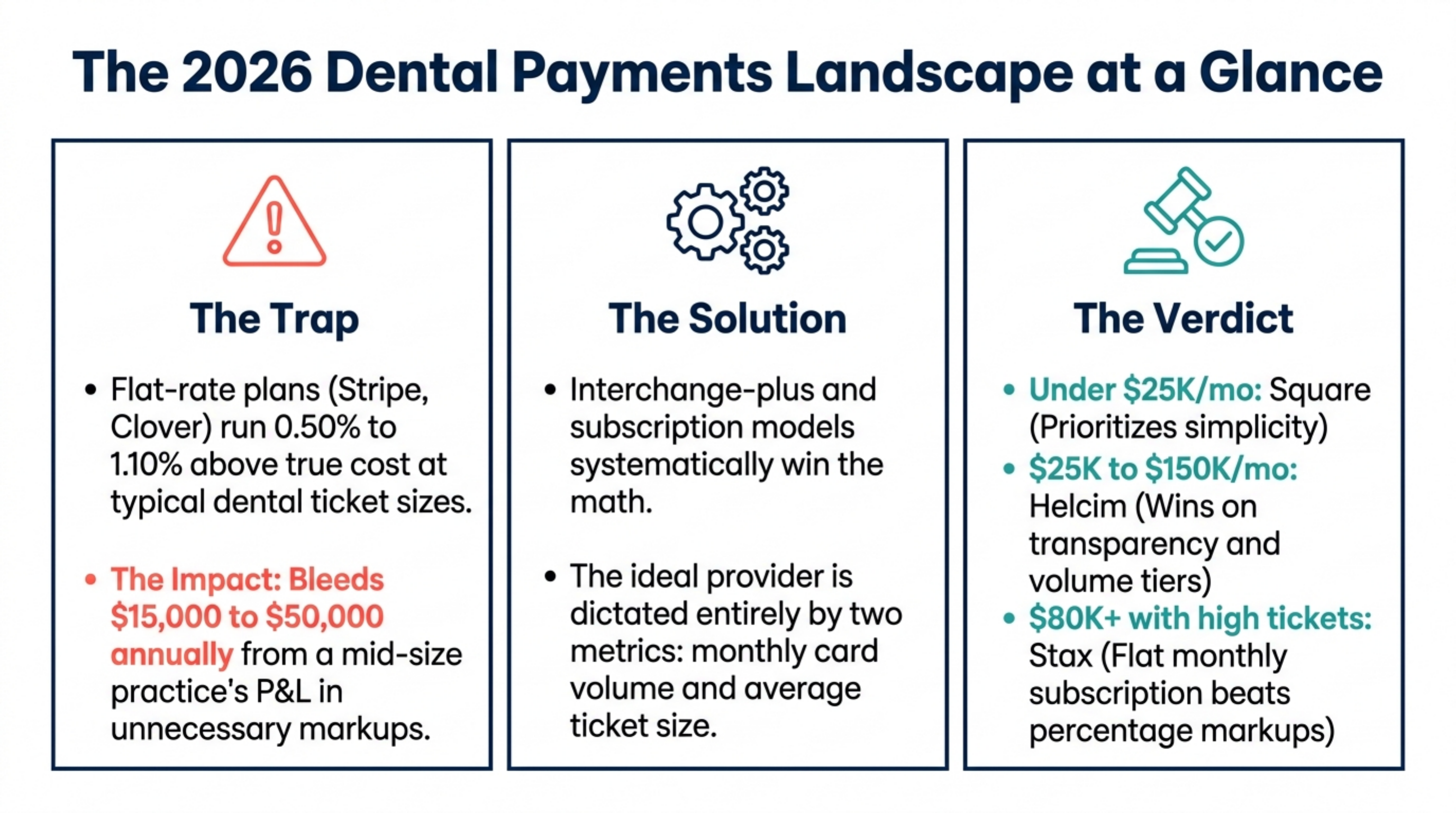
For dental practices running $25K to $5M monthly card volume, Helcim's interchange-plus pricing wins on cost and transparency for most offices. Stax's $99 monthly subscription beats Helcim above roughly $80K monthly volume with a high average ticket. Square fits practices under $25K with no practice management software integration needs. Flat-rate plans from Stripe and Clover run 0.50 to 1.10 percent above true cost at typical dental ticket sizes, which adds up to $15K to $50K per year on a mid-size practice.
How we ranked
Six criteria, weighted by what actually moves the P&L on a dental statement:
- Effective rate at $80K monthly volume with a $280 average ticket (40 percent weight)
- Contract length, early termination fee, and equipment lease lock-in (15 percent)
- Recurring billing for in-house dental membership plans (15 percent)
- Practice management software integration with Dentrix, Eaglesoft, Open Dental, Curve, and Carestream (15 percent)
- HSA and FSA card routing plus Level 2 data support on healthcare BIN ranges per Visa's Interchange Schedule (10 percent)
- Settlement speed from authorization to deposit (5 percent)
At a glance
Six providers most likely to surface in a dental processor search, with the numbers an operator actually compares:
| Provider | Headline pricing | Contract | Settlement | Best for | Watch out for |
|---|---|---|---|---|---|
| Helcim | IC + 0.40% + $0.08 in-person; IC + 0.50% + $0.25 online | None | 2 days | $25K to $150K monthly practices | No native Dentrix or Eaglesoft |
| Stax | $99/mo + IC + $0.08 in-person; + $0.18 online | Monthly | 2 days | $80K+ monthly with high ticket | Loses to Helcim under $50K |
| Payment Depot | $79 to $199/mo + IC + $0.05 to $0.15 | Monthly | 2 days | $75K to $250K cost-focused | Thinner reporting and PMS coverage |
| Square | 2.6% + $0.10 in-person; 2.9% + $0.30 online | None | 1 day | Solo practices under $25K | Costs climb above $35K monthly |
| Stripe | 2.9% + $0.30 online; 2.7% + $0.05 in-person | None | 2 days | Custom patient pay portals | 0.55 to 0.75% over IC+ at dental volume |
| Clover | $14.95 to $54.95/mo + 2.3 to 2.6% + $0.10 | 36 to 48 mo via ISO | 1 day | Turnkey POS plus payments bundle | Multi-year contract, hardware lock-in |
Helcim
Helcim runs interchange-plus pricing: card-present at IC + 0.40 percent + $0.08, card-not-present at IC + 0.50 percent + $0.25, with automatic volume tier discounts that drop the markup monthly without renegotiation, per helcim.com/pricing. No monthly fee, no contract, no early termination fee, no equipment lease. A Smart Terminal sells outright for around $329.
For a practice running $80K monthly with a 70/30 card-present-to-card-not-present split, effective cost lands near 2.30 to 2.50 percent depending on card mix, against published healthcare interchange of 1.65 to 2.00 percent on consumer credit per Visa's Interchange Schedule.
Helcim supports recurring billing for in-house membership plans, ACH at 0.5 percent capped at $6, and direct integration with Open Dental. Larger DSOs occasionally outgrow Helcim's volume tiers and switch to Stax above $150K monthly.
Best for: independent practices and 1 to 5 location groups doing $25K to $150K monthly.
Avoid if: you need a native Dentrix or Eaglesoft integration that Helcim does not currently offer.
Stax
Stax charges $99 per month plus interchange plus $0.08 per card-present transaction and $0.18 per card-not-present transaction, per staxpayments.com/pricing. No percentage markup at all. The flat subscription replaces the per-transaction percentage, which is why the model only wins above a volume threshold.
At $80K monthly with a $280 average ticket (roughly 285 transactions), Stax costs $99 plus interchange plus about $23 in per-transaction fees, working out to an effective rate near 1.95 to 2.15 percent including network assessments. Below $50K monthly, the $99 fee gets diluted across too few transactions and Stax loses to Helcim's interchange-plus.
Stax integrates with Open Dental, Dentrix, and Eaglesoft through CardConnect and partner connectors. Recurring billing for membership plans is built in. Equipment is sold outright. Setup typically takes 1 to 2 business days.
Best for: established practices and small DSOs above $80K monthly, especially with high average tickets from restorative or implant work.
Avoid if: monthly volume sits below $50K consistently, where the subscription cost outpaces percentage savings.
Payment Depot
Payment Depot offers wholesale pricing with a monthly membership of $79 to $199 depending on plan, plus interchange plus $0.05 to $0.15 per transaction, per paymentdepot.com/pricing. The model mirrors Stax: subscription in exchange for no percentage markup. Payment Depot was acquired by Stax in 2021 but still operates with its own pricing tiers.
At $100K monthly card volume, the mid-tier $99 plan plus a $0.10 per-transaction fee delivers effective rates near 2.05 to 2.25 percent on healthcare card mix, calculated against the published interchange tables on Visa's site.
Integration coverage is narrower than Stax. Payment Depot supports Open Dental and a handful of others through the Authorize.net gateway. Recurring billing works for membership plans but the reporting feels thinner than Helcim or Stax. Equipment is sold outright.
Best for: cost-focused practices doing $75K to $250K monthly that want a no-frills wholesale rate.
Avoid if: you need deep PMS integration or detailed reporting tools.
Square
Square charges 2.6 percent + $0.10 in person, 2.9 percent + $0.30 online, and 3.5 percent + $0.15 for keyed transactions, per squareup.com/us/en/pricing. No monthly fee on the base plan, no contract, no early termination fee. Hardware starts at a free magstripe reader; a Square Terminal sells for $299.
For a small practice doing $20K monthly card volume, Square's all-in effective rate sits around 2.75 to 2.95 percent, roughly 0.30 to 0.50 percent above interchange-plus alternatives. That works out to a $720 to $1,200 annual delta, often less than the time cost of switching for a solo office.
Square's Appointments product handles dental scheduling, and Square's recurring billing covers simple membership plans. PMS integration is limited: no native Dentrix or Eaglesoft connector. Funding lands in one business day, faster than most alternatives. Per Federal Reserve payments data, faster funding continues to matter most to small merchants without working capital lines.
Best for: solo practices under $25K monthly with no PMS integration requirement.
Avoid if: processing more than $35K monthly or running on Dentrix, Eaglesoft, or Curve.
Stripe
Stripe charges 2.9 percent + $0.30 for online card transactions and 2.7 percent + $0.05 in person on its standard plan, per stripe.com/pricing. No monthly fee, no contract. Stripe Terminal hardware runs $59 to $349 depending on model.
For a dental practice running $80K monthly, Stripe's online rate works out to about 0.55 to 0.75 percent above interchange-plus on healthcare card mix. On $960K annual card volume, that is $5,300 to $7,200 per year in extra cost. The in-person rate is closer to alternatives but still 0.20 to 0.35 percent above interchange-plus.
Stripe is strong on developer tooling and API integration, which matters for custom patient portals or third-party billing platforms. Native PMS integration is rare in dental. Most offices use Stripe only for online estimate deposits or self-pay portals, not the in-office card terminal.
Best for: practices with custom patient-pay portals or tech-forward DSOs building proprietary billing flows.
Avoid if: card volume is mostly in-office and the goal is the lowest effective rate.
Clover
Clover bundles hardware with monthly software plans of $14.95 to $54.95 plus transaction rates of 2.3 to 2.6 percent + $0.10 in person and 3.5 percent + $0.10 keyed, per clover.com/pos-systems. Clover is owned by Fiserv and is typically resold by an Independent Sales Organization (ISO), so actual rates vary by reseller and contracts often include 36 to 48 month terms with early termination fees of $295 to $495.
For a dental practice doing $80K monthly through a Clover ISO at 2.5 percent + $0.10 in person, the effective rate runs 0.50 to 0.85 percent above interchange-plus on healthcare cards. The Clover hardware is locked to the Clover ecosystem, so leaving the processor usually means buying new equipment.
Clover integrates with some PMS systems through middleware. Hardware ranges from $499 (Mini) to $1,799 (Station Duo) outright, or via lease at $40 to $150 monthly that often exceeds the purchase price over a 36 month lease.
Best for: small group practices wanting a turnkey POS plus payments bundle.
Avoid if: you object to multi-year contracts, hardware lock-in, or ISO-set markups.
Verdict
For most independent dental practices running $25K to $150K monthly card volume, Helcim wins on transparency, total cost, and absence of contract or hardware lock-in. The interchange-plus pricing with automatic volume tiers means the effective rate gets better as the practice grows, without a renegotiation cycle.
Above $80K monthly with a higher average ticket from restorative or implant work, Stax's $99 subscription beats Helcim's percentage markup. The crossover point depends on card mix and ticket size; run a side-by-side on the last 90 days of statements before switching.
Square remains the right call for practices under $25K monthly with no PMS integration needs. The flat rate costs more per dollar processed, but the time saved versus migrating an interchange-plus account is real.
Stripe and Clover work for specific narrow cases but carry 0.50 to 1.10 percent in markup over interchange-plus alternatives at dental volumes, which compounds to $15K to $50K per year in unnecessary processing cost on a mid-size practice.