TL;DR
For yoga and fitness studios processing $25K to $150K monthly volume, Helcim wins on effective rate with interchange-plus pricing and no monthly fee. Square is the pick for studios under $25K monthly because zero base fees offset its flat-rate markup. Stripe wins when the studio runs a custom booking app or a multi-location parent operation. Stax makes sense above $75K with consistent recurring membership volume. Clover and PayPal serve narrow niches: retail-heavy storefronts and donation or workshop-driven brands respectively.
How we ranked
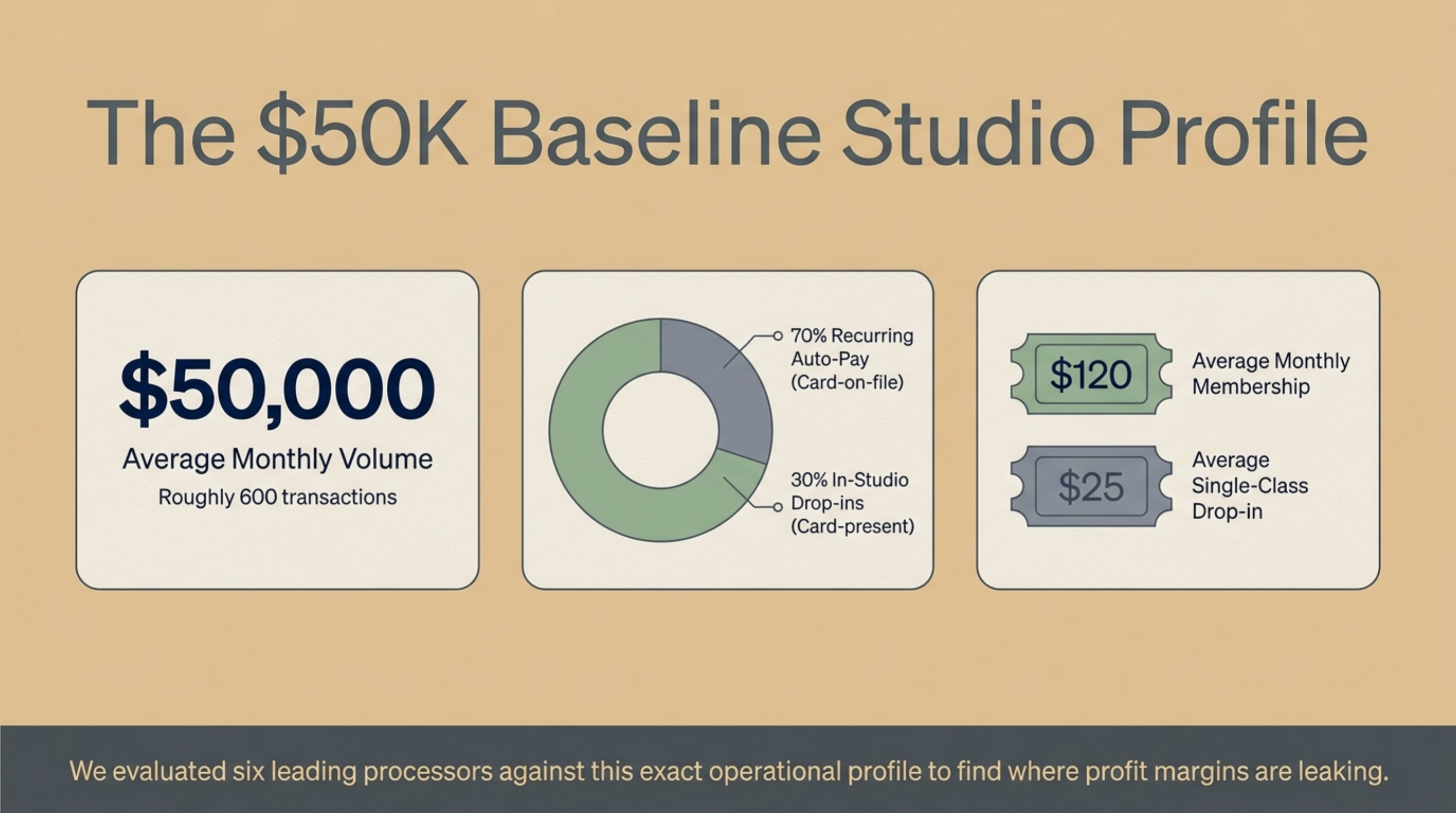
We tested each processor against the operational profile of a typical yoga or fitness studio: average drop-in ticket between $15 and $30, monthly memberships between $120 and $200, 60 to 80 percent of revenue from recurring auto-pay, and a mix of in-studio swipes and online bookings. The criteria, weighted highest first:
- Effective rate at $50K monthly volume with a 70-30 split between recurring (card-on-file) and card-present transactions.
- Recurring billing failure handling: account updater, retries, dunning sequences.
- Integration with the major studio software stacks (Mindbody, Zen Planner, Pike13, ClassPass).
- Settlement speed and reserve policy.
- Contract length and early termination fee.
- PCI scope and card-on-file vault cost.
Pricing data comes from each processor's public pricing page as of June 2026. Interchange components are sourced from Visa's published interchange schedule and Mastercard's interchange tables. Volume benchmarks reference the Federal Reserve Payments Studies.
At a glance
| Provider | Headline pricing | Contract | Settlement | Best for | Watch out for |
|---|---|---|---|---|---|
| Stripe | 2.9% + $0.30 online, 2.7% + $0.05 in-person | None | 2 days | Custom apps, multi-location | $0.30 fixed hurts small drop-ins |
| Square | 2.6% + $0.10 in-person, 2.9% + $0.30 online | None | 1 day | Studios under $25K monthly | Holds on chargeback spikes |
| Helcim | IC + 0.40% + $0.08 in-person, IC + 0.50% + $0.25 online | None | 2 days | $25K to $150K studios | No native Mindbody integration |
| Stax | $99/mo + IC + $0.08 in-person, + $0.18 online | Month-to-month | 2 days | $75K+ membership-heavy | Wasted below $30K volume |
| Clover | Plans $14.95 to $54.95/mo, 2.3 to 2.6% + $0.10 in-person | Varies by reseller | 1 day | Retail-heavy studios | Hardware locked to processor |
| PayPal | 3.49% + $0.49 standard, 2.29% + $0.09 in-person | None | 1 day | Donation, high-ticket workshops | Highest fixed fee in this set |
Stripe
Stripe charges 2.9 percent plus $0.30 for online payments and 2.7 percent plus $0.05 in person, with no monthly fee and no setup fee per Stripe's pricing page. There is no contract and no early termination fee. Settlement runs on a two-day rolling schedule for new merchants.
Two things matter for studios. First, Stripe's card-on-file vault and Subscriptions product handle recurring class memberships with account updater built in, cutting involuntary churn from expired or reissued cards. Second, the $0.30 fixed component is brutal on drop-in tickets: a $15 drop-in costs 4.9 percent effective, not 2.9 percent.
Stripe is the right pick when the studio runs a custom booking app or a multi-location parent operation that needs Connect for instructor payouts. It is the wrong pick if the studio uses Mindbody or Zen Planner with their bundled processors, because the integration tax outweighs any rate edge.
Avoid Stripe if average ticket is below $20 and most volume is single-class drop-ins. The effective rate at that mix runs 0.50 to 0.80 percent above what Helcim would charge on the same volume.
Square
Square charges 2.6 percent plus $0.10 in person, 2.9 percent plus $0.30 online, and 3.5 percent plus $0.15 for keyed entries per its pricing page. There is no monthly fee on the free plan, no contract, and same-day deposits cost an extra 1.75 percent if enabled.
Square Appointments handles class booking, memberships, and recurring billing inside the same dashboard, removing the need for a separate studio software stack at smaller volumes. The contactless and chip reader starts at $59 and the integrated terminal runs $799.
Square is the default pick for studios under $25K monthly volume. The flat rate is competitive with interchange-plus once you back out the monthly fee a wholesale processor would charge, and zero contract risk matters when revenue is volatile.
Helcim
Helcim runs interchange-plus pricing with no monthly fee, no contract, and automatic volume discounts. The published markup is interchange plus 0.40 percent plus $0.08 in person and interchange plus 0.50 percent plus $0.25 online per Helcim's pricing page. Volume tiers reduce the markup further: above $50K monthly, the in-person markup drops to roughly 0.30 percent.
For a yoga studio with $50K monthly volume, 70 percent recurring memberships, and a 30 percent in-person mix, Helcim's effective all-in rate lands near 2.20 to 2.35 percent. The same volume on Square runs 2.65 to 2.75 percent. The annual gap is $1,500 to $2,700.
Helcim publishes its full fee schedule and includes card-on-file storage, a customer vault, recurring billing, and a virtual terminal at no additional cost. Account updater is included.
Drawbacks: onboarding takes one to three business days versus same-day with Square or Stripe, the integration library is narrower than Stripe's, and support runs business hours only. For studios using Mindbody, Helcim does not integrate directly; you either accept Mindbody's bundled processor or run two parallel systems.
Best fit: independent studios at $25K to $150K monthly volume that bill memberships through Helcim or a compatible class management tool.
Stax
Stax (formerly Fattmerchant) uses a subscription model: $99 per month plus interchange plus $0.08 per in-person transaction and $0.18 per online transaction, per Stax's pricing page. There is no percentage markup. Settlement is next business day on the Pro plan, two days on the base plan.
The math: Stax beats Helcim and Square only when average ticket is high enough that the flat $99 is dwarfed by what a percentage markup would cost. For a studio averaging a $25 ticket, the breakeven against Helcim sits around $75K to $90K monthly volume. Below that, the subscription is wasted.
Stax includes a vault, recurring billing, surcharging tools, and analytics dashboards. The platform supports surcharging where legal, which can return 2 to 3 percent of card volume to the studio if disclosed correctly.
Best fit: studios above $75K monthly with a strong recurring base where the predictability of a flat subscription matters more than the marginal savings. Avoid if monthly volume is below $30K. Avoid if the studio runs heavy seasonal swings, the fixed $99 still applies in slow months.
Clover
Clover is a POS-and-processing bundle. Plans run $14.95 to $54.95 per month, and processing rates depend on which reseller sold the contract, ranging from 2.3 to 2.6 percent plus $0.10 in person and 3.5 percent plus $0.10 keyed per Clover's pricing page.
The catch with Clover is that the hardware is locked to whichever processor signed the merchant. If the studio later moves to Helcim or Stripe, the Clover terminal becomes a paperweight unless reflashed by the new processor, which most refuse to do. Hardware costs $499 to $1,799 depending on the model.
Clover is built for retail and food service first, fitness second. The booking and membership tools require third-party apps from the Clover App Market, adding $20 to $80 per month per app.
Best fit: studios that also sell substantial retail (apparel, supplements, gear) and want one combined POS for retail and class check-in. Avoid if the studio has minimal retail; the hardware lock-in and reseller pricing variability rarely beat a software-first stack.
PayPal
PayPal's standard online card rate is 3.49 percent plus $0.49, the Advanced Checkout card rate is 2.59 percent plus $0.49, and in-person via PayPal Zettle is 2.29 percent plus $0.09 per PayPal's fee schedule. There is no monthly fee.
PayPal's value for fitness studios is consumer trust at checkout, especially for one-off drop-in classes or workshop signups from non-members. The PayPal button often converts better than a card form alone on certain audiences, though independent verification is mixed.
The downsides: the $0.49 fixed component is the highest in this comparison, making PayPal punitive on small tickets. A $20 drop-in costs 5.94 percent effective on the standard rate. Account holds also remain common in PayPal's risk model, with 21-day holds on funds when dispute ratios spike.
Best fit: studios with a heavy donation or pay-what-you-can model, or studios selling workshops with average ticket above $100. Avoid as the primary processor for recurring memberships.
Verdict
For most independent yoga and fitness studios processing $25K to $150K monthly volume, Helcim is the clearest choice. Interchange-plus pricing, no monthly fee, included card-on-file storage, and published volume discounts produce effective rates 0.30 to 0.55 percent below Square and Stripe at the same mix. On a studio doing $80K monthly, that gap is $2,800 to $5,200 a year.
Square is the runner-up only for studios under $25K monthly volume or studios where Square Appointments is already running the booking flow. Stripe wins when the studio operates a custom multi-location app or needs Connect-style payouts to instructors as 1099 contractors. Stax becomes the right pick above $75K monthly volume with stable recurring membership revenue. Clover and PayPal occupy narrower edges: Clover for retail-heavy studios, PayPal for donation-based or high-ticket workshop-driven brands.