TL;DR
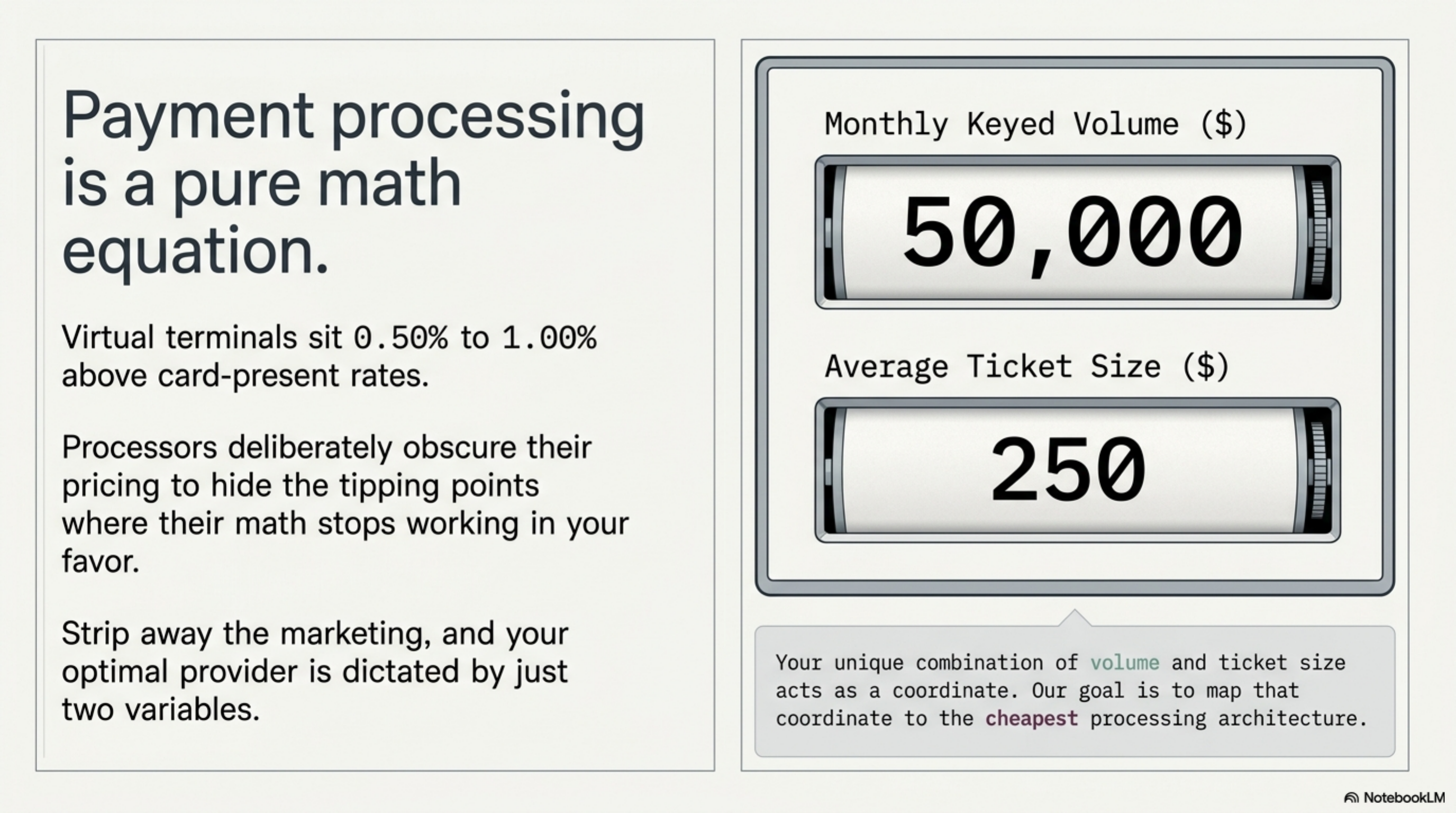
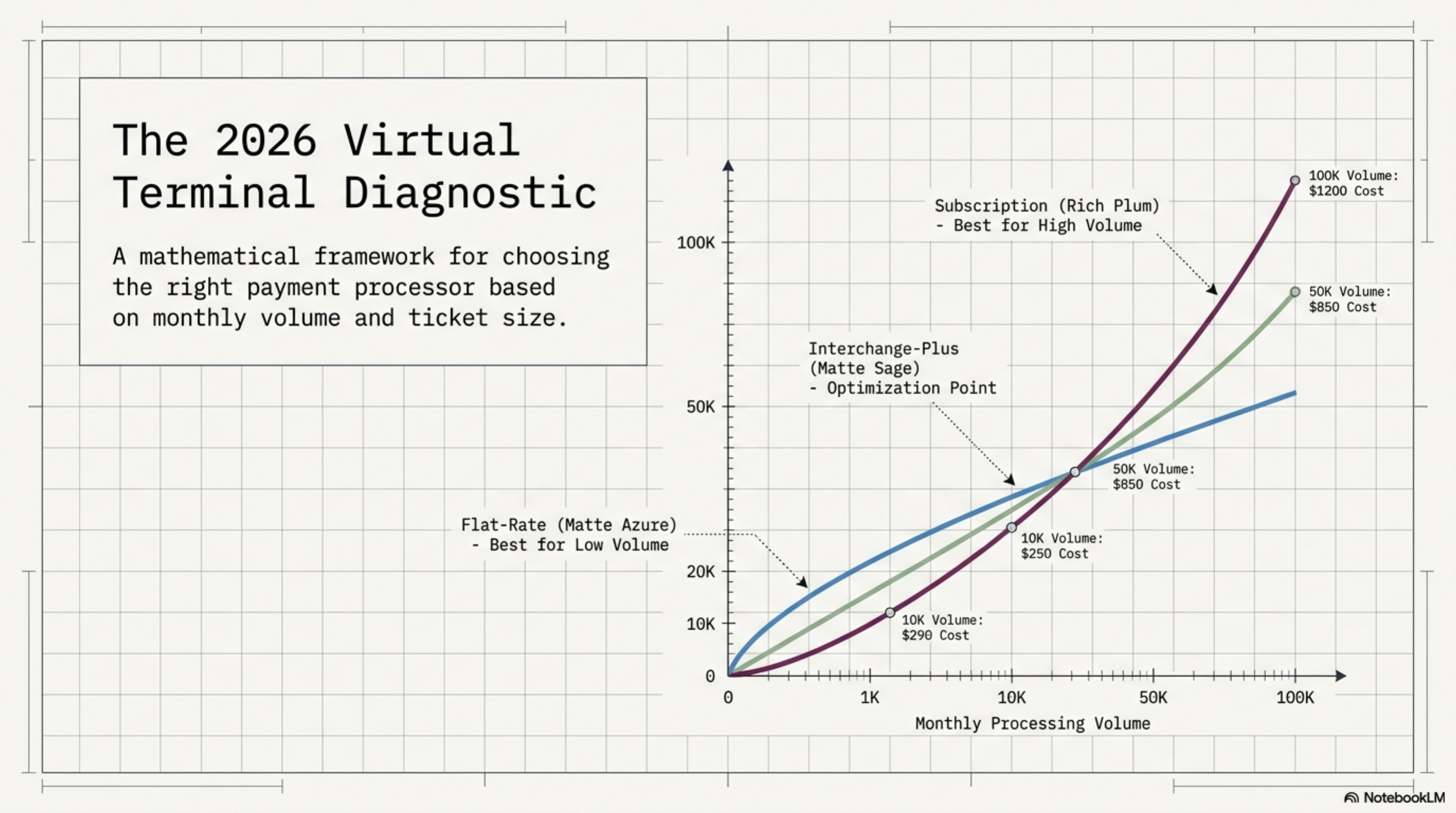
A virtual terminal is a browser-based form that processes keyed (card-not-present) transactions, which sit 0.50 to 1.00 percent above card-present rates per the Visa interchange schedule. From $25K to $80K monthly volume, Helcim wins on raw cost with interchange-plus 0.50 percent plus 25 cents and no monthly fee. Above $80K, Stax and Payment Depot subscription pricing pulls ahead. Stripe is the right pick below $25K where flat 2.9 percent beats subscription math. Square keyed at 3.5 percent plus 15 cents is the most expensive option once you cross $20K monthly.
How we ranked
Virtual terminals look identical on the surface. They diverge on five points that decide your real cost:
- Effective keyed rate at $100K monthly volume. We modeled a $200 average ticket and used regulated interchange benchmarks from the Federal Reserve payments studies for the floor.
- Monthly platform fee. Subscription processors require enough volume to amortize the $79 to $199 monthly cost. Below that breakeven, flat-rate wins.
- Recurring billing and card vault. Stored card tokenization is table stakes for B2B and subscription businesses. Some providers charge extra; some bundle it.
- Level 2 and level 3 data support. Passing line-item data on commercial cards saves 0.40 to 0.85 percent on those transactions, per Mastercard interchange criteria. Not every virtual terminal supports it.
- PCI scope. Hosted forms keep you in SAQ A scope. Self-hosted gateways push you to SAQ D and a six-figure compliance lift.
Settlement speed and dispute response time were tiebreakers, not primary criteria. We did not weight integrations because most operators run virtual terminals as a side channel to their POS or invoicing tool.
At a glance
Pricing pulled directly from each provider's public pricing page as of 2026. Effective rates assume a $200 average ticket on consumer Visa/Mastercard.
| Provider | Keyed rate | Monthly fee | Best for | Watch out for |
|---|---|---|---|---|
| Helcim | IC + 0.50% + $0.25 | $0 | $25K to $80K monthly, mixed B2C/B2B | Funding takes 2 business days |
| Stax | IC + $0.18 | $99 | $80K+ monthly, high ticket | Breakeven against Helcim at ~$85K |
| Payment Depot | IC + $0.05 to $0.15 | $79 to $199 | $100K+ monthly, low ticket count | Tiered membership creates cliff edges |
| Stripe | 2.9% + $0.30 | $0 | Under $25K monthly, dev-heavy | No level 2/3 data on standard plan |
| Square | 3.5% + $0.15 | $0 | Sub-$10K monthly, occasional keying | Highest effective rate above $20K |
| Clover | 3.5% + $0.10 | $14.95 to $54.95 | Existing Clover hardware merchants | Hardware lock-in, ISO reseller pricing varies |
| PayPal | 3.49% + $0.49 | $0 | Light keying, PayPal-trusted customers | $0.49 per-transaction fee kills small tickets |
Helcim
Helcim publishes interchange-plus pricing with no monthly fee and no contract. Keyed transactions run at interchange plus 0.50 percent plus 25 cents, with an automatic markup reduction that triggers as monthly volume climbs. The virtual terminal includes recurring billing, a card vault, customer profiles, and level 2 data passing on commercial cards at no extra cost.
On $100K monthly keyed volume across consumer cards, Helcim's effective rate lands near 2.40 to 2.55 percent depending on card mix. That math holds against Stax and Payment Depot up to roughly $80K monthly, where the subscription processors start to win on volume.
Best for: Operators between $25K and $80K monthly who key cards regularly and want interchange-plus without a contract or subscription.
Avoid if: You key less than $5K monthly. The interchange-plus structure is overkill when keyed volume is incidental.
Stax
Stax (formerly Fattmerchant) charges a flat $99 monthly subscription plus interchange plus 18 cents per keyed transaction, with no percentage markup on the processor side. Stax pricing scales by adding seats and modules, but the core math stays subscription-based.
At $80K monthly keyed volume on a $200 average ticket (400 transactions), Stax costs roughly $99 + interchange + $72 in per-transaction fees. Against Helcim's 0.50 percent markup on the same volume, Stax breaks even near $85K. Above that, every additional dollar in volume saves the processor percentage that Helcim would charge.
The virtual terminal supports recurring billing, stored cards, and ACH at additional cost. Level 3 data passing is available on the higher subscription tier, which matters for any merchant taking corporate purchase cards above $1,000.
Best for: Merchants above $80K monthly keyed volume with average tickets over $250, especially in B2B.
Avoid if: Monthly volume is variable. The $99 fee is sunk cost in low months.
Payment Depot
Payment Depot uses a tiered membership model: $79 to $199 monthly depending on volume, plus interchange plus 5 to 15 cents per transaction. There is no percentage markup at the processor level.
The math favors high-transaction-count merchants with low average tickets, since the per-transaction fee is the only variable cost above the membership. At 1,000 keyed transactions monthly with a $150 average ticket ($150K volume), Payment Depot at the $99 tier costs $99 + interchange + $100 in transaction fees, an effective rate of roughly 1.95 to 2.10 percent depending on card mix.
Best for: $100K+ monthly volume with high transaction counts and steady volume.
Avoid if: Volume is seasonal or your average ticket exceeds $500. Stax wins on higher tickets.
Stripe
Stripe's virtual terminal is part of its standard flat-rate plan: 2.9 percent plus 30 cents on online and keyed transactions. There is no monthly fee, no contract, and same-day account approval for most U.S. merchants.
The flat-rate math wins below $25K monthly keyed volume, where the interchange-plus alternatives have not yet amortized their friction (account underwriting, statement reading, monthly fee in Stax/Payment Depot's case). Above $25K, Helcim consistently wins by 0.30 to 0.45 percent on effective rate.
Stripe's developer tooling and API surface are the differentiator. If the virtual terminal is one of several payment channels in a custom-built application, the consolidation argument can outweigh the percentage savings until volume gets serious.
Best for: Under $25K monthly keyed volume, developer-heavy teams, merchants who already have Stripe for other channels.
Avoid if: Volume exceeds $40K monthly and you have no other Stripe integration. You are paying 0.40 to 0.55 percent above interchange-plus for convenience.
Square
Square charges 3.5 percent plus 15 cents on keyed transactions through its virtual terminal, per the published pricing page. That is the highest headline keyed rate on this list and reflects Square's product focus on in-person retail and food service, not card-not-present B2B.
At $50K monthly keyed volume, Square costs roughly $1,750 in percentage fees plus per-transaction fees. The same volume on Helcim runs closer to $1,200. The 0.90 to 1.10 percent gap compounds into $6,000 to $7,000 annually at that tier alone.
The virtual terminal is free to access if you have any Square account, and it supports basic recurring billing. There is no level 2/3 data passing.
Best for: Sub-$10K monthly keyed volume, occasional phone orders, merchants whose primary channel is Square's POS.
Avoid if: Keyed volume exceeds $20K monthly. Every other provider on this list is cheaper at that point.
Clover
Clover bundles a virtual terminal with its POS plans, priced from $14.95 to $54.95 monthly, with keyed transactions at 3.5 percent plus 10 cents. The hardware platform is the primary product. The virtual terminal is a side channel for existing Clover merchants.
Clover is sold through a wide reseller network (Fiserv, banks, ISOs), so the rate you actually get can vary from the published numbers. Some resellers add a 0.30 to 0.50 percent markup on top of the published rate. Read the schedule of fees on your statement, not the marketing page.
Best for: Existing Clover hardware merchants who key cards occasionally and do not want a second account.
Avoid if: You are picking a virtual terminal as a primary channel. The bundled plans are designed to sell hardware.
PayPal
PayPal's virtual terminal sits at 3.49 percent plus 49 cents on standard keyed transactions. The 49-cent per-transaction component is the giveaway: PayPal designed this product for occasional use, not for a primary processing channel.
On a $50 ticket, the 49-cent fee alone is 0.98 percent. Add the 3.49 percent and the effective rate exceeds 4.47 percent. Few other channels at any tier in the industry come close to that.
The Advanced Card plan at 2.59 percent plus 49 cents cuts the percentage but keeps the per-transaction floor. It only makes sense on average tickets above $500, and even then Stax or Payment Depot beats it on the same volume.
Best for: Merchants whose customers specifically prefer paying via PayPal and who key cards infrequently.
Avoid if: Average ticket is below $100. The per-transaction fee dominates.
Verdict
For most operators between $25K and $80K monthly keyed volume, Helcim is the winner. Interchange-plus 0.50 percent plus 25 cents, no monthly fee, no contract, level 2 data included. The math holds across consumer and B2B card mixes.
Above $80K monthly with average tickets over $250, Stax wins on subscription math. Above $100K monthly with high transaction counts and low average tickets, Payment Depot takes it. Below $25K monthly where keying is occasional and you want zero friction, Stripe is correct.
The two we recommend avoiding as a primary virtual terminal: Square (3.5 percent plus 15 cents is uncompetitive above $20K monthly) and PayPal (the 49-cent per-transaction fee makes small tickets uneconomic). Both are fine as secondary channels for the customer subset who prefers them.