TL;DR
Clover wins for retail, salons, quick-service food, and any business under $30K in monthly card volume because plans start at $14.95 per month with 2.3 percent to 2.6 percent plus $0.10 card-present rates. Toast wins for full-service restaurants above $50K monthly volume that need online ordering, kitchen display, and labor reporting tied to the POS. Both lock hardware to their processing. Switching either platform means replacing the POS, not just the merchant account.
How we ranked
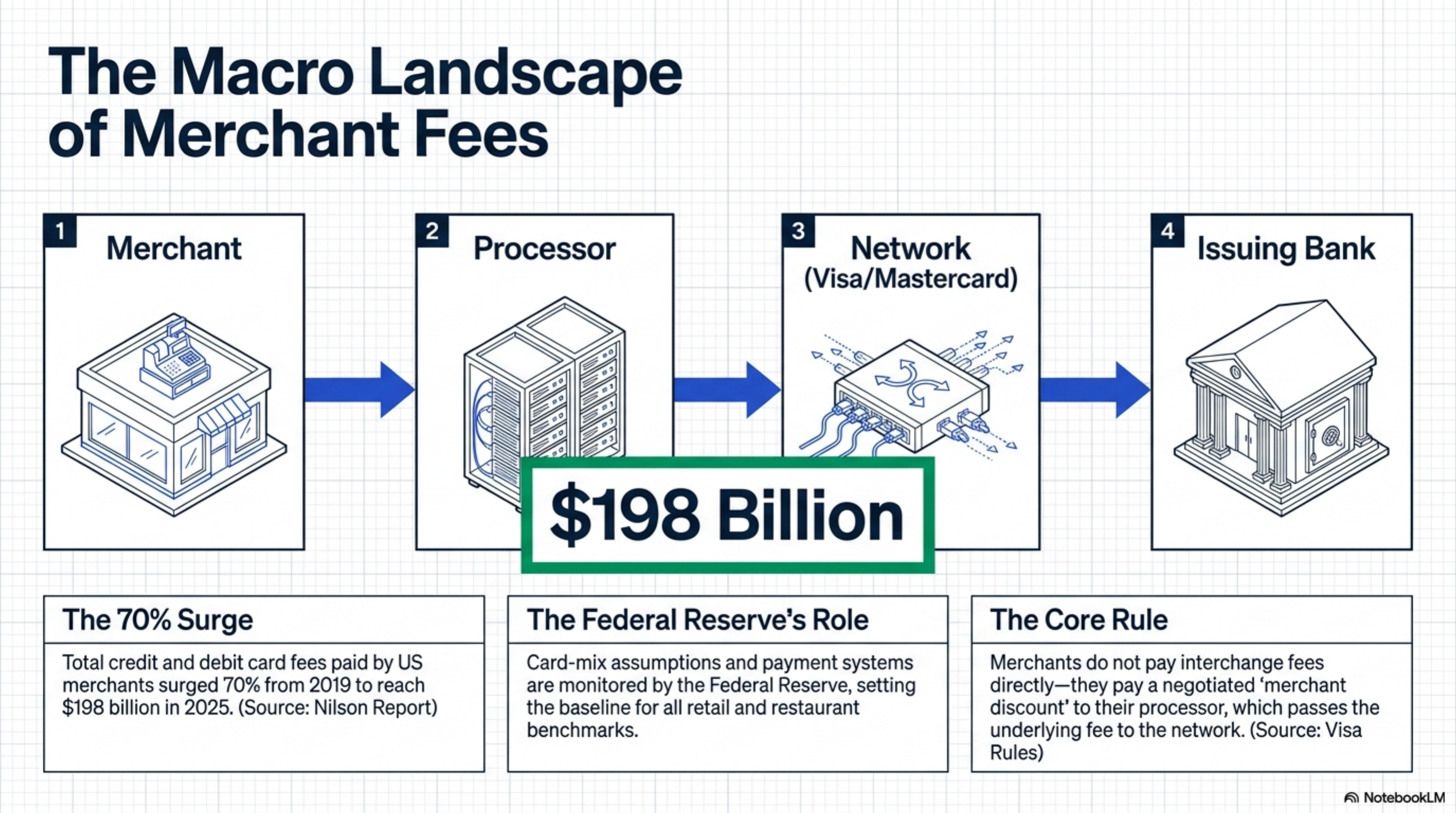
We graded both platforms on six criteria with the weights an operator running $25K to $5M in monthly card volume actually cares about. Effective rate at $250K monthly volume (35 percent), counting flat-rate processing, plan fees, and the markup over interchange published by Visa and Mastercard. Contract length, early termination fees, and reserve clauses (15 percent). Hardware lock-in and resale value if you switch (15 percent). Settlement speed for card deposits (10 percent). Vertical fit, which is restaurant-specific features versus general retail (15 percent). Support response time for chargebacks and disputes (10 percent). Pricing came from each provider's public pricing page and was checked against the Visa Interchange Schedule and Mastercard's published interchange rates. Card-mix assumptions follow the Federal Reserve Payments Study averages for restaurant and retail merchants.
If your business is split between restaurant and retail (a deli with a counter and a small grocery section, for example), price each side separately. The right answer is rarely the same POS for both.
At a glance
Pricing as published on each provider's pricing page. Effective rates assume a card mix of 60 percent credit, 40 percent debit consistent with restaurant and retail benchmarks reported by the Nilson Report.
| Provider | Headline pricing | Contract | Settlement | Best for | Watch out for |
|---|---|---|---|---|---|
| Clover | 2.3% to 2.6% + $0.10 in-person, $14.95 to $54.95 per month plan | 36 to 48 month hardware lease typical | Next day | Retail and QSR under $30K per month | Hardware lock-in, low resale value |
| Toast | 2.49% to 2.99% + $0.15 card-present, $0 to $165 per month software | 24 to 36 months with auto-renewal | Next day | Full-service restaurants $50K+ per month | Add-on modules billed separately |
| Square for Restaurants | 2.6% + $0.10 in-person, $0 to $153 per month per location | Month-to-month | Next day, instant for 1.5% fee | Single-location quick service | No interchange-plus option |
| Helcim | IC + 0.40% + $0.08 in-person | No contract | 1 to 2 business days | $50K+ retail and non-restaurant | No restaurant-specific POS |
Clover
Clover is the POS arm of Fiserv (NYSE: FI) and runs its own merchant processing. Card-present rates published on the Clover pricing page run 2.3 percent to 2.6 percent plus $0.10, with the lower rate tied to higher-volume software plans. Keyed and card-not-present transactions are 3.5 percent plus $0.10. Software plans run from $14.95 per month (Payments Plus) to $54.95 per month (Register Lite for table service), with Register at the top end at roughly $84.95 per month.
Hardware is the lock-in. A Clover Station Solo runs about $1,699 outright, the Flex handheld around $599, and the Mini around $799. Clover devices only process through Clover. If you switch processors, you replace the hardware. Resale value on the secondary market is low because reprogramming requires Fiserv cooperation.
Contract terms vary by reseller. Direct merchants get month-to-month software, but hardware financing is usually 36 to 48 months. The same hardware from Fiserv direct can cost 0.30 to 0.50 percentage points less in processing than the same device sold through an ISO reseller.
Roughly 60 percent of Clover devices in the U.S. are sold through ISO resellers, not Fiserv direct. The processing rate on a Clover sold by your local bank or a phone-sales ISO is often 0.40 percent higher than Fiserv's direct rate for the same hardware. Ask who the merchant account is with before you sign.
Who it's for: retail, quick-service restaurants, and service businesses under $30K in monthly card volume that need a tablet POS with inventory and basic CRM. Who should avoid it: full-service restaurants needing kitchen display, online ordering, and labor scheduling tied to the POS. Clover offers those modules, but lacks the depth Toast has built for that segment.
Toast
Toast (NYSE: TOST) is a restaurant-only POS that went public in 2021. Toast does not publish a single flat rate. The Starter Kit plan has no monthly software fee and charges 2.99 percent plus $0.15 per card-present transaction per the Toast pricing page. The Core plan runs $69 per month with custom processing rates negotiated per merchant, typically landing at 2.49 percent to 2.69 percent plus $0.15 card-present.
Above the Core plan, Toast sells modules separately: online ordering at $75 per month, payroll, gift cards, marketing, and loyalty. A mid-sized full-service restaurant on Toast typically pays $250 to $600 per month in software fees on top of processing.
Hardware is also lock-in. The Toast Flex terminal, Toast Go 2 handheld, and kitchen display screens only run Toast software. Hardware financing is common at $0 down with 36-month terms, which spreads the device cost across the contract rather than waiving it.
A 70-seat full-service restaurant doing $250K monthly card volume on Toast Core typically pays: $69 software + $75 online ordering + about $6,300 in processing at 2.49 percent plus $0.15 across roughly 7,000 transactions. All-in: $6,444 per month. The same volume on Toast Starter Kit at 2.99 percent plus $0.15 pays $7,500 in processing. The $69 Core plan saves $1,000 per month at this volume.
Toast's standard merchant services agreement specifies 24 to 36 months with renewal periods, and early termination is typically the remaining hardware balance plus software fees through the term. Read the agreement before signing.
Who it's for: full-service and fast-casual restaurants above $50K monthly card volume that need online ordering, kitchen display, payroll, and labor reporting tied to the POS. Who should avoid it: retail, salons, non-food service businesses, and any restaurant under $25K monthly volume where the Starter Kit's 2.99 percent rate erodes margin faster than the $69 Core upgrade saves.
Square for Restaurants
Square's restaurant tier charges 2.6 percent plus $0.10 for card-present transactions, the same as Square's general POS. The software is free at the base tier, $60 per month per location for Plus, and $153 per month per location for Premium per the Square pricing page. Hardware is cheaper than Clover or Toast: the Square Register is $799 and the Square Terminal is $299.
Square has no contract and no early termination fee. Settlement is next business day for free, instant for a 1.5 percent fee. The hardware works as a card reader for any Square merchant, so resale holds value.
Who it's for: single-location quick-service restaurants, food trucks, coffee shops, and full-service restaurants under $40K monthly card volume that want no contract and quick setup. Who should avoid it: restaurants needing interchange-plus pricing, complex kitchen display routing across multiple stations, or labor scheduling tied to the POS. Square does not offer interchange-plus, so above $80K monthly volume the flat rate runs roughly 0.30 to 0.60 percent above what an interchange-plus processor would charge on the same card mix, based on the Visa and Mastercard interchange schedules.
Helcim
Helcim publishes interchange-plus rates with no monthly fee, no contract, and automatic volume discounts. Card-present rate is interchange plus 0.40 percent plus $0.08, and card-not-present is interchange plus 0.50 percent plus $0.25 per the Helcim pricing page. There is no software fee, no early termination fee, and no PCI compliance charge.
Helcim's hardware is a card reader at $99 and a smart terminal at $329. It does not sell a full restaurant POS. Merchants pair Helcim with a third-party POS or use Helcim's web-based dashboard for invoicing and a virtual terminal.
A retail merchant doing $150K monthly card volume on Square pays roughly 2.6 percent plus $0.10, or about $4,050 per month at 3,500 transactions. The same volume on Helcim at interchange plus 0.40 percent plus $0.08 lands around $3,250 per month given an average debit-weighted interchange near 1.4 percent. Savings: about $800 per month, or $9,600 per year.
Who it's for: retail, professional services, B2B, and any business above $50K monthly card volume that wants interchange-plus and can pair Helcim with a separate POS. Who should avoid it: full-service restaurants needing tableside ordering and kitchen display. Helcim does not functionally replace Toast on the restaurant side.
Verdict
For full-service restaurants above $50K in monthly card volume that need online ordering, kitchen display, and integrated labor reporting, Toast Core is the better choice. The $69 per month software plus 2.49 percent to 2.69 percent plus $0.15 effective rate plus restaurant-specific modules outperform Clover for that vertical. For retail, salons, professional services, and quick-service food under $30K monthly volume, Clover plans starting at $14.95 with 2.3 percent to 2.6 percent plus $0.10 card-present win on total cost.
Both lock hardware to processing. The decision is a 3-to-5-year commitment. Before signing either, get an interchange-plus quote from Helcim or Stax for the payment side and price a Toast or Clover module replacement (Lightspeed for retail, TouchBistro for restaurants) for the software side. If the savings clear $400 per month over the term, the migration pays for itself in year one.