TL;DR
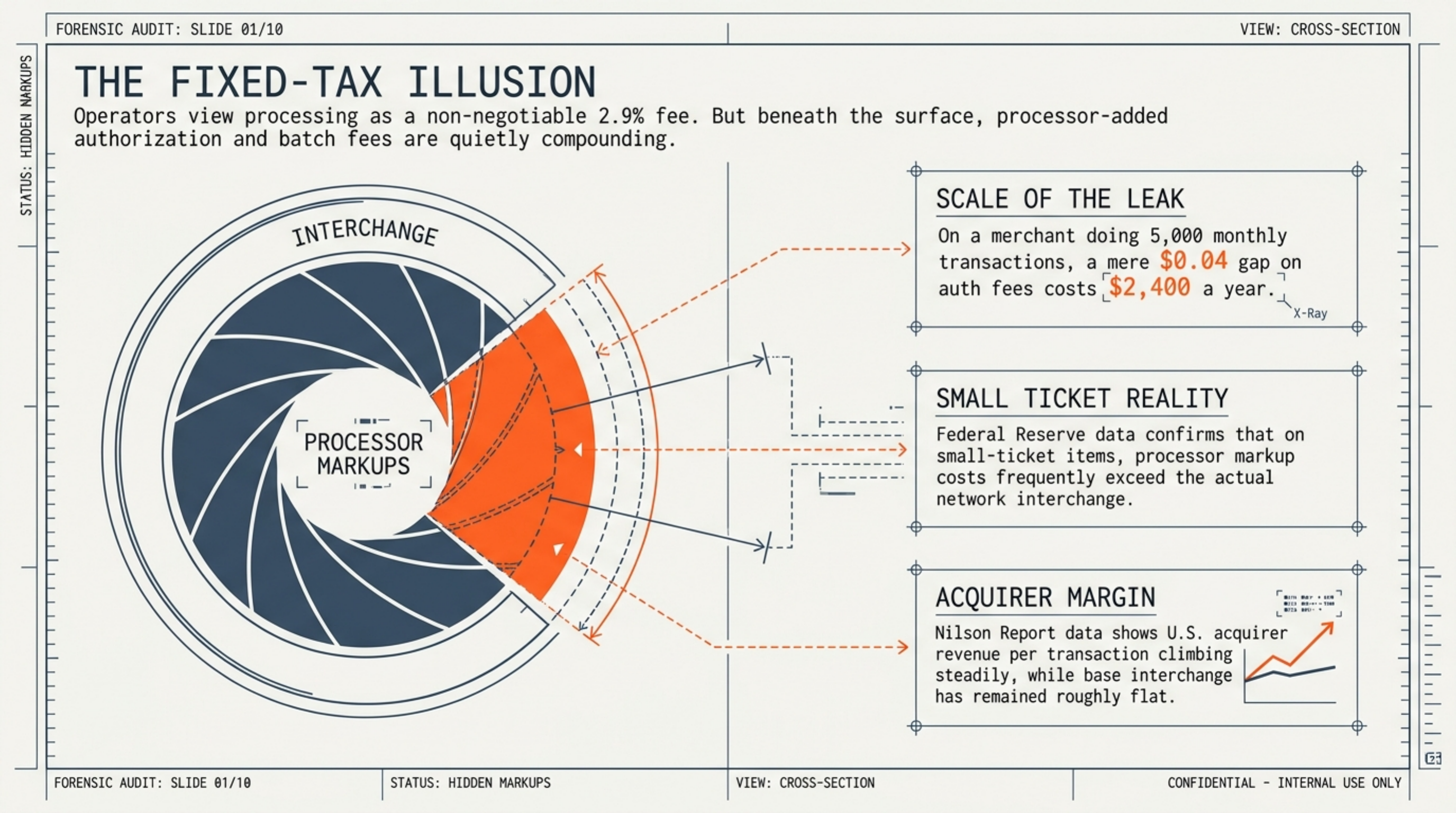
Authorization fees and batch fees are processor charges stacked on top of interchange. On statements we have audited, auth fees commonly run 3 to 25 cents per card request and batch fees 10 to 35 cents per day. On a merchant doing 5,000 monthly transactions, a 4-cent gap on auth fees alone costs $2,400 a year. These line items rise quietly on annual PCI notices and almost no operator audits them. Pull six months of statements, calculate your blended per-transaction cost, and demand a contractual cap before signing anything else.
What this actually is
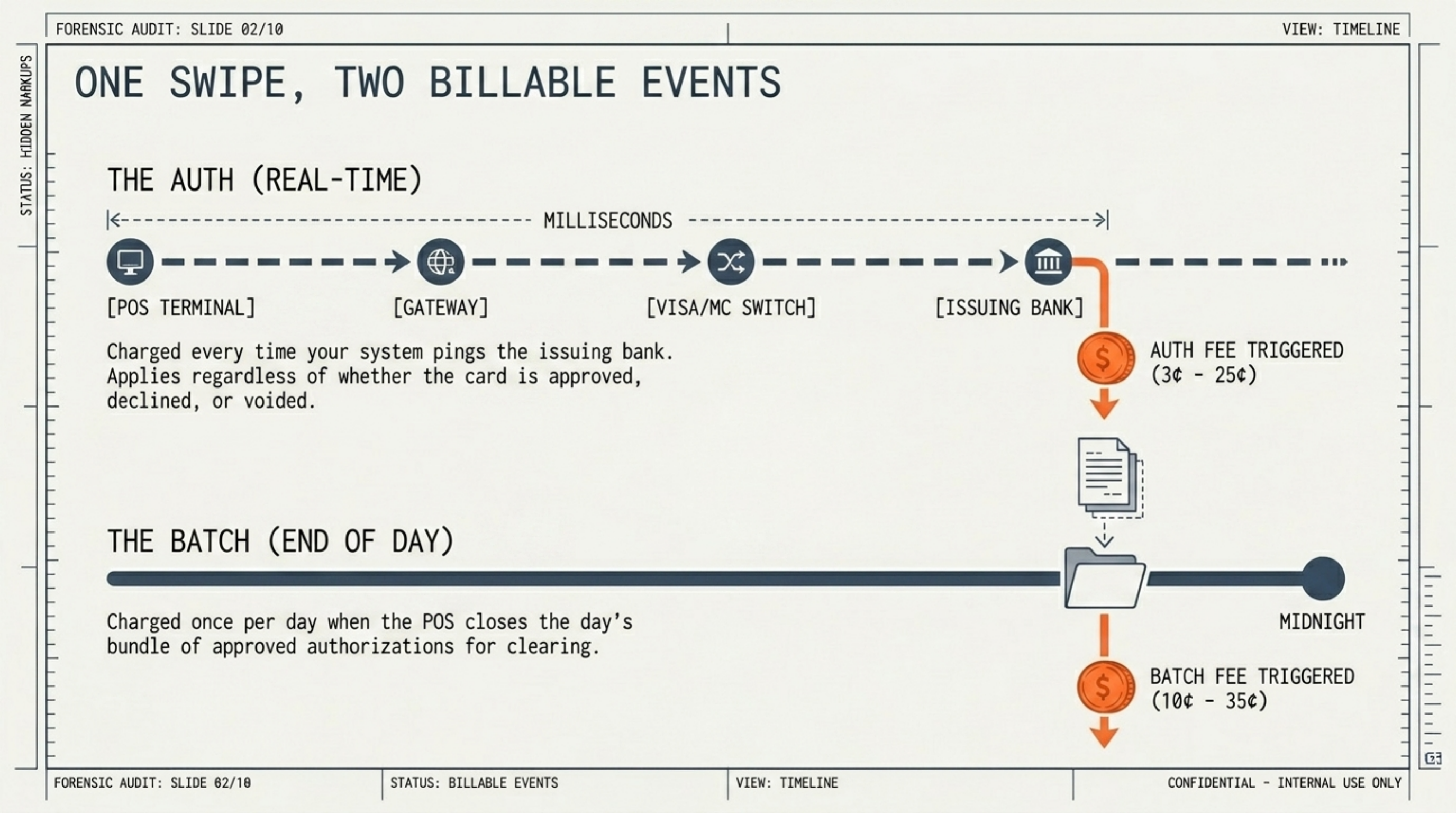
Authorization fees are charged every time a card is presented to your system and a request is sent to the issuing bank for approval. The fee applies whether the transaction is approved, declined, or voided before settlement. Batch fees are charged once per day when the merchant closes the batch and submits the day's approved authorizations for clearing.
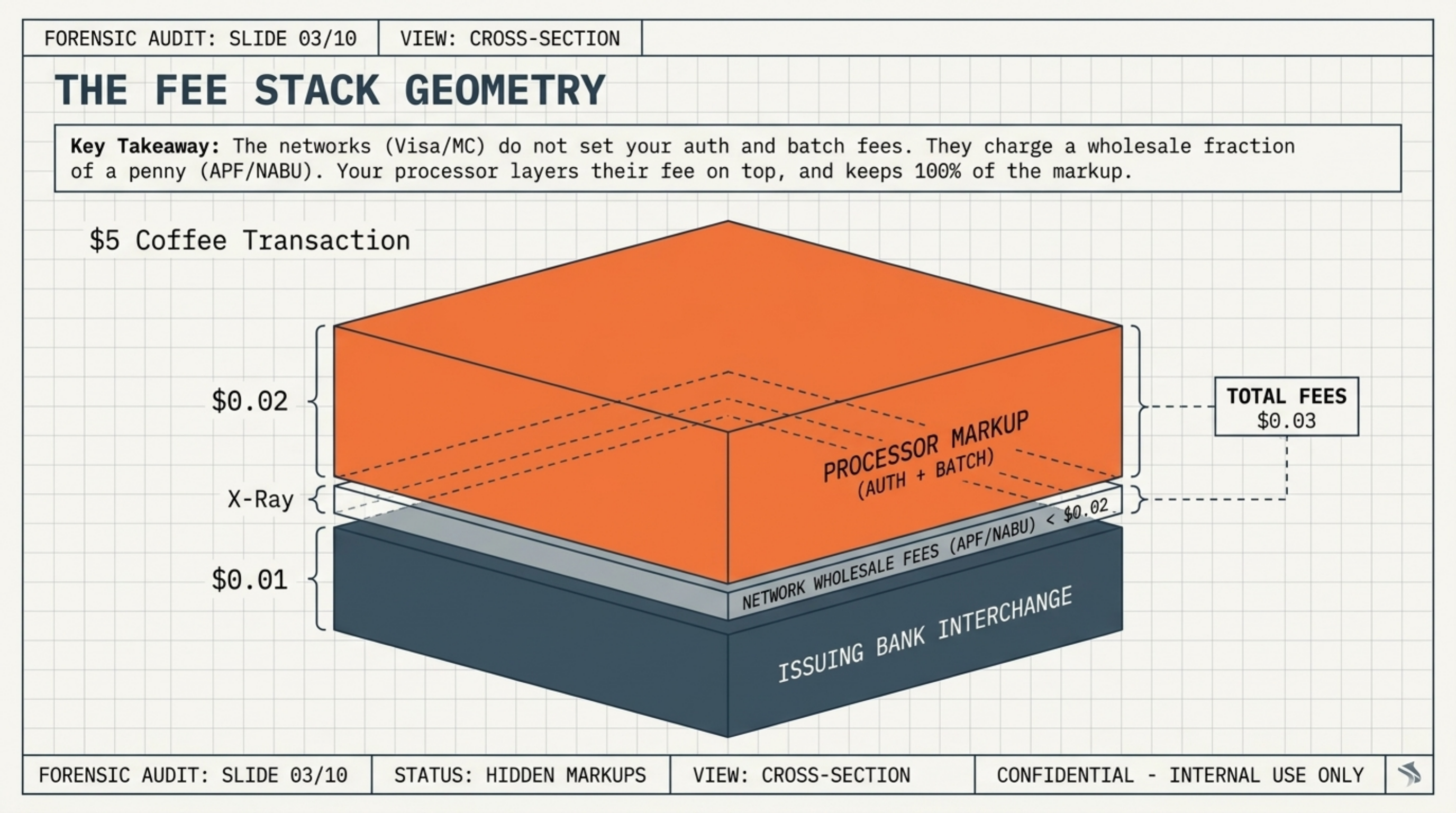
Both are processor-side fees. The card networks do not set them. Visa and Mastercard publish interchange rates that go to the issuing bank, and the networks separately bill assessment fees. Authorization and batch line items are added by your acquirer or processor on top of all of that.
The Federal Reserve payments studies document that processor markup costs frequently match or exceed interchange itself, especially on small-ticket transactions where fixed cents dominate the math. On small-ticket transactions like a $5 coffee, the processor's per-item, auth, and batch fees in aggregate often exceed the interchange and assessments owed to the issuer and networks. The processor takes more than the issuer.
On a statement, look for line items labeled "Authorization Fee," "Transaction Fee," "Batch Header Fee," "Daily Discount," "ACH Batch Settlement," "Gateway Authorization," or "Per-Item Fee." These are the same charges under different names. Some processors fold them into a higher discount rate rather than break them out, which makes year-over-year comparison harder.
Batch and authorization fees are flat per-transaction and per-day charges your processor adds on top of interchange, not set by Visa or Mastercard.
How it works under the hood
One card sale produces two separate billable events. The first is the authorization, when the processor sends a request to the issuer in real time. The second is the capture and settlement, when the processor packages all approved auths into a batch file and submits it for clearing.
The flow looks like this:
- Customer presents card at POS or checkout. The terminal or gateway captures track data, EMV chip data, or PAN.
- Processor routes an authorization request through the Visa or Mastercard switch to the cardholder's issuing bank.
- Issuer evaluates the request and returns an approve, decline, or referral. The authorization fee posts at this moment.
- Merchant either completes the sale or voids the auth. Voiding does not refund the auth fee.
- At end of day, the merchant or POS triggers a batch close. Approved auths are bundled into a settlement file.
- Batch header fee posts. The clearing file is sent through the network.
- Interchange and assessment fees post 24 to 48 hours later when funds settle.
On the statements we have audited, authorization fees commonly run from roughly 3 cents on a high-volume IC++ account to 25 cents on a small flat-rate merchant. Batch fees commonly run from 10 cents to 35 cents per close. Some processors zero out the batch fee and price the auth fee higher. Others do the inverse. A few charge both at the top of their respective ranges and still call the contract competitive.
The networks themselves charge a separate authorization processing fee at the wholesale level. Visa's Acquirer Processing Fee (APF) and Mastercard's Network Access and Brand Usage (NABU) fee are both small flat per-auth charges, generally under 2 cents each. The current published rates are disclosed by acquirers in their fee schedules; refer to your processor's most recent rate sheet for the exact figure. Both are baked into the assessment line items on a properly disclosed statement. The processor's auth fee is layered above the network charge, and the processor keeps the entire markup.
Flat-rate plans bundle this differently. Stripe and Square publish a single headline rate that combines the percentage and per-transaction components, and card-not-present account verification calls and $0 auths typically bill at the same per-item rate. The auth fee is not separately disclosed on a flat-rate statement, but it is built into the per-transaction component. That is why high-frequency, small-ticket merchants pay far more on flat-rate than they would on interchange-plus.
Where it goes wrong for operators
Five patterns drain money from merchants who assume these fees are fixed and small.
Pattern 1: Annual creep on PCI notices. Your processor sends a notice each January raising the auth fee by 1 to 3 cents and the batch fee by 5 cents. Contracts often allow this with 30 days written notice. On 10,000 monthly transactions, a 2-cent auth bump costs $2,400 a year. Five years of compounding produces four-figure annual creep with no service change. The change-of-terms language is almost never read, and the increase is rarely contested.
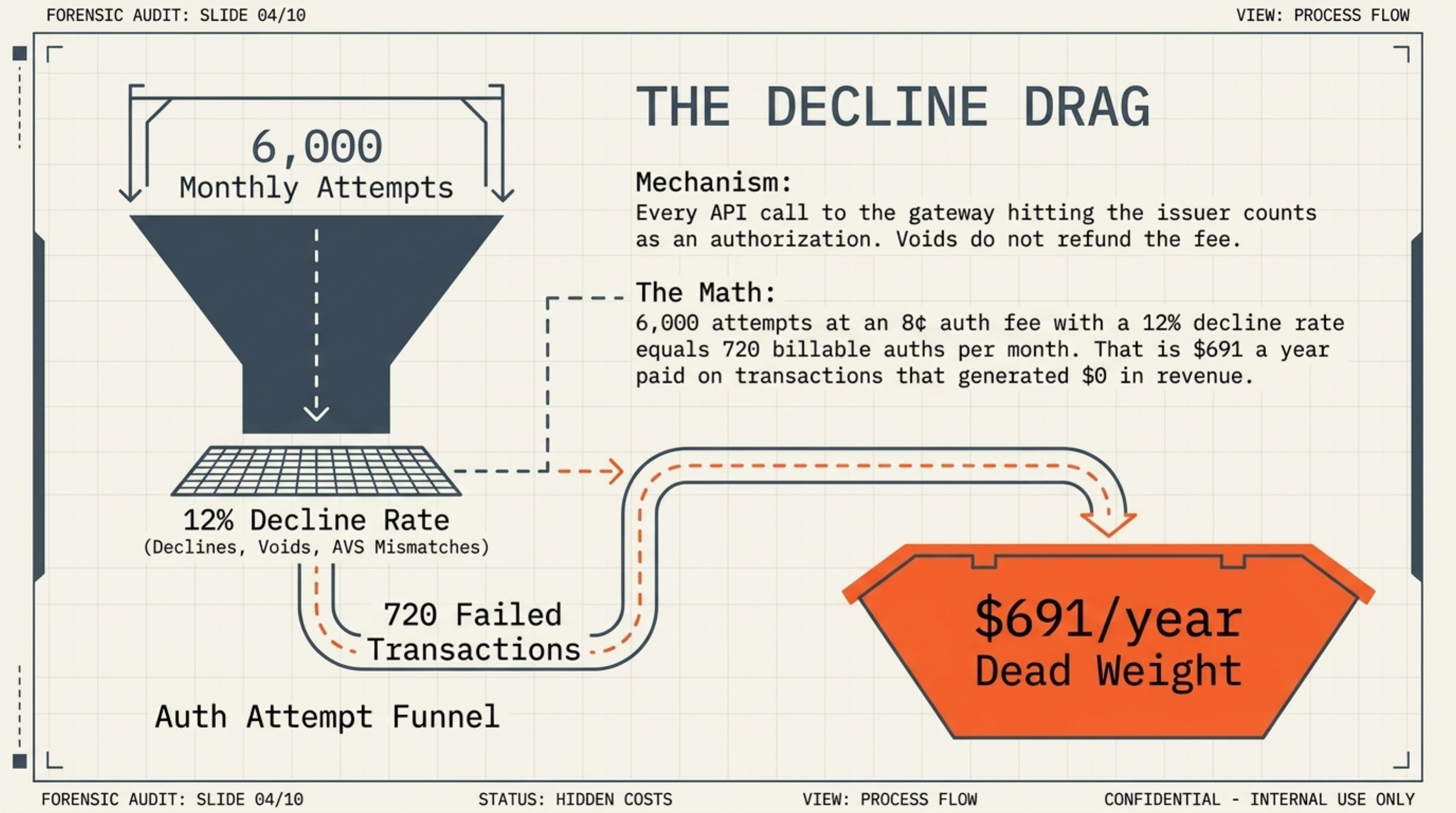
Pattern 2: Declines and voids count. A 12 percent decline rate at 8 cents per auth on 6,000 attempts means 720 declined billable auths at $57.60 monthly, $691 a year, on transactions that never produced revenue. Card-on-file verification calls compound this. SaaS platforms running monthly $0 auths to validate stored cards can run thousands of additional billable auths per month without anyone tracking the unit cost.
Pattern 3: Multiple batches per day. Restaurants and some retailers settle two or three times daily for shift accounting or cash-flow reasons. Each batch close triggers a separate batch fee. At 25 cents per batch and three closes per day, that is 75 cents a day, $273 a year, on a single location. Multi-location operators stack this cost per terminal and per location, often without realizing the consolidated total.
Pattern 4: Tokenization billed as auth. When you store a card for recurring billing, some processors run a $0 auth to validate. That bills as a full auth. Card updater services that refresh expired tokens also fire auth calls. A SaaS platform with 5,000 stored cards refreshed monthly adds 5,000 billable auths and another 5,000 on annual re-validation, a hidden 10,000-call drag at full per-auth pricing.
Pattern 5: Gateway fees stacked. Authorize.Net, NMI, and similar gateways charge their own per-transaction fee on top of the processor's auth fee. Merchants on a gateway plus a separate acquirer often pay two auth fees per transaction without realizing it. Nilson Report data consistently shows U.S. acquirer revenue per transaction climbing while interchange has stayed roughly flat. The gap is processor fees, not network fees.
Worked example with real numbers
Profile: a home goods e-commerce operator. Monthly card volume $400,000. Average ticket $85. About 4,705 settled transactions per month. Including declines and voids, roughly 5,300 monthly auth attempts. Card mix is 95 percent CNP, 5 percent recurring subscribers with stored cards.
Current setup: a flat-rate processor on a published rate consistent with Stripe's pricing or Square's pricing for standard online card payments, plus a 5 cent gateway authorization fee on every auth attempt, plus a 20 cent batch fee on a single daily batch.
Math at the current rate, using a 2.9 percent plus 30 cent published online card rate as illustrative:
- Discount: 2.9% of $400,000 = $11,600
- Per-transaction: $0.30 x 4,705 = $1,411
- Gateway auth: $0.05 x 5,300 = $265
- Batch: $0.20 x 30 = $6
- Monthly total: $13,282
Effective rate: 3.32 percent of gross volume.
Now move to an interchange-plus deal at 35 basis points plus 8 cents per item, with a 4 cent auth fee and a 15 cent batch fee. Assume blended interchange and assessments of 1.85 percent on this CNP card mix.
- Interchange and assessments: 1.85% x $400,000 = $7,400
- Processor markup: 0.35% x $400,000 = $1,400
- Per-transaction: $0.08 x 4,705 = $376
- Auth fee: $0.04 x 5,300 = $212
- Batch fee: $0.15 x 30 = $4.50
- Monthly total: $9,393
Monthly savings: $3,889. Annual savings: $46,668. The auth and batch components alone account for $703 of the annual gap. The rest is discount-rate compression.
Plug your own numbers in. Total auth attempts times your per-auth fee, plus settlement days times your batch fee, divided by gross volume, gives you the auth and batch drag as a percentage of revenue. Anything above 0.15 percent on a CNP merchant is overpriced.
Operator playbook
What to do this week:
- Pull six months of statements. Find every line item containing "auth," "batch," "transaction fee," "per-item," or "daily discount." Add them up by month and total.
- Calculate your true per-auth and per-batch cost. Divide total auth fees by total auth attempts, including declines and voids. Divide total batch fees by number of settlement days. Get one blended cents number each.
- Benchmark against the 5 to 10 cent range. Anything above 10 cents per auth on monthly volume over $250,000 is negotiable. Batch fees above 25 cents on a single daily close are negotiable at any volume above $50,000.
- Send three written questions to your processor. Ask: What is my contractual per-auth fee? What is my batch fee? Are both capped under the contract, and which clause permits an increase?
- Demand a price cap clause. Refuse a contract that allows unilateral fee increases on 30 days notice. Counter with a clause requiring written merchant consent or no fee increase during the term.
- Audit your decline rate. A decline rate above 8 percent on CNP or 4 percent on card-present points to AVS or BIN routing problems. Fixing them reduces billable auths and recovers revenue.
- Consolidate batches. If you close two or three batches a day, switch to one close right before the daily cutoff. Cash flow rarely justifies the per-batch fee at modern next-day funding speeds.
- Get a competing quote in writing. Take your full statement to two competing processors. Ask for an apples-to-apples interchange-plus quote with auth and batch fees disclosed in the contract body. Use the quote as a renegotiation lever even if you do not switch.
Most merchants find the third question gets a discount before they finish the call.