TL;DR
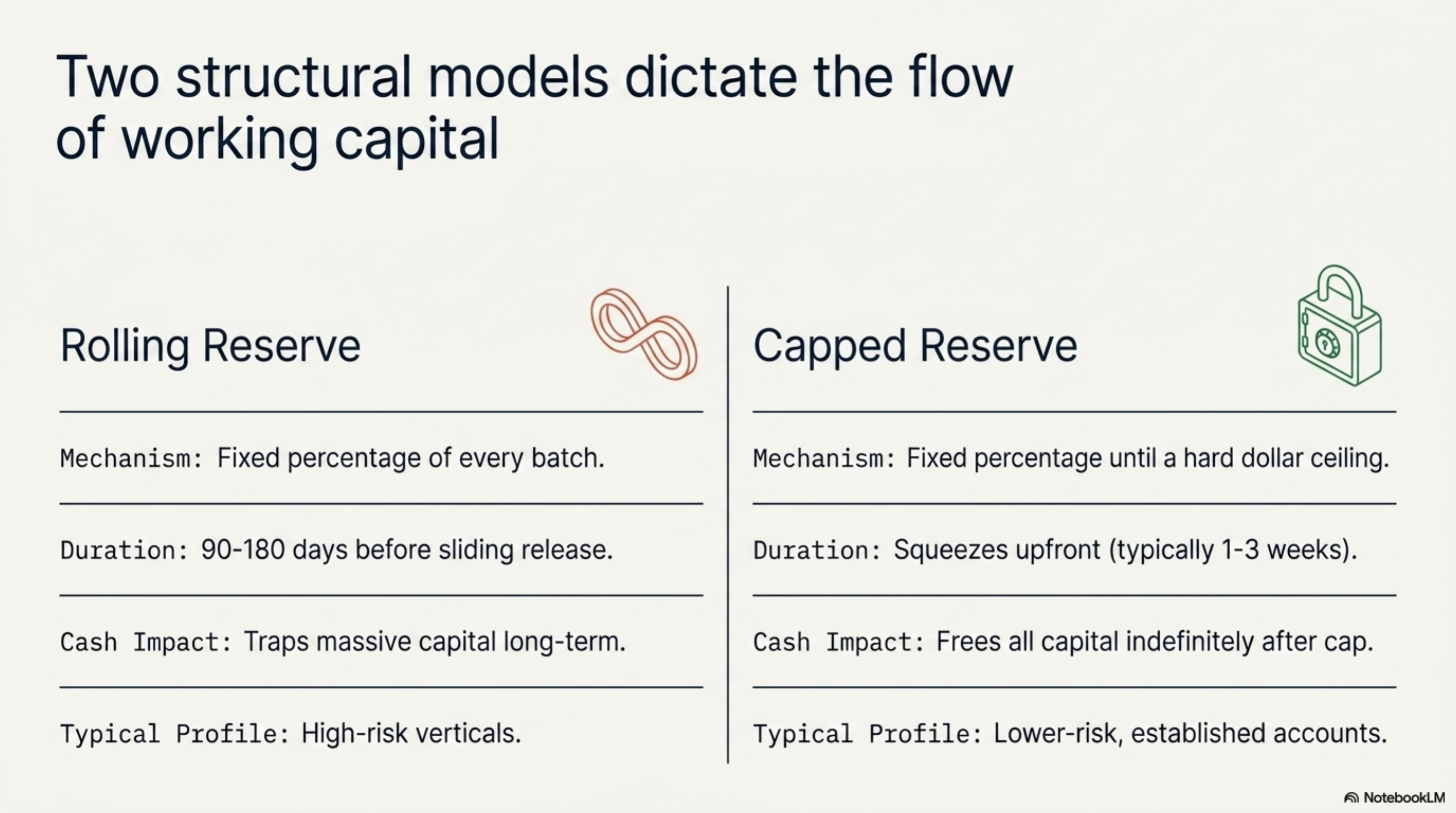
A rolling reserve withholds a fixed percentage of every settlement, usually 5 to 10 percent, for 90 to 180 days before releasing it back. A capped reserve withholds the same percentage but stops once a hard dollar ceiling is hit, typically 1 to 3 weeks of volume. Rolling reserves trap more cash long-term. Capped reserves squeeze payouts harder upfront. Pull the reserve clause in your merchant agreement, run the math on both, and renegotiate the trigger before you renew.
What this actually is
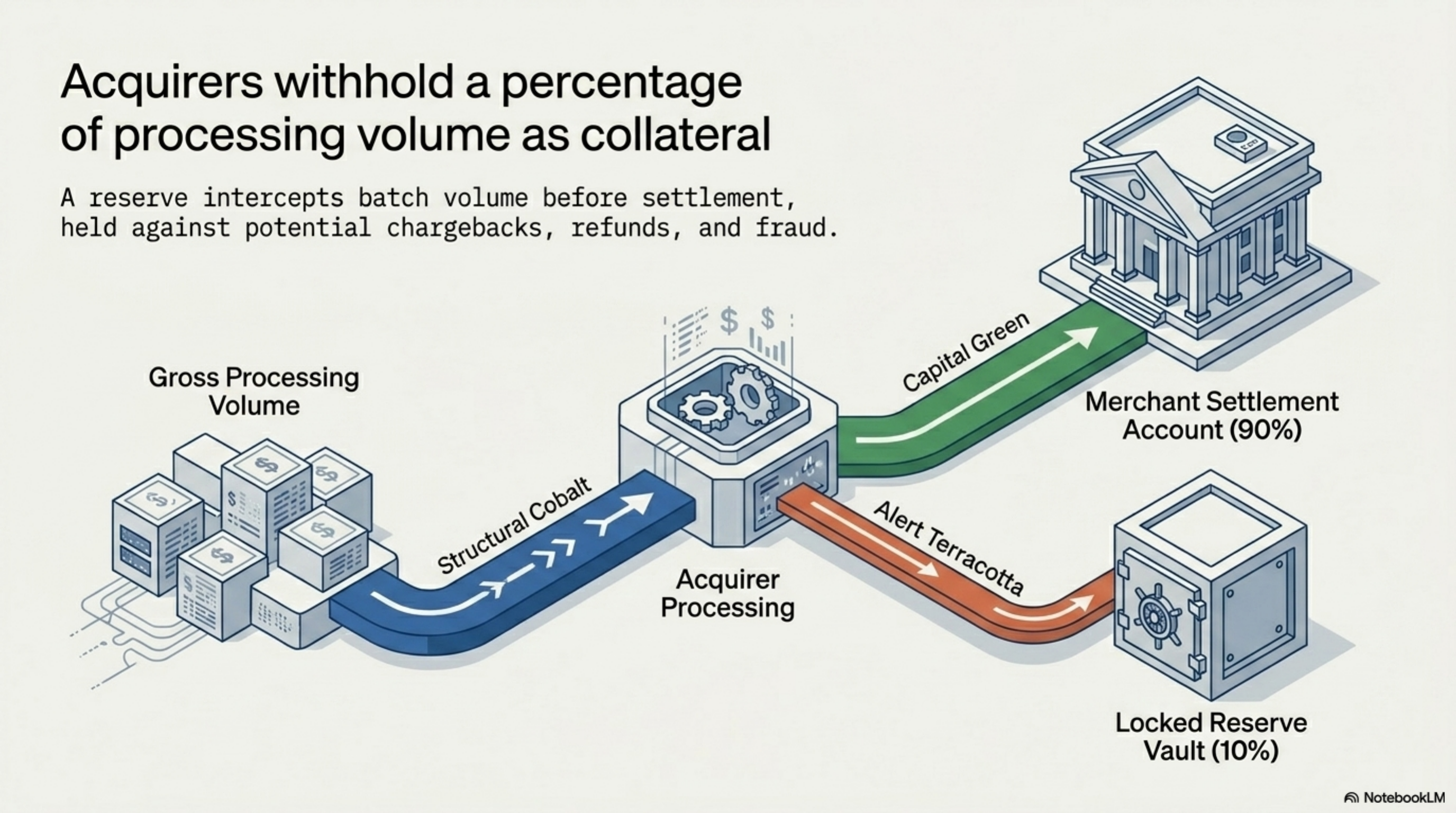
A reserve is a portion of your processing volume that an acquiring bank holds back from your settlement to cover potential chargebacks, refunds, ACH returns, and fraud losses. The card networks themselves do not mandate reserves. Acquirers impose them under the merchant agreement based on their own underwriting and risk policies. The Federal Reserve's payment systems research tracks chargeback exposure across retail categories, and that loss curve is what acquirers model against when sizing reserves.
Two reserve structures dominate the U.S. market. A rolling reserve takes a fixed percentage of every settlement batch, holds each day's withholding for a defined period, then releases it back to the merchant on a sliding schedule. A capped reserve takes the same percentage from each batch but stops collecting once the total held balance reaches a dollar ceiling, then resumes only if the balance drops below the cap. Both reduce daily payouts during the funding cycle. Both appear in the merchant agreement as a single paragraph that most operators skim before signing.
The choice between the two structures is rarely offered to the merchant. The acquirer picks based on MCC code, average ticket, refund rate, processing history, time in business, and the strength of the personal guarantee. High-risk verticals (nutraceuticals, CBD, subscription billing, ticketing, travel, debt collection) usually get rolling reserves. Lower-risk verticals with thin processing history typically get capped. Established accounts with clean chargeback ratios often run with no reserve at all.
A reserve is a percentage of card volume an acquirer withholds from payouts to cover future chargebacks, refunds, and fraud losses on your account.
How it works under the hood
Settlement reserves run inside the acquirer's funding system, not the card networks. Here is the standard sequence.
- You batch out at end of day. Authorization totals flow to the acquirer.
- The acquirer nets gross volume against fees, chargebacks, and refunds for that batch.
- Before funding your bank account, the acquirer withholds the reserve percentage on rolling structures, or up to the dollar cap on capped structures.
- The reserve balance sits in an acquirer-controlled deposit account, sometimes labeled a Merchant Reserve Account in your agreement.
- On day 91, or day 181 depending on terms, the first day's withheld funds release back to your settlement account.
- The cycle continues for the life of the agreement, with each batch's reserve releasing on its own anniversary date.
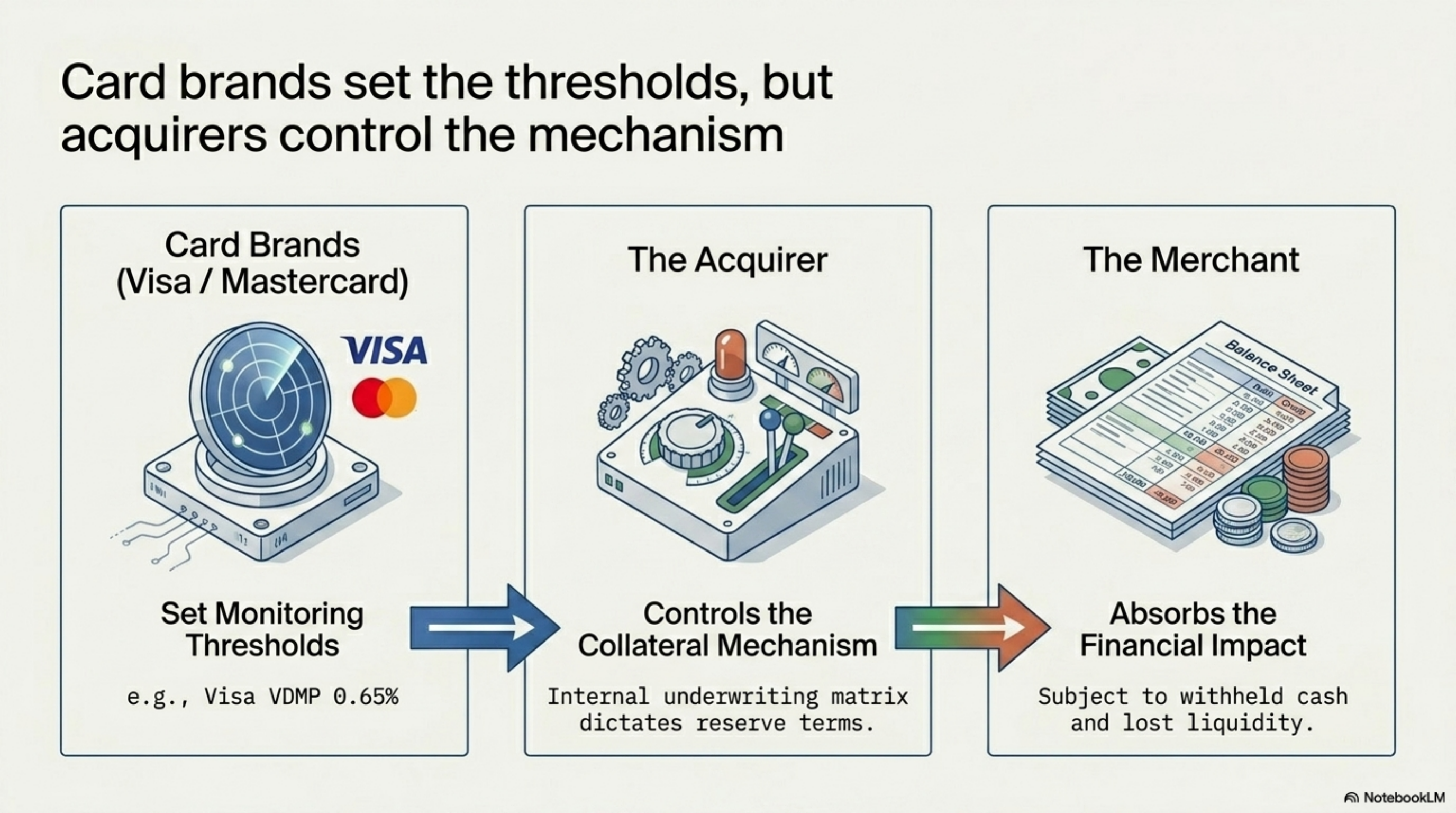
The percentages and timing come from each acquirer's underwriting matrix, not the card brands. Visa's merchant rules require acquirers to manage chargeback exposure but leave the mechanism to the acquirer. Mastercard's interchange and rules documentation takes the same posture. The card brands set monitoring thresholds. The acquirer decides how to collateralize against them.
Rolling reserve math is mechanical. A 10 percent rolling reserve on $500K monthly volume traps $50K per month. At 180 days, peak trapped cash sits at roughly $300K once the schedule fully loads. Releases begin in month seven at $50K per month, offsetting new withholdings exactly. Steady-state trapped cash stays at $300K for the life of the agreement.
Capped reserve math is front-loaded. A capped reserve at 10 percent of batches with a $50K ceiling on the same merchant fills in roughly 10 calendar days, then stops. The merchant feels the squeeze for two weeks, then payouts return to normal. Cash trapped: $50K, indefinitely, until the contract ends or the cap is renegotiated.
Where it goes wrong for operators
Five patterns hit operators on reserves.
1. The auto-escalation clause. Most rolling reserve agreements include language allowing the acquirer to raise the percentage at its sole discretion if chargeback ratios cross Visa's VDMP early warning threshold of 0.65 percent or Mastercard's standard chargeback monitoring threshold of 1.5 percent. At $500K monthly volume, a jump from 5 percent to 10 percent rolling adds $25K per month to trapped cash. The merchant sees this in the next funding cycle, not in a separate notice letter.
2. The capped-converts-to-rolling clause. Some capped structures convert to rolling once the cap is reached if certain conditions persist. The contract calls this a capped reserve. The acquirer's funding system runs it as a rolling reserve once the trigger fires. Read the clause for the words "until released at acquirer's sole discretion" or "reserve account may be reset."
3. Release timing on contract termination. Reserve releases are typically held for 180 days past the last processing date, not the last day of the contract. A merchant who switches processors with $300K in rolling reserve waits six months past the final batch for full release, not from the contract end date. Many agreements add 30 to 90 days on top for chargeback exposure tail.
4. The MCC reclassification. When an acquirer reclassifies a merchant from MCC 5734 (computer software) to MCC 5968 (continuity and subscription) based on refund patterns, reserve terms recalibrate automatically. The merchant did not change anything operational. The risk profile, per the acquirer's policy matrix, did.
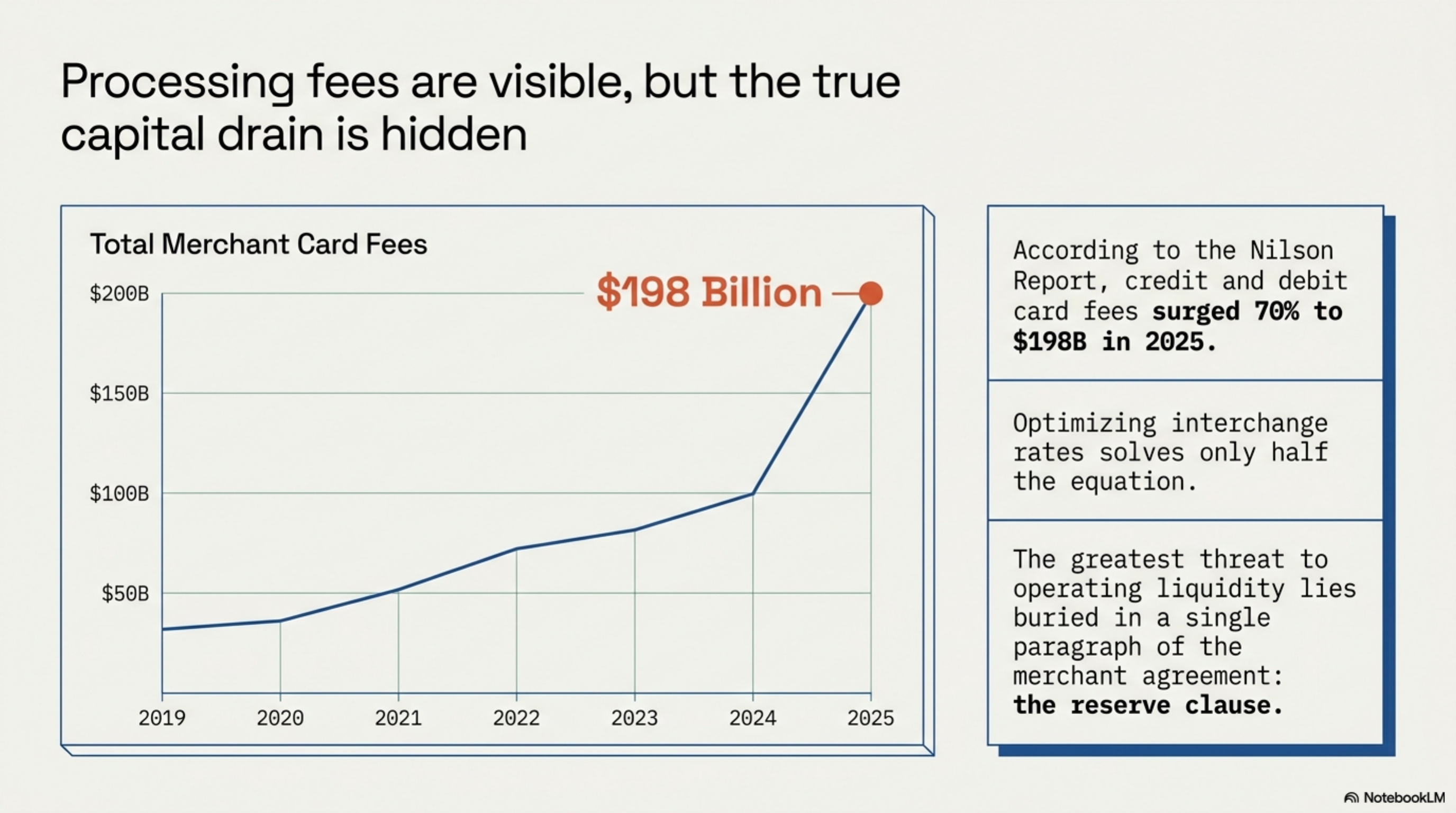
5. Reserve interest. Reserve balances sit in non-interest-bearing accounts in nearly all standard agreements. The acquirer collects float income on the deposit. The Nilson Report has tracked reserve and float income as a meaningful share of acquirer profit margins on high-risk portfolios.
Worked example with real numbers
SaaS subscription operator, MCC 5734, $400K monthly card volume, $89 average ticket, roughly 4,500 transactions per month. Current processor: rolling reserve, 7 percent, 180 days. Pricing: interchange-plus 0.40 percent plus $0.12.
Reserve math at steady state on the rolling structure:
- Monthly withholding: $400K x 7% = $28K
- Peak trapped balance at month six: $168K
- Steady-state trapped cash from month seven onward: $168K, indefinitely
- Implicit cost of capital at an 8 percent treasury yield: roughly $13,440 per year in lost float income
If the same operator negotiated to a capped reserve at 7 percent with a $60K hard cap:
- First two months: $28K per month withheld until the cap is reached on roughly day 64
- Steady-state trapped cash: $60K
- Cost of capital at 8 percent: $4,800 per year
- Annual savings versus rolling: $8,640 in float income, plus $108K freed back into working capital
The negotiation lever: the merchant brought 14 months of clean chargeback data, a written request for a capped structure, and a competing term sheet from a second processor with capped reserve language. The current acquirer matched within a billing cycle.
Operator playbook
- Pull the reserve clause. Find the section titled "Reserve Account," "Holdback," or "Security Deposit" in your merchant agreement. Read the percentage, the trigger, the release schedule, and the auto-escalation language word by word.
- Calculate trapped cash at steady state. Rolling: monthly volume times reserve percentage times release period in months. Capped: just the cap. Convert to a cost of capital using your treasury yield or your IRR on operating capital, whichever is higher.
- Pull 12 months of chargeback data. Acquirers respond to numbers. A ratio under 0.5 percent, a refund rate under 5 percent, and zero VDMP or MATCH list flags is the package that gets reserve terms renegotiated.
- Request the capped structure in writing. Email your account manager with specific terms: "We are requesting conversion from a 10 percent rolling reserve to a capped reserve at 10 percent of batches with a hard cap of [X] weeks of processing volume. Please respond within 10 business days." Keep the paper trail.
- Get a competing offer. A signed term sheet from a second acquirer with explicit reserve terms is the strongest lever you have. Most account managers escalate to retention when shown a competitor's reserve language in writing.
- Ask about reserve interest. Some acquirers will pay treasury-rate interest on reserve balances above $100K or $250K if asked. The answer is usually no. Ask anyway and put both the request and the response in writing.
- Negotiate release on contract termination. Push for 90-day release instead of 180-day release on the final reserve balance at contract end. This is the single most overlooked clause and the easiest win on a renewal.
- Set a quarterly calendar reminder. Review your reserve balance and trigger conditions every quarter. Reserve creep is silent. The acquirer will not call you when ratios drift back below trigger thresholds, even though they reset the percentage upward without one.