TL;DR
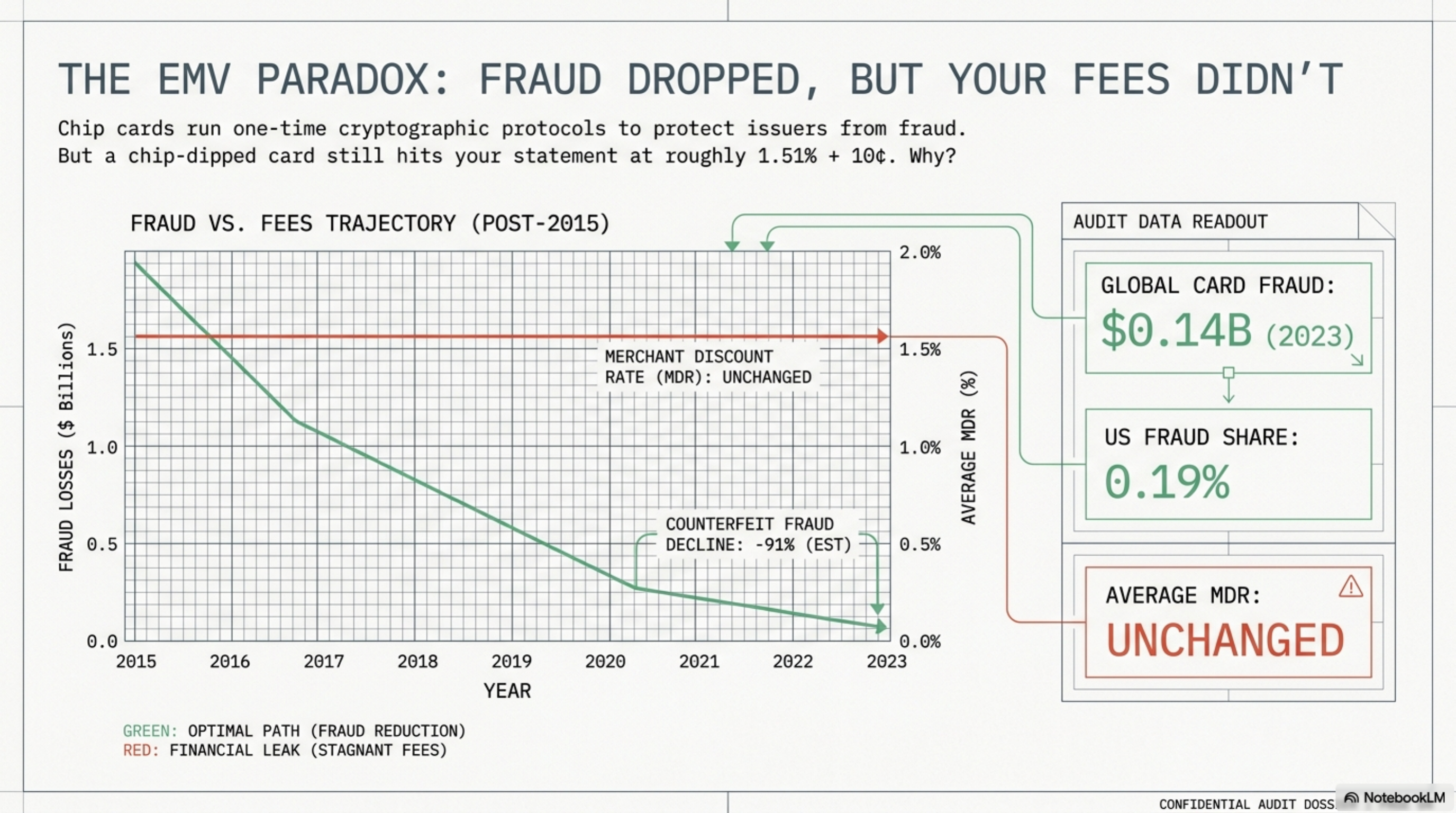
EMV chip cards reduced counterfeit fraud after the October 2015 US liability shift but did not reduce your merchant discount rate. A chip-dipped consumer Visa still hits the Card Present Standard category at roughly 1.51 percent plus 10 cents, and your MDR adds processor markup on top. If your statement shows downgrades to non-qualified or standard interchange on chip transactions, your terminal config, batch timing, or contract is leaking 0.30 to 0.60 percent on those swipes.
What this actually is
EMV stands for Europay, Mastercard, and Visa: the three networks that wrote the original chip-card specification. Chip cards run a cryptographic protocol that authenticates each transaction with a one-time cryptogram instead of the static track data stored on a magstripe. MDR, the merchant discount rate, is the all-in percentage plus per-transaction fee a processor charges to settle a card payment after netting interchange, assessments, and markup.
The Federal Reserve Payments Study tracks card volumes and fraud rates every three years. The 2022 release showed in-person counterfeit fraud dropped sharply between 2015 and 2019 after the EMV liability shift took effect in October 2015. The shift moved liability for counterfeit card-present fraud from the issuer to whichever party (issuer, acquirer, or merchant) was the least EMV-compliant at the point of sale.
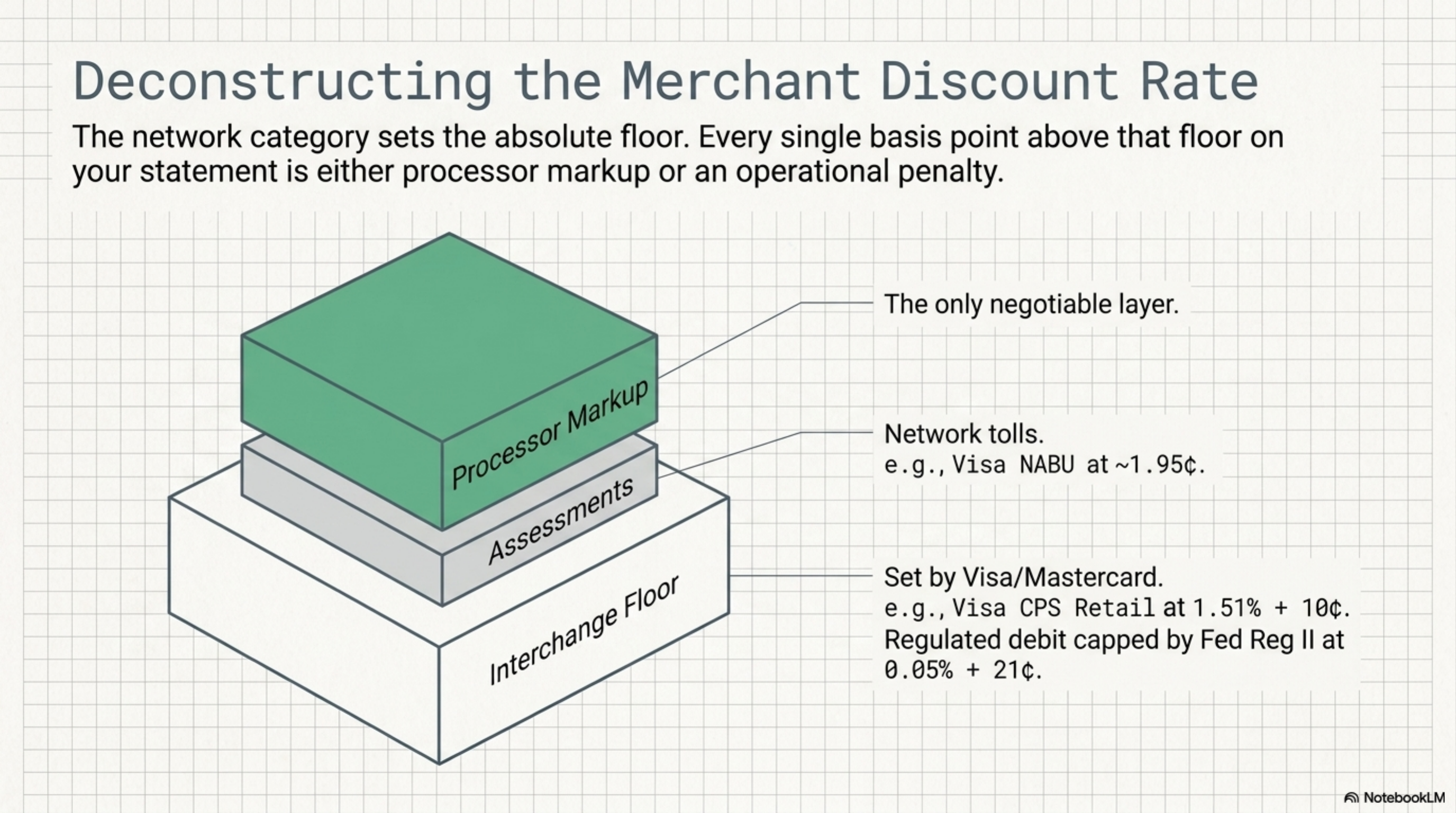
Visa publishes its US interchange schedule with categories that separate card-present chip transactions from keyed and magstripe entry. Mastercard does the same through its Interchange Rates and Criteria document. Chip transactions land in the lowest card-present interchange tiers when the terminal sends the right data fields and the batch settles in time. The MDR your processor bills you includes that interchange floor, plus network assessments, plus the processor markup.
EMV and chip card MDR is the merchant discount rate billed on chip-dipped or tapped transactions, built from card-present interchange, network assessments, and processor markup.
How it works under the hood
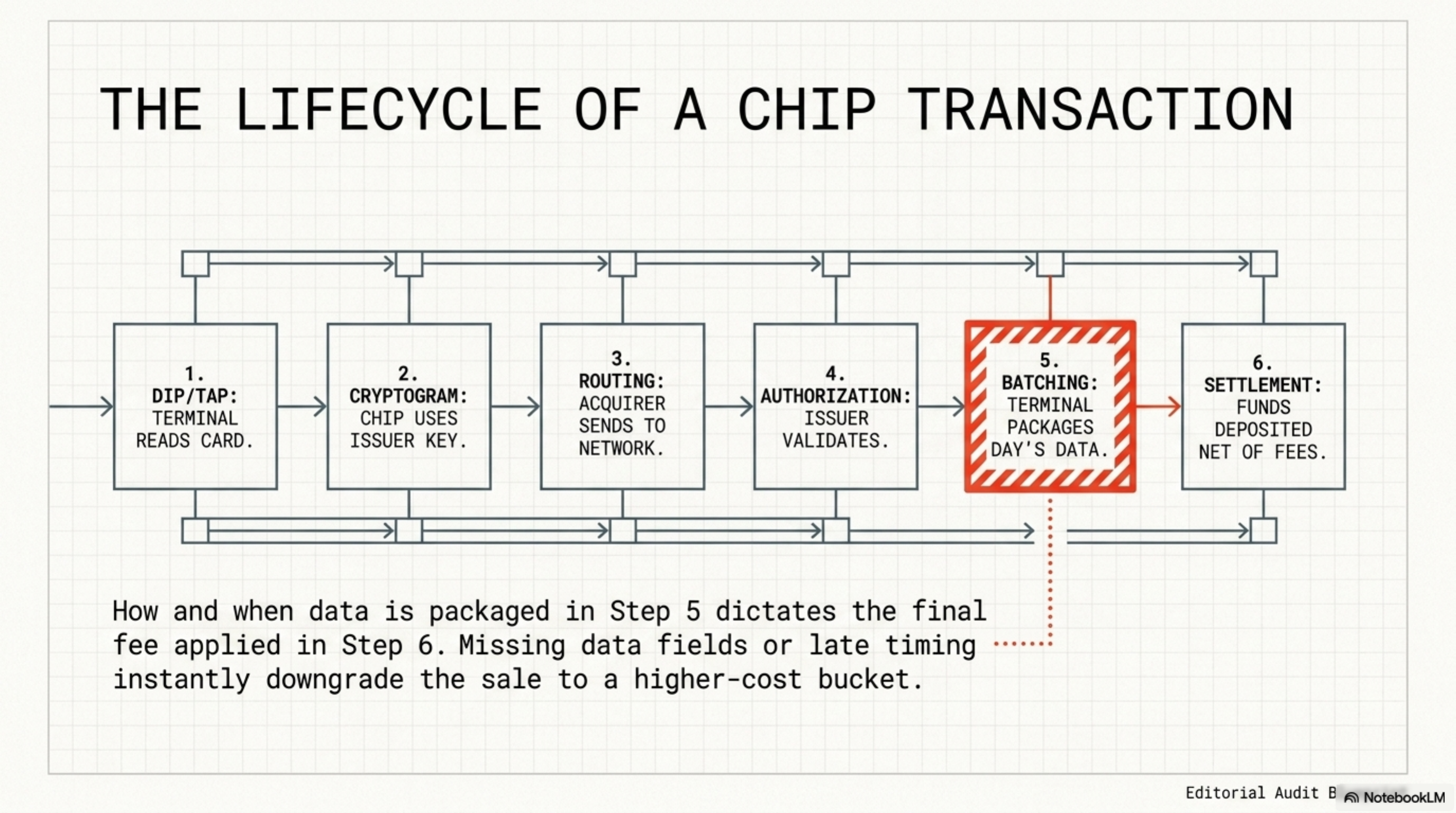
A chip transaction at a properly configured terminal moves through six steps before it shows up as a line on your statement.
- The cardholder dips or taps. The chip uses the issuer key to generate an Application Cryptogram tied to the amount, terminal, and transaction counter.
- The terminal sends the cryptogram and transaction data through your acquirer to the card network.
- The network forwards the authorization to the issuer. The issuer validates the cryptogram and returns approve or decline.
- You batch the day's transactions. The batch must carry the chip data fields and cryptogram for each sale to qualify for chip interchange.
- The network assigns the interchange category based on the data submitted. Missing fields drop the sale to a higher-cost bucket.
- The acquirer settles funds into your account net of interchange, network assessments, and processor markup. The combined cost is your effective MDR.
Visa's Card Present Standard (CPS) Retail rate for non-regulated consumer credit was 1.51 percent plus 10 cents on the most recent published US interchange schedule. Mastercard's Merit III consumer credit ran 1.58 percent plus 10 cents. Regulated debit covered by the Durbin Amendment is capped at 0.05 percent plus 21 cents, with an additional 1 cent fraud-prevention adjustment for qualifying issuers under Regulation II from the Federal Reserve.
Network assessments add roughly 0.14 percent (Visa) and 0.1375 percent (Mastercard) on top of interchange, plus small per-authorization fees: the Visa NABU runs about 1.95 cents and the Mastercard APF runs about 1.95 cents as well.
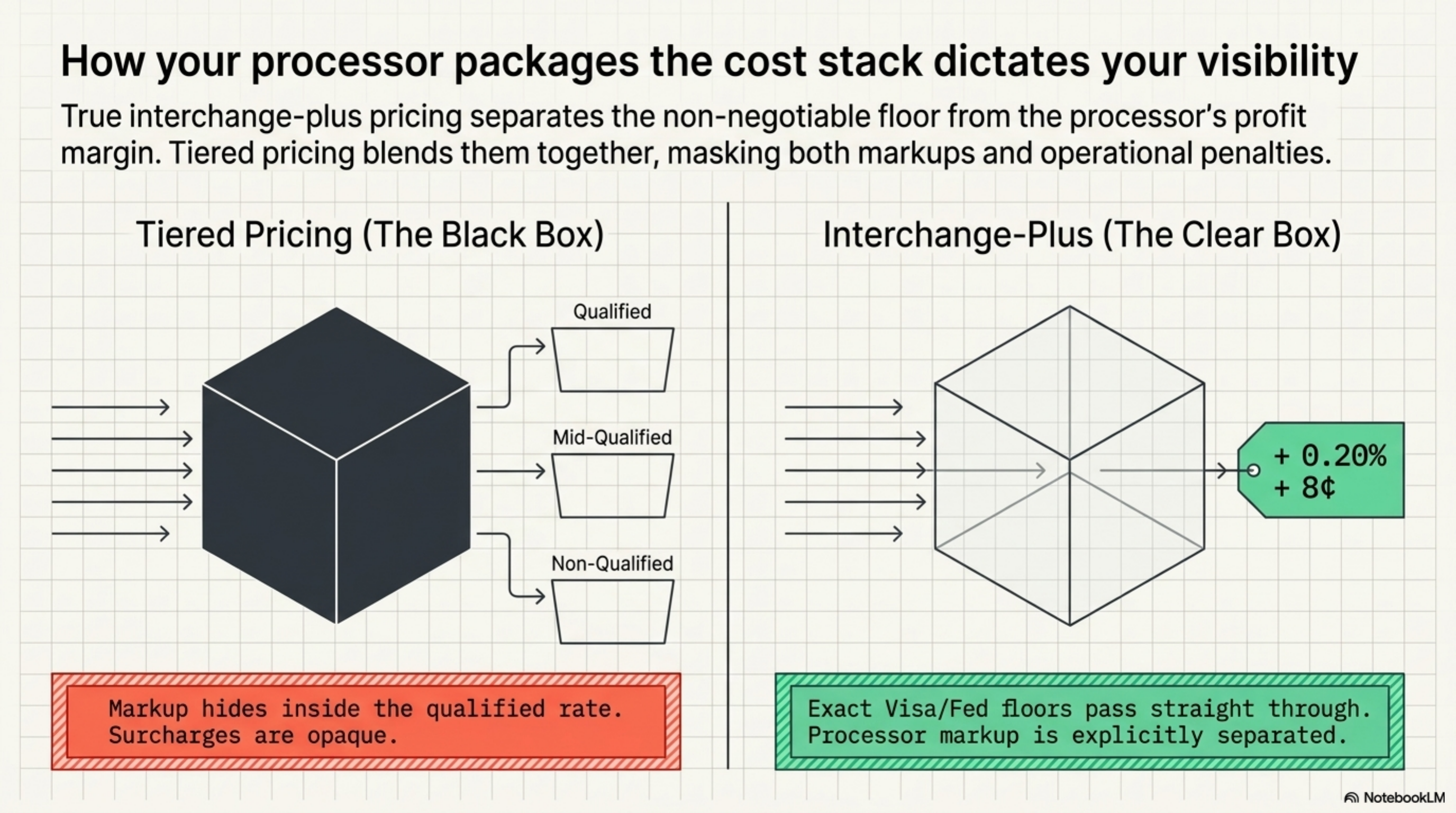
Your processor markup sits above that floor. On true interchange-plus pricing, the markup is explicit: a card-present account in the $200K to $500K monthly volume band should see 0.15 to 0.35 percent plus 5 to 10 cents per transaction. On tiered pricing, the markup hides inside the qualified rate, which can run 0.30 to 1.10 percent above what an interchange-plus account would pay on the same card mix. On flat-rate pricing such as 2.6 percent plus 10 cents, the markup is whatever sits between your headline rate and the actual interchange your batch qualifies for.
A properly batched chip transaction hits a 1.51 percent interchange floor for consumer Visa credit. Anything above that on your statement is markup or downgrade, not chip cost.
Where it goes wrong for operators
Four patterns drain margin on chip transactions, and all of them show up after the contract is signed.
Magstripe fallback downgrades
If a chip read fails for any reason (worn contact, damaged chip, terminal config), the terminal can fall back to a magstripe swipe. The network then routes that sale to a higher-cost category such as CPS Retail Key Entry or Electronic Interchange Reimbursement Fee (EIRF). The downgrade adds 0.30 to 0.65 percent over the chip rate. On $250,000 monthly volume with a 4 percent fallback rate, that is roughly $30 to $65 per month leaking from one terminal config issue.
Late batching
Visa's Card Present Standard rate requires the batch to settle within roughly 24 hours of authorization. Settle later and the transaction downgrades to the Standard interchange category, which costs 0.50 to 1.00 percent more. Auto-batch settings on many terminals are pinned to a fixed clock time; a busy Friday close that pushes past 9 PM can drop the entire batch to next-day settlement. At $500K monthly volume, one missed batch a week is about $400 to $800 in extra cost per month.
Missing data fields
Integrated POS systems sometimes strip data the network needs to grant chip pricing: CVV results, card sequence number, terminal capability flags. The transaction goes through and the customer is happy; the interchange category quietly drops to EIRF. The statement shows a non-qualified surcharge column instead of a clean downgrade line.
Bundled qualified rates
Tiered processors bundle chip and magstripe transactions under one qualified rate, then break out non-qualified and mid-qualified at 1.5 to 2.5 percent above the headline number. Most operators look at the headline qualified rate and never reconcile the breakout columns. Nilson Report figures for US processing volume confirm that a meaningful share of card-present spending settles outside the cleanest interchange categories every year.
Magstripe fallback on a chip-capable terminal is a cost line, not a customer-service line. Every fallback adds 30 to 65 basis points to that sale.
Worked example with real numbers
Profile: independent restaurant, one location, $185,000 monthly card volume, $42 average ticket, about 4,400 monthly transactions. Card mix on the last statement was 70 percent consumer credit (split roughly 25 percent non-rewards, 20 percent Mastercard consumer, 25 percent rewards Visa), 25 percent regulated debit, 5 percent non-regulated debit. Current pricing is tiered: 1.79 percent plus 10 cents qualified, 2.49 percent mid-qualified, 3.29 percent non-qualified.
The last statement broke out as:
- Qualified volume: $138,750 at 1.79 percent + 10 cents = $2,484 rate + $330 per-tx = $2,814
- Mid-qualified volume: $33,300 at 2.49 percent + 10 cents = $829 + $79 = $908
- Non-qualified volume: $12,950 at 3.29 percent + 10 cents = $426 + $31 = $457
- Monthly fees (statement, PCI, gateway, batch): $89
Total monthly processing: $4,268. Effective MDR: 2.31 percent.
Now reprice the same volume on interchange-plus at 0.20 percent plus 8 cents markup:
- Regulated debit (~$46,250, 1,100 tx): 0.05 percent + 22 cents = $23 + $242 = $265
- Non-regulated debit (~$9,250, 220 tx): 1.20 percent + 15 cents = $111 + $33 = $144
- Visa CPS Retail non-rewards credit (~$46,250, 1,100 tx): 1.51 percent + 10 cents = $698 + $110 = $808
- Mastercard Merit III consumer credit (~$46,250, 1,100 tx): 1.58 percent + 10 cents = $731 + $110 = $841
- Visa CPS Retail Rewards 1 (~$37,000, 880 tx): 1.65 percent + 10 cents = $610 + $88 = $698
Interchange subtotal: $2,756. Assessments at roughly 0.13 percent plus 2 cents per authorization: $241 + $88 = $329. Processor markup at 0.20 percent + 8 cents: $370 + $352 = $722. Monthly fees: $25. Total: $3,832. Effective MDR: 2.07 percent.
The savings come from one source: the tiered qualified rate of 1.79 percent was 28 basis points above the blended Visa CPS Retail and Mastercard Merit III floor of about 1.51 to 1.58 percent. The mid-qualified and non-qualified columns added another 70 basis points on top of that. Repricing surfaces both.
Operator playbook
Run this sequence over the next ten business days. Each step takes 30 to 90 minutes and the cumulative effect is usually 25 to 70 basis points off your effective MDR.
- Pull three consecutive monthly statements. Add total fees, divide by total card volume, write down the effective MDR for each month. Anything above 2.40 percent on a card-present account with mixed debit and credit volume is a flag.
- Reconcile every breakout column. Find qualified, mid-qualified, non-qualified, and any EIRF or Standard line. Calculate what percentage of card-present volume is falling outside the qualified column. Above 5 percent on chip-enabled hardware is the leak.
- Audit terminal config. Confirm chip and contactless are both active. Check the EMV kernel version with your processor. Ask for the magstripe fallback rate from the last 90 days; target under 2 percent.
- Check batch close time. Pull the auto-batch setting on every terminal. Compare to your busiest close-of-day. If the auto-batch fires before your last sale of the day clears, push the time later by 60 to 90 minutes.
- Request a line-item interchange-plus reprice quote. Ask the current processor in writing for interchange-plus pricing on your existing contract. Specify cost-plus pass-through of interchange and assessments, with markup quoted as basis points plus cents per transaction.
- Run a two-quote spread. Send the same three statements to two independent processors. Ask each for an interchange-plus quote with no PCI fee bundle, no monthly minimum, and no early-termination fee.
- Negotiate the markup, not the rate. Card-present markup in the $150K to $500K monthly volume band should sit between 0.15 and 0.35 percent plus 5 to 10 cents. Anything above 0.40 percent markup is a giveaway to your salesperson, not pricing.
Effective MDR is the only number that matters on a statement. The qualified rate is marketing; the effective MDR is what hit your bank account.