TL;DR
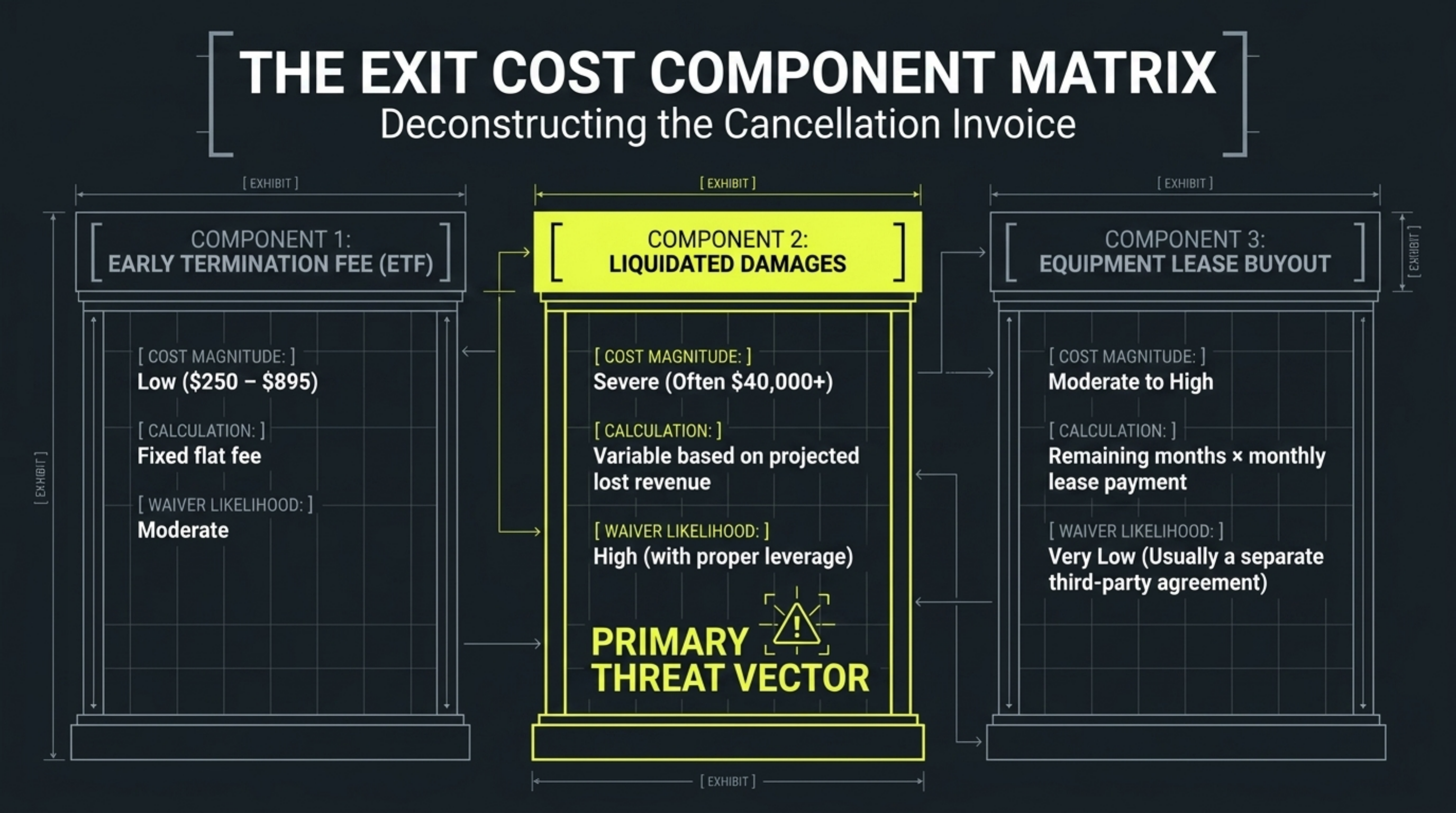
Processor exit fees come in three forms: a flat early termination fee of $250 to $895, a liquidated damages clause tied to lost future processing revenue, and an equipment lease buyout. A four-year contract at $200K monthly volume regularly produces a $25,000 to $55,000 exit bill. The first move is to pull your contract and locate the liquidated damages formula, the auto-renewal window, and the equipment lease terms before you contact your processor. Most contracts have at least one waiver lever.
What this actually is
An exit fee is the total cost a merchant pays to leave a processing contract before the agreed term ends. Three components show up on most cancellation invoices: an early termination fee (ETF), a liquidated damages clause, and an equipment lease buyout if the merchant signed a separate lease (usually with First Data Global Leasing, Northern Leasing, or Lease Finance Group).
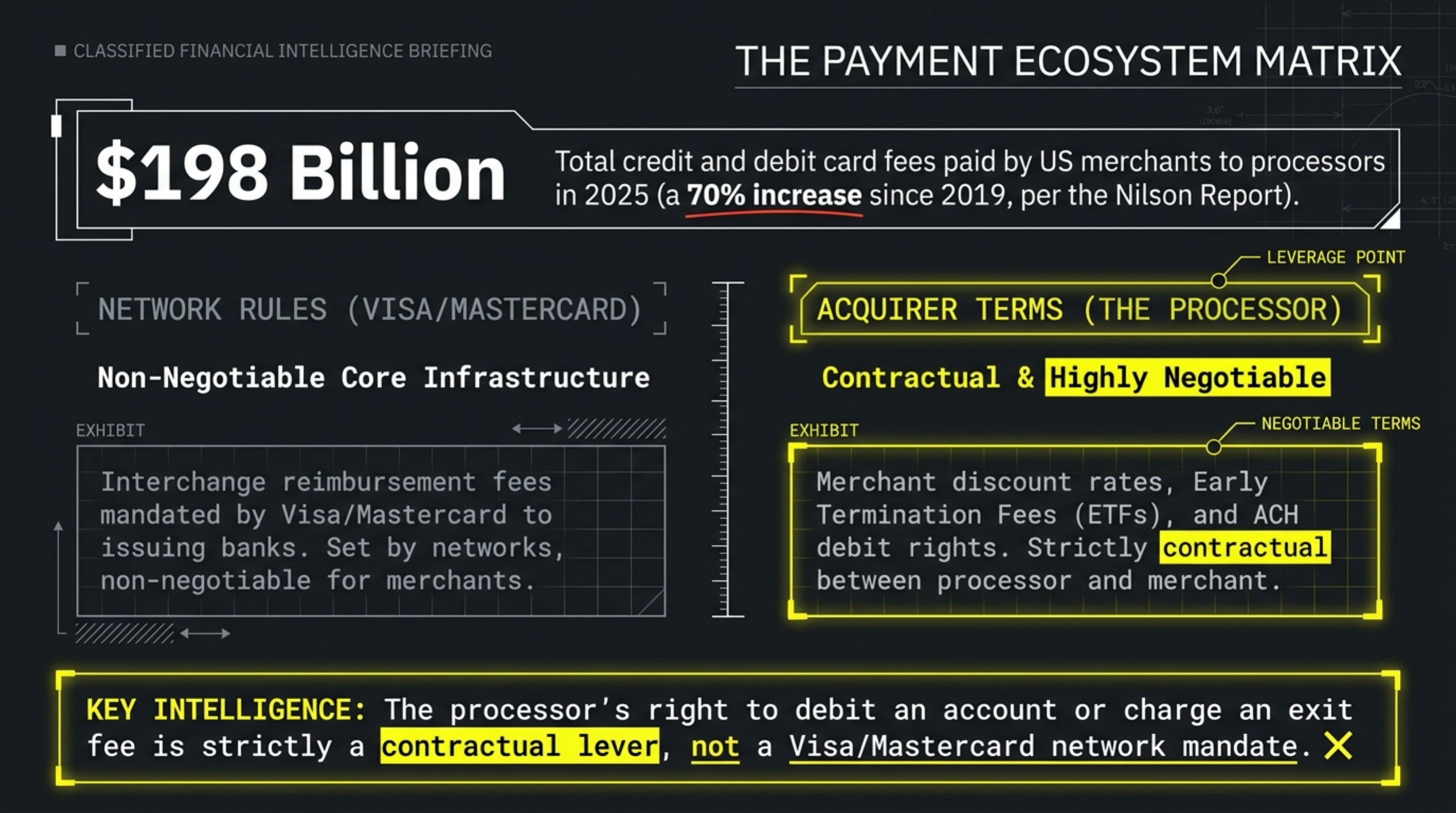
The Federal Reserve's payments research reports that the majority of U.S. card volume flows through a small set of acquirers, most of whom write multi-year contracts with automatic renewal language and material exit penalties built into the standard merchant services agreement.
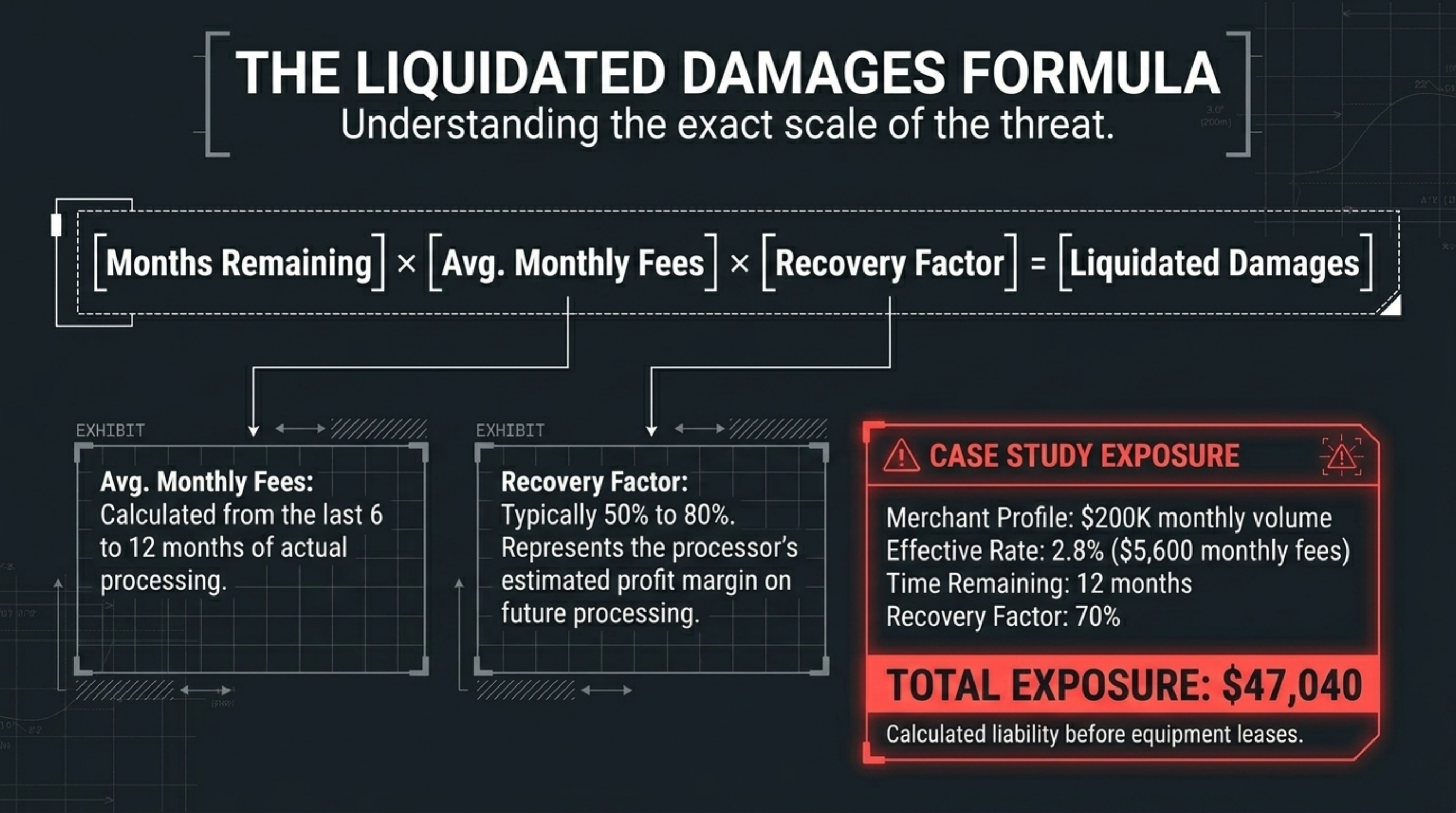
The ETF is the simplest piece: a fixed dollar amount, typically $250 to $895, written into the merchant services agreement. The liquidated damages clause is the expensive one. It estimates the processor's lost margin over the remaining contract term, usually calculated as the average monthly processing fees times months remaining, then multiplied by a recovery factor (often 50 to 80 percent of estimated future revenue). The equipment lease rides separately and almost always survives a processor switch. The combined number on a four-year contract canceled at year two can clear $50,000.
An exit fee is the combined cost a merchant pays to leave a processing contract early, comprising an early termination fee, a liquidated damages charge, and any outstanding equipment lease buyout.
How it works under the hood
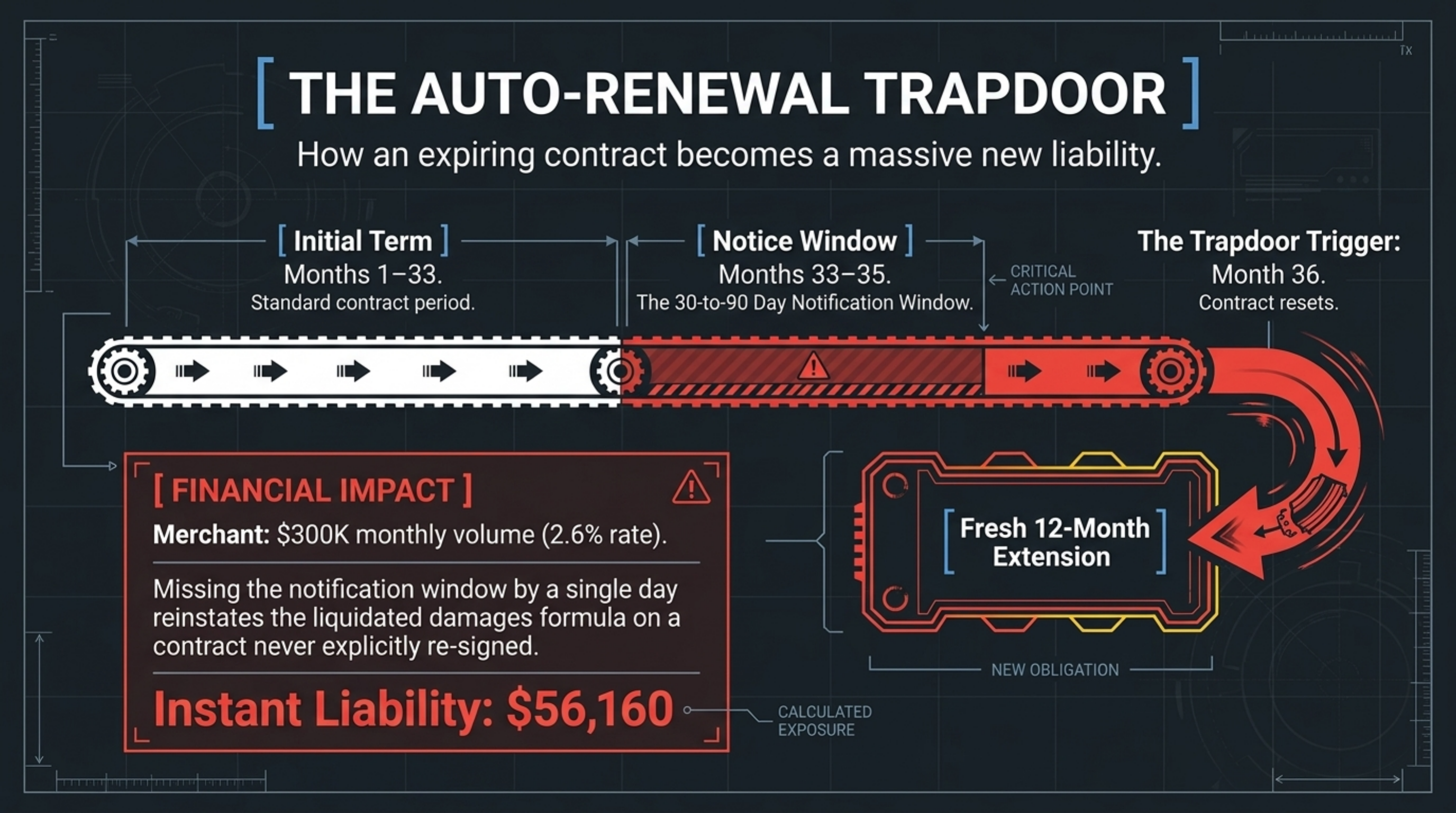
Most merchant services agreements have a three-year initial term with automatic 12-month renewals unless the merchant gives written notice within a specified window, often 30 to 90 days before renewal. Miss the window and the contract renews. The full ETF and liquidated damages clause now apply for another year.
Here is the typical flow when a merchant tries to leave:
- Merchant signs with a new processor. The new acquirer initiates the BIN switch with the card networks.
- The outgoing processor's system flags the closed MID and triggers an account closure ticket internally.
- The contract terms engine pulls the ETF amount and the average monthly processing fees over the last 6 to 12 months.
- The liquidated damages formula calculates: (months remaining) x (average monthly processing fees) x (recovery factor).
- The merchant receives a final invoice listing the ETF, the liquidated damages, any equipment lease balance, and a PCI noncompliance fee if applicable.
- The processor ACH-debits the merchant's settlement bank account for the invoice total within 5 to 30 days of MID closure.
The ACH pull is the critical step. Most merchant services agreements grant the processor the right to debit the merchant's bank account for any amounts owed, without further authorization. Visa's published rules and Mastercard's interchange documentation set acquirer-level requirements, so the processor's right to debit is contractual rather than network-mandated.
Recovery factors vary by processor and contract vintage. Heartland legacy contracts historically used a lower factor. First Data legacy contracts (now under Fiserv) often used closer to 75 percent of remaining gross processing fees. Always read the specific formula in your agreement.
The math is meaningful. A $200K monthly volume merchant with an effective rate of 2.8 percent generates $5,600 in monthly processing fees. Twelve months remaining at a 70 percent recovery factor produces $47,040 in liquidated damages, before equipment.
Most merchant services contracts auto-renew for 12 months if notice is missed in a 30 to 90 day window. The renewal restarts full liquidated damages exposure.
Where it goes wrong for operators
Five patterns trip up most merchants when they try to leave a processor.
Pattern 1: Auto-renewal trigger missed. Operator signed in 2022, never read the renewal clause, and the contract auto-renewed in 2025 for another 12 months. The full liquidated damages formula now applies to a contract the merchant never re-signed. At $300K monthly volume and a 2.6 percent effective rate, that is roughly $7,800 in monthly fees, times 12 months, times a 60 percent recovery factor, or $56,160.
Pattern 2: Equipment lease pretends to be the same contract. Many merchants sign one document with the processor and a separate equipment lease with a third party, often non-cancellable. The processor switch closes the MID but leaves the lease intact, generating $80 to $150 in monthly payments for years. Northern Leasing and Lease Finance Group cases are heavily litigated in New York state court. Public dockets are worth checking before signing.
Pattern 3: Reserve account held for 180 days. Even after cancellation, the processor's right to hold reserve funds against chargebacks does not end. A $50,000 rolling reserve gets released 180 days after the last transaction. That can mean cash sitting outside the operator's control for half a year, even after the MID is closed.
Pattern 4: PCI noncompliance fee triggered on close. Processors with monthly PCI fees often trigger a $19.95 to $49.95 noncompliance fee in the final billing cycle if the SAQ is not on file. Submitting the SAQ before the cancellation notice saves the final charge.
Pattern 5: ACH debit after closure exceeds the account balance. The processor's final invoice often arrives 10 to 30 days after MID closure. If the merchant has moved settlement to the new processor and the old bank account is low, the ACH pull bounces. The processor can then report the merchant to MATCH (Member Alert to Control High-risk merchants), and future processor onboarding becomes harder.
The MATCH listing lasts five years and follows the principal owner across businesses. Do not let a contested exit invoice trigger a MATCH placement. Pay under protest if you must, then dispute in writing.
Worked example with real numbers
Merchant profile: a regional auto repair chain with four locations. Vertical: automotive services. Monthly processing volume: $420,000. Average ticket: $385. Current rate: tiered pricing with an effective rate of 2.94 percent. Current processor: First Data legacy contract signed in June 2022 for 36 months, auto-renewed in June 2025 for 12 months. Contract end date: June 2026.
Cancellation as of January 2026, five months remaining:
- Monthly processing fees: $420,000 x 2.94 percent = $12,348
- Five months of remaining fees: $61,740
- Recovery factor of 70 percent: $43,218 in liquidated damages
- Flat ETF: $495
- Equipment lease balance on three POS terminals: $4,860
- PCI noncompliance fee in final billing cycle: $39.95
Total cancellation bill: $48,612.95.
If the operator waits until April 2026 to issue cancellation notice (with 60 days notice required), the contract ends naturally in June 2026 with no liquidated damages and no ETF. Cost of waiting: roughly $61,740 in continued processing fees at the higher rate over five months. But if the operator negotiates IC++ pricing at the new processor with an effective rate of 2.35 percent, monthly savings would be $2,478 ($420,000 x 0.59 percent).
Switching immediately and paying the exit bill is $48,612. Waiting five months at the higher rate is $12,390 in foregone savings ($2,478 x 5). Break-even on paying the exit fee versus waiting is 19.6 months of new savings.
Same operator negotiates a 50 percent reduction in the liquidated damages clause (a common waiver outcome with documented competitive pressure and a written threat to file a complaint with the state attorney general). The exit bill drops to about $27,000. Break-even drops to 10.9 months of new processor savings, well inside a normal contract horizon.
If the operator plans to stay with the new processor at least 24 months, paying the full exit fee still nets positive: $59,472 in savings minus $48,612 exit cost equals $10,860 net.
Operator playbook
Run these eight steps in order. Most operators who follow them end up paying 30 to 70 percent less than the first exit invoice quoted.
- Pull your merchant services agreement and the equipment lease (if separate). Search for "liquidated damages," "early termination," "auto-renewal," and "lease." If you cannot find the document, request it in writing from your account manager. Most state UCC provisions require the processor to provide a copy within 30 days.
- Calculate the actual exit cost using the formula in your contract. Multiply your last 6 months average processing fees by months remaining, then by the recovery factor (usually 50 to 80 percent). Add the flat ETF and any equipment lease payoff.
- Compare exit cost to projected savings on a 24-month horizon at the new processor's rate. Break-even is exit cost divided by monthly savings. If break-even is over 20 months, wait for the contract to end naturally.
- Request a written waiver of the liquidated damages clause citing one of three levers: the auto-renewal notice was not received as required by the contract, the processor failed to honor a price hold, or the processor materially changed terms (a mid-term fee schedule update qualifies in many states under UCC good-faith provisions).
- Submit cancellation notice via certified mail with return receipt to the address listed in the contract, not just the account manager's email. Keep a timestamped copy. Email confirmation alone does not satisfy notice requirements in most agreements.
- Issue a written ACH revocation to your bank for the processor's debit authority, effective the day after the contract ends. Business accounts rely on UCC Article 4A and your bank's stop-payment process, not Regulation E.
- Hold the new processor's onboarding until your cancellation is confirmed in writing. Dual MIDs for even 48 hours can trigger duplicate billing and reserve holds on both accounts.
- Document everything. Keep all notices, invoices, certified mail receipts, and call logs for at least three years. The strongest position in any dispute is the documented paper trail.
"A $200K monthly volume merchant with 12 months remaining typically faces $40,000 to $55,000 in liquidated damages, before any equipment buyout."