TL;DR
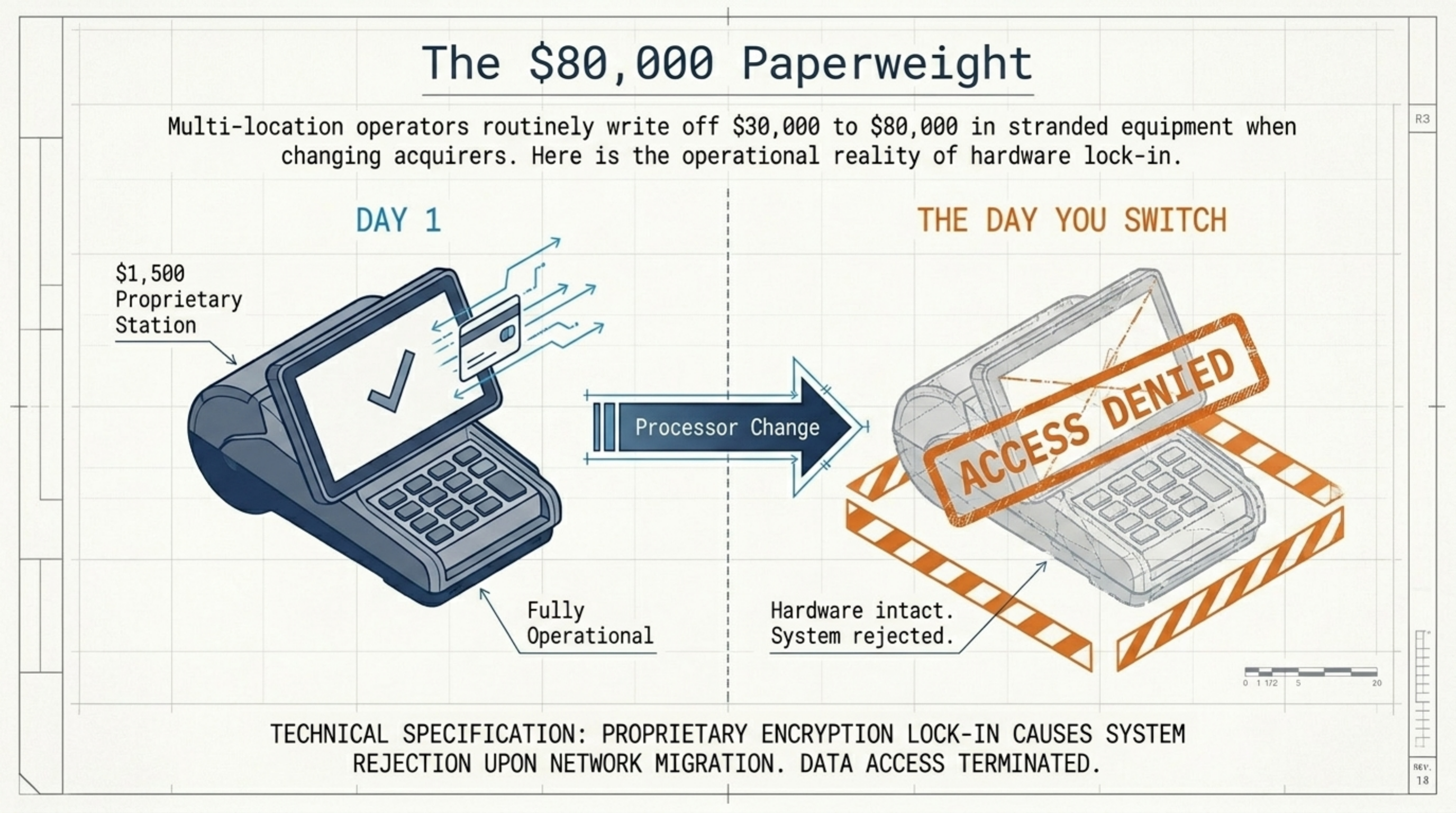
Hardware lock-in is why your $1,500 Clover Station or $700 Toast Flex stops working the day you switch processors. The terminal is loaded with processor-specific encryption keys, registered to that processor's terminal ID network, and often financed under a non-cancelable 48-month lease. Switching means buying new hardware, paying early termination on the lease, or both. Most multi-location operators write off $30,000 to $80,000 in stranded equipment when they move acquirers.
What this actually is
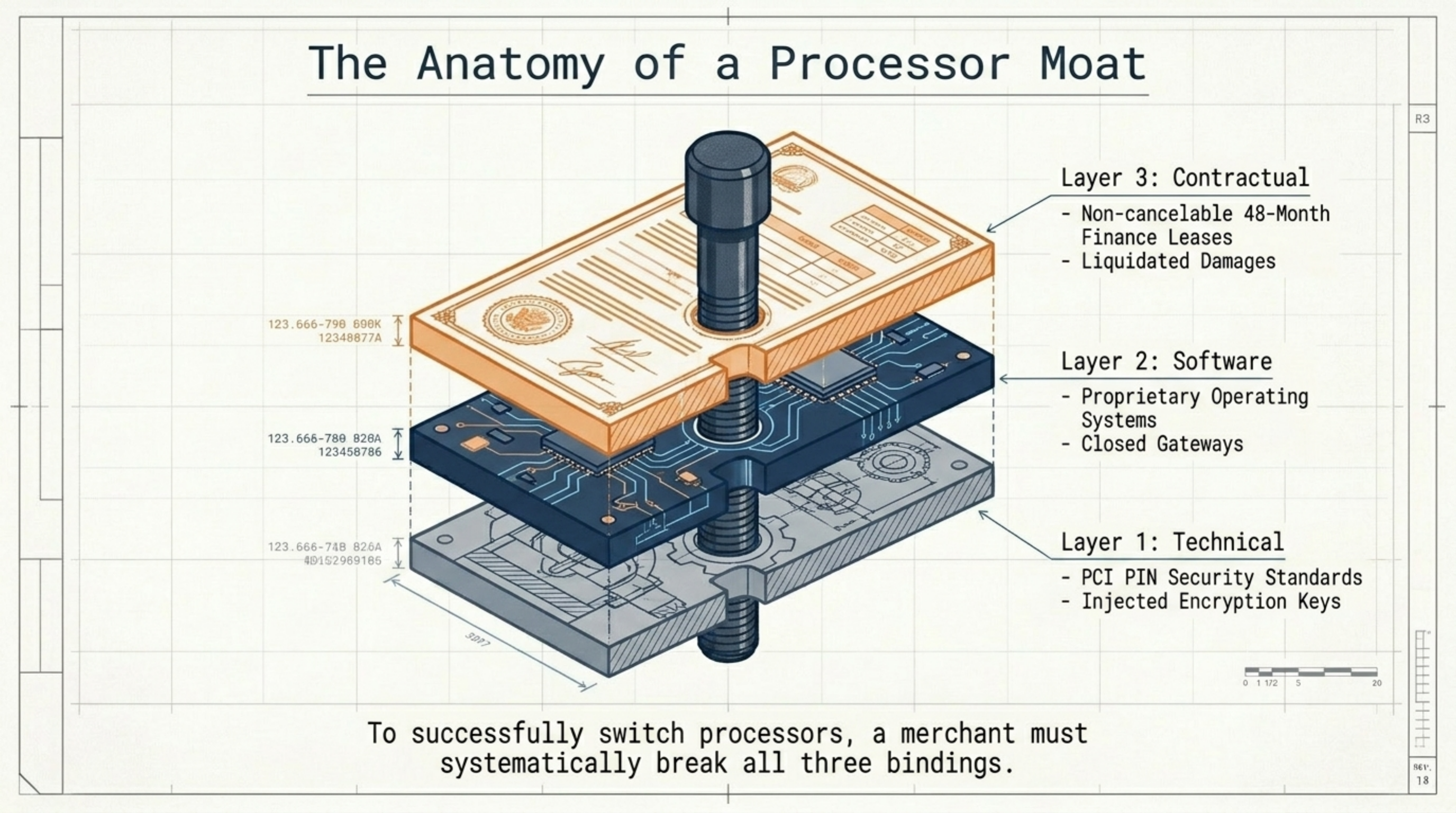
Hardware lock-in is the bundle of technical, software, and contractual mechanisms that bind a payment terminal to a single processor or acquirer. It operates at three layers, and a merchant needs to break all three to actually move equipment between processors.
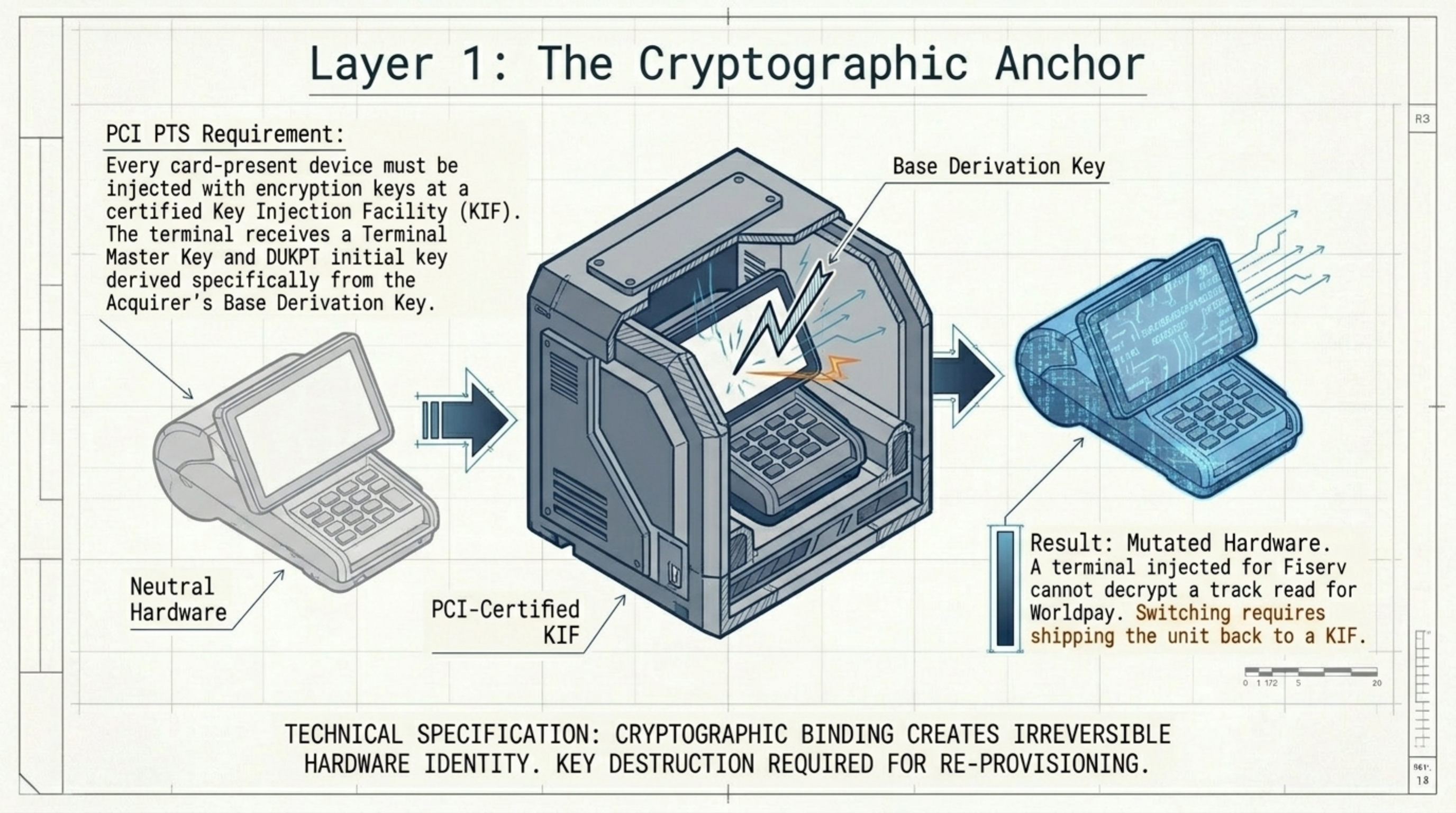
At the technical layer, every card-present terminal needs encryption keys injected before it can accept a payment. The keys are loaded at a Key Injection Facility (KIF) certified under the PCI PIN Security standard. Those keys are processor-specific. A terminal injected for Fiserv will not decrypt a track read for Worldpay, and vice versa. The PCI Security Standards Council documents the key injection requirements in its PCI PIN Security Requirements, and the keys themselves are derived from the acquirer's Base Derivation Key.
At the software layer, several major POS vendors run proprietary operating systems that only authenticate to their own gateway. Clover, Toast, and Square hardware fall into this category. Even if you could swap the keys, the device firmware refuses to talk to anything outside the parent network.
At the contract layer, equipment leases through First Data Global Leasing, Northern Leasing, Lease Finance Group, and similar finance partners are written as non-cancelable finance leases. The merchant owes the full remaining stream of payments regardless of whether the hardware still works for them.
Hardware lock-in is when a payment terminal is tied to one processor by encryption keys, proprietary software, or a non-cancelable lease that prevents switching.
How it works under the hood
The lock-in flow starts before the terminal arrives at your counter. Here is what happens, step by step, from device manufacture to the moment you try to leave.
- Manufacture. A PCI PTS approved device ships from PAX, Verifone, Ingenico, or Castles to the processor's distribution partner. The list of currently approved devices is maintained by the PCI Security Standards Council.
- Key injection. The unit is shipped to the processor's Key Injection Facility. The KIF loads the Terminal Master Key and the DUKPT initial key derived from the acquirer's Base Derivation Key. Each terminal now has a unique key fingerprint tied to one acquirer.
- TID registration. The acquirer assigns a Terminal Identification Number, registers it with Visa and Mastercard, and binds it to the merchant's MID. Visa publishes the merchant identification framework in its Visa Core Rules and Visa Product and Service Rules.
- Software load. The terminal pulls its application from the processor's TMS (Terminal Management System). On Clover and Toast hardware, the OS itself is proprietary. On semi-integrated devices, only the payment app is processor-branded.
- Lease origination. If the merchant takes the equipment on a lease, the lease is sold to a third-party finance company within days. The merchant's signature on the lease is a personal guarantee separate from the merchant services agreement.
- Activation. The terminal boots, dials the acquirer's host, completes a logon, and is ready to process. The host record now contains the device serial number, the injected key index, the TID, and the MID. All four must match on every transaction.
When you try to leave, all four bindings have to be broken. The serial number is fixed in the chip. The injected key requires return shipping to a KIF and a re-injection cycle. The TID has to be deactivated by the old acquirer and a new one issued by the new acquirer. The MID has to be closed and reopened. On proprietary devices, the firmware refuses every step.
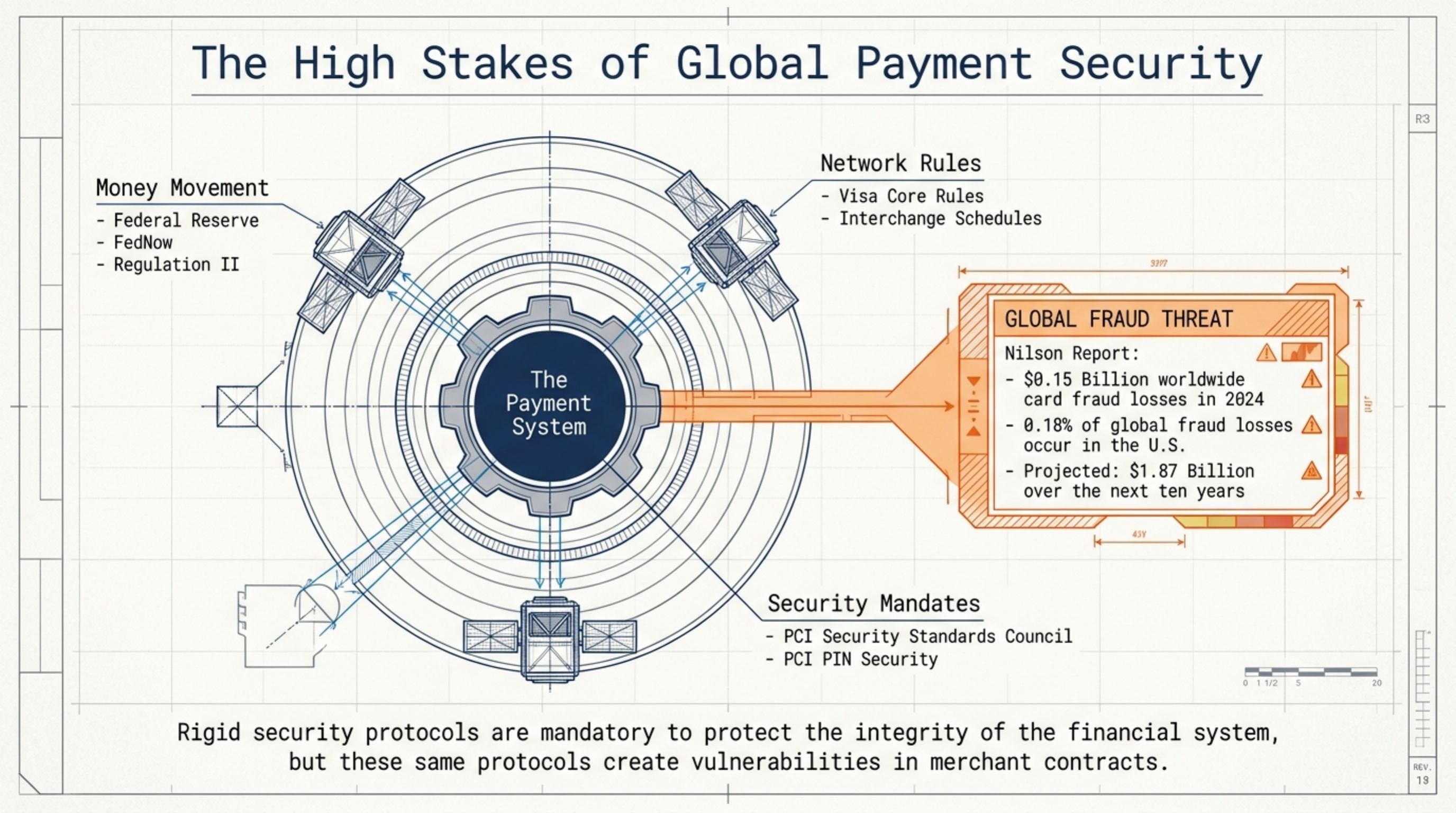
The Federal Reserve documents the U.S. acquiring stack in its payments systems reference materials and its triennial Payments Study, which is where the volume of card-present terminals in the field is tracked.
Where it goes wrong for operators
Five patterns account for most of the dollar damage. Each one shows up on a real statement or lease document.
1. Non-cancelable 48-month leases. The standard First Data Global Leasing or Northern Leasing contract runs 48 months at $50 to $130 per terminal per month. At $89 per month for 48 months, a single terminal lease totals $4,272. The lease is non-cancelable, and on most contracts the merchant owes the full remaining balance as liquidated damages if processing stops. On a 10-terminal estate, that is $42,720 of liability sitting on the personal guarantee.
2. Proprietary OS that only talks to the parent network. Clover, Toast, Square, Lightspeed Restaurant K-Series, and Revel all run software stacks that authenticate exclusively to the parent processor. There is no firmware path to repoint them. When the merchant leaves, the hardware becomes a paperweight or a low-value secondhand sale on eBay.
3. Reprogramming fees on "open" PAX and Verifone units. Even semi-integrated terminals that physically support multiple processors charge $50 to $200 per unit to be reinjected with new keys. The reinjection requires the device be shipped to a KIF, which adds 5 to 10 business days of downtime per terminal.
4. The bundled software subscription. Toast charges $69 per location per month for its base POS software, with separate fees for online ordering, payroll, and inventory. Switching processors means losing the software too, which forces a full POS migration on top of the hardware spend.
5. "Free terminal" placement programs. When a processor places hardware at no upfront cost, the terms of service almost always include a return clause. Failure to return the unit within 10 to 30 days of account closure triggers a non-return fee of $300 to $750 per device, charged to the bank account on file.
Worked example with real numbers
Consider a regional quick-service restaurant operator with 8 locations doing $400,000 in monthly card volume on a $14 average ticket. Current setup: Toast POS at every location, with one Toast Flex handheld and one kitchen display per store, plus a primary station. Hardware purchased outright for $4,200 per location. Software at $69 per month per location, payment processing at 2.49 percent plus 15 cents card present, and Toast Capital loan with 24 months remaining at $2,800 per month across the chain.
The operator gets an interchange-plus quote at 0.25 percent plus 10 cents over interchange from a regional acquirer. On the existing card mix, that would drop the effective rate from 2.49 percent plus 15 cents to roughly 2.05 percent plus 18 cents, a savings of about 0.35 percent on volume. On $400,000 per month, that is $1,400 per month or $16,800 per year in processing savings.
The math on switching:
- Stranded Toast hardware: 8 locations at $4,200 = $33,600 written off.
- Toast software termination: most Toast contracts include a 30-day notice clause but do not refund hardware. No early termination fee on month-to-month software, but the equipment is gone.
- Toast Capital loan: collected as a fixed percentage of card sales. If sales move to a new processor, the loan typically accelerates and the full balance comes due. With 24 months at $2,800, that is $67,200 owed at switch.
- New hardware: $1,200 per location for semi-integrated terminals plus a third-party POS at $79 per location per month, totals $9,600 in hardware and $632 per month in new software.
Year-one cost of switching: $33,600 stranded hardware plus $67,200 accelerated loan plus $9,600 new hardware, minus $16,800 in processing savings. Net first-year cost: $93,600.
Year-two onward: $16,800 per year in processing savings minus $7,584 per year in new software, net $9,216 per year. The breakeven on the switch is just over 10 years. That is the cost of having bought into a closed stack.
Operator playbook
Do these five to eight things this week to either prevent lock-in on your next hardware purchase or measure your existing exposure.
- Pull every lease agreement. Find the leasing company name (not the processor name) on the document. Confirm the monthly payment, the remaining term, and the liquidated damages clause. Add up the total remaining liability across all terminals. This number is your minimum cost to leave.
- Check the device PCI PTS approval. Look up your terminal model in the PCI PTS approval list. If the device is on the list, it is technically capable of running multiple acquirer profiles. If it is proprietary (Clover Station, Toast Flex, Square Register), it is not.
- Request your key injection history in writing. Email your current processor and ask which KIF holds the keys for your terminals and whether they will release the device for re-injection. Get the per-device reprogramming fee in writing.
- Stop signing 48-month leases. On any new placement, insist on either outright purchase, a 12-month rental, or month-to-month. The leasing economics only work for the leasing company. A $300 PAX A920 bought outright beats $89 a month for 48 months ($4,272) every time.
- Separate hardware from software from processing. The three pieces should be three separate contracts with three separate exit clauses. If the salesperson refuses to break them apart, that is the lock-in being designed in front of you.
- Ask the new processor to buy out the old lease. Larger acquirers will offer $200 to $500 per terminal as an equipment buyout incentive on multi-location deals. Get the offer in writing before signing anything new.
- Read the non-return clause. On any "free terminal" placement, find the return address, the return window (usually 10 to 30 days), and the non-return fee. Photograph the units before shipping and use a tracked carrier.
- Benchmark against published interchange. Pull the current Mastercard interchange schedules and Visa schedules. Your effective rate above interchange tells you whether a switch is worth the lock-in pain in the first place.