TL;DR
When a card issued outside the U.S. runs at a U.S. merchant, three fees stack on top of domestic interchange: a higher international interchange tier, a network cross-border assessment, and often a currency conversion margin. A merchant processing 10 percent international volume on $300,000 monthly card sales pays an extra $1,500 to $3,200 every month. The fix is pricing structure, not vendor choice. Pull your statement, isolate the international line items, and check what your processor is keeping versus what is passing through to the network.
What this actually is
Two related fees apply when a card crosses national borders during a transaction. Both run on top of the standard domestic interchange that a U.S. merchant pays on a U.S. card.
The first is international interchange itself. Visa and Mastercard maintain separate interchange schedules for cross-border transactions. These rates run higher than domestic equivalents because of greater fraud exposure, longer settlement cycles, and additional regulatory overhead between issuing and acquiring countries. Visa publishes its International Interchange Reimbursement Fee program in its public regulations documentation. Mastercard publishes its Worldwide Interchange Programs document with the same framework.
The second is a network-level assessment added on top of interchange. Visa calls it the International Service Assessment (ISA). Mastercard calls it the Cross-Border Assessment Fee. Both are flat percentages that go to the network itself, not the issuing bank. Visa's ISA is 1.00 percent when the transaction settles in the same currency the card was issued in, and 1.40 percent when currencies differ. Mastercard's Cross-Border Assessment Fee is 0.60 percent same currency and 1.00 percent different currency.
These assessments are non-negotiable. Every U.S. acquirer pays them on every cross-border transaction. The merchant sees them either as a separate line item on an IC++ statement or buried inside a flat international surcharge on a flat-rate processor.
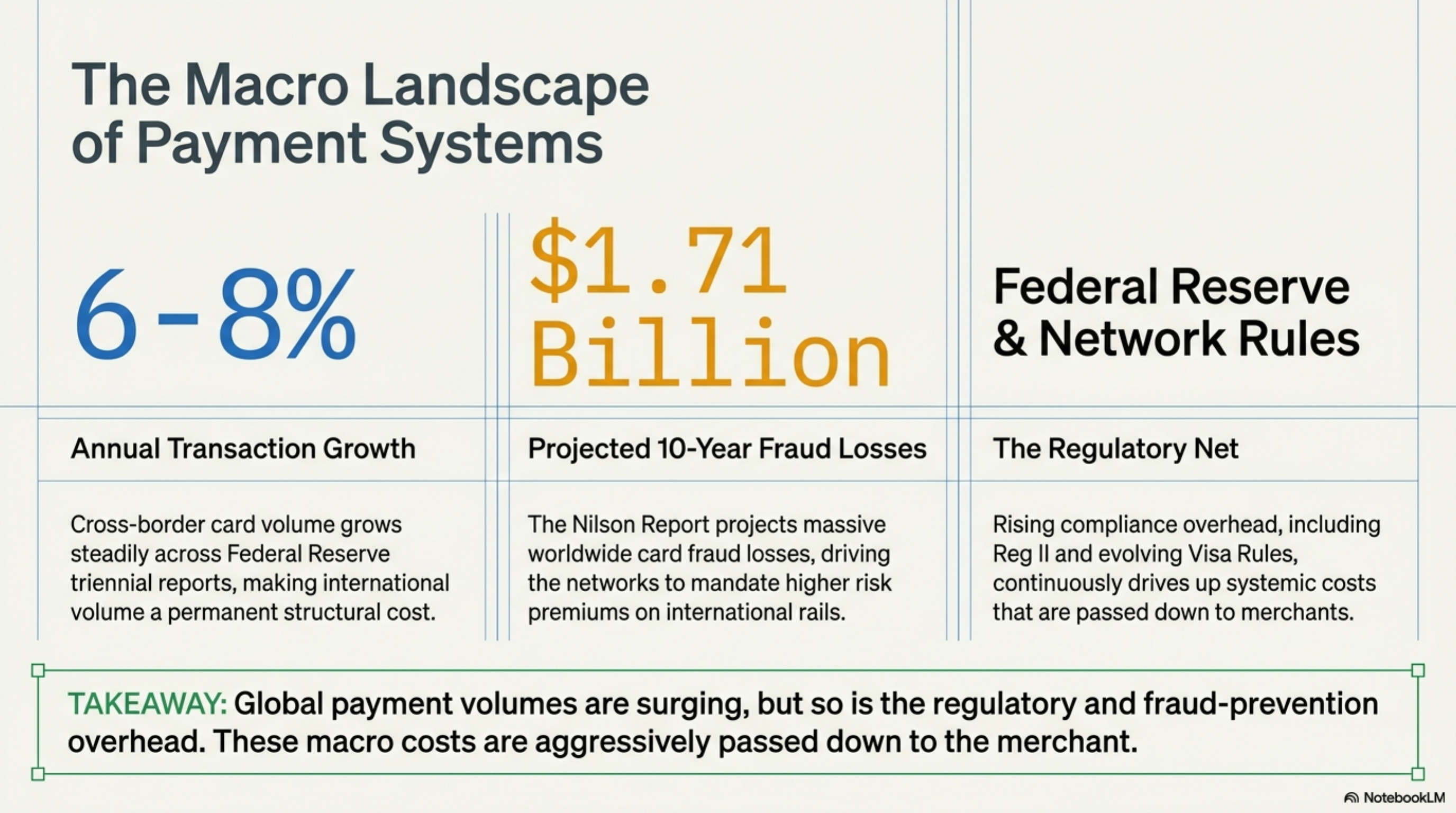
The Federal Reserve Payments Study tracks cross-border card volume across its triennial reports and shows international card transactions growing roughly 6 to 8 percent annually in dollar terms. For any U.S. merchant with an e-commerce footprint, international volume is a structural cost line that is not going away.
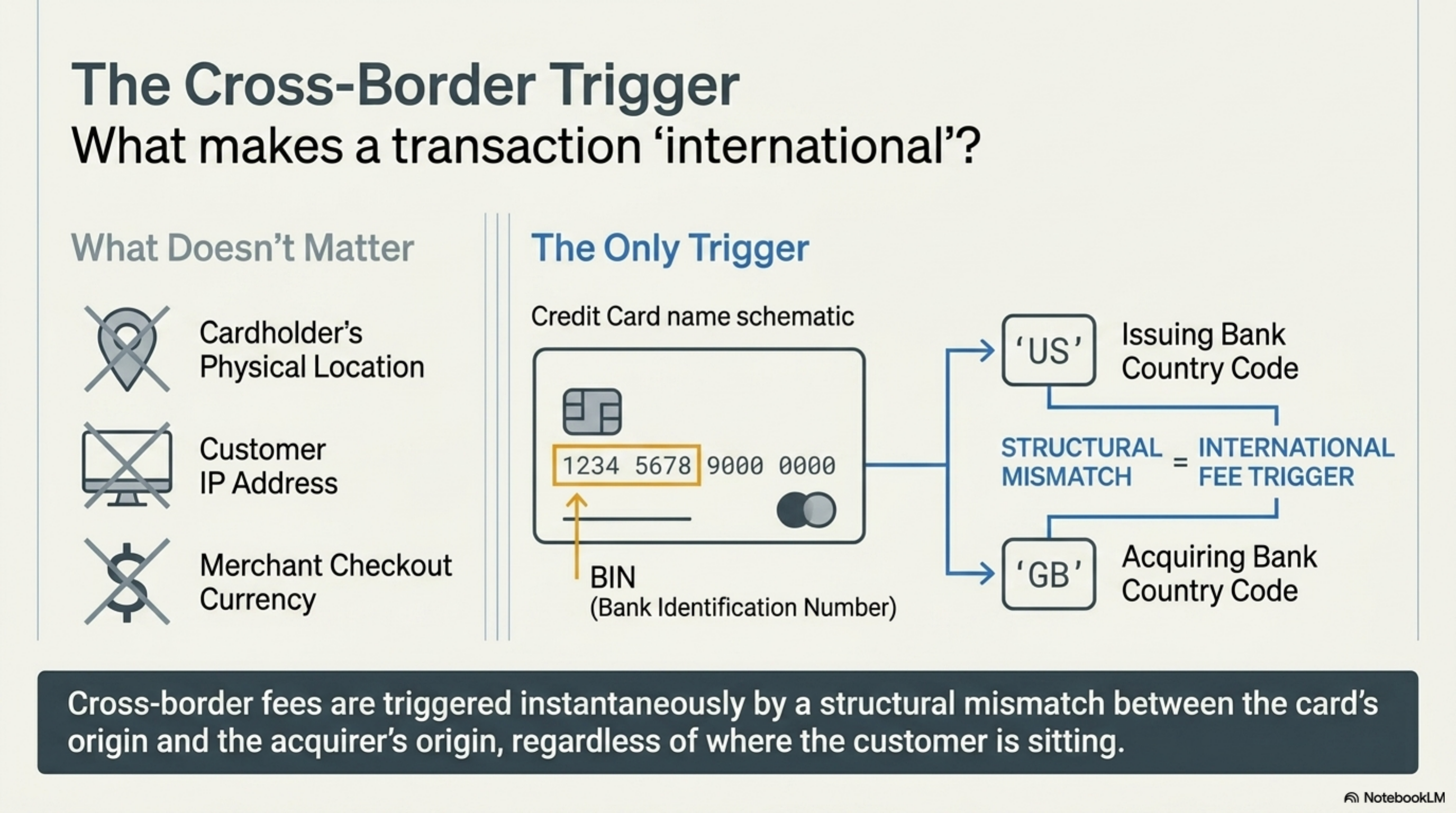
A transaction is flagged cross-border based on the card issuer's country code, which the acquirer reads from the card's BIN (Bank Identification Number). The merchant's currency, the cardholder's physical location, and the IP address are all irrelevant. Only the card issuer's country matters.
International and cross-border interchange is the higher fee that card networks charge when a card issued in one country runs at a merchant acquiring in another country.
How it works under the hood
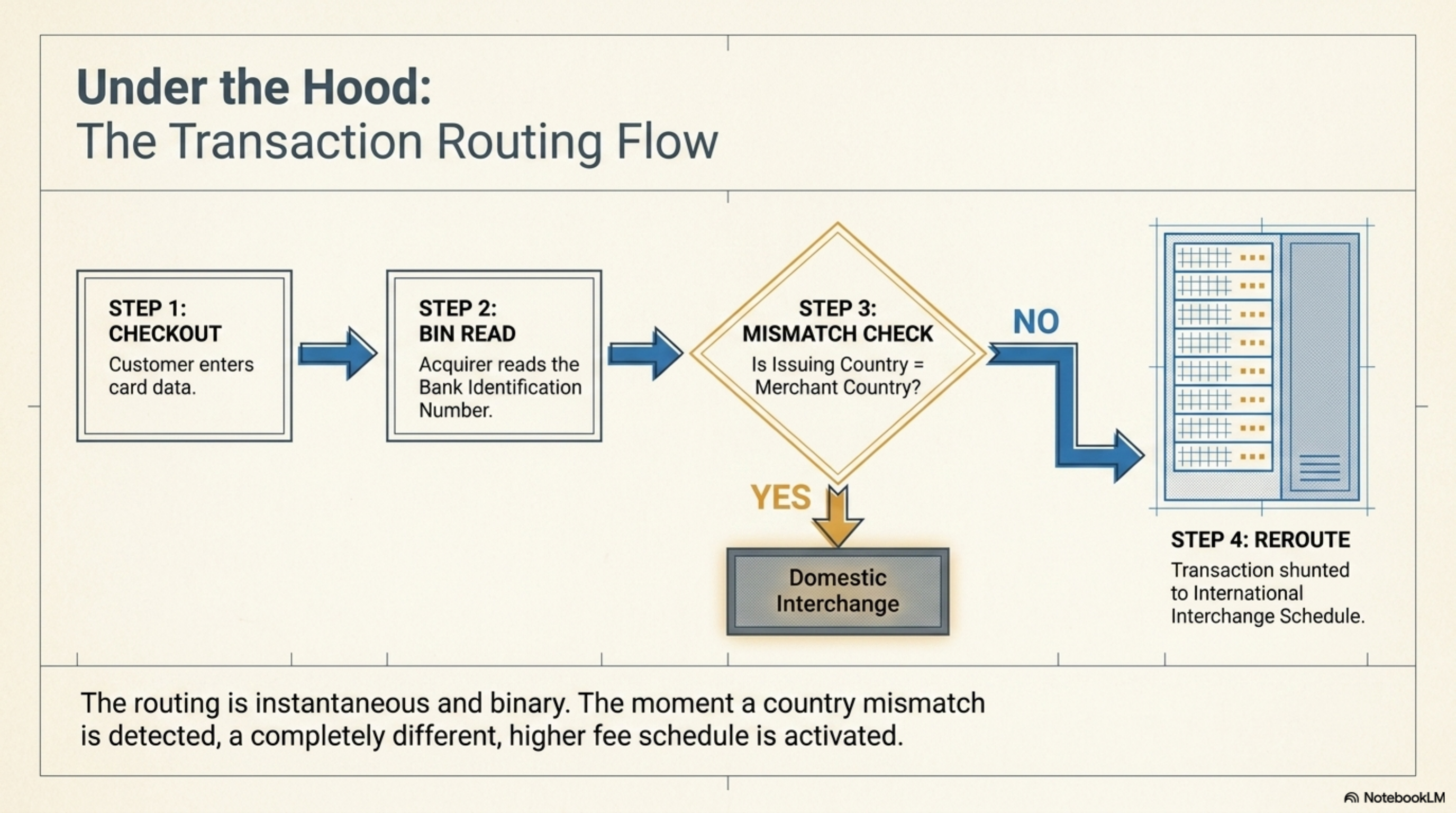
The flow runs the same on every cross-border transaction. The mechanics determine which fees apply and at what rate:
- Customer enters card data at checkout or terminal.
- Acquirer reads the card's BIN, which encodes the issuing country.
- Acquirer compares issuing country to merchant country.
- If countries differ, the transaction routes through the network's international interchange schedule.
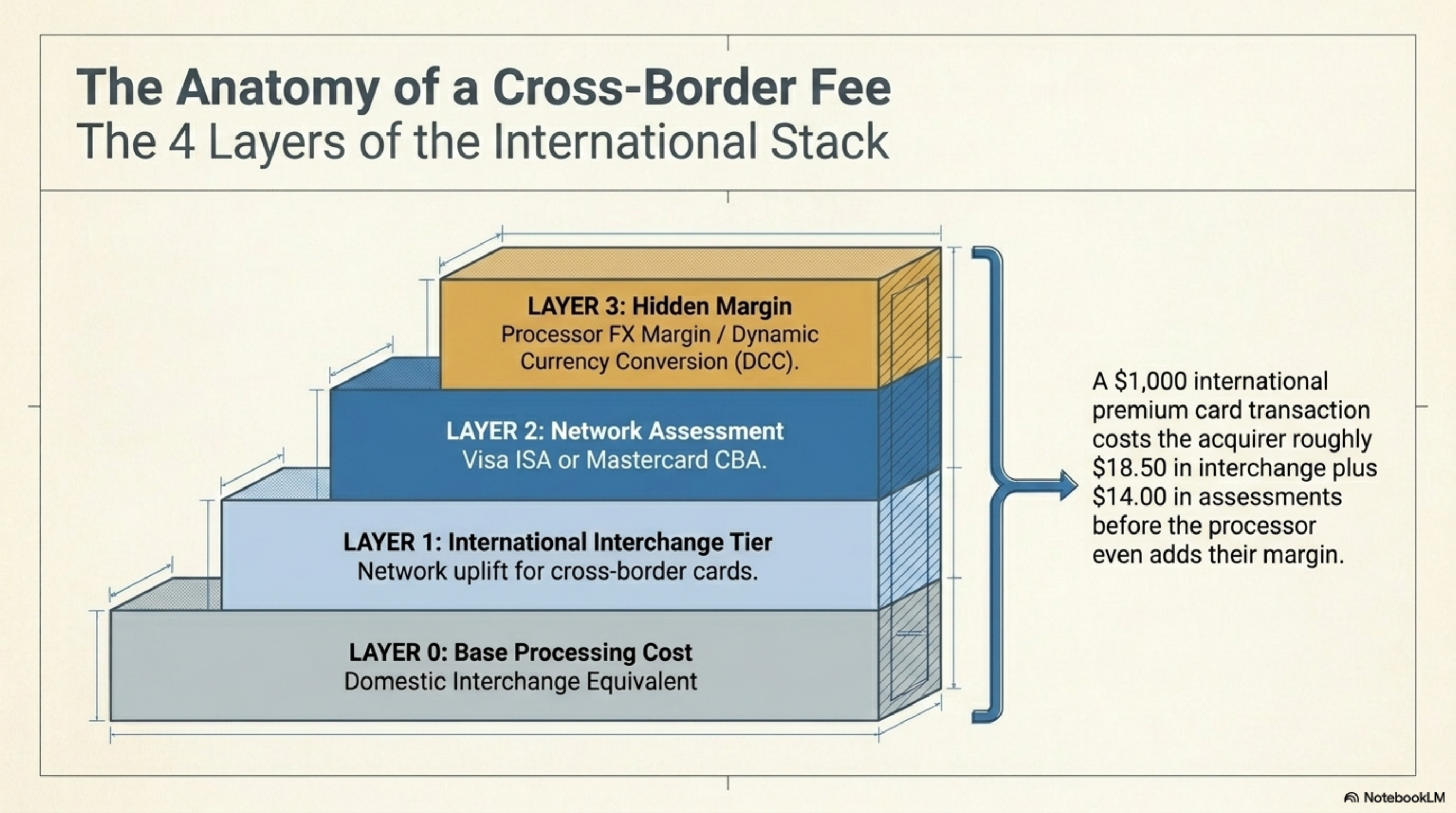
- Network applies the international interchange tier based on card product type (consumer credit, premium, commercial).
- Network adds the cross-border assessment (Visa ISA or Mastercard CBA).
- If the transaction settles in a different currency than the card was issued in, the network applies the higher-tier assessment plus the processor's FX margin.
Visa publishes specific international interchange tiers in its public schedules. Sample rates from the Visa USA Interchange Reimbursement Fees publication:
- International Consumer Standard: 1.10 percent + USD 0.00
- International Consumer Enhanced: 1.60 percent + USD 0.00
- International Consumer Premium: 1.80 percent + USD 0.00
- International Commercial: 2.00 percent + USD 0.00
Mastercard's published international interchange tiers run on a similar curve:
- World Card Consumer International: 1.10 percent + USD 0.00
- World Elite Consumer International: 1.85 percent + USD 0.00
Compare these to domestic equivalents. The domestic Visa Consumer Credit CPS Retail rate is around 1.51 percent + USD 0.10. A premium domestic card runs 1.80 to 2.10 percent. The international tier is not always higher than the domestic premium tier, but it stacks the cross-border assessment on top.
A premium international card with currency conversion costs the acquirer 3.25 percent in interchange and assessments alone, before any processor markup.
A $1,000 international premium card transaction at a U.S. merchant costs the acquirer roughly $18.50 in interchange and $14.00 in ISA, before any processor takes a cent. The merchant on a flat 2.9 percent rate sees only the $29 deduction. The processor pockets the difference between $29 and its actual cost.
If the cardholder is presented with a Dynamic Currency Conversion (DCC) option at checkout, a fourth layer enters. DCC lets the cardholder pay in their home currency at the point of sale. The conversion is done by the merchant's acquirer at a marked-up rate, typically 3 to 7 percent above the wholesale FX rate. The revenue is split between the acquirer and the merchant. If the merchant doesn't see DCC revenue itemized on their statement, the acquirer is keeping all of it.
The country flag on the BIN is the only thing that matters. A Visa card from a U.S.-headquartered multinational issued through its London subsidiary routes at international rates even though the cardholder, the merchant, and the currency are all American.
Where it goes wrong for operators
Six patterns burn operators repeatedly.
First: flat-rate international surcharges that don't track to actual cost. Stripe and Square publish a flat additional 1.5 percent on international cards. The actual Visa ISA on a same-currency transaction is 1.0 percent. The processor is keeping 50 basis points before their base rate even applies. On a transaction settled in a foreign currency, the ISA goes to 1.4 percent and the processor's 1.5 percent still does not cover their cost. They recover it through FX margin instead.
Second: FX conversion done at the processor level. When a merchant accepts EUR or GBP cards but settles in USD, someone converts the currency. Visa publishes its FX rate daily. The processor's effective FX rate is typically 1.5 to 3.0 percent above Visa's published rate. On a $400 international transaction, that is $6 to $12 of pure margin the merchant never sees itemized.
Third: international cards that don't look international. A growing pattern: U.S. multinationals issue corporate cards through European subsidiaries. The card looks like a normal Visa or Mastercard to the cashier, but the BIN routes to a European issuer. The transaction hits the international interchange tier without anyone at the merchant noticing.
A 0.40 percent FX margin on $50,000 of monthly international volume costs the merchant $200 every month. Over a 36-month contract, that is $7,200 the processor keeps without itemizing.
Fourth: contract clauses that exempt international fees from the negotiated rate. The standard processor contract negotiates a discount rate on the domestic portion of volume only. International transactions route through a separate fee schedule that does not get the discount. The merchant signs a 2.4 percent contract and pays 3.9 percent on international cards because the contract reserved that line.
Fifth: surcharge programs that don't account for international cards. A merchant who adds a 3 percent surcharge to recover credit card fees is in violation of Visa's surcharge program rules if the actual international cost of acceptance exceeds the surcharge cap. Visa caps merchant surcharges at the actual cost of acceptance. Charging 3 percent on a card that costs the merchant 3.6 percent in interchange and assessments puts the merchant outside the program rules.
Sixth: chargeback economics on international transactions. International cards carry higher chargeback rates, sometimes 2 to 3 times the domestic rate, and many processors charge an elevated chargeback fee for international disputes, often $25 to $40 per case compared to $15 domestic. Verify your contract's chargeback fee schedule for international transactions before assuming your dispute economics match your domestic baseline.
Worked example with real numbers
The merchant profile: a B2B SaaS company selling enterprise software subscriptions. Monthly card volume of $450,000. Average ticket of $1,800. Twelve percent of volume comes from international customers, primarily UK, Germany, Australia, and Singapore. Current processor: a flat-rate plan at 2.9 percent + USD 0.30 plus an additional 1.5 percent international surcharge.
Domestic volume runs at $396,000 per month. Cost on the flat plan: 2.9 percent applied to that volume plus USD 0.30 across 220 transactions equals $11,484 plus $66, total $11,550 per month.
International volume runs at $54,000 per month, roughly 30 transactions. Cost on the flat plan: 4.4 percent applied to $54,000 plus USD 0.30 across 30 transactions equals $2,376 plus $9, total $2,385 per month.
Total monthly processing on the flat plan: $13,935.
The same merchant on an IC++ contract at 0.20 percent + USD 0.08 markup:
Domestic interchange weighted average for commercial subscription cards: 1.85 percent + USD 0.10. Assessment: 0.13 percent. Processor markup: 0.20 percent + USD 0.08. Total domestic: 2.18 percent + USD 0.18 equals $8,633 plus $40, total $8,673.
International interchange: 1.85 percent + USD 0.00 average across the volume. ISA: 1.0 percent same-currency. Assessment: 0.13 percent. Processor markup: 0.20 percent + USD 0.08. Total international: 3.18 percent + USD 0.08 equals $1,717 plus $2.40, total $1,719.
Total monthly processing on the IC++ contract: $10,392.
Monthly savings: $3,543. Annual savings: $42,516. Over a five-year contract: $212,580.
The international portion alone went from $2,385 to $1,719, a 28 percent reduction on that volume slice. The IC++ structure exposes the actual ISA (1.0 percent) instead of the blended 1.5 percent surcharge, and the merchant sees what the network is keeping separately from what the processor is keeping.
International fees are typically the third-largest line on a SaaS merchant statement after domestic interchange and network assessments. Most operators have never been shown what their international fees look like itemized against the published Mastercard interchange schedule or Visa's published rates.
Now consider the same merchant if half of the international volume settles in foreign currency rather than USD. The Visa ISA on that half goes from 1.0 percent to 1.4 percent. Run the math: 50 percent of $54,000 equals $27,000 hit with the 0.4 percent uplift, which is $108 extra per month, $1,296 per year. The processor's FX margin on that $27,000 at 2 percent above wholesale equals another $540 per month, $6,480 per year. Negotiating both lines into the contract recovers most of that.
Operator playbook
A numbered list of actions to run this week:
- Download your last three statements and pull every transaction over $200. For each, look up the BIN online (free BIN lookup tools exist) and tag non-US issuers. Total the volume to know your international percentage.
- If your international percentage is above 5 percent, the negotiation lever is real. Above 10 percent, an IC++ contract will save significant money even after switching costs.
- Request a quote on IC++ pricing from at least two competing processors. Specify that international fees must be broken out as Visa ISA, Mastercard Cross-Border Assessment, and processor markup separately on every statement.
- Demand the processor pass through the actual Visa ISA (1.0 percent or 1.4 percent) instead of a blended international surcharge. If they refuse, you are paying margin instead of cost.
- Verify the FX conversion rate against Visa's published daily rate. If your statement shows a USD amount for a EUR charge, divide to derive the exchange rate and compare against Visa's published rate for that day. Anything above a 0.50 percent spread is processor margin.
- If you are a B2B merchant accepting recurring international subscriptions, switch the billing currency to the cardholder's local currency where feasible. Charging EUR directly to a EUR card eliminates the FX margin layer and drops the Visa ISA from 1.4 to 1.0 percent.
- Audit any Dynamic Currency Conversion on your terminals or checkout. If your processor offers DCC and the revenue split is not visible on your statement, you are not seeing your share. Turn it off or renegotiate the split.
- Add international interchange optimization to your contract review checklist. The right clause locks the processor to pass-through pricing on international transactions for the contract term, with quarterly statement review rights.
"International volume is usually under 15 percent of a merchant's revenue but generates 30 to 40 percent of the avoidable processing cost. That gap is where the processor's margin lives."