TL;DR
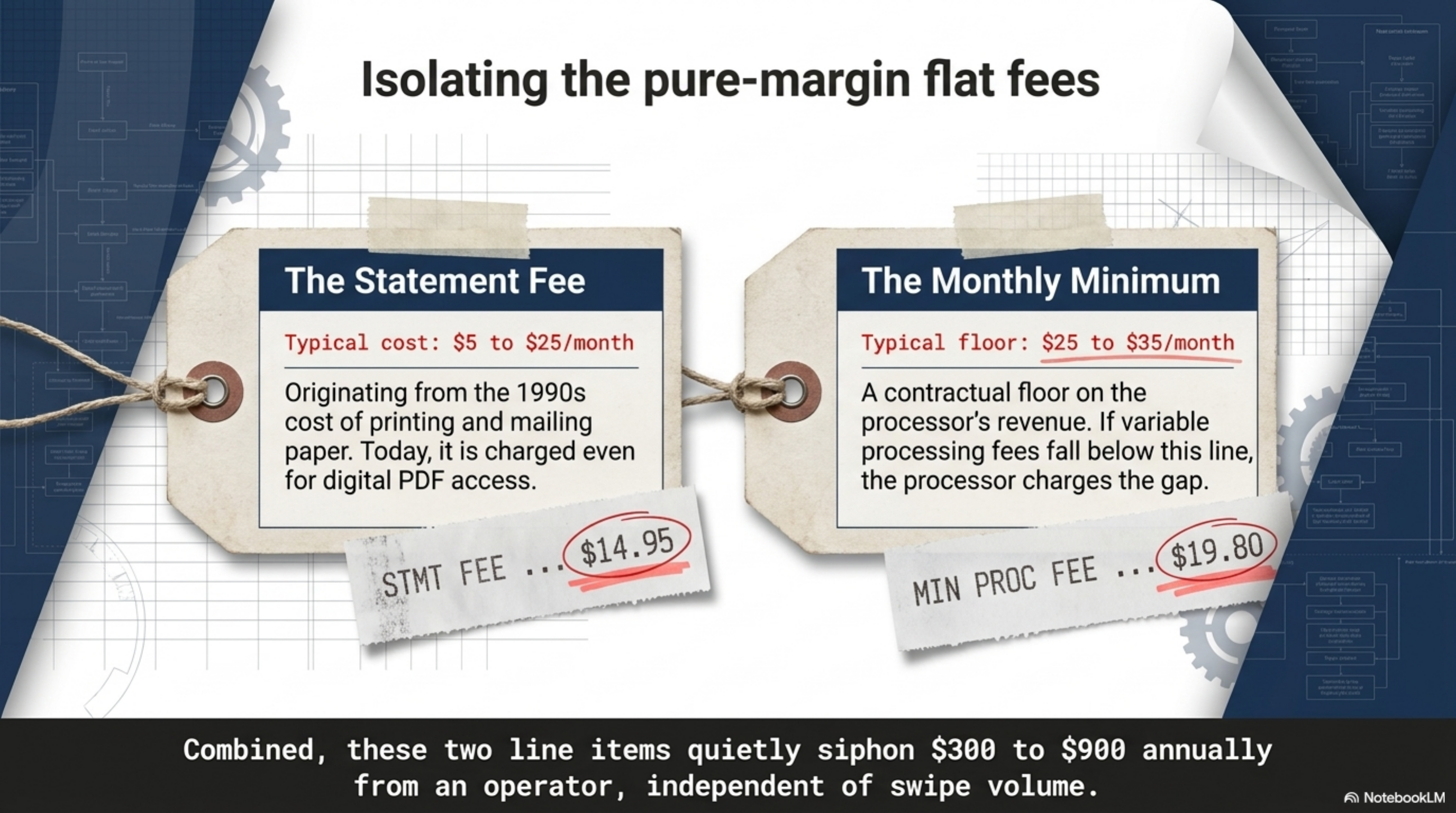
Monthly minimums and statement fees are flat charges from your acquirer, not from Visa or Mastercard. A monthly minimum kicks in when your processing fees fall below a contractual floor, usually $25 to $35. Statement fees run $5 to $25 each month for a paper or PDF statement. Together they can add $300 to $900 a year. Most can be waived in writing, removed by moving to interchange-plus pricing, or dropped during a renewal conversation under the standard 30-day notice clause.
What this actually is
A monthly minimum fee is a floor on the processing revenue your acquirer collects from you each month. If the variable fees on your account (discount rate, transaction fees, authorization fees) total less than the contractual floor, the acquirer charges you the difference. A statement fee is a separate flat monthly charge tied to producing the merchant statement, whether it arrives as paper or as a PDF inside a portal.
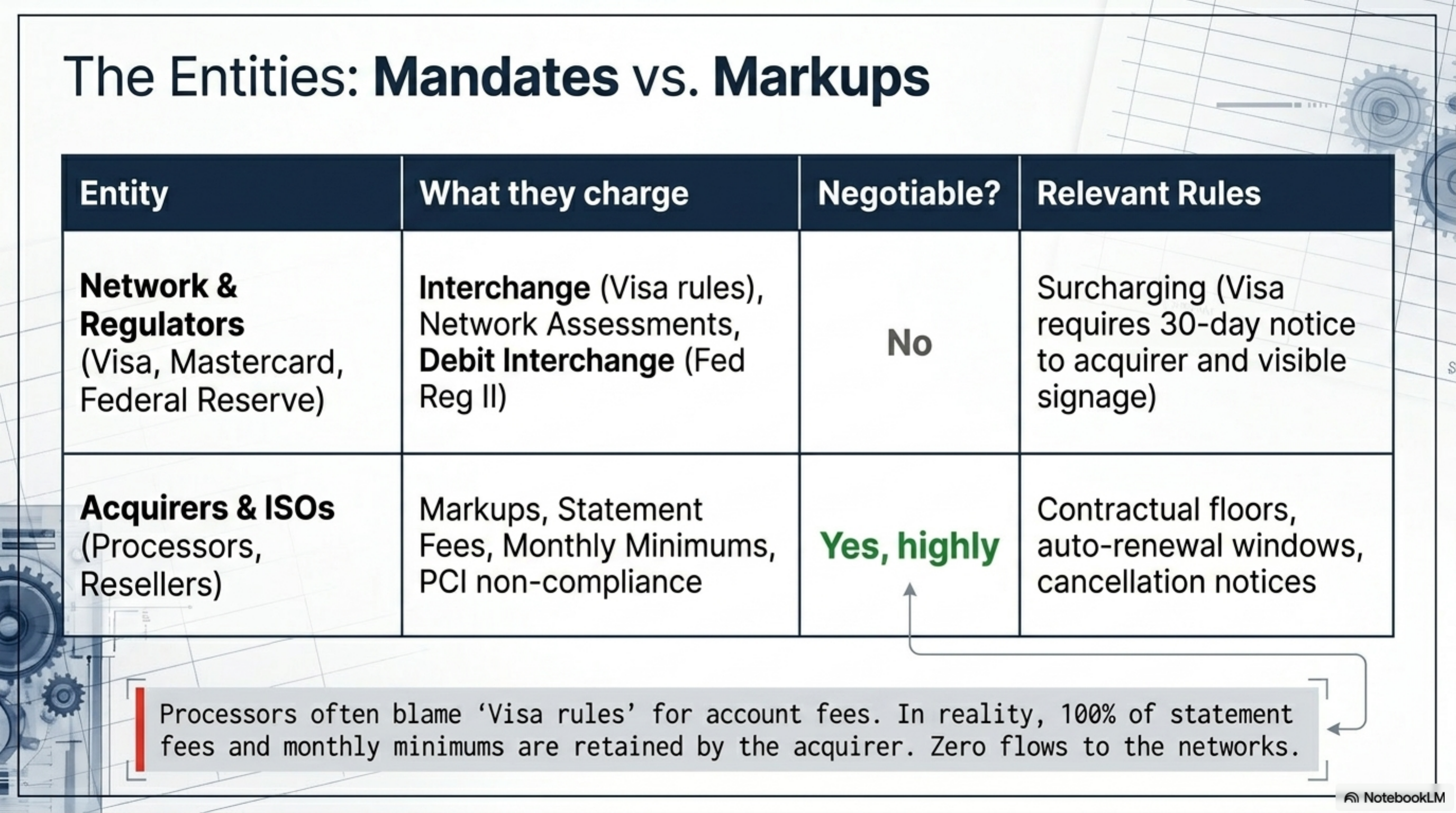
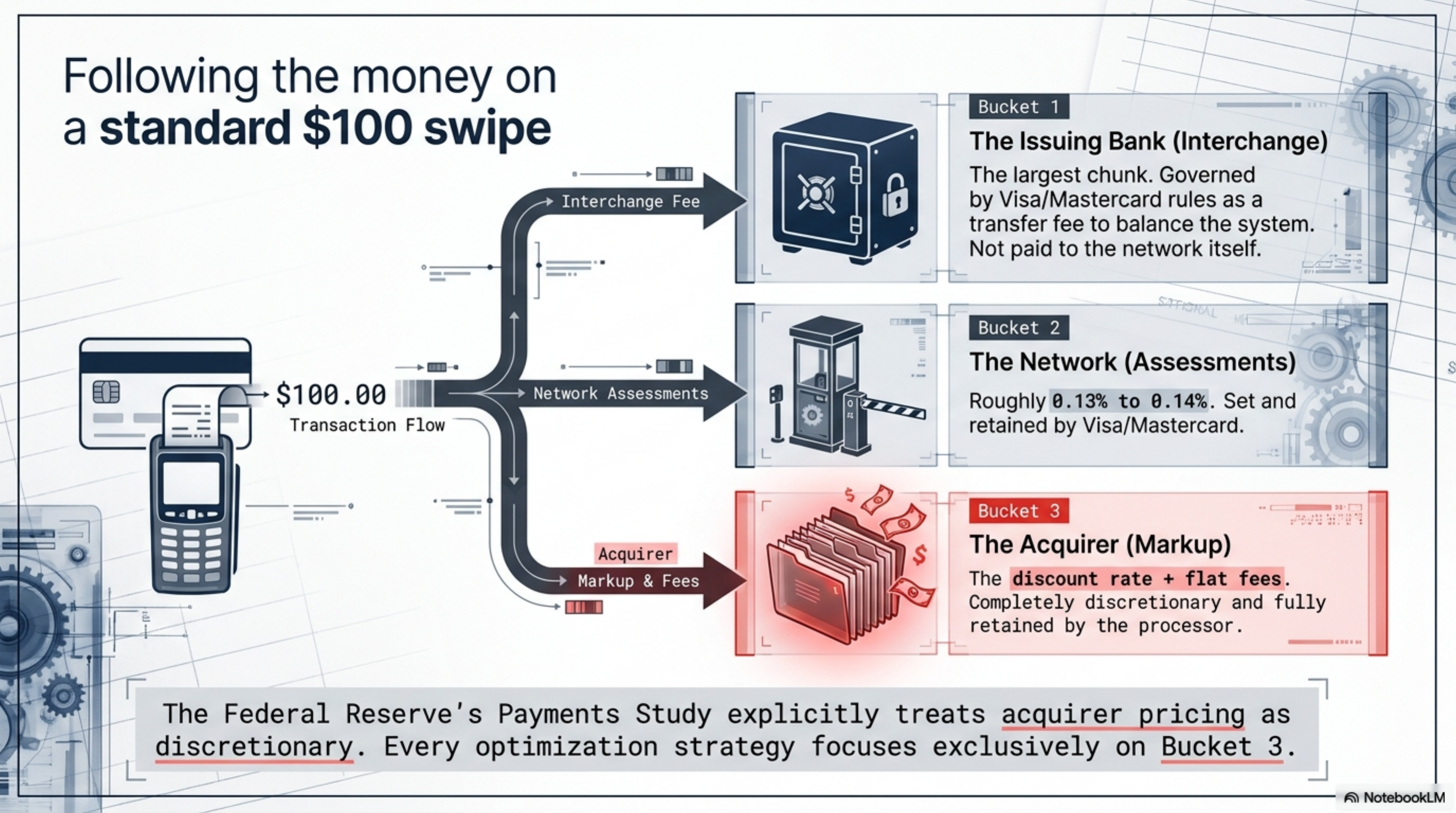
Both charges originate from the merchant services agreement signed with the acquirer or ISO. They are not set by Visa, Mastercard, or any federal regulator. The Federal Reserve's payments studies treat acquirer pricing as discretionary, separate from interchange (paid to the issuing bank) and network assessments (paid to Visa or Mastercard).
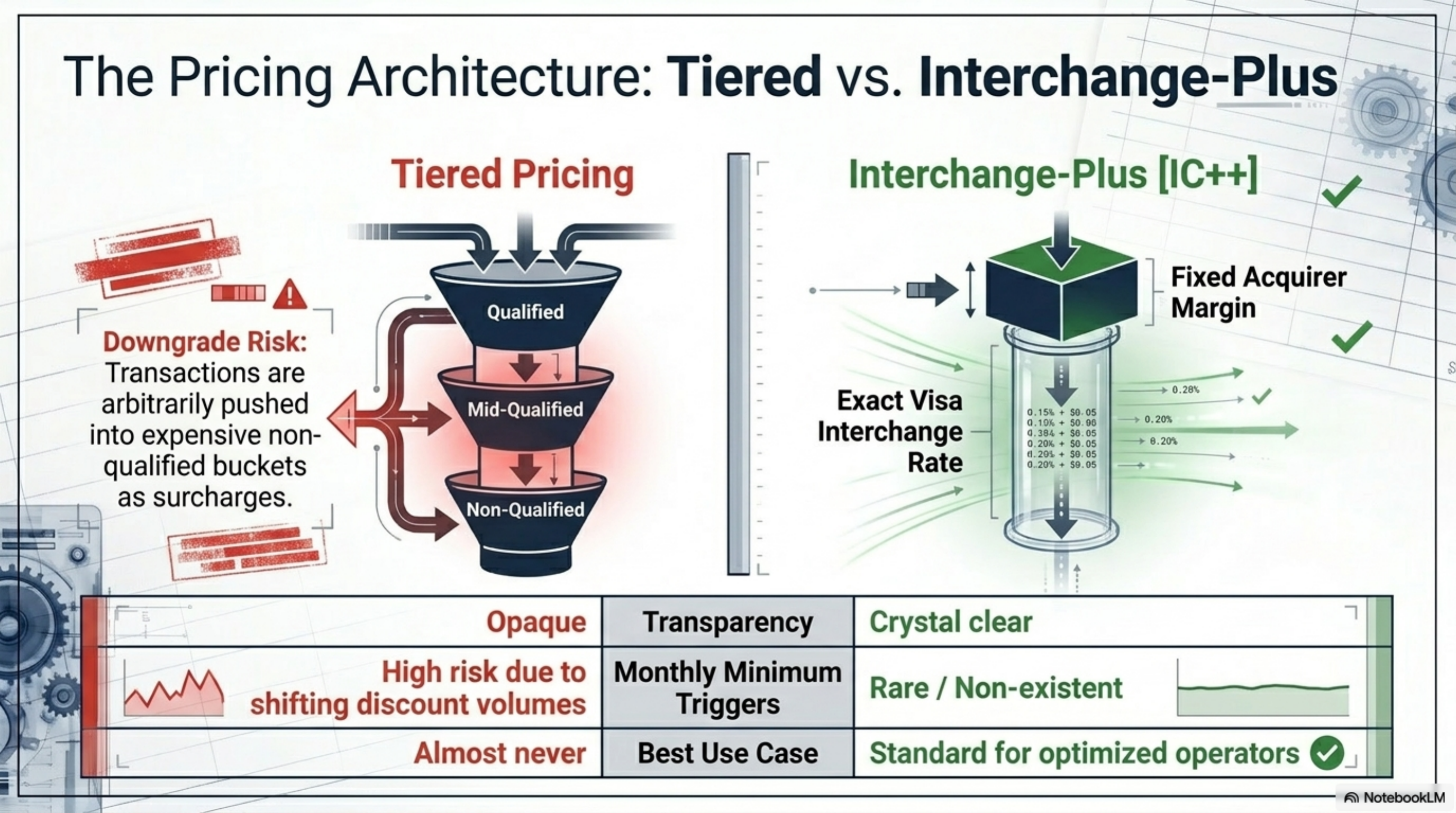
Two contractual variants matter. A total fee minimum floors the sum of all your monthly processing charges. A discount minimum floors only the percentage-rate portion of the bill, called the discount fee. The discount minimum is older and triggers more often, because tiered contracts move transactions between qualified, mid-qualified, and non-qualified buckets, and only the qualified portion counts toward the discount line.
Statement fees originated when acquirers physically printed and mailed statements in the 1990s. Production cost is effectively zero now, but the fee remains in most contracts because the line is buried below the rate page.
A monthly minimum is a contractual floor on your acquirer's monthly revenue from your account; a statement fee is the flat monthly charge for producing your statement.
How it works under the hood
The fees settle out of the same daily deposit account your acquirer already debits. There is no separate invoice. If you do not read the statement, you do not see them.
The flow:
- Each card transaction generates three layers of cost: interchange (set by Visa or Mastercard, paid to the cardholder's issuing bank), network assessments (the network's cut, around 0.13 to 0.14 percent), and the acquirer markup (the discount rate plus any transaction fees defined in your contract). See the published Visa regulations and fees page for the interchange schedule.
- At month end, your acquirer tallies the variable fees billed against your account. This includes the markup portion of every transaction plus any per-transaction fees the acquirer keeps.
- If the acquirer-retained revenue for the month falls below the monthly minimum stated in your contract, the difference is charged as a line item. Look for MIN FEE, MO MIN, MONTHLY DISCOUNT MIN, or MIN PROC FEE.
- The statement fee is added separately, regardless of volume and regardless of whether the minimum triggered. Look for STMT FEE, MONTHLY SERVICE, STATEMENT, or PAPER STATEMENT.
- Both fees settle by ACH debit on the first or second business day of the following month, alongside any chargeback, retrieval, and regulatory fees.
Counterparties matter. The monthly minimum is paid entirely to the acquirer or the ISO that resold you the account. None of it flows to Visa, Mastercard, the issuing bank, or any regulator. Mastercard's interchange documentation explicitly separates network-set rates from acquirer pricing. Statement fees route the same way: 100 percent retained by the acquirer or ISO. There is no upstream cost to recover.
The monthly minimum and statement fee combined are 100 percent acquirer revenue. Not one cent flows to the card networks.
Timing creates a second trap. The fee year often does not align with your accounting year. Some contracts use a January-to-December cycle; others run on the contract anniversary. The annual PCI fee (which is not the same as the monthly PCI noncompliance fee) frequently lands in the same statement cycle as a regulatory compliance fee, making one large January or July bill look like a billing error to operators who are not tracking the cycle.
Where it goes wrong for operators
Five patterns produce most of the damage.
Pattern 1: Discount minimum on a tiered contract. On tiered pricing, downgrades push transactions out of the qualified bucket and into mid- or non-qualified tiers, which are billed as separate surcharges. The discount line on the statement drops because the bank reclassifies your transactions, not because volume dropped. A merchant with $40,000 monthly volume and a $50 discount minimum can still trigger the minimum if non-qualified surcharges land in a separate fee category. The bill: $20 to $40 per month, every month, with no obvious cause.
Pattern 2: Flat-fee stacking outside the rate. The fees-other-than-card-processing section of the statement often shows four or five separate flat charges: statement fee ($10 to $20), PCI noncompliance fee ($19.95 to $29.95), regulatory product fee ($3.95 to $9.95), IRS reporting fee ($2.50 to $5), and account-on-file fee. On a $1,500-volume month, these alone can run 3 percent of revenue before any card cost.
Pattern 3: Seasonal businesses get hit every off-season. Landscapers, ski rentals, holiday retailers, tax preparers, and pool services all face this. A pool service doing $40,000 in summer months and $800 in January will trigger the minimum every winter month. According to long-running industry reporting from the Nilson Report, U.S. merchant pricing concentration remains high enough that off-season fees rarely get audited at the account level.
A pool service paying a $35 monthly minimum and $15 statement fee through five winter months loses $250 per year on slow months alone, $1,250 over a five-year deal, before any rate-side cost.
Pattern 4: Statement fees survive promotional periods. Many ISOs advertise no statement fee for the first 12 months. The contract specifies the fee snaps back at month 13. Most operators do not re-read the contract at that point. The fee appears, the bill does not change much, and the charge runs for the next 48 months.
Pattern 5: Cancellation clauses preserve the fees through the notice window. Standard contracts require 30 to 90 days written notice. If your replacement processor goes live on March 1 but you mailed notice to the existing processor on February 15, you owe the statement and monthly minimum through March, April, and possibly May. Many merchants are billed by two processors simultaneously during a switch.
Worked example with real numbers
A small antique and consignment shop on a tiered processing contract.
- Vertical: independent retail, antique and consignment
- Average monthly volume: $12,400
- Average ticket: $74
- Pricing: 1.79% qualified, 2.49% mid-qualified, 3.29% non-qualified, plus $0.15 per transaction
- Monthly minimum: $35 (discount minimum variant)
- Statement fee: $14.95
- PCI noncompliance fee: $19.95 (the merchant has not completed the SAQ)
- Regulatory product fee: $4.95
- 36-month contract, auto-renewing in 12-month windows
A typical July month produces $338 in card-processing fees plus the four flat charges, totaling $377.85 on $12,400 in volume (a 3.05 percent effective rate).
The shop is seasonal. November to February average $2,800 in volume. The math for an average January:
- Card volume: $2,800, 38 transactions at $74 average ticket
- Discount fees, 60% qualified, 30% mid, 10% non-qualified: $1,680 at 1.79% = $30.07; $840 at 2.49% = $20.92; $280 at 3.29% = $9.21. Total discount: $60.20
- Transaction fees: 38 at $0.15 = $5.70
- Discount plus transaction: $65.90
Since $65.90 exceeds the $35 discount minimum, no minimum fee triggers this month. But in the worst month of the year, a December closure week leaves $600 in volume. Discount fees drop to roughly $14, transaction fees to $1.20, and the $35 minimum triggers a $19.80 surcharge.
December for this shop: $14 discount plus $1.20 transactions plus $19.80 minimum plus $14.95 statement plus $19.95 PCI plus $4.95 regulatory equals $74.85 on $600 in volume. Effective cost: 12.5 percent. Annualized across all 12 months, the shop pays $470 in statement, PCI, and regulatory fees plus roughly $90 in triggered monthly minimum charges, for $560 in pure flat-fee cost.
An interchange-plus quote from an independent ISO for the same shop typically removes the monthly minimum, the statement fee, and the regulatory product fee. Annual savings of $400 to $600 on flat fees alone, before the rate-side improvement, are common.
Operator playbook
Five working days of attention is usually enough to remove every flat fee on a merchant statement.
- Pull the last 12 monthly statements. If the portal does not show them, email your processor; they are required to provide them on request.
- List every flat fee and its monthly amount. Look for: statement fee, monthly minimum, annual PCI fee, monthly PCI noncompliance fee, regulatory product fee, IRS reporting fee, batch fee, gateway fee, and account-on-file fee. Total the flat fees and divide by your lowest-volume month. That number is your effective-rate floor: the percentage you cannot get below regardless of card mix.
- Email the processor in writing requesting the statement fee and monthly minimum be waived. Use this wording: "Please confirm waiver of the monthly minimum and statement fee effective the next billing cycle." Most ISOs waive both for any account doing more than $10,000 monthly when asked directly.
- Complete the PCI Self-Assessment Questionnaire (SAQ) through the processor's compliance portal. Most merchants pay the $19.95 monthly noncompliance fee for years simply because no one explained that the SAQ takes 30 minutes. The annual PCI fee is separate and typically not waivable.
- Pull the cancellation clause from your contract. Note the notice period (30, 60, or 90 days), the auto-renewal window, and any early termination fee. Calendar the next no-penalty cancellation window.
- Request three interchange-plus quotes from independent ISOs. IC++ contracts almost never carry monthly minimums because the acquirer earns a known per-transaction margin, so a floor is unnecessary. Bring the quotes into the next renewal conversation as a negotiating point.
- If the processor refuses to waive the fees, send 30-day written notice and complete the switch. The fees waived over a 36-month replacement contract typically pay for two days of staff time invested in the switch.
- After the switch, set a calendar reminder for month 13 and month 25. Promotional fee waivers expire silently, and the only defense is a recurring review of the fee block on the statement.
"Most merchants on tiered contracts pay $400 to $900 a year in fees that have nothing to do with card processing. The line items are negotiable, but only if you ask in writing."