TL;DR
Processor reserves are a working capital tax, not a fixed cost of accepting cards. The default terms in a merchant agreement (5 to 10 percent rolling, 180 day release, unilateral adjustment rights) are an opening offer the underwriter expects you to push back on. Operators who present 12 months of clean chargeback data, audited financials, and a competing term sheet usually cut the held balance by 30 to 50 percent within a quarter.
What this actually is
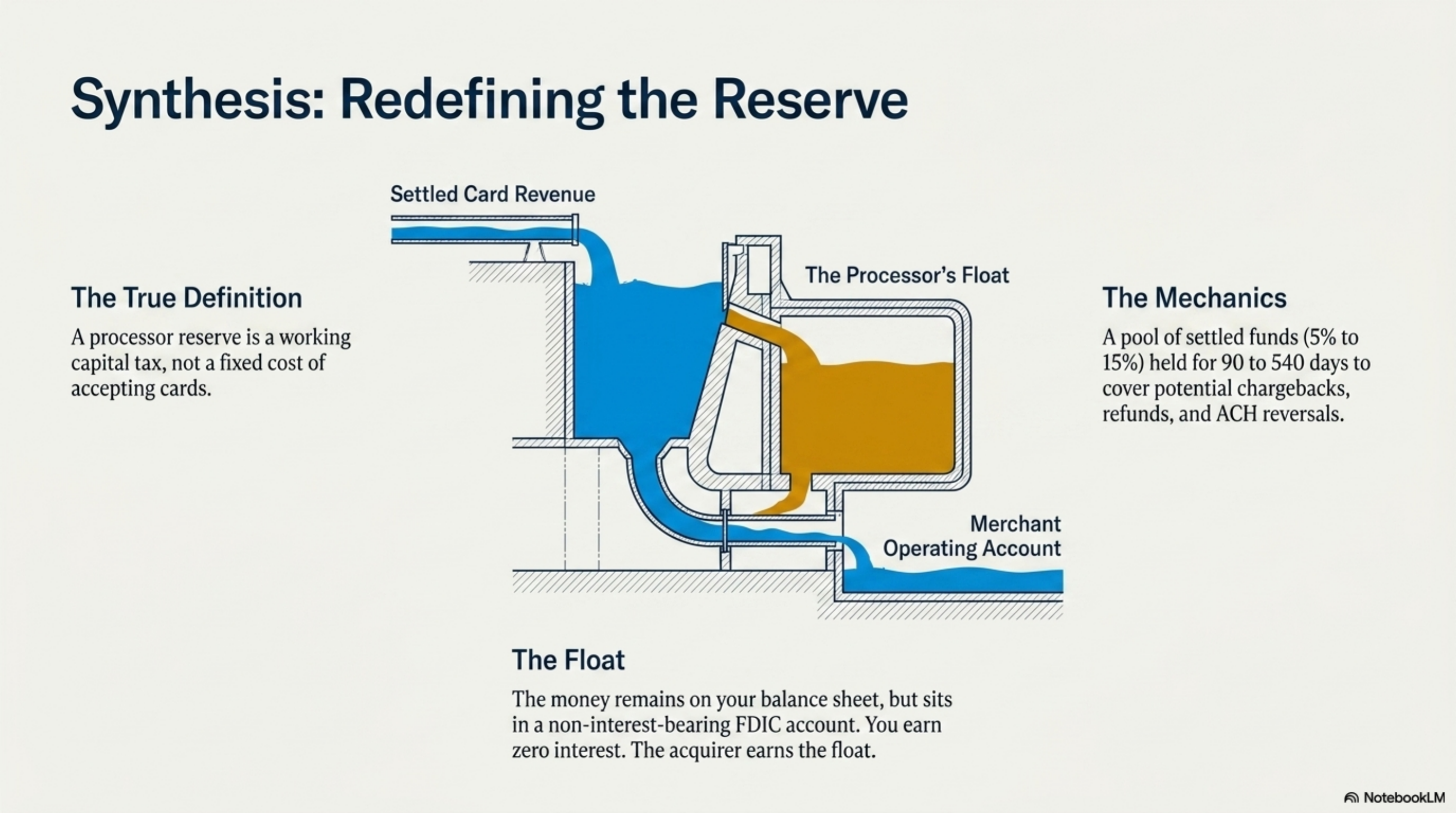
A merchant reserve is a pool of your settled funds that the acquirer holds back to cover potential chargebacks, refunds, fraud losses, and ACH reversals. It is not a fee. The money still belongs to you on your balance sheet, but it sits in a non-interest-bearing account controlled by the processor. You cannot draw on it, pledge it, or move it.
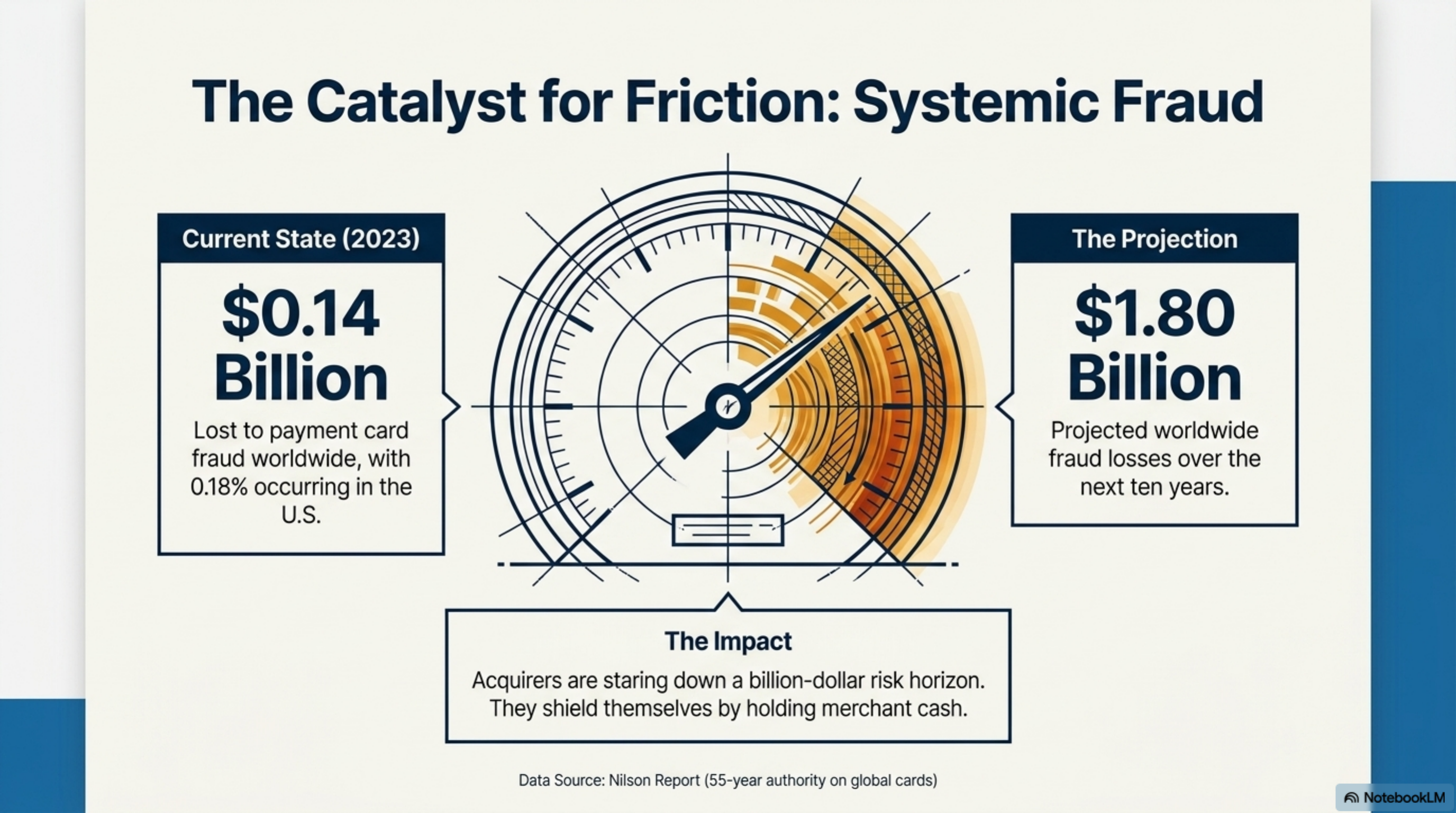
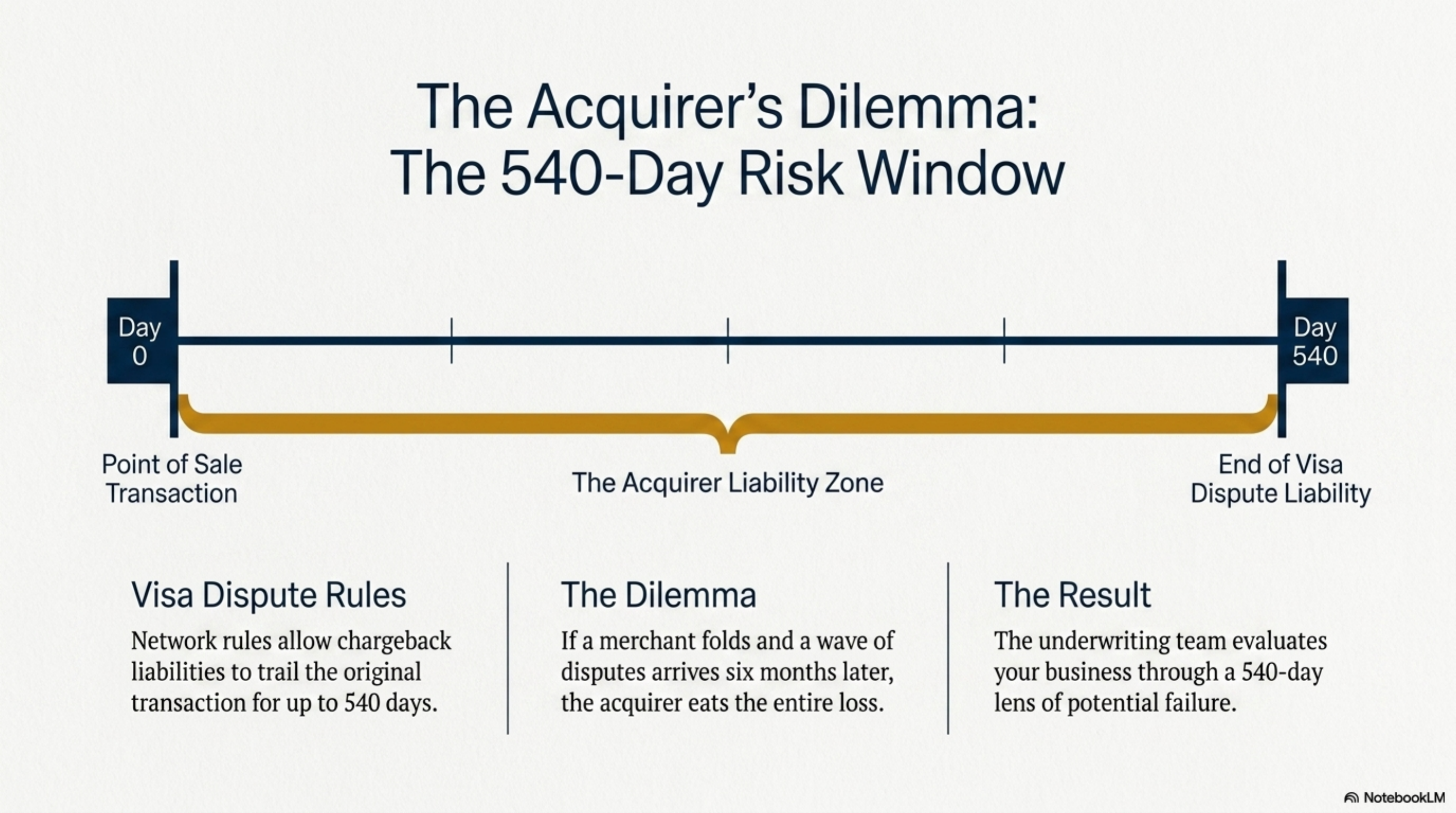
Reserves exist because the acquirer is on the hook for chargebacks for up to 540 days under Visa's dispute rules and similar windows under Mastercard's chargeback framework. If a merchant goes out of business and a wave of disputes arrives 6 months later, the acquirer eats the loss unless reserve funds are available.
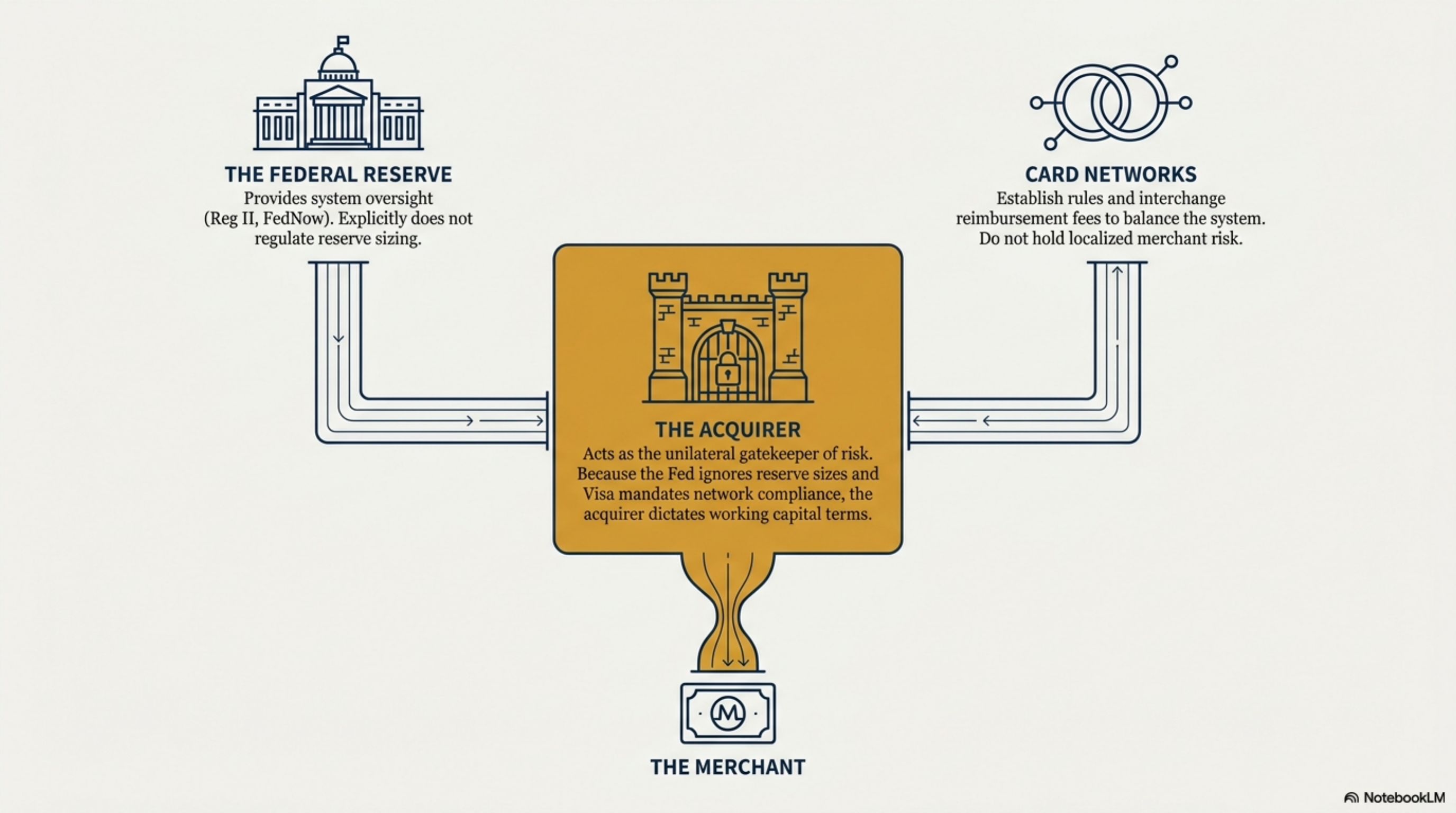
The Federal Reserve's payments system oversight does not regulate reserve sizing. That decision is left entirely to the acquirer's risk team and is governed by your merchant agreement, not card brand rules. This is why two card-not-present merchants in the same vertical, with identical processing volume, can end up with reserves that differ by a factor of three.
A processor reserve is a portion of settled card revenue (typically 5 to 15 percent) that an acquirer withholds for 90 to 540 days to cover future chargebacks, refunds, and fraud losses.
How it works under the hood
There are three reserve structures in common use, and the difference between them is the difference between a small drag on cash flow and a multi-month working capital problem.
- Rolling reserve. The processor withholds a fixed percentage of every settlement batch and releases the funds after a defined holdback period. A 10 percent rolling reserve with a 180 day release means that on day 181, you start receiving back the funds withheld on day 1. Steady state, the processor is sitting on roughly 60 days of your gross volume at all times (10 percent times 180 days divided by 30).
- Upfront reserve (capped). The processor withholds 100 percent of settlements until a target dollar amount is hit, then releases everything above the cap. A $50,000 upfront reserve on a merchant doing $200,000 monthly is fully funded in roughly 8 days, then settlements run normally. The held balance does not grow with revenue.
- Minimum reserve plus rolling. A hybrid: the processor builds an upfront balance to a floor, then continues to take a smaller rolling percentage on top. Common in high-risk verticals (travel, supplements, subscription) where the underwriter wants both a buffer and ongoing protection.
Funds typically sit in a Federal Deposit Insurance Corporation (FDIC) insured deposit account at the acquirer's sponsor bank, segregated from operating accounts but not from the acquirer's other merchants. You earn no interest. The acquirer earns the float, which is one reason reserve terms rarely get volunteered for renegotiation.
Release events are governed by the contract. Standard language allows the processor to extend the release window if chargeback ratios spike, if the merchant terminates, or if the underwriter's risk model flags the account. Termination is the worst case: most agreements allow the acquirer to hold reserves for 270 days past the close date, sometimes longer.
Where it goes wrong for operators
The reserve is rarely the headline term in a processor pitch. It surfaces in the merchant agreement, often in a schedule attached to the main document, and the operator is usually focused on the discount rate. Four patterns show up repeatedly on statements and contracts.
Pattern 1: The rolling reserve that compounds with growth. A 10 percent rolling reserve looks small at $100,000 monthly volume ($60,000 held). At $500,000 monthly, the same percentage holds $300,000 off the balance sheet. Operators who scale fast and never revisit the reserve term find that growth itself is funding the processor's risk position. At a 10 percent annualized cost of capital, $300,000 in held funds costs $30,000 per year in foregone working capital.
Pattern 2: The unilateral adjustment clause. Most agreements include language allowing the acquirer to raise the reserve percentage "at any time, in its sole discretion, upon 30 days written notice." In practice this triggers when chargeback ratios cross 0.65 percent (the Visa monitoring threshold under VAMP) or when the underwriter sees a vertical-wide loss event. Operators who assumed their 5 percent reserve was fixed have woken up to 15 percent reserves with a Tuesday email.
Pattern 3: The release window that resets. Some contracts state the release window is 180 days from the date of the original transaction. Others state it is 180 days from the last transaction in the account. The second version means that if you keep processing, the oldest reserves never release. A merchant doing continuous volume sees the held balance grow to a steady state and then never shrinks until the account closes.
Pattern 4: The post-termination hold. Standard termination language gives the acquirer 270 days to release final reserve funds. For a merchant doing $1 million monthly with a 10 percent reserve, that is potentially $600,000 frozen for 9 months after the relationship ends. Operators changing processors mid-year often discover they need a bridge loan to cover payroll while old reserves unwind.
Most reserve clauses give the processor unilateral authority to raise the percentage with 30 days notice. The merchant has no equivalent right to lower it.
Worked example with real numbers
Consider an operator profile: a direct-to-consumer skincare brand, card-not-present, 14 months old, processing $850,000 monthly through a high-risk-tolerant acquirer. Average ticket $68. Chargeback ratio for the trailing 6 months: 0.41 percent. Current pricing: 3.25 percent plus $0.25 on a tiered structure. Reserve term in the original agreement: 10 percent rolling, 180 day release, unilateral adjustment with 30 days notice.
At steady state, the held reserve balance is approximately $510,000 (10 percent of $850,000 times 6 months). The merchant has been processing for 14 months, so the reserve hit steady state around month 7 and has been growing only with topline revenue since.
The operator pulls a competing term sheet from a second acquirer offering 7 percent rolling reserve with a 120 day release, citing the trailing 6 months of clean chargeback data. The math on the new term: 7 percent of $850,000 times 4 months equals roughly $238,000 at steady state. That is a $272,000 reduction in held funds.
The operator presents Term B to the incumbent and asks for a match. The incumbent's risk team counter-offers: 8 percent rolling, 150 day release, with a written commitment to a tiered step-down (down to 5 percent after 12 more months of sub-0.50 percent chargeback ratios). The operator accepts because the step-down language is in writing.
Twelve months later, the reserve drops to 5 percent / 90 day release: roughly $128,000 held against $850,000 monthly volume. Total working capital recovered versus the original term: approximately $382,000.
None of this required leaving the processor. It required pulling a competing term sheet, presenting clean chargeback data, and asking for the step-down language in writing.
Operator playbook
Reserve negotiation is a discrete event, not an ongoing process. Set aside one week, do the work in order, and have a target term in writing before you call the rep.
- Pull the current reserve balance from your statement. Look for line items labeled "Reserve," "Holdback," "Risk Reserve," or "Settlement Reserve." Get a 12 month history. Calculate the steady state balance and the implied cost at your blended cost of capital.
- Read the reserve clause and the termination clause together. Note the exact percentage, release window definition (transaction date vs last activity date), adjustment rights, and post-termination hold period. Flag any "sole discretion" language.
- Compile 12 months of chargeback data. Pull the trailing chargeback ratio (disputes divided by transactions, and disputes divided by sales volume) by month. If the ratio is under 0.65 percent and trending flat or down, you have a negotiation lever. If it is above, fix that first.
- Get a competing term sheet. Approach two acquirers in your vertical and request reserve terms specifically. Do not negotiate rate at this stage. Have them propose reserve percentage, release window, and adjustment language in writing.
- Ask for a step-down schedule, not just a one-time cut. The most defensible ask is a written commitment that the reserve drops by 1 to 2 percentage points every 6 months conditional on chargeback performance. Underwriters approve step-downs more readily than headline reductions because the risk model still works.
- Push to convert rolling to capped upfront where the chargeback profile allows. A capped upfront reserve does not grow with revenue. For a merchant scaling 30 percent year over year, this is the single largest working capital lever in the contract.
- Get the post-termination hold in writing. The default 270 day hold is negotiable down to 90 to 180 days when chargeback history is clean. This matters most at the moment you switch processors, which is exactly when you have no leverage if you did not negotiate it upfront.
- Re-negotiate annually. Set a calendar reminder. The risk profile that justified your reserve at month 6 does not justify the same reserve at month 18. Acquirers will not volunteer a reduction; they will grant one when asked with data.