TL;DR
Most U.S. debit transactions can route over more than one network. Federal Reserve Regulation II requires every debit card to carry at least two unaffiliated networks, and the merchant picks. For card-present transactions running $15 to $50 average tickets, the routing choice swings debit cost by 0.15 to 0.35 percent of debit volume. The first move: pull last month's statement, find the network breakdown, and request least-cost routing from the processor in writing.
What this actually is
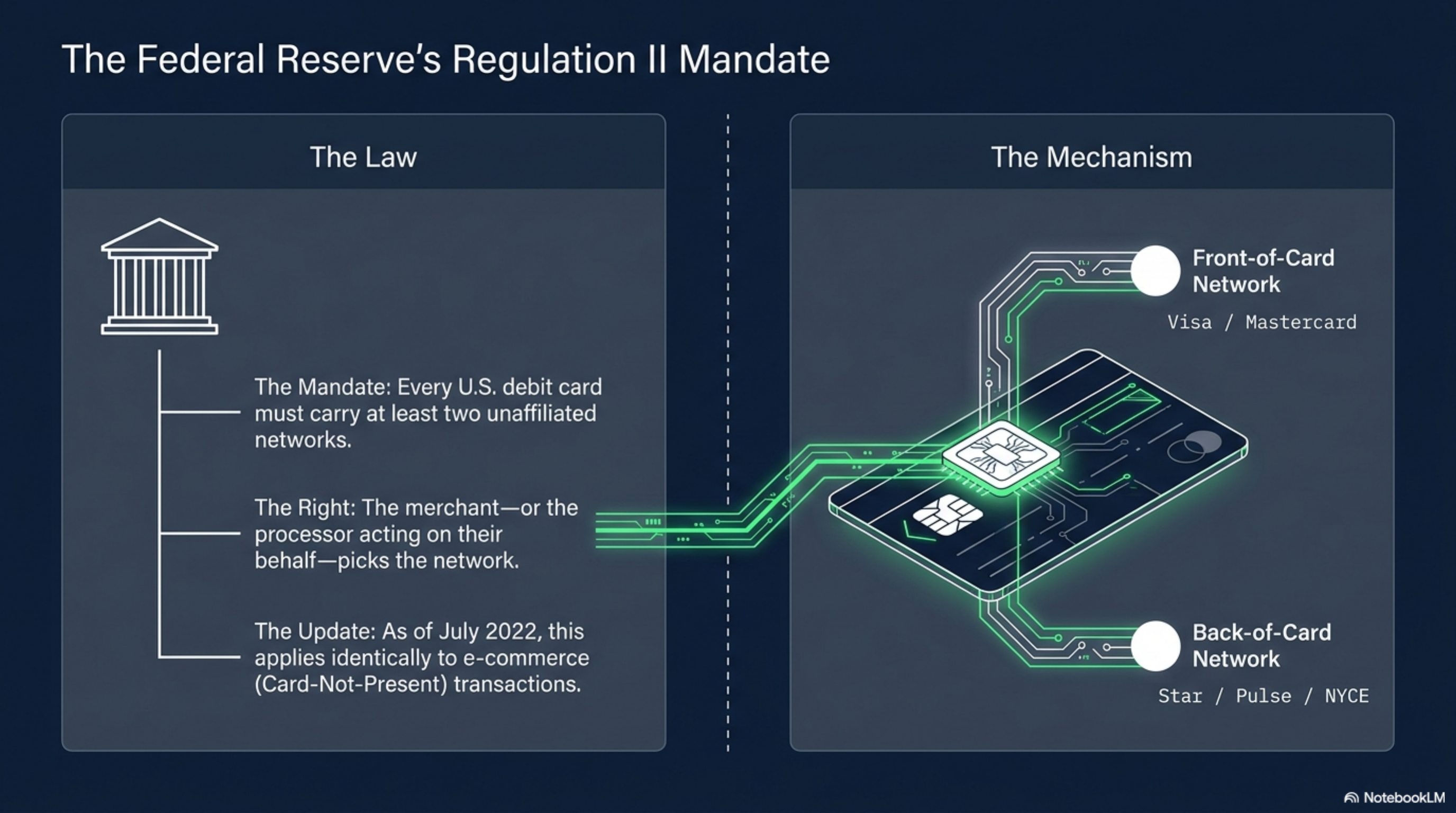
PIN debit routing is the merchant's right to choose which debit network settles a debit card transaction. Federal Reserve Regulation II, the implementing rule of the Durbin Amendment, requires every U.S. debit card to carry at least two unaffiliated networks. The merchant, or the merchant's processor acting on the merchant's behalf, picks which network handles authorization and settlement on each transaction.
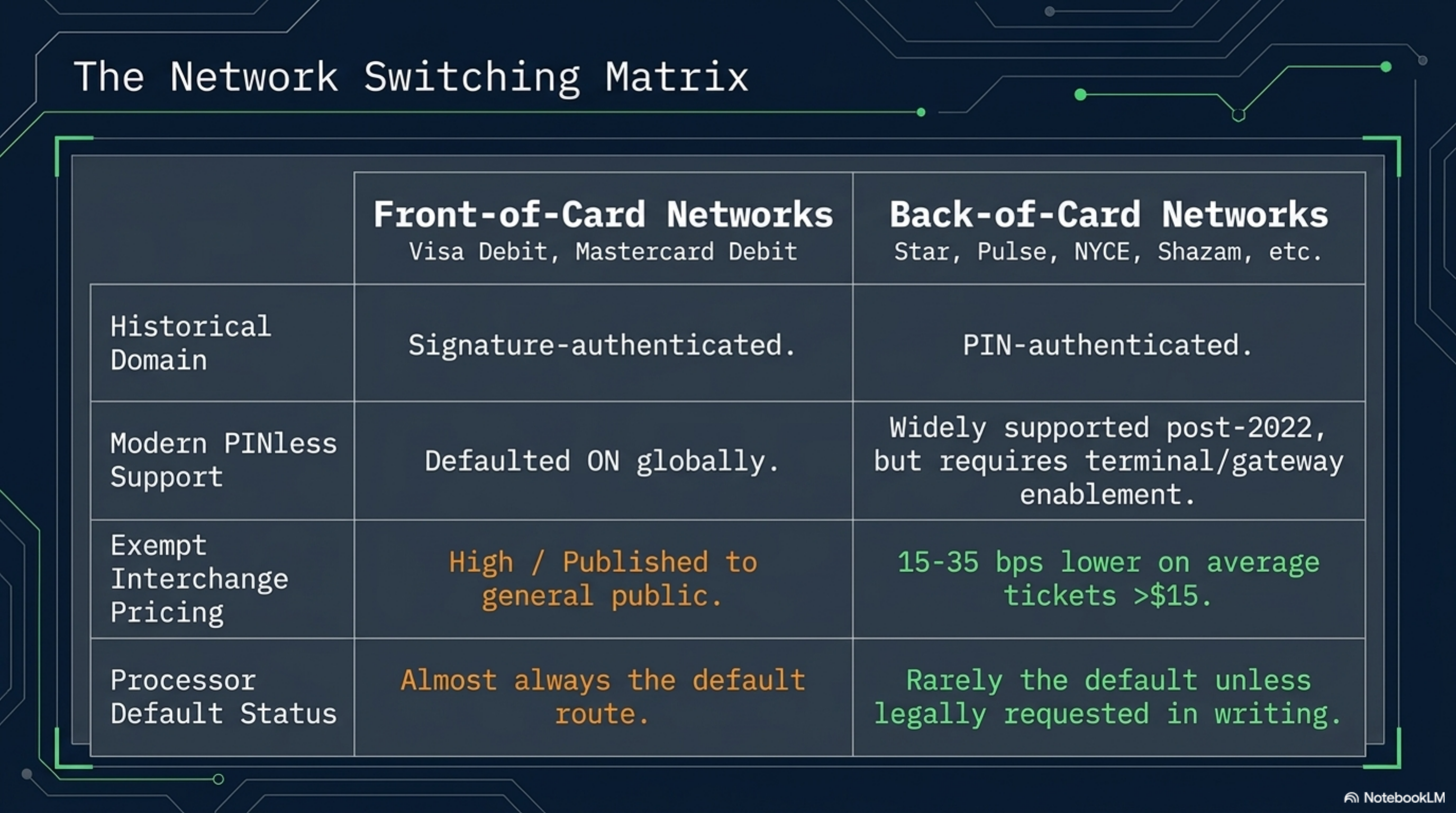
The networks split into two groups. Front-of-card networks (Visa Debit and Mastercard Debit) historically handled signature-authenticated debit. Back-of-card networks (Star, Pulse, NYCE, Maestro, Interlink, Accel, Shazam, Jeanie, ATH, AFFN, CU24) historically handled PIN-authenticated debit. The Federal Reserve's July 2022 clarification extended the dual-network requirement to card-not-present transactions, with issuer compliance required by July 2023. E-commerce merchants now hold the same routing rights as in-person retailers.
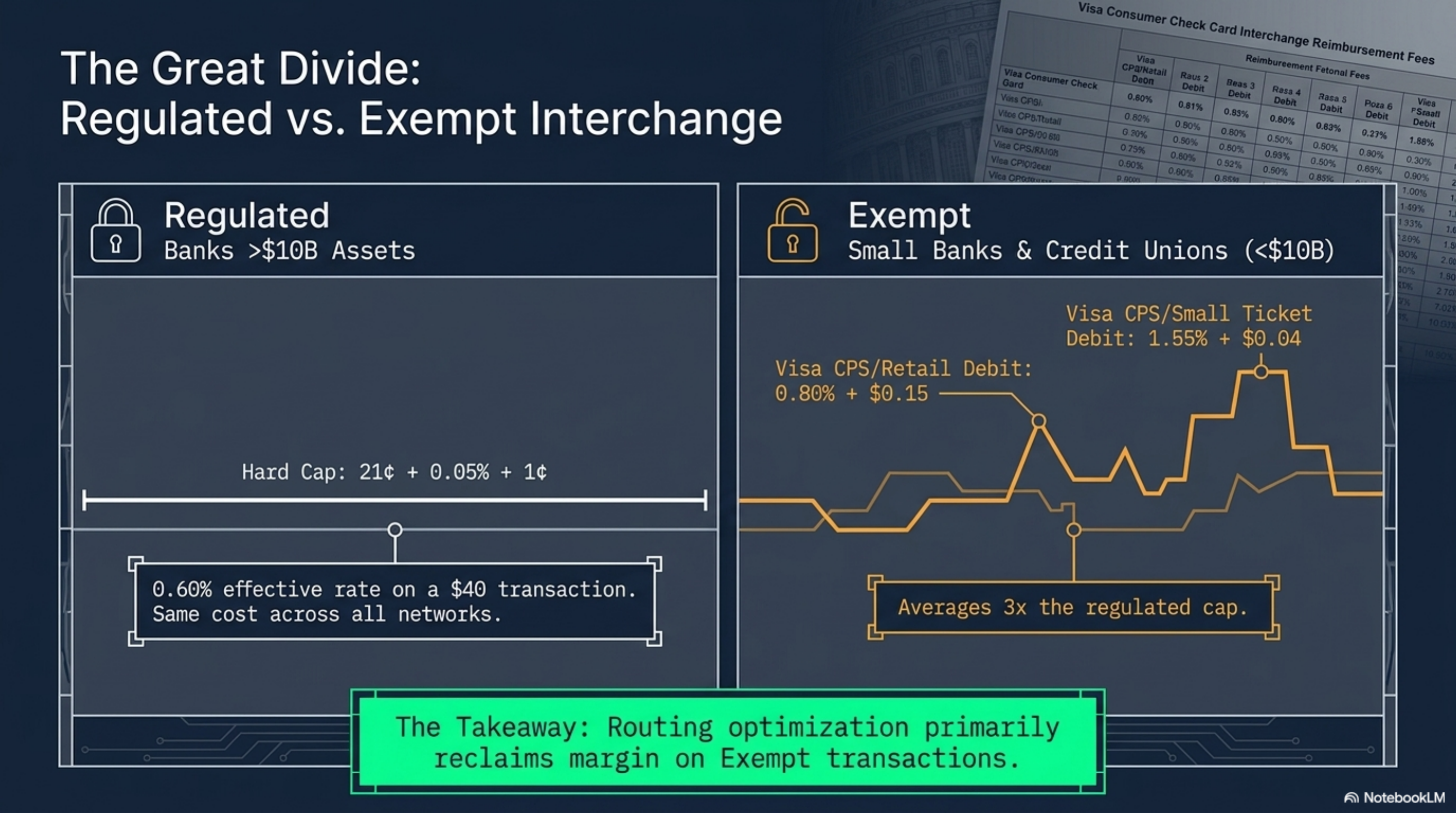
Regulated debit cards, issued by banks with $10 billion or more in U.S. assets, are capped under Regulation II at 21 cents plus 0.05 percent of the transaction plus a 1 cent fraud-prevention adjustment. Exempt cards, issued by smaller institutions and credit unions, are not capped and route at the network's published interchange. On small tickets, that exempt interchange typically falls in a 1.15 to 1.75 percent range depending on category and network, per Visa's published schedule.
The dollar magnitude is significant. Federal Reserve Regulation II data collections show U.S. debit card volume in the trillions of dollars annually, with the average exempt interchange running roughly three times the regulated cap on a per-transaction basis. The gap between the two is the routing prize.
PIN debit routing is the merchant's legal right under Regulation II to choose which debit network handles authorization and settlement on each U.S. debit card transaction.
How it works under the hood
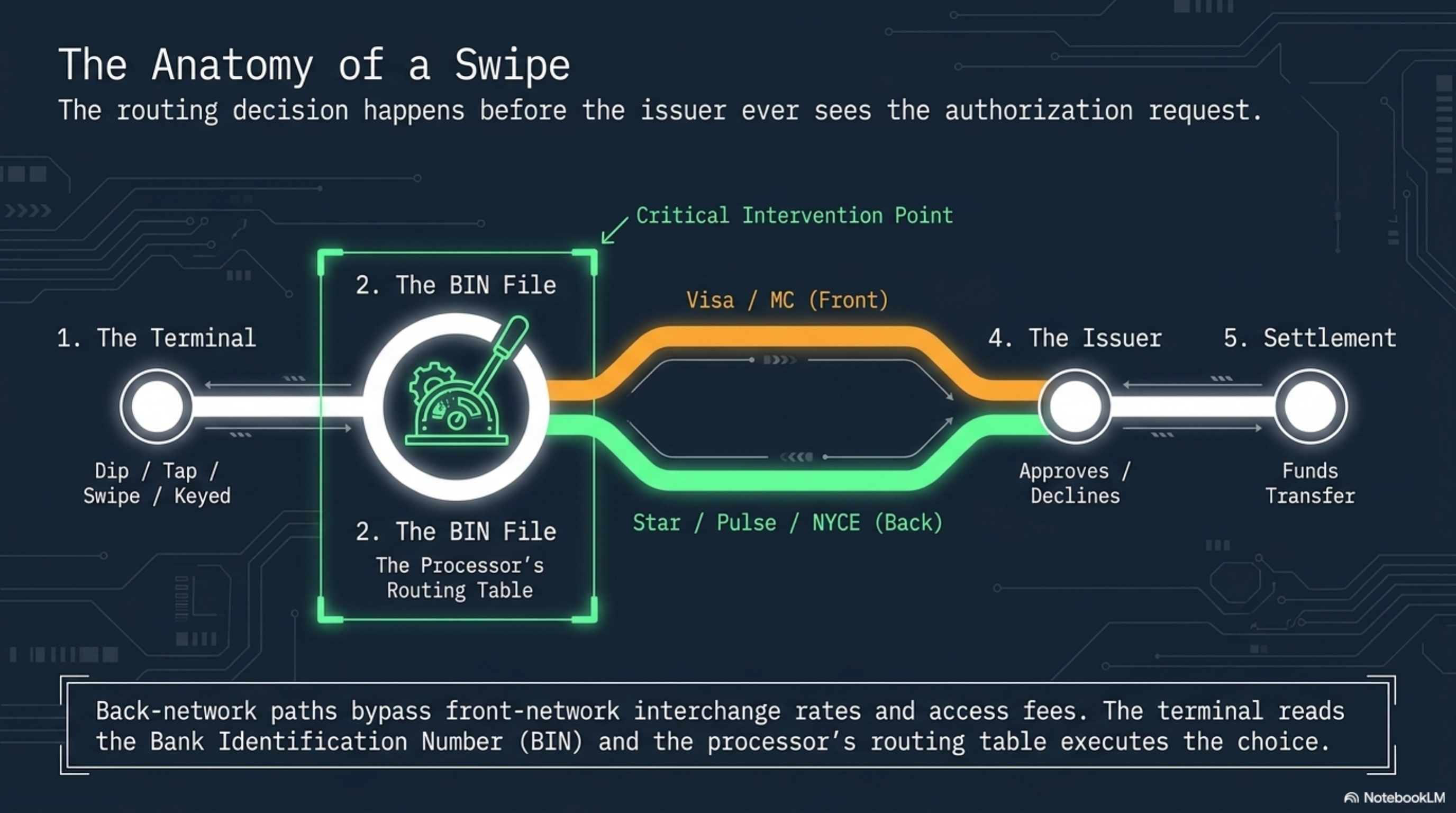
A debit transaction touches at least five parties between swipe and settlement. The order matters because the routing decision happens before the issuer ever sees the authorization request.
The flow:
- The card is presented at the terminal (dip, tap, swipe, or keyed entry).
- The terminal reads the card's BIN (bank identification number) and queries the processor's BIN file to identify which networks the card carries.
- The processor's routing table picks one network based on rules the merchant or the processor set: cost, approval rate, PIN versus PINless, small-ticket category.
- The authorization request goes to the chosen network, which forwards it to the issuer.
- The issuer approves or declines, the response routes back, and settlement happens through the same network at its published interchange.
The cost difference between networks shows up in two places: interchange and network access fees. Visa publishes its USA Interchange Reimbursement Fee schedule (PDF) twice a year, and Mastercard publishes its U.S. region interchange rates (linked PDFs on the same page) on the same cadence. Back-of-card networks like Star, Pulse, and Shazam publish schedules to processors but not to the general public, so the merchant has to ask their processor for the network-specific cost.
For regulated debit, the cap is the same across every network: 21 cents plus 0.05 percent plus a 1 cent fraud adjustment. On a $40 transaction, that is 24 cents, or 0.60 percent. The networks differ in their access fees and acquirer fees, which range from 1 to 5 cents per authorization depending on transaction size and processor agreement.
For exempt debit, the gap is wider. Per the Visa IRF schedule linked above, exempt debit in the CPS Small Ticket Debit category settles in a roughly 1.55 percent plus 4 cent range, and CPS Retail Debit in a roughly 0.80 percent plus 15 cent range. Back-of-card networks (Pulse, Star, NYCE) do not publish their exempt-debit rate cards, but processor-reported ranges for the same card and the same ticket size typically come in 15 to 35 basis points below the Visa CPS equivalent on tickets above $15, usually with a higher fixed-cent component and a lower percentage. On tickets above $15, back-network exempt debit typically wins; on tickets under $10, front-network small-ticket categories sometimes win because the fixed-cent component is smaller.
The BIN file matters more than most operators realize. A BIN file is the processor's internal database that maps the first 6 to 8 digits of every U.S. debit card to its issuing bank, its regulation status (regulated or exempt), and the networks the card carries. Processors refresh the BIN file weekly. Errors in the BIN file cause misrouted transactions, with exempt cards routing under regulated rules and missing the back-network savings.
PINless routing is the second technical lever. Before 2022, a back-of-card network usually needed PIN entry to authorize. Pulse, Star, and NYCE now process most exempt debit transactions without a PIN, which means a merchant with a chip-and-tap terminal can route any debit card to any enabled network without changing the customer experience. The catch is that the terminal firmware and the processor's gateway both have to support PINless back-network authorization. Most modern U.S. card-present terminals do; older firmware sometimes does not.
Where it goes wrong for operators
The routing right exists in federal regulation. The execution depends on the processor's defaults, the merchant's PIN-pad hardware, and the contract language buried on page 7 of the merchant services agreement. Five patterns repeat across the merchants who pay the most.
Default routing locked to the front network. A processor's BIN file ships with a default route, almost always to Visa Debit or Mastercard Debit. Unless the merchant requests least-cost routing in writing, the processor's table runs every debit transaction over the front network. A $200,000 monthly volume merchant with a 55 percent debit mix can lose $4,000 to $7,000 a year to this default.
Tiered pricing hides the network choice. On a tiered or bundled plan, the merchant sees one qualified debit line and one non-qualified debit line. The actual network is invisible. The processor pockets the routing spread between the cheaper back network and the more expensive front network, billed to the merchant at the qualified rate.
PIN-only routing on cards that allow PINless. The 2022 Federal Reserve clarification confirmed that back-of-card networks can route PINless transactions, including card-not-present. Some processors still treat PIN entry as a gate for back-network routing, leaving 20 to 40 percent of debit volume on the front network for no reason other than terminal configuration.
Small-ticket penalty. Per the Visa IRF schedule, the CPS Small Ticket Debit category applies to qualifying transactions under $15 and prices in the roughly 1.55 percent plus 4 cent range on exempt cards. The same card on Pulse, Star, or NYCE can settle at a lower effective rate, but only above a $5 to $7 break-even point. Below that, the front-network small-ticket category often wins. Coffee shops, parking, vending, and laundromats are the worst hit by misrouting on either side of the break-even.
Stale gateway routing. Some payment gateways, especially older e-commerce gateways, hardcode network selection by issuer name rather than reading the BIN file in real time. A merchant who switched issuers or who processes cards from a bank that recently changed BIN ranges can end up with stale routing, with transactions going to a network the card no longer prefers. Annual gateway audits catch this.
Routing fee add-ons. Some processors charge 0.05 to 0.10 percent as a least-cost routing service fee on top of the network savings. The savings still clear, but the processor takes a third of them. This fee is negotiable and is almost never disclosed unless asked.
Most merchants on default routing pay 0.15 to 0.35 percent more on exempt debit than they need to. The processor pockets the spread.
Worked example with real numbers
Consider a casual restaurant chain with four locations.
- Vertical: full-service casual dining
- Monthly volume: $420,000
- Average ticket: $42
- Transaction count: 10,000 per month
- Debit mix: 40 percent of volume, 45 percent of transactions
- Current pricing: interchange-plus 0.25 percent plus 10 cents
Debit dollar volume runs $168,000 per month across 4,500 transactions. Roughly 55 percent of debit transactions are on regulated cards and 45 percent are on exempt cards.
The figures below combine Visa's published IRF rates with a representative back-network range. Back-of-card networks do not publish exempt-debit rate cards, so the back-network leg is illustrative and based on the typical processor-reported range; the structure of the savings holds, but your actual back-network rate will depend on what your processor has negotiated.
Under the processor's default front-network routing on Visa Debit and Mastercard Debit, the math runs as follows.
Regulated debit (2,475 transactions): cap of 21 cents plus 0.05 percent plus a 1 cent fraud adjustment, per Regulation II. At $42 average ticket, that is 23.1 cents per transaction. Total: $572.
Exempt debit on Visa CPS Retail Debit (2,025 transactions): per Visa's published IRF schedule, this category settles in a roughly 0.80 percent plus 15 cent range on exempt debit. At $42 average, that is approximately 48.6 cents per transaction. Total: $984.
Network access fees and processor markup add 0.25 percent plus 10 cents per debit transaction: $570.
Default-routing debit cost per month: $2,126.
With least-cost routing engaged, the 2,025 exempt transactions move to a back-of-card network (Pulse, Star, NYCE). Back-network exempt debit retail typically falls in a processor-reported range of 0.15 to 0.35 percent below the Visa CPS equivalent on tickets above $15. For illustration, assume the back-network leg settles roughly 0.25 percent below Visa CPS Retail Debit, in a 0.55 percent plus 12 cent range. Your processor's actual rate may differ.
Illustrative back-network exempt debit: 0.55 percent of $85,050 plus 12 cents times 2,025 = $468 plus $243 = $711.
Least-cost routing debit cost per month: $572 plus $711 plus $570 = $1,853.
Monthly savings: $273. Annual savings: $3,276. Over a typical 36 month renewal cycle: $9,828.
The savings scale linearly with debit volume. A merchant doing $1 million monthly with the same 40 percent debit mix and $42 average ticket saves roughly $650 per month, or $23,400 over 36 months, on the same routing change. The interchange-plus structure makes the savings visible; on tiered pricing, the processor would absorb most of this spread and the merchant would never see it.
Operator playbook
Eight moves, in order. The first five can be done this week.
- Pull the last three monthly statements. Look for line items labeled Visa Debit, MC Debit, Star, Pulse, NYCE, Maestro, Interlink, Accel, or Shazam. Count transactions per network. If you see only Visa Debit and MC Debit lines, you are routing 100 percent to the front network.
- Ask the processor for the BIN routing table. The merchant has the right to see how transactions route. Request it in writing. If the processor refuses or stalls, that is a signal the routing spread is part of their margin.
- Request least-cost routing in writing, citing Regulation II. The Federal Reserve confirmed in 2022 that the merchant, or processor acting on the merchant's behalf, picks the network. The processor cannot opt the merchant out of the right.
- Audit terminal PIN-pad capability. PINless back-network routing works on most modern terminals, but older firmware sometimes blocks it. Ask the processor whether your terminal model supports back-network PINless authorization on debit cards.
- Compare your debit effective rate to the regulated cap. Add total debit fees on your statement, divide by total debit volume. If the result is above 0.85 percent on a card-present merchant with average tickets over $20, you are not on least-cost routing.
- Check for a routing service fee or debit access fee line. Processors sometimes charge 0.05 to 0.10 percent to do the routing the regulation already requires. This fee is negotiable.
- Renegotiate at renewal, not before. The processor has the least negotiating power 90 to 60 days before contract expiration. Bring three competing interchange-plus quotes that explicitly list debit network routing and ask the incumbent to match.
- Run a quarterly debit audit. Pull the network breakdown every three months. Routing tables update, BIN files change, and acquirers periodically rotate default routes. A merchant who set up least-cost routing two years ago is probably leaking 5 to 15 basis points by now.
A $300,000 monthly volume merchant with 50 percent debit volume loses $2,700 to $6,300 a year to default routing. The fix is a 30 minute conversation with the processor and one annual statement audit.