TL;DR
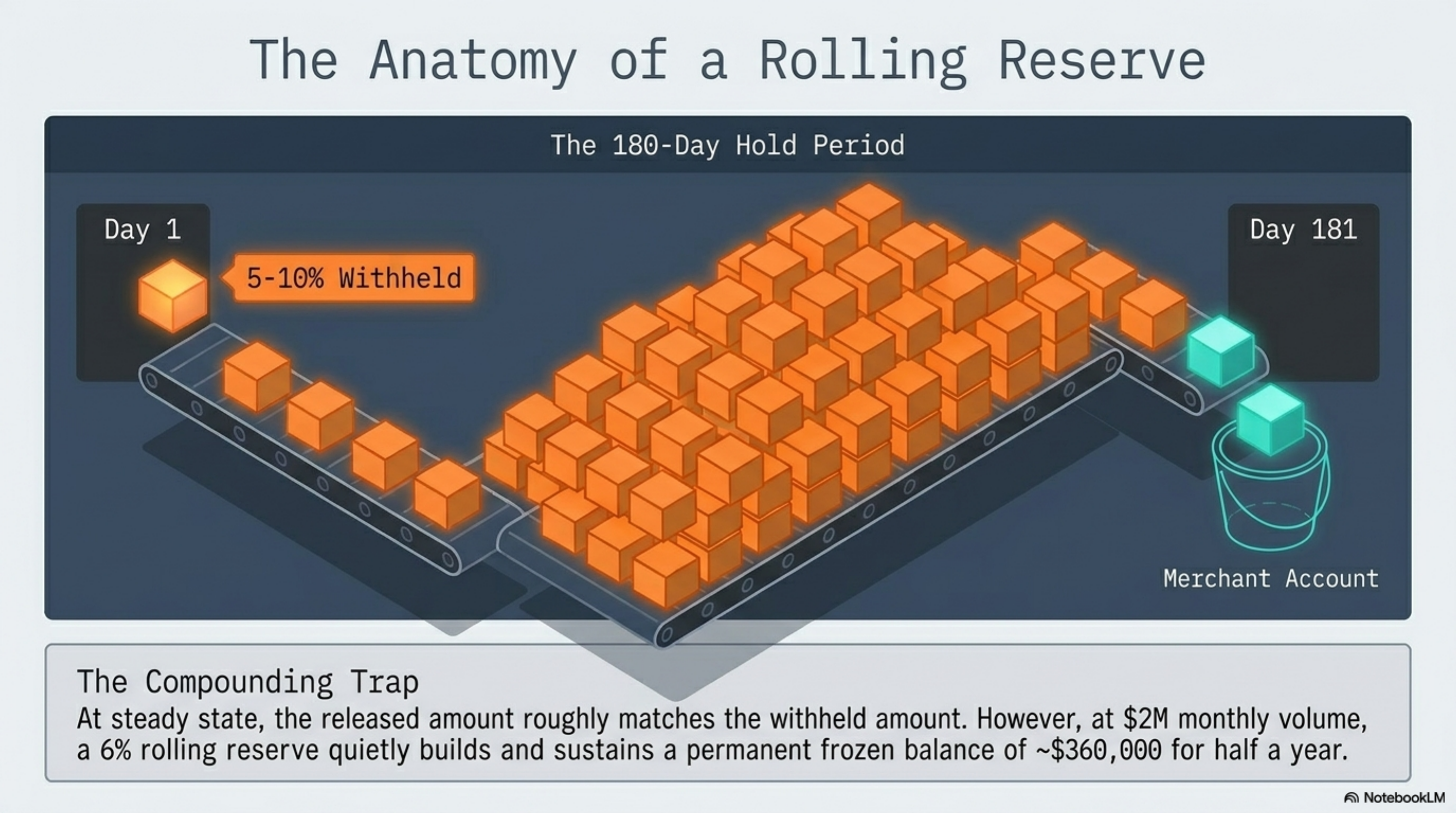
Processors hold 5 to 10 percent of your gross sales for 90 to 180 days to cover chargeback risk. At $2M monthly volume, a 6 percent rolling reserve freezes around $360,000 in working capital for half a year. The reserve is almost always negotiable for accounts above $1M monthly. Bring 12 months of chargeback data, two competing acquirer quotes, and a counter-proposal that swaps a rolling percentage for a capped dollar amount.
What this actually is
A merchant reserve is money the processor or its sponsoring bank withholds from your settlements to cover the chargeback, refund, and fraud losses the underwriter believes your account could generate over the dispute window. The reserve sits on the acquirer's books, not yours. It does not earn interest for you, and the release schedule is set in your merchant agreement, not by you.
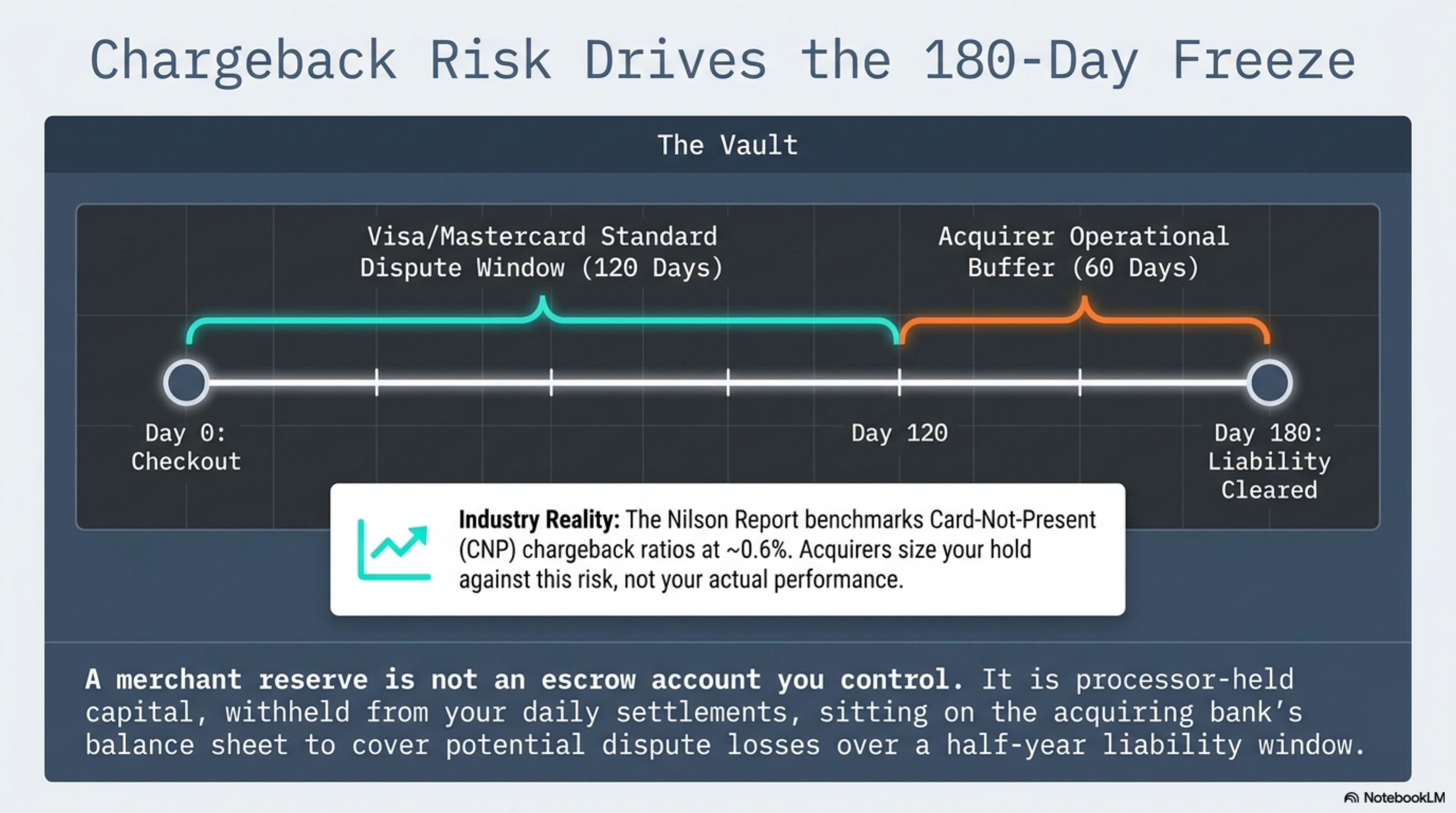
The Federal Reserve's payments program distinguishes settlement risk (the two-day gap between batch close and funding) from chargeback risk (the 120-day window during which a cardholder can dispute). Reserves are sized against the second. Visa's published rules and Mastercard's chargeback framework both set 120 days from transaction or delivery as the standard dispute window for most reason codes. Acquirers add another 60 days of operational buffer, which is why 180 days is the default hold period in most rolling reserve clauses.
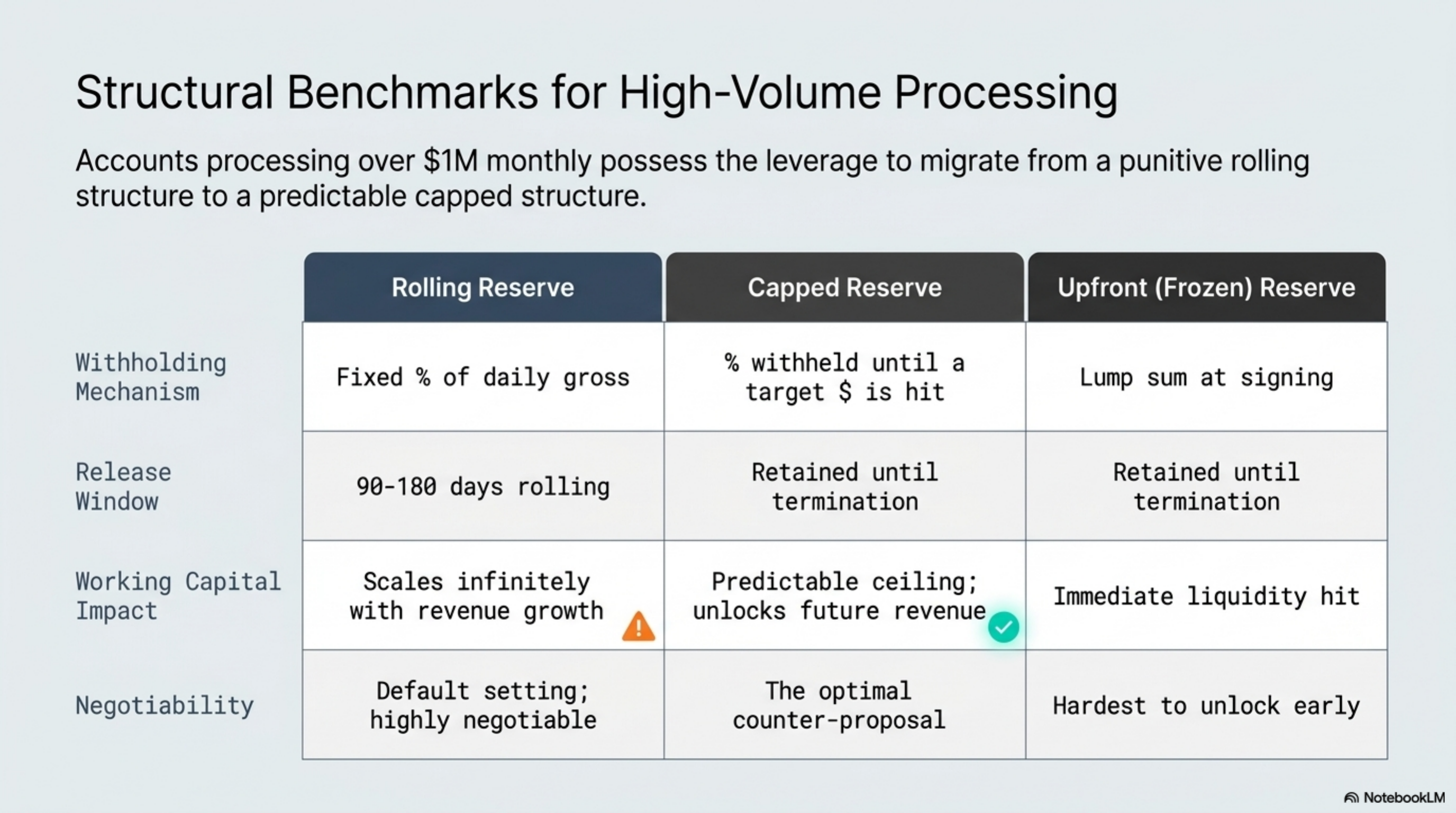
Three reserve structures appear in nearly every contract:
- Rolling reserve: a fixed percentage of each day's settlements (commonly 5 to 10 percent) is withheld and released after a defined hold period.
- Capped reserve: a target dollar amount the processor builds by withholding a percentage until the cap is reached, then stopping.
- Upfront or frozen reserve: a lump sum funded at signing and held for the life of the account.
The number is set during underwriting based on volume, vertical, chargeback history, and balance-sheet strength. Most merchant agreements give the acquirer broad discretion to raise the reserve any time conditions change.
A merchant reserve is processor-held money withheld from your settlements to cover future chargebacks, refunds, and fraud, released on the schedule defined in your merchant agreement.
How it works under the hood
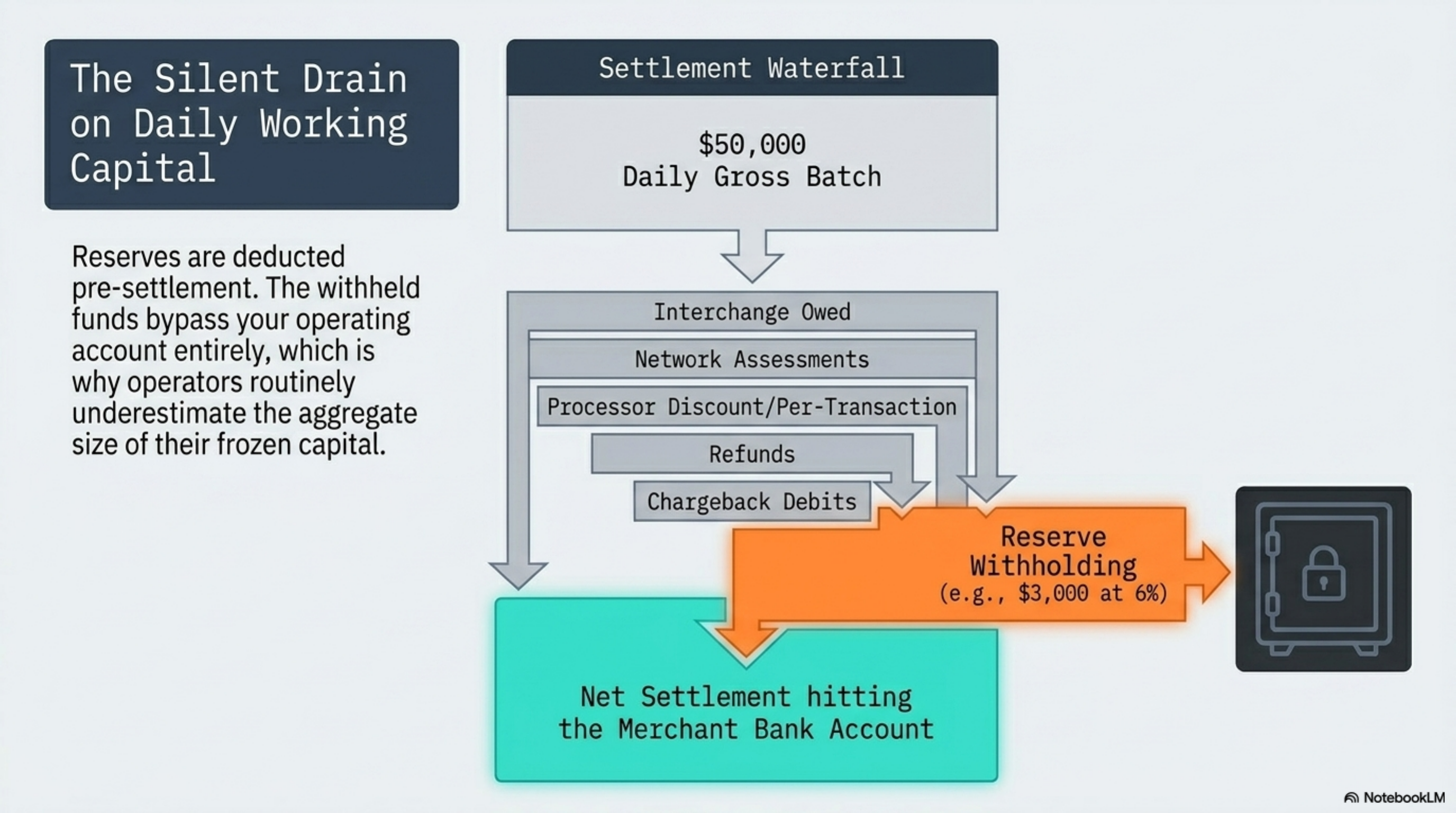
When you batch out at end of day, your processor receives funds from the card networks two business days later under standard ACH settlement. Before the net amount hits your bank, the settlement engine applies deductions in this order:
- Interchange owed to the issuing bank
- Network assessments (Visa, Mastercard, Discover, Amex)
- The processor's discount and per-transaction fees
- Refunds processed that day
- Chargeback debits and representment fees
- Reserve withholding
- Other monthly billed fees (PCI compliance, statement fees, minimums)
The reserve line is where merchants lose track. On a 6 percent rolling reserve at $50,000 daily volume, the processor withholds $3,000 from each day's settlement. That $3,000 enters a reserve account on the acquiring bank's balance sheet. On day 91 (or 181, depending on your release window), the $3,000 from day 1 is released back as a credit on your monthly statement. The reserve account itself never appears in your operating bank account, which is why many merchants underestimate the size of the balance.
Most processors will not show you the reserve balance unless you ask. Request a reserve account statement or held-funds report monthly. The number is usually larger than operators expect.
Acquirers size reserves using a standard formula. Monthly volume times projected chargeback ratio times average chargeback amount times a recovery multiplier, sized against your balance-sheet strength as recorded in underwriting. A merchant doing $1M monthly at a 0.3 percent chargeback ratio has $3,000 of monthly dispute exposure. Most underwriters size the reserve to cover 10 to 30 times that monthly exposure, which is how a clean account ends up at 5 percent and a high-risk vertical ends up at 10 to 15 percent.
The Nilson Report's annual fraud and chargeback summaries are the benchmark dataset most acquirers calibrate against. For card-not-present merchants in 2024, the industry-wide chargeback ratio averaged around 0.6 percent of transactions, with refund rates layered on top. If your actuals sit below the published industry benchmark for your vertical, you have a documented argument for a reserve reduction.
Reserve structure varies by acquirer type. Aggregators like Stripe, PayPal, and Square hold reserves on their own balance sheets through their sponsoring banks (Goldman Sachs, JPMorgan Chase, and Wells Fargo respectively, as recorded in their public filings). Pure-play acquirers like Adyen, Worldpay, and Chase Payment Solutions hold reserves at the sponsor bank directly. ISO-based processors layer the reserve at multiple levels: the sponsor bank holds funds, the ISO bills the merchant, and the merchant has visibility only into the ISO's interface. This matters when you negotiate. At an aggregator, the reserve term is bound by portfolio-wide underwriting policy and is hard to move below floor levels. At a direct acquirer or ISO, reserves are account-specific and the underwriter has more latitude to deviate from defaults.
Reserve release is mechanical but easy to miss. On a 180-day rolling release, the credit lines on your monthly statement (often labeled reserve released or reserve refund) reflect funds withheld 180 days earlier. At steady state, the released amount roughly matches the withheld amount each month. The reserve only grows when volume grows, and only shrinks when volume shrinks or when you negotiate a structural change.
Where it goes wrong for operators
Pattern 1: Mid-contract reserve increases without notice. Most merchant agreements (Stripe, Adyen, PayPal, traditional ISOs, Worldpay) contain a clause that lets the acquirer raise reserves at its sole discretion based on perceived risk-profile changes. A spike in chargebacks, a refund surge, a credit downgrade, or a regulatory inquiry can trigger it. At $2M monthly, a jump from 6 to 12 percent withholds an extra $120,000 per month into the reserve for the hold window. Most contracts require zero written notice.
Pattern 2: Termination reserve extends the hold. When you offboard, the reserve typically stays in place an additional 180 to 270 days past your last transaction date. Read the reserve-release-upon-termination clause carefully. Many merchants discover they cannot fully retrieve $400,000 or more for nine months after switching processors.
Pattern 3: The processor keeps the float. The acquirer earns Treasury yield on the reserve balance and almost never passes it through. At a $500,000 average reserve and a 5 percent risk-free yield, that is $25,000 per year in float income the processor pockets. High-volume merchants can sometimes negotiate an interest credit, but most processors resist hard.
Pattern 4: Reserve sized against projection, not actuals. New merchants accept reserves sized to the volume they projected during sales conversations. If you projected $5M and are doing $1.5M, your reserve percentage is effectively three times higher against actual chargeback exposure than the underwriting math intended. Most processors will not reduce automatically. You have to ask.
Pattern 5: Seasonal compounding. A retailer doing 40 percent of annual volume in Q4 sees the reserve pool peak in January and February, exactly when working capital is tightest after holiday inventory and payroll. A $5M Q4 month with a 6 percent rolling reserve ties up $300,000 from one month alone, on top of the baseline reserve from the other eleven months.
Pattern 6: Portfolio-wide hikes from sponsor-bank examinations. When a sponsoring bank goes through a regulatory examination from the OCC, Federal Reserve, or state regulator, it can be required to raise reserves across an entire merchant portfolio to satisfy capital and risk requirements. Your account performance has nothing to do with it. The bank passes the increase to the acquirer, who passes it to you. Read your contract for the regulatory pass-through clause.
A reserve increase clause is enforceable even when your chargeback rate sits below industry benchmark. Acquirers can cite portfolio-wide risk policy changes, not just your account performance.
Worked example with real numbers
Merchant profile: B2B SaaS company, $1.8M monthly processing volume, $450 average ticket, current pricing IC+ 0.35 percent plus $0.12. Card-not-present only, 87 percent recurring billing, trailing 12-month chargeback ratio of 0.18 percent. Current reserve structure: 7 percent rolling, 180-day release.
Step 1: Average reserve balance. At $1.8M monthly volume and 7 percent withholding, $126,000 per month enters the reserve. With a 180-day release window, the steady-state reserve balance is six months of withholding: $126,000 times 6 equals $756,000.
Step 2: Cost of capital. At a 9 percent corporate borrowing rate (typical for a mid-market SaaS revolving credit line in 2026), holding $756,000 captive costs $68,040 per year in foregone capital. That is the true annualized cost of the reserve, separate from any processing fees.
Step 3: Actual chargeback exposure. Monthly chargebacks at 0.18 percent on $1.8M equal $3,240. Annualized chargeback exposure: $38,880. Even at three times annual coverage (a conservative buffer most acquirers will accept on a clean account), the underwriter only needs $116,640 of coverage, not $756,000.
At three times annual chargeback coverage, this merchant's risk-justified reserve is $116,640. The current $756,000 balance is 6.5 times what the underwriting math supports.
Step 4: Counter-proposal. The operator proposes a capped reserve at $200,000 (about five times annual chargeback exposure, which gives the underwriter cushion) in place of the 7 percent rolling reserve. They agree the acquirer can withhold 7 percent of new settlements whenever the reserve balance dips below $200,000. Net result: the steady-state reserve drops from $756,000 to $200,000, unfreezing $556,000 in working capital and saving $50,040 per year in cost of capital.
Step 5: Release schedule. The operator pushes for a 90-day release window on the capped balance, supported by a documented sub-0.2 percent dispute history. Most acquirers concede this on accounts above $1M monthly with two consecutive years of clean chargeback ratios.
Total annualized impact for this merchant: $50,040 saved in cost of capital, $556,000 unfrozen working capital, and a 90-day reduction in offboarding hold if the relationship ends.
"Reserves above $1M monthly are negotiable. The size of the reduction is roughly proportional to the strength of your alternative quote in writing."
Operator playbook
- Pull the last 12 months of statements and isolate every line labeled reserve held, rolling reserve, reserve withheld, or merchant reserve. Sum the withheld amounts and the released amounts each month. The running difference is your reserve balance trajectory.
- Calculate your true 12-month chargeback rate. Divide the chargeback debit line by gross volume. Express it in basis points and in dollars per month. Compare against the published Nilson industry benchmark for your vertical.
- Run the cost-of-capital math. Multiply your steady-state reserve balance by your blended cost of capital (your line of credit rate, your equity cost, or the risk-free Treasury yield, whichever the reserve is displacing). This single number is the centerpiece of your negotiation.
- Request the underwriting memo or reserve worksheet from your processor. Most large acquirers will provide it when asked. The memo shows the projected volume and projected chargeback rate used to size your reserve. If your actuals are lower than projections, you have a documented case.
- Get two competing acquirer quotes in writing, including the proposed reserve structure. Adyen, Worldpay, Chase Payment Solutions, and Stripe's enterprise team will all quote a reserve for accounts above $1M monthly. A competing capped-reserve proposal in writing is the single most reliable lever for moving the incumbent.
- Counter on structure, not just rate. Propose a capped reserve at three to five times annual chargeback exposure, a 90-day release window, and contract language requiring 30 days written notice plus a documented risk event before any increase.
- Add a step-down trigger. Negotiate automatic reserve reduction at defined performance milestones (six clean months at sub-0.2 percent dispute ratio, for example). Processors give up little upfront, and you gain a contractual ratchet downward.
- Time the request to renewal or to a clean quarterly chargeback review. Mid-contract reductions without a triggering event in your favor almost never go through. Renewal windows reset everyone's posture and create the natural opening for restructuring.