TL;DR
Restaurant POS setup decides whether your card volume qualifies for Visa CPS/Restaurant interchange or gets downgraded to EIRF or Standard, which costs 50 to 100 basis points more per transaction. The pain points are tip-adjust timing, pre-auth tolerance, MCC coding, and batch windows. Fix all four at the POS layer and most operators cut 0.20 to 0.45 percent off their effective rate without switching processors or signing a new contract.
What this actually is
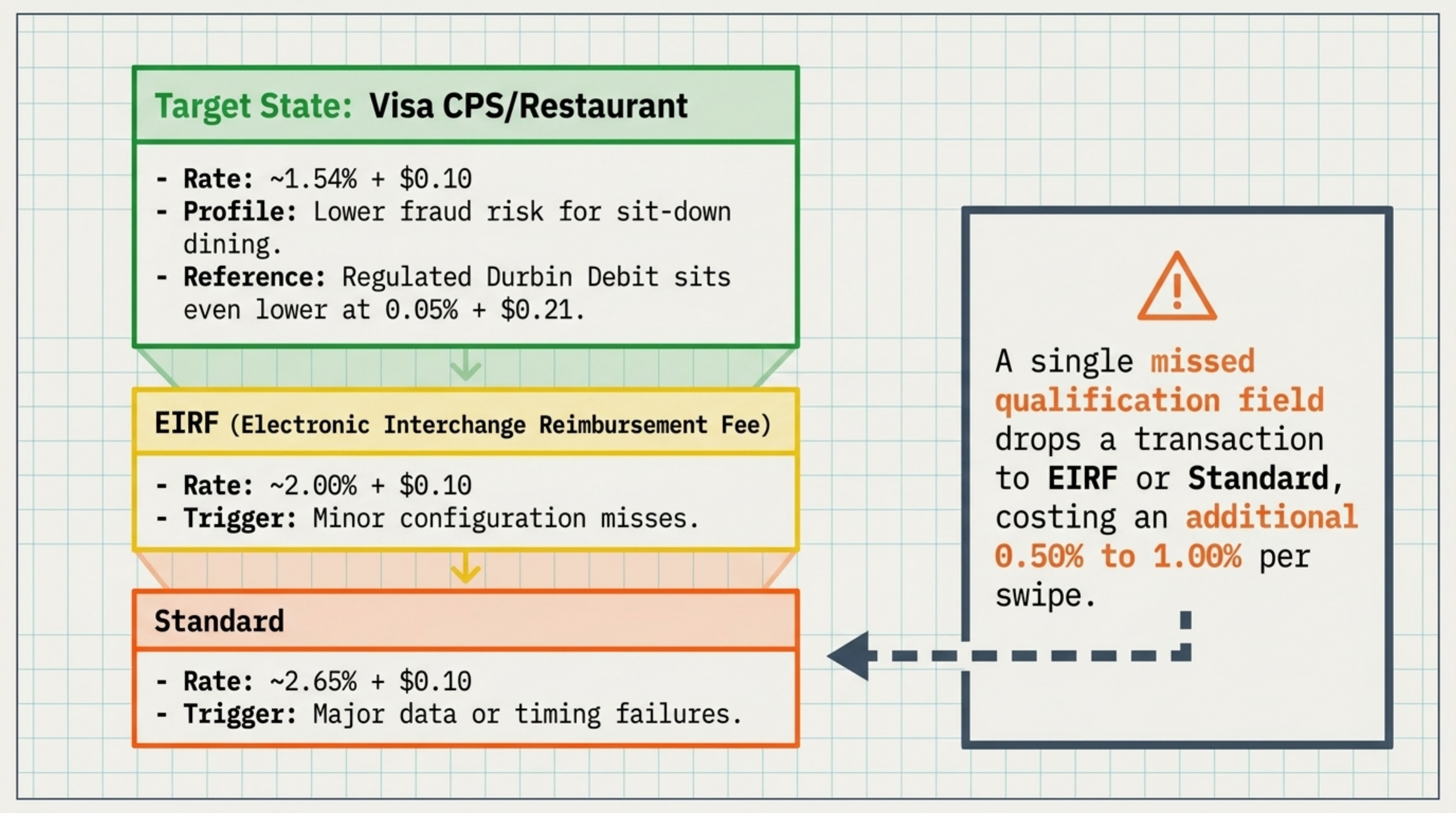
A restaurant-specific POS setup is the configuration of a point-of-sale system that lets card transactions qualify for the restaurant interchange categories the card networks publish. The relevant programs are Visa CPS/Restaurant under the Consumer Product Sales program and the Mastercard Restaurant Merchant Group. Both exist because a sit-down dining transaction has a different fraud and chargeback profile than a retail swipe, and the networks price that risk into a dedicated rate.
For Visa, the relevant MCCs are 5812 (eating places and restaurants), 5813 (drinking places, including bars and taverns), and 5814 (fast food). Each has its own interchange treatment. A consumer credit card processed correctly at a 5812 location qualifies for CPS/Restaurant at roughly 1.54 percent plus $0.10 according to the published Visa interchange schedules. Mastercard's Restaurant Merchant Group sits in a similar band under its interchange rates and criteria publication. The corresponding regulated consumer debit rates are lower under the Durbin cap of 0.05 percent plus $0.21.
The qualification rules are technical: card-present indicator, magnetic stripe or chip read with the right service code, settlement within 24 hours of authorization, final amount within tip tolerance, correct MCC at boarding. Most are POS settings, not contract terms. Most operators look at the contract first when the bill seems high. The POS configuration is where the money lives.
A restaurant-specific POS setup configures MCC, tip-adjust flow, pre-auth tolerance, and batch timing to qualify card transactions for Visa CPS/Restaurant or Mastercard Restaurant interchange.
How it works under the hood
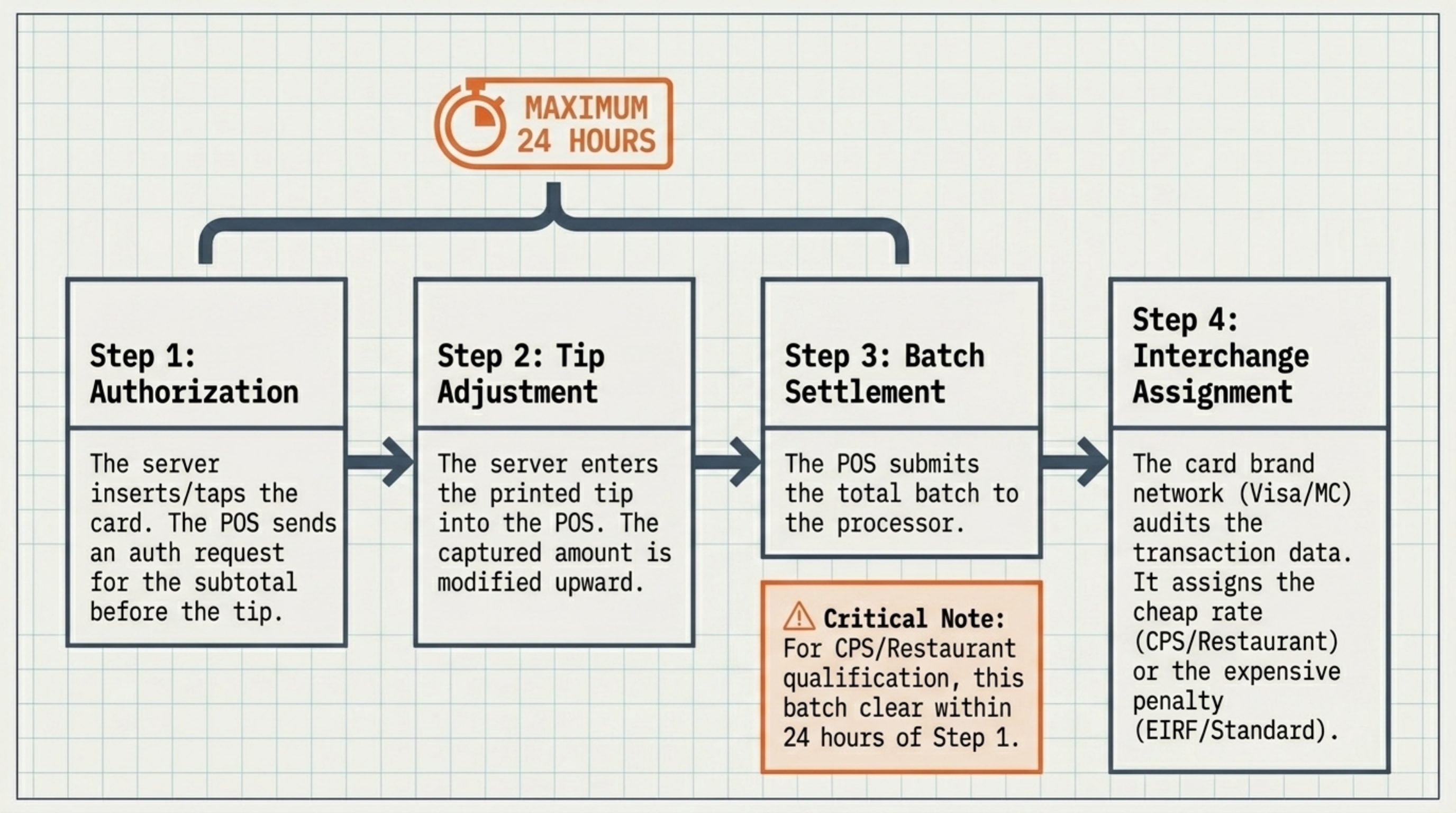
Restaurant card transactions move through four steps. Each one carries a network rule the POS must respect, or the transaction loses its restaurant interchange qualification at settlement.
- Authorization. The server inserts, taps, or swipes the card at the table or counter. The POS sends an auth request for the subtotal of the check, before tip. The issuer approves, places a hold on the cardholder's available credit, and returns an auth code. For sit-down restaurants, this is a pre-auth and the dollar amount excludes tip.
- Tip adjustment. The server enters the printed tip into the POS after the guest leaves. The POS modifies the captured amount upward by the tip value. Visa allows the final settlement amount to exceed the original auth by up to 20 percent on restaurant MCCs without forcing a new authorization, per its operating regulations. Some POS systems perform an incremental auth instead of a tip adjust, which is also allowed.
- Batch settlement. The POS submits the batch to the processor at end of day or on a fixed schedule. The processor passes the batch to the acquirer, which routes each transaction to the issuing bank for clearing. For Visa CPS/Restaurant qualification, the settled transaction must clear within 24 hours of the original auth.
- Interchange assignment. The card brand reads the settlement message, checks the card-present indicator, the chip or stripe data, the timing, and the final amount, then assigns the interchange rate. CPS/Restaurant is the target. EIRF or Standard is the downgrade.
The numbers from Federal Reserve payments studies consistently show U.S. interchange averaging 1.7 to 2.3 percent across card-present categories, with restaurant sitting toward the lower end when configured correctly. The gap between a qualified and downgraded restaurant transaction is roughly 50 to 100 basis points.
The POS controls steps 1, 2, and 3. The contract controls how downgrades are billed. The 24-hour batch window starts at authorization time, not when you close the batch at end of shift.
Where it goes wrong for operators
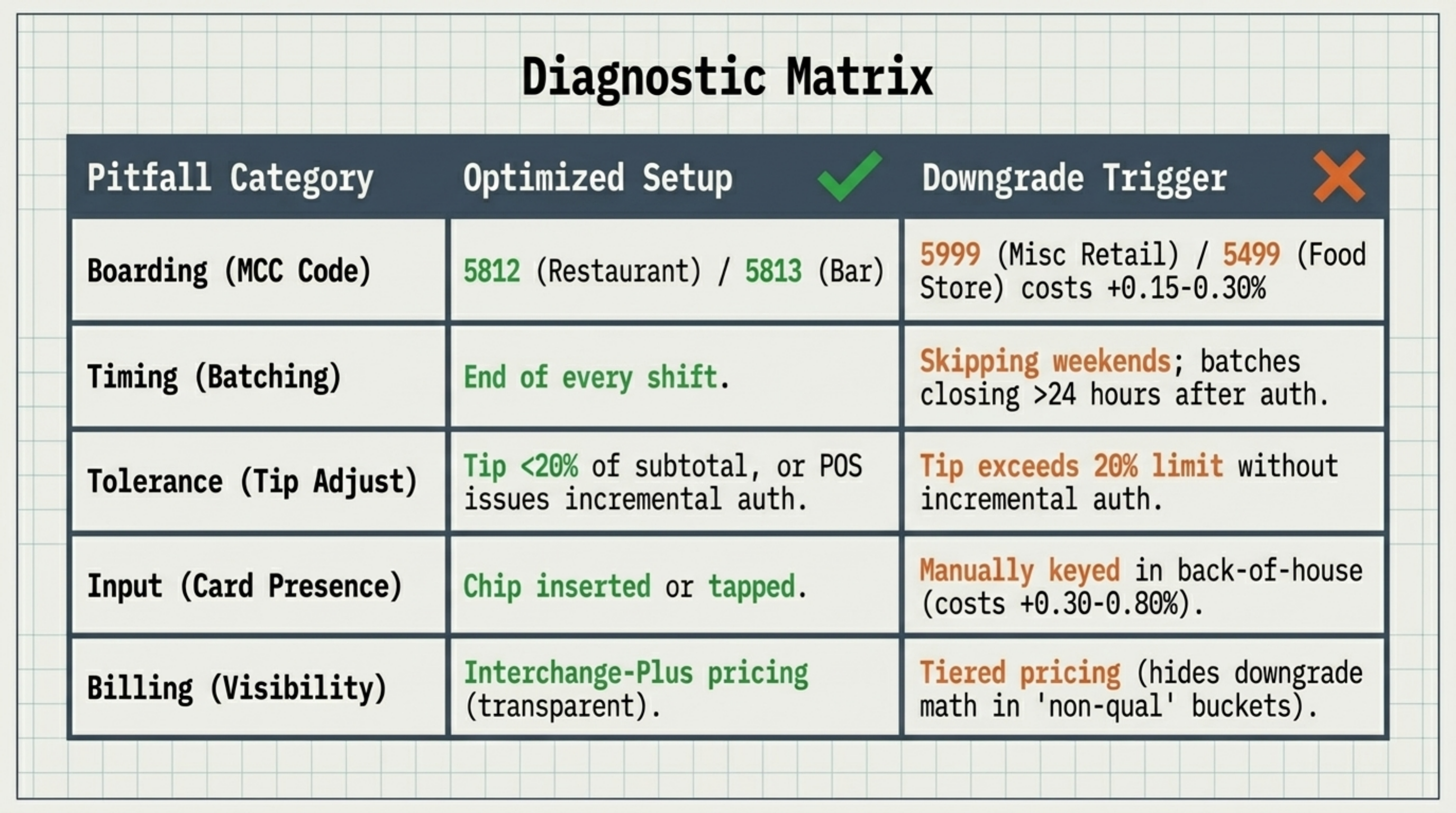
Five patterns show up on restaurant statements over and over. Each one ties back to a specific POS or boarding setting.
The MCC is wrong. A boarding agent codes the merchant as 5999 (miscellaneous retail) or 5499 (food stores) instead of 5812. The card brand never considers the account for CPS/Restaurant. Every consumer credit transaction qualifies at retail rates, which on average run 0.15 to 0.30 percent above restaurant rates. On $185,000 monthly volume, the gap is $280 to $560 a month.
Tip-adjust timing slips. The POS captures the auth on Friday at 10 PM. The server adjusts the tip Saturday morning. The batch goes out Saturday night, 26 hours after auth. Visa's 24-hour window has closed. Every transaction in that batch downgrades.
Pre-auth tolerance breached. A guest tips 25 percent on a $40 check. The auth was $40, the settlement is $50. The settlement exceeds the 20 percent tip tolerance Visa allows. The transaction downgrades unless the POS issued an incremental auth.
Card not present by accident. The server takes the card to the back of the house. They key the number into the POS instead of inserting the chip. The card-present flag is now false. The transaction qualifies for card-not-present interchange, which runs 30 to 80 basis points higher than card-present restaurant rates.
Tiered pricing hides the math. On a tiered plan, the processor sets the qualified rate but reserves the right to move any transaction into mid-qual or non-qual buckets. On interchange-plus, the merchant sees the actual interchange category on each transaction and pays a fixed markup. Tiered processors keep the downgrade spread; interchange-plus passes it through. Nilson Report data shows tiered pricing remains common at sub-$500K monthly volume even though interchange-plus is more transparent.
A 25 percent downgrade rate at $185,000 monthly volume costs roughly $600 to $900 extra every billing cycle.
Worked example with real numbers
Run the math on the current bill. Total items at $52 average = roughly 3,558 per month.
Qualified bucket: $185,000 x 62 percent = $114,700 at 1.79 percent + $0.15 per item. Items in bucket = 2,206. Cost: $114,700 x 0.0179 + 2,206 x $0.15 = $2,053 + $331 = $2,384.
Mid-qualified: $185,000 x 28 percent = $51,800 at 2.49 percent + $0.20. Items = 996. Cost: $51,800 x 0.0249 + 996 x $0.20 = $1,290 + $199 = $1,489.
Non-qualified: $185,000 x 10 percent = $18,500 at 3.39 percent + $0.25. Items = 356. Cost: $18,500 x 0.0339 + 356 x $0.25 = $627 + $89 = $716.
Total processing: $2,384 + $1,489 + $716 = $4,589. Effective rate: $4,589 divided by $185,000 = 2.48 percent.
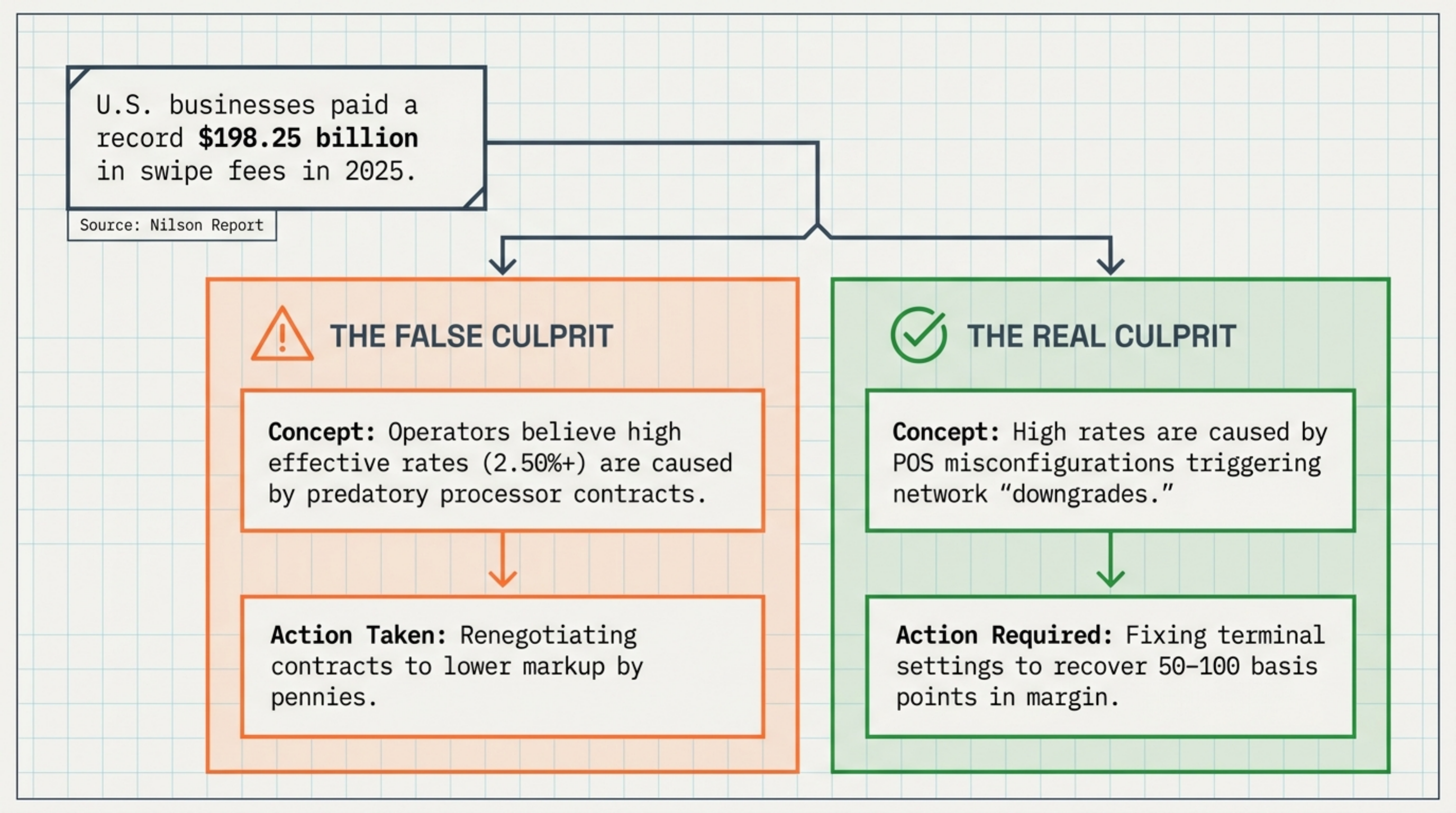
Now assume the same restaurant fixes the POS setup. MCC confirmed 5812. Batches run at end of every shift, not skipping weekends. Tip tolerance set at 20 percent at the POS level with incremental auths above that threshold. Chip-insert enforced for all dine-in tickets. Downgrade rate drops to 5 percent (all non-qualified, no mid-qual).
Recalculate. Qualified: $175,750 at 1.79 percent + 3,380 items x $0.15 = $3,146 + $507 = $3,653. Non-qual: $9,250 x 0.0339 + 178 items x $0.25 = $314 + $45 = $359. New total: $4,012. Effective rate: 2.17 percent.
Difference: $577 per month, $6,924 per year. No new contract. No new processor. The POS settings did the work.
Operator playbook
- Pull your last three statements and find the MCC. It should be 5812, 5813, or 5814 for restaurants and bars. If it says anything else, ask the processor to reboard the account under the correct MCC. This change usually clears in two billing cycles.
- Find the downgrade line items. Look for headers like "EIRF," "Standard," "non-qualified," or "mid-qualified." Add up the dollar volume in each. Divide by total volume. If downgrades exceed 5 percent, the POS configuration is bleeding margin.
- Audit batch timing. Pull the batch report for the last seven days. Confirm every batch closes within 24 hours of the earliest auth in it. If your POS allows split batches by shift, enable it so late-night dinner service does not get held into the next day.
- Set tip tolerance at the POS. Most modern restaurant POS systems (Toast, Square for Restaurants, Clover, SpotOn, Lightspeed) expose a tip tolerance setting. Set it to 20 percent or configure the system to issue an incremental authorization on tips above that threshold.
- Eliminate manually keyed dine-in transactions. Train servers to insert or tap the card at the table with a handheld device, or at the counter on pickup. Manual entry on dine-in is a card-not-present downgrade by definition.
- Move from tiered to interchange-plus pricing. Ask your processor for an IC+ quote with a fixed markup of 0.25 to 0.50 percent + $0.10. If they refuse, get a competing quote from two other processors and present it. Tiered processors usually match rather than lose the account.
- Demand a downgrade reason-code report. The processor's back office has it. Ask for a monthly statement supplement that breaks downgrades into the specific Visa or Mastercard reason codes. This is what proves whether the issue is timing, tolerance, or data integrity.
- Review interchange rates each April and October when Visa and Mastercard publish updates. Confirm your processor's markup did not silently widen alongside the network rate change.