TL;DR
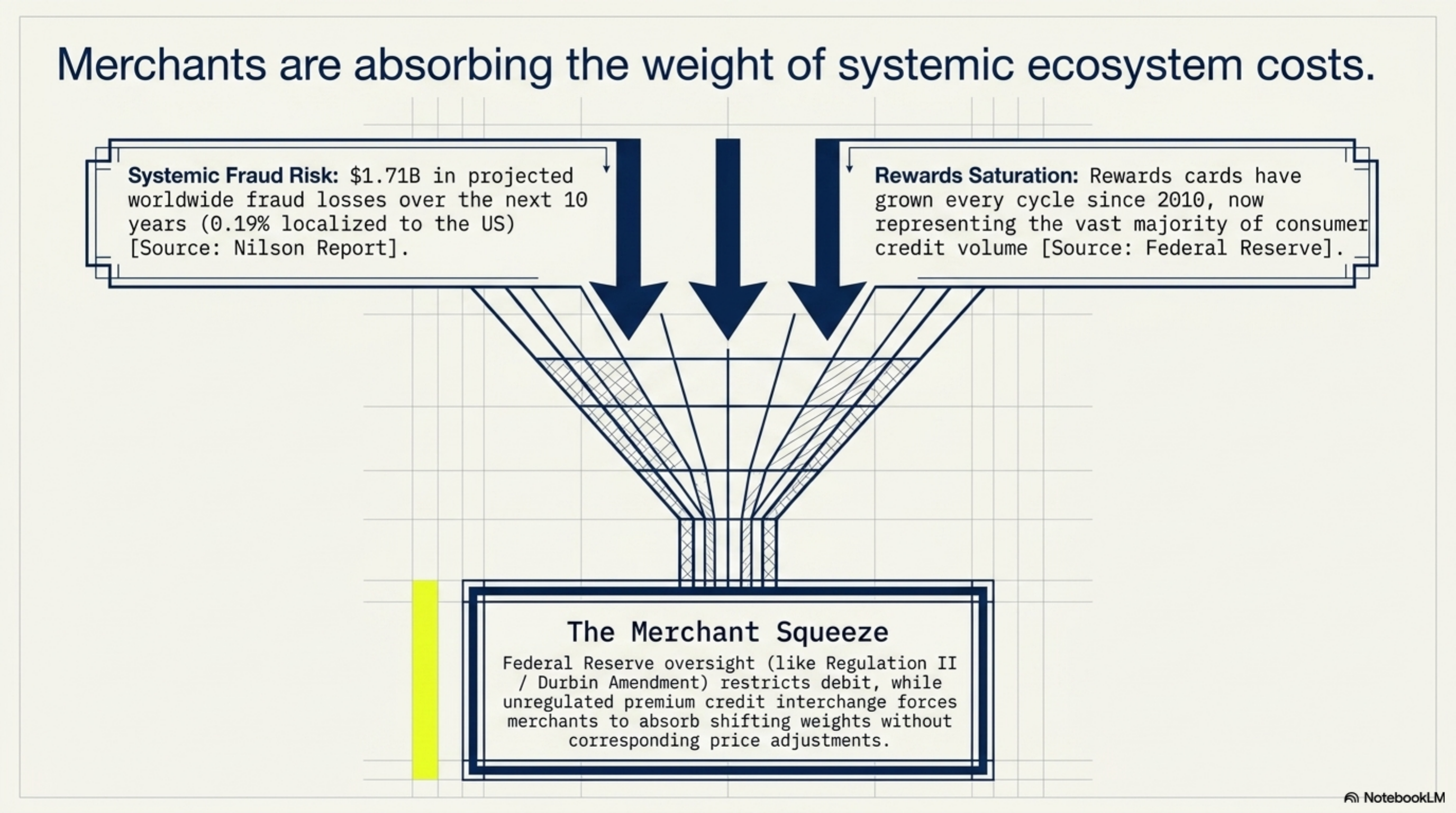
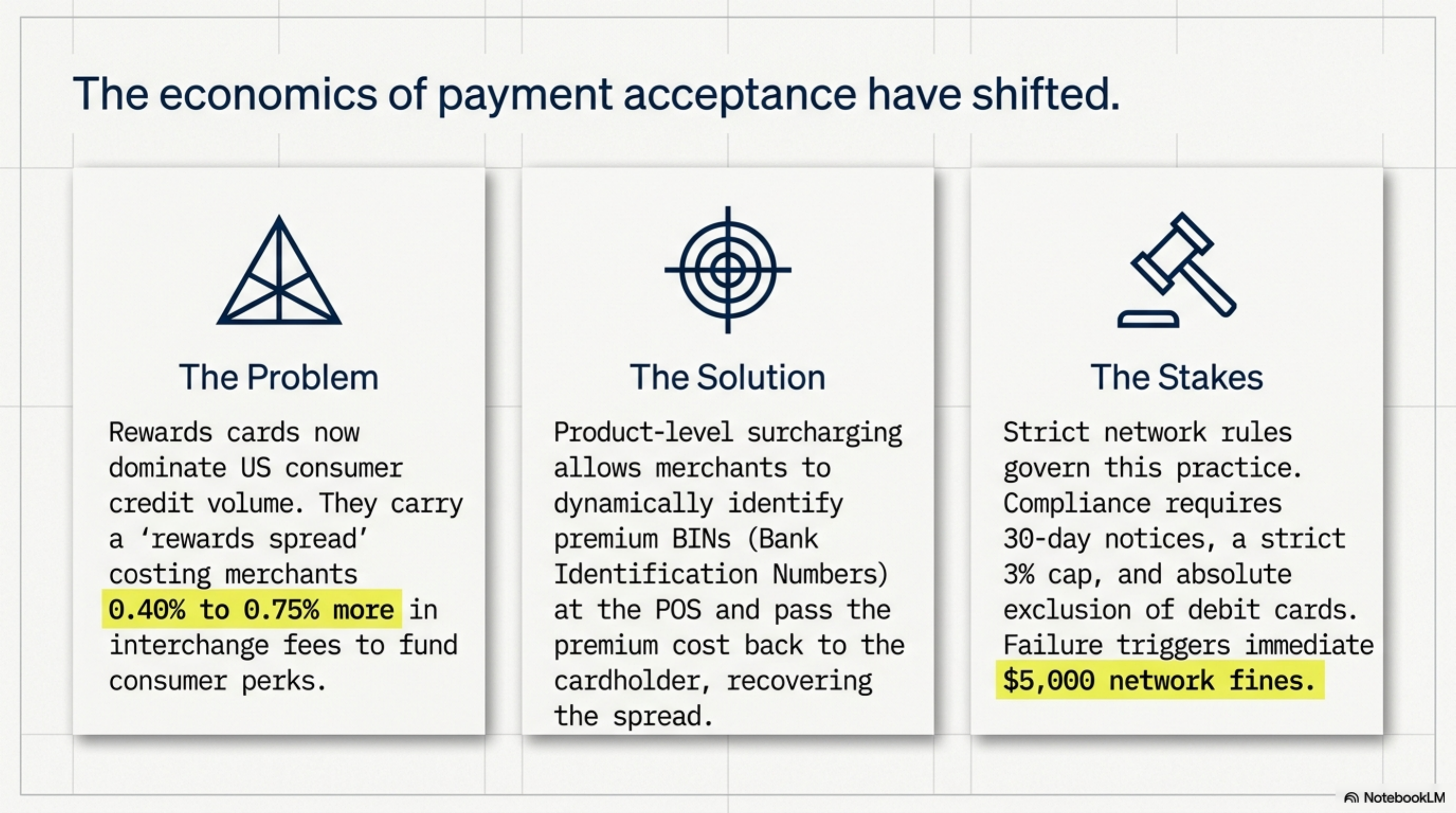
Rewards cards cost merchants roughly 0.40 to 0.75 percent more in interchange than non-rewards consumer credit, an estimate derived from the published Visa USA Interchange Reimbursement Fees and Mastercard U.S. Region Interchange Programs and Rates schedules. Visa and Mastercard both permit product-level surcharging that passes the premium back to the customer, but the rules are strict: 30-day notice to each network, signage at every entry and the POS, a cap of 3 percent in the U.S., and zero surcharge on debit. Done right, the program recovers most of the rewards spread. Done wrong, network fines for non-compliance with the surcharge rules begin at $5,000 per violation under the Visa Core Rules and Visa Product and Service Rules (see the non-compliance assessments schedule).
What this actually is
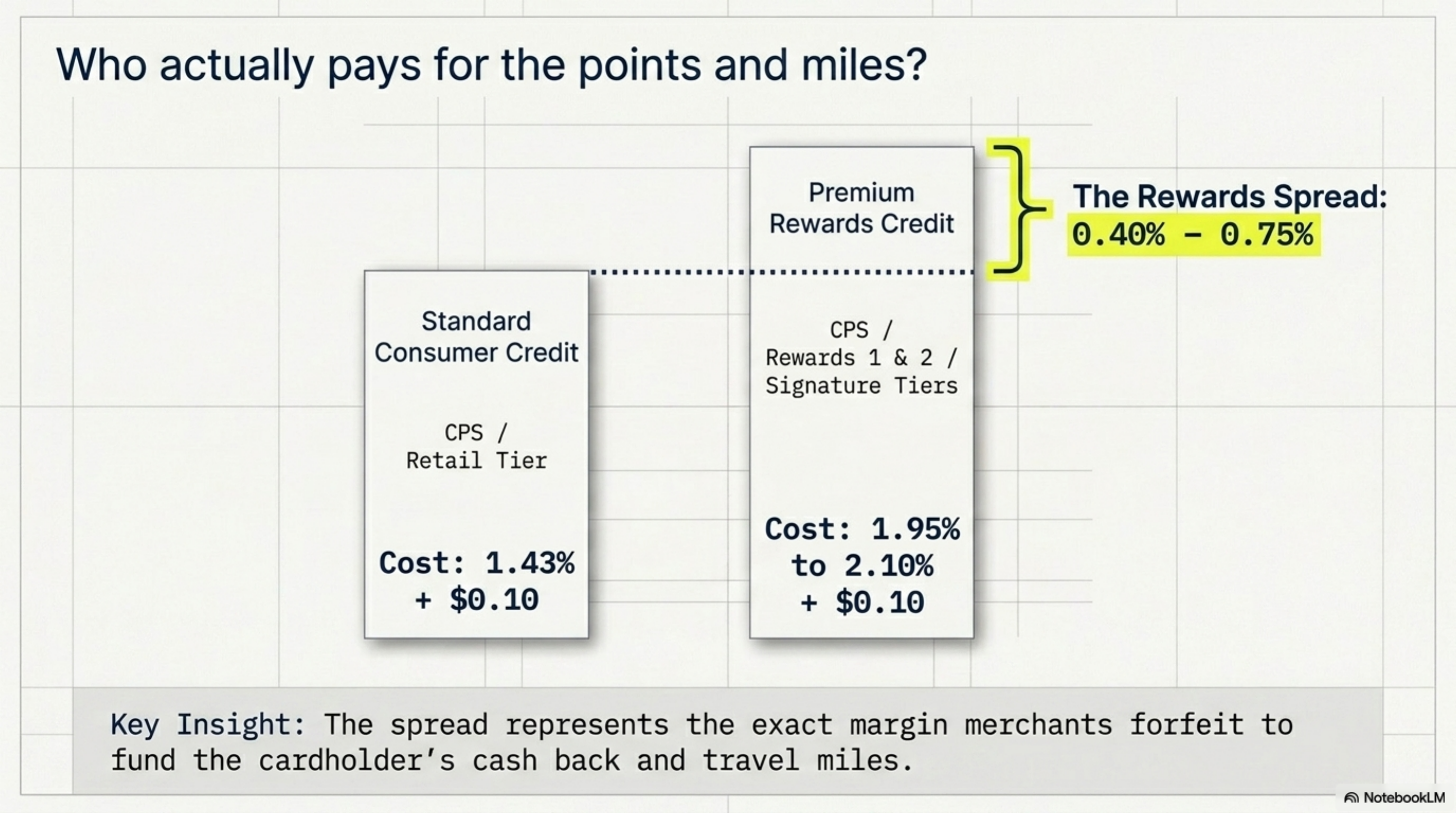
A rewards card surcharge is a fee a merchant adds at checkout when the customer pays with a rewards-branded credit card (Visa Signature, Visa Infinite, Mastercard World, Mastercard World Elite, Amex Platinum, and similar). The point is to recover the higher interchange those products carry. Standard consumer credit interchange on a card-present transaction sits around 1.43 percent plus $0.10 (CPS / Retail tier). A premium rewards card on the same transaction can run 1.95 to 2.10 percent plus $0.10 (CPS / Rewards 1 and CPS / Rewards 2 / Signature tiers) under the Visa USA Interchange Reimbursement Fees schedule. The spread is what funds the cardholder's points, miles, and cash back.
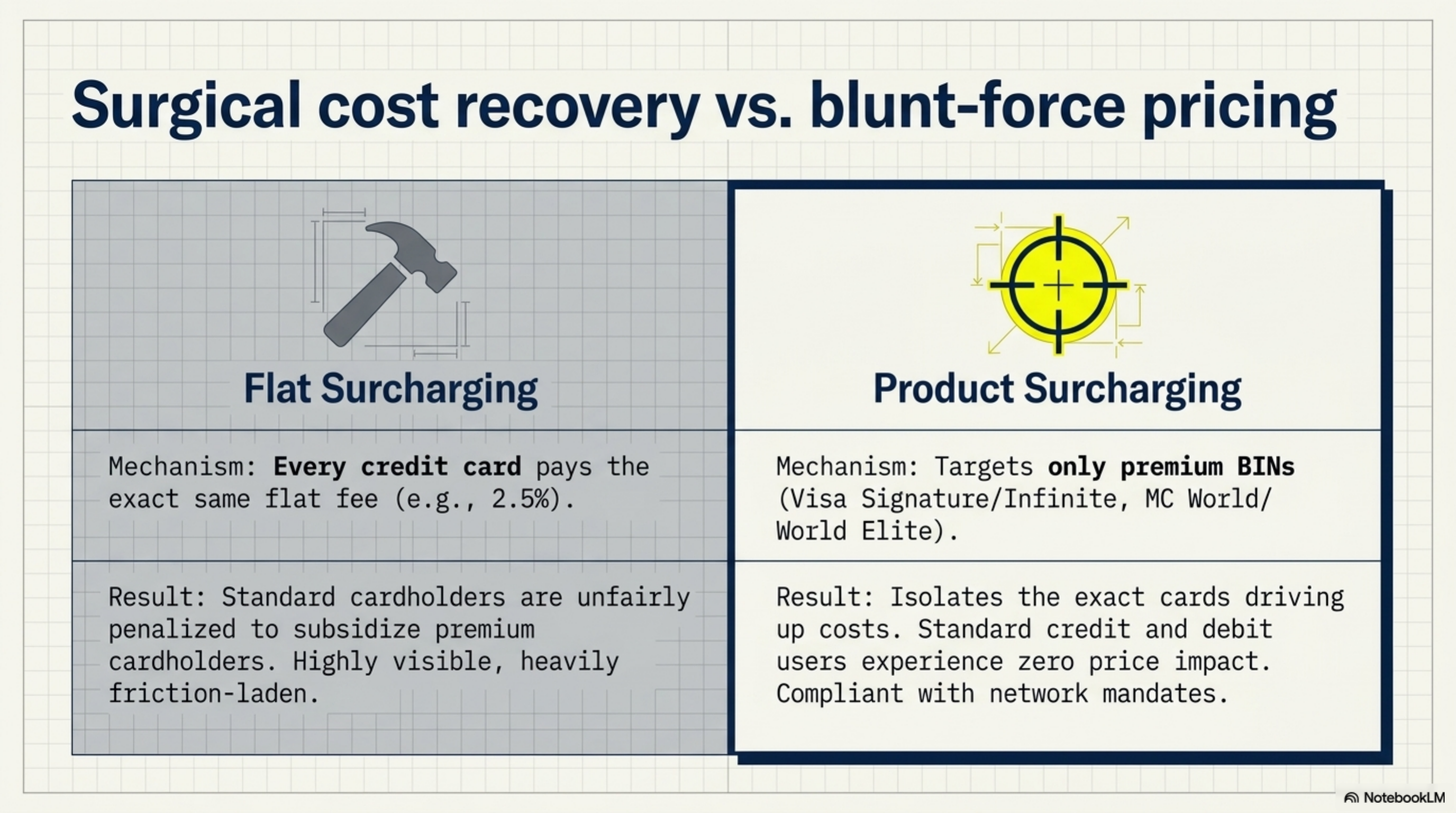
The card networks call this practice product surcharging. It is distinct from a flat credit surcharge, where every card pays the same rate, and from brand surcharging, where all Visa cards pay one rate and all Mastercard cards another. Product surcharging requires real-time card identification at the point of sale, because the surcharge applies only to specific BIN ranges within each network.
A rewards card surcharge is a fee added at checkout, only on premium rewards-branded credit cards, to recover their higher interchange cost.
How it works under the hood
The flow is more complicated than a flat surcharge because the processor has to know what kind of card the customer just presented before it can quote the right price.
- Card insertion or tap. The terminal reads the BIN (the first 8 digits of the card number) and queries the processor for the card product.
- Product lookup. The processor matches the BIN against Visa and Mastercard product files, which classify each BIN as standard, rewards, signature, world, world elite, business, or commercial.
- Surcharge decision. If the BIN is a rewards product on a network the merchant has registered to surcharge, the terminal adds the surcharge as a separate line item, never folded into the base price.
- Receipt disclosure. The receipt must show the surcharge as a discrete line, labeled, and not exceeding the network cap.
- Settlement. The surcharge is part of the authorized amount. The processor collects normal interchange on the gross, including the surcharge, which is why the cap matters.
The caps are set by the networks. Visa's Core Rules cap a U.S. credit surcharge at 3 percent and at no more than the merchant's effective discount rate on that card. Mastercard lowered its U.S. credit surcharge cap to 3 percent in an April 2023 rule update to align with Visa. Amex generally requires equal treatment with other credit cards; Discover follows the network norms in most states.
Merchants must notify each card network and their acquirer in writing at least 30 days before they begin to surcharge. Visa and Mastercard each publish a one-page registration form. The notice locks the surcharge rate the merchant declares; raising it later requires a new 30-day notice.
The 3 percent cap is a ceiling, not a target. Most operators land between 1.0 and 1.8 percent and still recover the full rewards spread.
Where it goes wrong for operators
Four patterns trip up merchants who set up rewards surcharging without reading the fine print.
State-level bans. Two states still ban surcharging outright: Massachusetts and Connecticut. New York's outright ban was struck down on First Amendment grounds in Expressions Hair Design v. Schneiderman, but the state's disclosure rule still controls how the surcharge must be shown to customers. A merchant operating in multiple states needs per-state policies. At $200K in monthly Massachusetts revenue, switching the surcharge on by mistake is a refund obligation plus a state attorney general matter.
Cap stacking. The 3 percent cap is per transaction, not per program. A merchant who already charges a flat 2.5 percent surcharge on all credit and then tries to add a 1 percent premium card charge on top has stacked to 3.5 percent and broken the cap. The fix is either lowering the base or running product surcharging instead of a flat surcharge, not both.
POS software gaps. Older terminals cannot read product BIN tables in real time. The merchant signs up, posts the signs, then learns the equipment cannot tell a Visa Signature from a Visa Traditional and either surcharges everyone or no one. At $1.5M annual volume that mistake costs roughly $4,500 in over-collected surcharge that has to be refunded.
Cap below the recovery rate. On many premium rewards products the effective merchant discount rate runs 2.4 to 2.6 percent. The 3 percent cap covers it. But if the processor's markup is high, say 0.50 percent on top of interchange, a 1.5 percent surcharge may not fully cover the cost. Recover the rewards spread first by negotiating the processing markup down before deciding what to surcharge.
Worked example with real numbers
Consider a single-location casual dining restaurant in Texas. Monthly card volume: $220,000. Average ticket: $48. Card mix from the last 12 statements: 70 percent credit, 30 percent debit. Of the credit, 62 percent is rewards (Visa Signature, Mastercard World, and World Elite), based on the BIN breakdown on the September 2025 statement. Current pricing: interchange-plus 0.30 percent plus $0.10 per transaction.
Monthly rewards credit volume: $220,000 x 70 percent x 62 percent = $95,480. At an average effective interchange of 2.05 percent on rewards versus 1.55 percent on non-rewards (rates drawn from the Visa USA Interchange Reimbursement Fees CPS / Rewards 2 and CPS / Retail tiers), the rewards spread is 0.50 percent of $95,480, which is $477 per month, or about $5,725 per year in incremental cost the merchant is absorbing.
Two outcomes mattered more than the dollar figure. First, customer complaints landed at four per month for the first 60 days and zero by month four, consistent with patterns Nilson Report data shows across surcharging case studies. Second, the rewards share of credit volume dropped 4 percentage points by month six as some regulars shifted to debit, which further reduced the interchange base.
The merchant's effective rate on credit volume fell from 2.35 percent to 1.92 percent net of surcharge collections. That is a 43 basis point improvement on a $185K monthly credit base.
Operator playbook
If you are sitting on a statement showing 60 percent or more of your credit volume on rewards cards, these are the steps to take this week.
- Pull three months of statements and find the BIN summary. Most processors include a card-product breakdown by category (rewards, signature, world, world elite, business). If yours does not, request it in writing. Calculate the rewards percentage of credit volume and the effective interchange rate on each category.
- Calculate the rewards spread. Subtract your non-rewards consumer credit effective rate from your rewards effective rate. Multiply the difference by rewards monthly volume. That dollar figure is what the surcharge program needs to recover at minimum.
- Check state law. Confirm you do not operate in Massachusetts or Connecticut. For all other states, confirm whether the state has a disclosure rule (New York) and what the signage requirements are.
- File the 30-day notice. Submit the Visa Merchant Surcharge Notification form and the Mastercard equivalent through your acquirer. Pick a surcharge rate at or below 3 percent and at or below your effective discount rate on rewards.
- Reprogram the POS. Confirm with the vendor that the terminal can identify product BINs in real time and apply the surcharge only to rewards credit. Run a test mode for 7 days before going live.
- Post the signage. Networks require notice at point of store entry and at the POS. Receipts must show the surcharge as a discrete line. The networks audit signage, and missing signs are the most common fine trigger (see the non-compliance assessments schedule in the Visa Core Rules, which sets first-occurrence assessments at $5,000).
- Train staff on the script. A one-line answer to "why is there an extra charge" prevents most customer pushback. Sample: "It is a fee from your card issuer for the rewards program on that card. Debit cards have no fee."
- Audit at day 60. Pull the first two months of post-launch statements. Confirm the surcharge was applied to the right BINs, the cap was not exceeded, and the recovery matches your projection. Adjust the rate up or down within the cap if needed, with another 30-day notice.