TL;DR
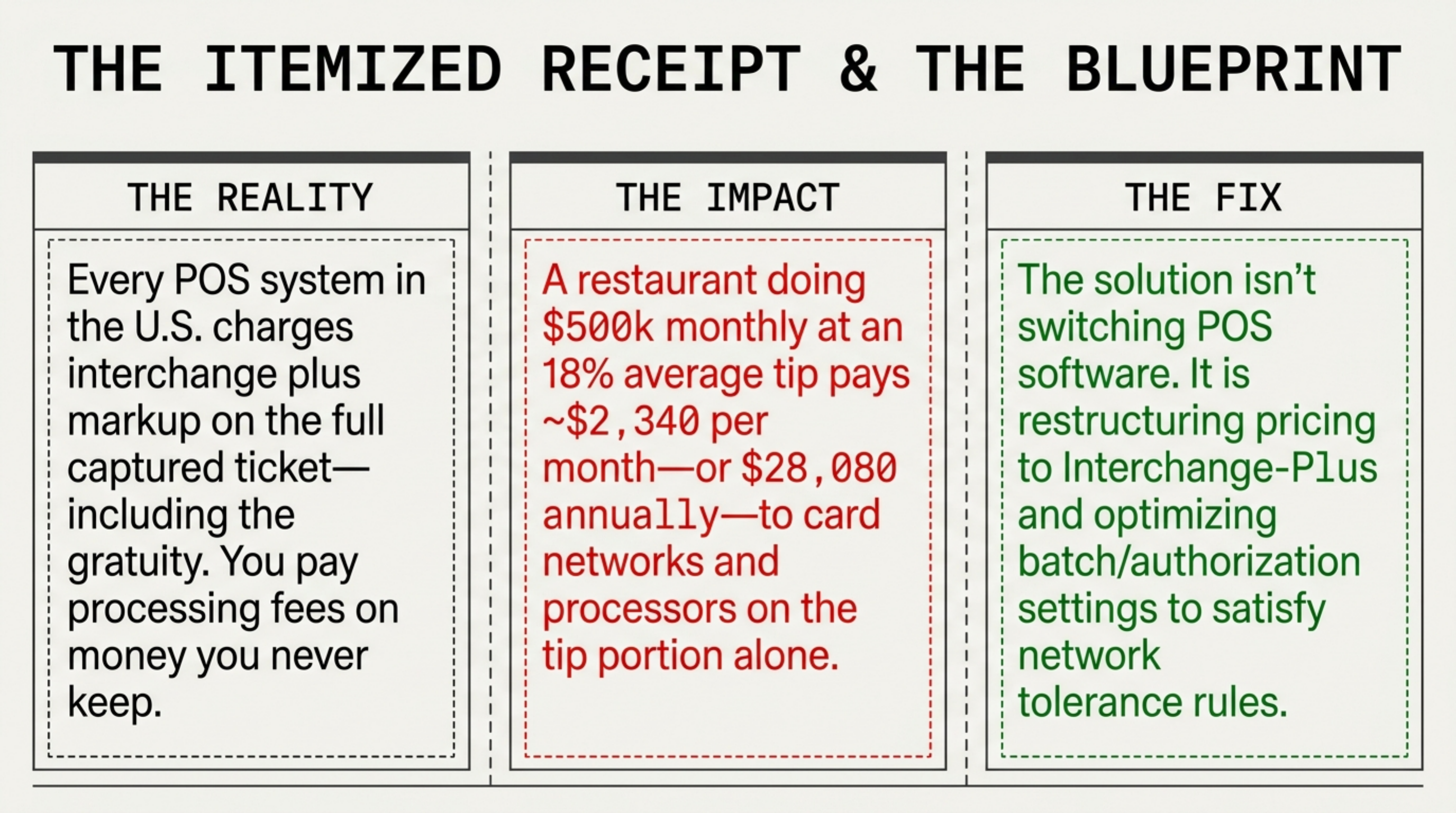
Every POS system in the United States charges interchange plus processor markup on the full captured ticket, including the tip. A restaurant doing $500,000 monthly at 18 percent average tip pays roughly $2,340 per month, or $28,080 per year, in card fees on the tip portion alone. The fix is not switching POS vendors. It is moving from flat-rate or tiered pricing to interchange-plus and confirming your processor settles tips on the original authorization line within Visa CPS Restaurant tolerance.
What this actually is
When a guest taps or dips a card at a restaurant POS, the terminal authorizes a base amount. The server then enters the tip after the meal, and the terminal sends a second settlement message to capture the final total including the gratuity. Both Visa and Mastercard treat the tip as part of the same transaction for pricing purposes, which means interchange is calculated on the captured total, not the original auth.
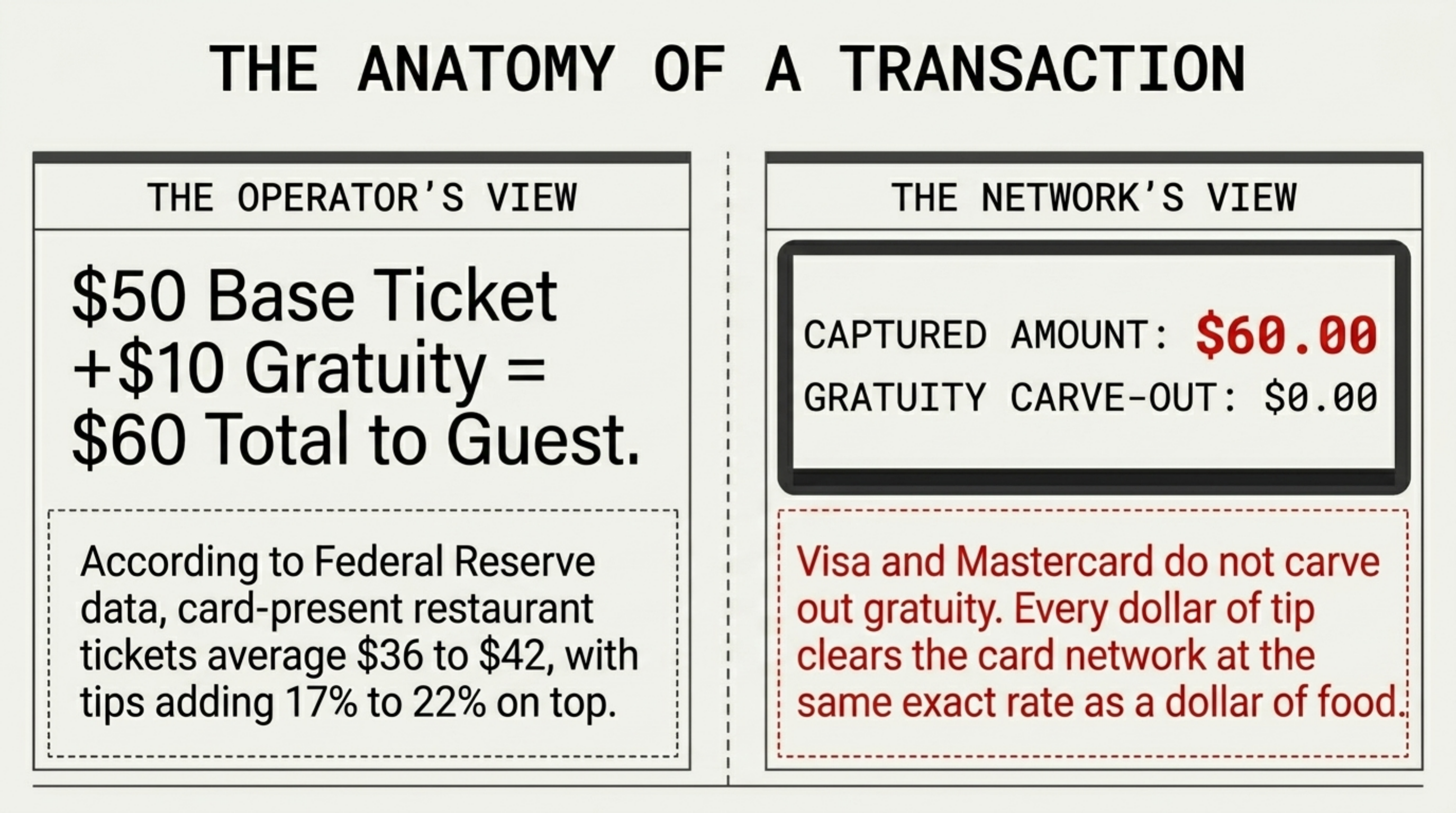
Federal Reserve payments data shows that card-present restaurant transactions in the United States average $36 to $42 per ticket. Tips on those tickets add 17 to 22 percent on top, varying by region and service style. Visa publishes its restaurant interchange schedule openly on its small-business regulations and fees page. Mastercard publishes a parallel schedule. Both networks list rates as a percentage of the captured amount plus a per-item fee, with no carve-out or discount for the gratuity portion.
The result: a $50 ticket with a $10 tip is treated as a $60 transaction for interchange. The processor's discount rate, whether flat or interchange-plus, applies to the full $60. The merchant pays card-processing fees on money the merchant never keeps. For a typical restaurant doing $500,000 monthly card volume at 18 percent average tips, the tip-portion processing fee runs $2,200 to $2,400 per month, depending on the pricing plan.
Most operators do not see this number broken out. Processor statements show total fees as one bundle. The tip-portion cost is buried inside the effective rate, and no sales rep at a flat-rate POS will surface it for you.
A tipping fee on a POS system is the percentage and per-item interchange and processor markup charged on the gratuity portion of a card sale alongside the base ticket.
How it works under the hood
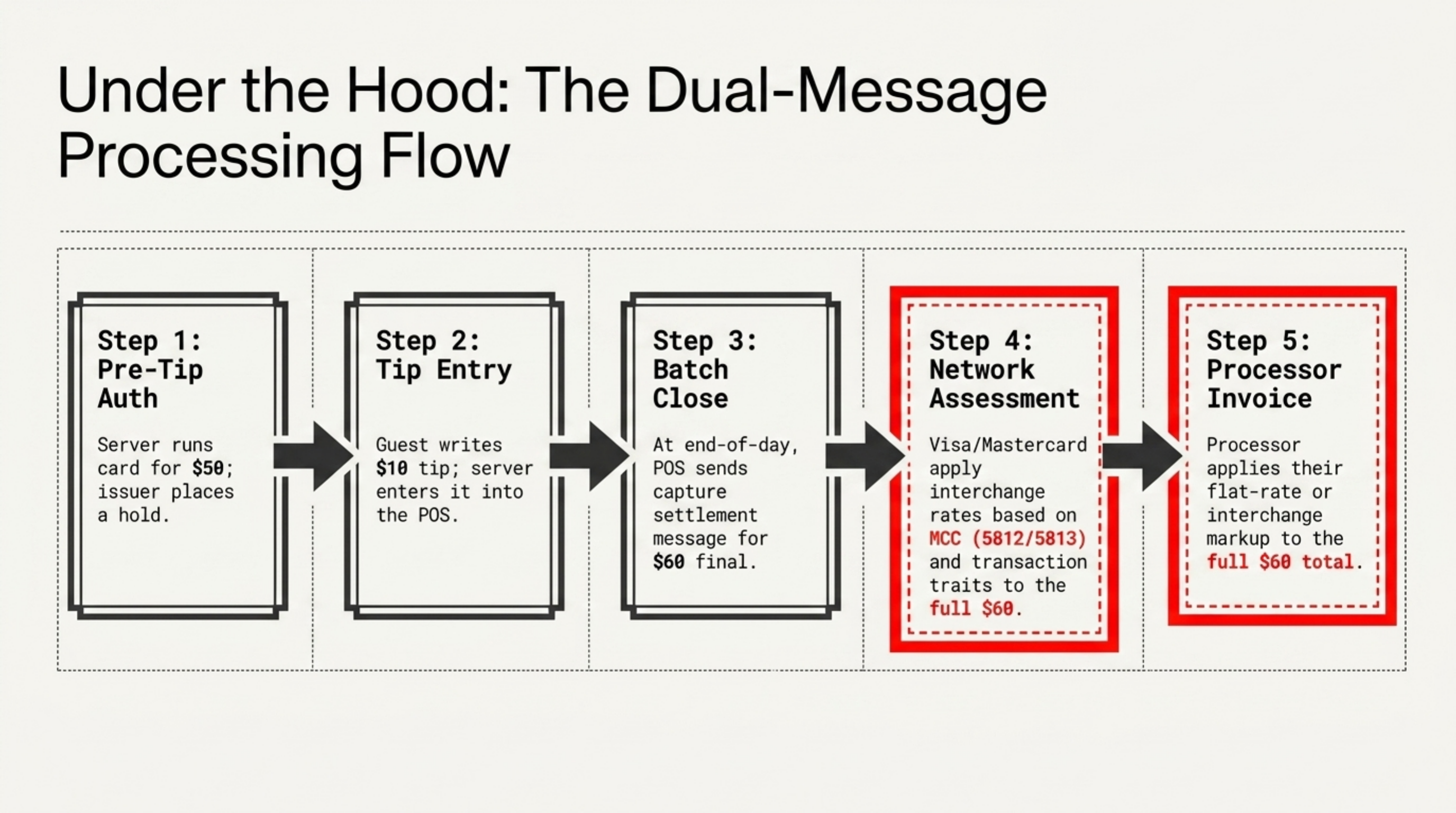
Restaurant POS systems use a two-message flow called auth and capture, sometimes called dual-message processing. The numbered sequence below walks through what happens when a card with a tip is processed at a sit-down restaurant.
- The server runs the card for the pre-tip total. The POS sends an authorization request for, say, $50. The issuer approves and places a hold on the cardholder account.
- The guest signs the receipt and writes a tip of $10. The server enters the tip into the POS. Most restaurant POS systems batch these tip adjustments and send them at end-of-day close.
- At batch close, the POS sends a capture or settlement message for the final amount, in this case $60. Interchange and assessments are calculated on the $60.
- The acquirer routes the settlement file to Visa, Mastercard, Discover, or American Express. Each network applies its published interchange rate based on the card type, MCC code, and transaction characteristics.
- The processor invoices the merchant. On a flat-rate plan, the merchant sees a single line: 2.6 percent plus 10 cents per transaction, applied to the captured $60. On interchange-plus, the merchant sees the interchange line of around 1.65 percent plus 10 cents for a Visa Traditional Rewards card at a restaurant MCC, plus the processor's fixed markup.
Visa's restaurant interchange schedule lists CPS Restaurant rates that apply when the transaction is captured within Visa's defined window and within a tip tolerance of 20 percent above the original auth amount. If the final tip pushes the total above 120 percent of the auth, the transaction can downgrade to a non-qualified or Standard rate, which can add 0.30 to 0.50 percent to the interchange cost. Mastercard publishes a similar tip tolerance rule under its Convenience Purchase program for restaurant MCCs 5812 and 5813. Both networks require the capture to happen within a defined window, typically 24 to 72 hours depending on the program.
Debit transactions add a wrinkle. PIN debit runs single-message and clears in real time, so tip-adjust is not always supported on debit cards routed that way. Signature debit follows the same dual-message flow as credit and supports tip adjust. Most restaurant POS systems force signature debit by default to allow the tip-adjust workflow, which means the merchant pays the signature-debit interchange rate rather than the lower PIN-debit rate, often a difference of 0.10 to 0.20 percent.
Every dollar of tip clears the card network at the same rate as a dollar of food. The interchange schedule does not distinguish between the two.
Where it goes wrong for operators
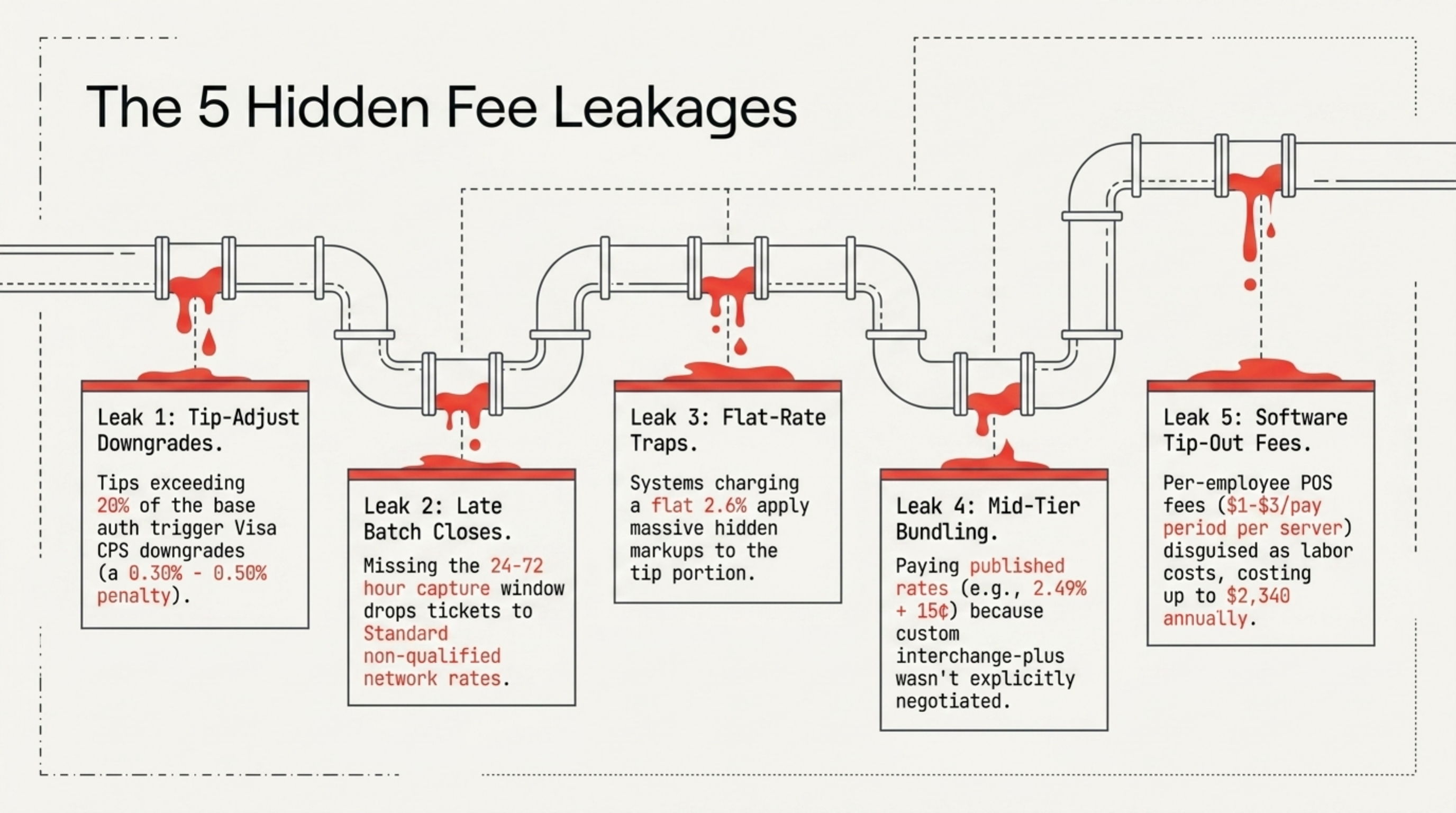
Five patterns cost restaurant operators real money on tipping fees, none of which appear on the contract face page.
First, tip-adjust downgrades. If a guest tips above 20 percent of the base auth, the captured amount exceeds Visa's tip tolerance, and the transaction can downgrade to a higher interchange tier. At $400,000 monthly volume with a 5 percent downgrade rate, the extra cost is roughly $400 per month in surcharges. The fix is incremental authorization at the moment the tip is entered, which most modern POS platforms support but rarely enable by default.
Second, late batch closes. Visa CPS Restaurant requires capture within a defined window after authorization. POS systems that batch tips manually, or restaurants that close the batch on the next business day after a busy Friday night, can miss the window and pay 0.30 to 0.50 percent in downgrade fees. A $500,000 monthly restaurant losing 8 percent of volume to late batches pays around $200 monthly in avoidable downgrades, or $2,400 per year.
Third, flat-rate processors on high-tip operations. Square, Toast Standard, and Clover Flex all charge a flat percentage on the captured total. At 2.6 percent on a $500,000 restaurant with 18 percent tips, the effective markup on the tip portion is identical to the markup on food. Switching to interchange-plus at 0.25 percent markup saves approximately 0.40 to 0.55 percent on the tip portion, or $360 to $495 per month on tips alone, before counting the savings on the food portion.
Fourth, mid-tier POS bundled processing. Toast Standard charges 2.49 percent plus 15 cents card-present, with the percentage applied to the full captured total including tip. Toast Custom can drop the percentage to interchange-plus by negotiation, but the merchant must ask. Most operators take the published rate without requesting the custom tier because the sales rep is not paid to mention it. The same pattern applies to Clover bundled programs through Fiserv and to most ISO-branded POS bundles.
Fifth, tip-out fees inside the POS. Some POS platforms charge per-employee tip distribution fees, often $1 to $3 per pay period per server. At 30 employees over 26 pay periods, that runs $780 to $2,340 annually with no card-processing logic involved. It is a software fee disguised as a labor cost and rarely shows up on a processor statement at all, since it bills through the POS subscription.
Each pattern is fixable with one phone call or one statement audit. None of them go away on their own.
Worked example with real numbers
Profile: a 90-seat full-service restaurant in Austin, Texas. Monthly card volume of $480,000 across roughly 12,000 transactions. Average ticket of $40 pre-tip. Average tip rate of 19 percent. Current processor is a major flat-rate POS vendor charging 2.49 percent plus 15 cents card-present and 3.5 percent plus 15 cents card-not-present. Card-not-present volume is roughly 5 percent, from online ordering.
Monthly tip volume: $480,000 times 19 percent equals $91,200. Total captured volume on cards including tips: $480,000 plus $91,200 equals $571,200.
At 2.49 percent plus 15 cents per ticket on 12,000 transactions: $14,222 in percentage fees plus $1,800 in per-item fees equals $16,022 per month. Annual: $192,264. Of that, the tip portion alone drives $91,200 times 2.49 percent, or $2,271 per month, or $27,253 per year. The merchant has paid $27,253 to card networks and the processor on dollars that go directly to staff.
Switch to interchange-plus at 0.25 percent markup over published interchange. Estimated blended interchange for a restaurant card mix: roughly 1.75 percent plus 10 cents per transaction. That assumes mostly CPS Restaurant on Visa Traditional Rewards and Mastercard Core Value, with some premium reward cards mixed in at 2.10 percent. New effective rate: 1.75 plus 0.25 equals 2.00 percent, plus a blended 20 cents per transaction. Monthly cost: $571,200 times 2.00 percent equals $11,424, plus $2,400 per-item, equals $13,824. Annual: $165,888.
Savings: $192,264 minus $165,888 equals $26,376 per year. Of that, the tip-portion savings alone is approximately $4,469 per year. Over a five-year POS contract, total savings clear $130,000.
Operator playbook
- Pull three months of processor statements. Calculate effective rate by dividing total fees by total volume, including tips. Compare the result to the rate printed on your contract. The gap is your true markup, and the larger that gap, the more room you have to negotiate.
- Calculate your tip-portion processing cost directly. Take monthly tip volume, which is gross card sales times average tip percentage, and multiply by your effective rate. This is the line nobody at your processor will show you, and it is usually the number that wins a renegotiation.
- Request a downgrade report from the processor. Ask for the percentage of monthly volume captured at non-qualified or Standard interchange tiers. Anything above 3 percent points to tip tolerance or batch-close issues that an incremental-auth setting will fix.
- Confirm your batch close happens within 24 hours of authorization. POS settings often default to manual close. Switch to auto-close at end of business day and verify the timestamp on the first batch report.
- Get interchange-plus quotes from three processors that integrate with your existing POS. Specify 0.20 to 0.30 percent markup over interchange with no monthly minimum. Tell each one you are getting competing quotes and ask for the schedule A in writing.
- Audit per-employee tip distribution fees inside the POS. If your platform charges per server per pay period for tip splits, calculate the annual cost and compare to free third-party tools or built-in payroll integration.
- Ask your processor in writing whether your settled transactions use the CPS Restaurant program for Visa and Convenience Purchase for Mastercard. Both require tip tolerance compliance and capture within window. If the answer is unclear, your tickets are likely downgrading.
- Renegotiate annually. Processing rates for restaurants have come down 0.10 to 0.20 percent per year since 2022, per Nilson Report data on acquirer revenue compression. Your contract should reflect that, or it is time to switch.
Interchange-plus at 0.25 percent markup beats flat-rate by 0.40 to 0.55 percent on the captured total, tips included. That gap is your annual savings.