TL;DR
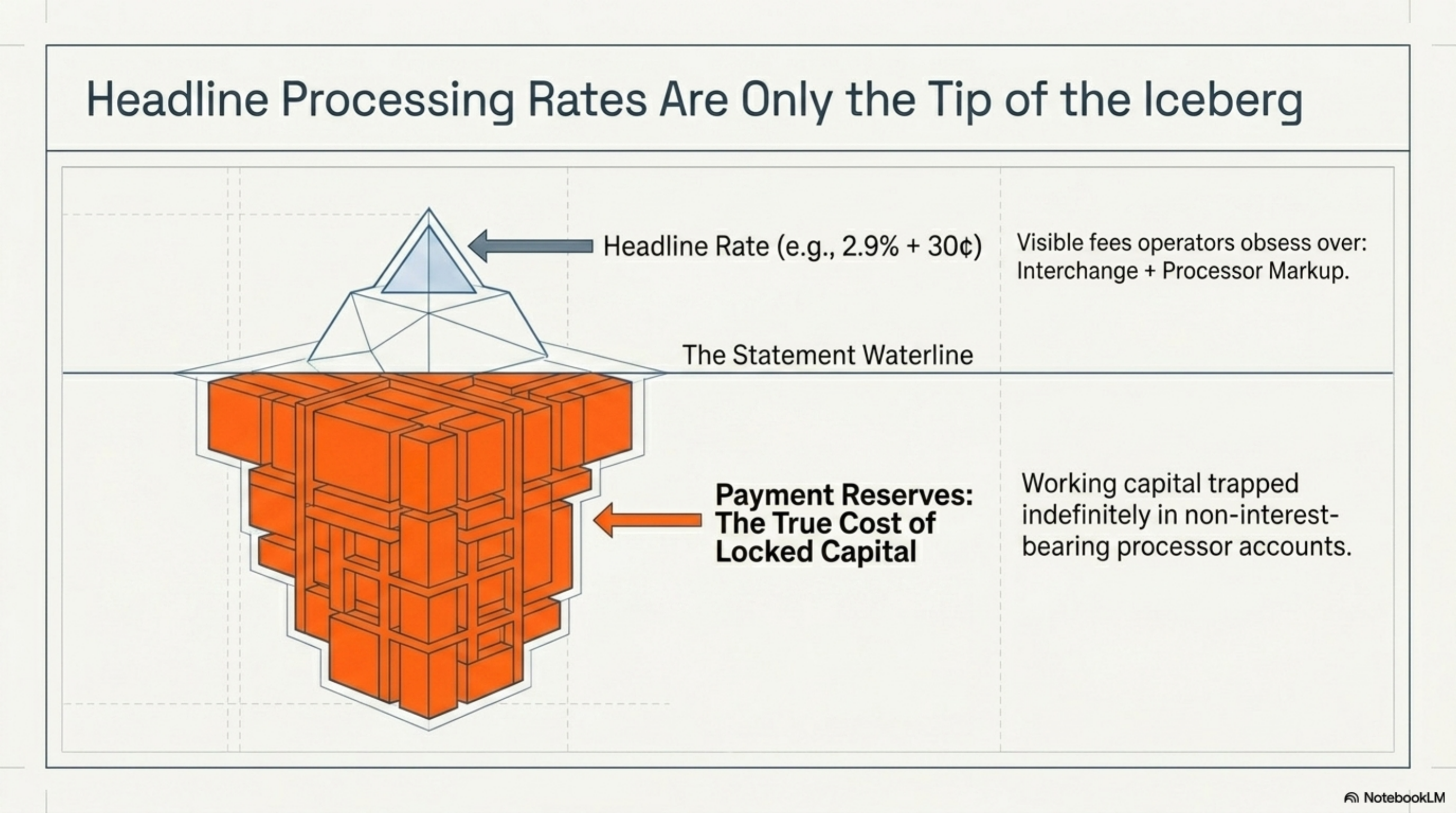
Payment processors hold reserves to cover chargeback and refund risk, and the cost shows up as locked cash, not as a line item on your rate sheet. A 10 percent rolling reserve on $500K of monthly card volume with a 180 day release period locks roughly $300K of working capital indefinitely, because new sales replenish the pool faster than old withholds release. The real cost is your financing rate on that locked balance. Pull the reserve clause from your contract, model the steady-state balance at three growth scenarios, and price it at your cost of capital before any renewal.
What this actually is
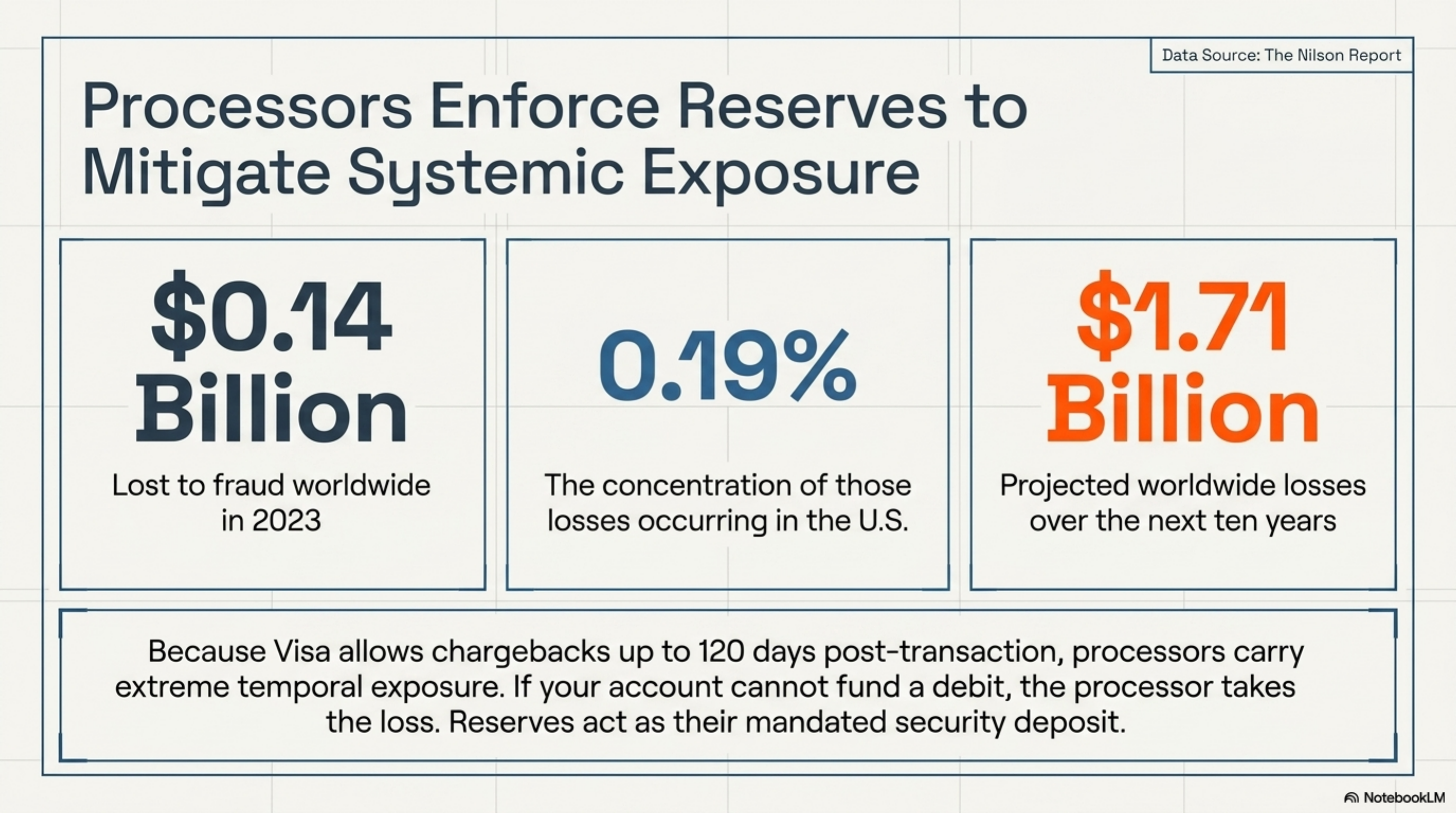
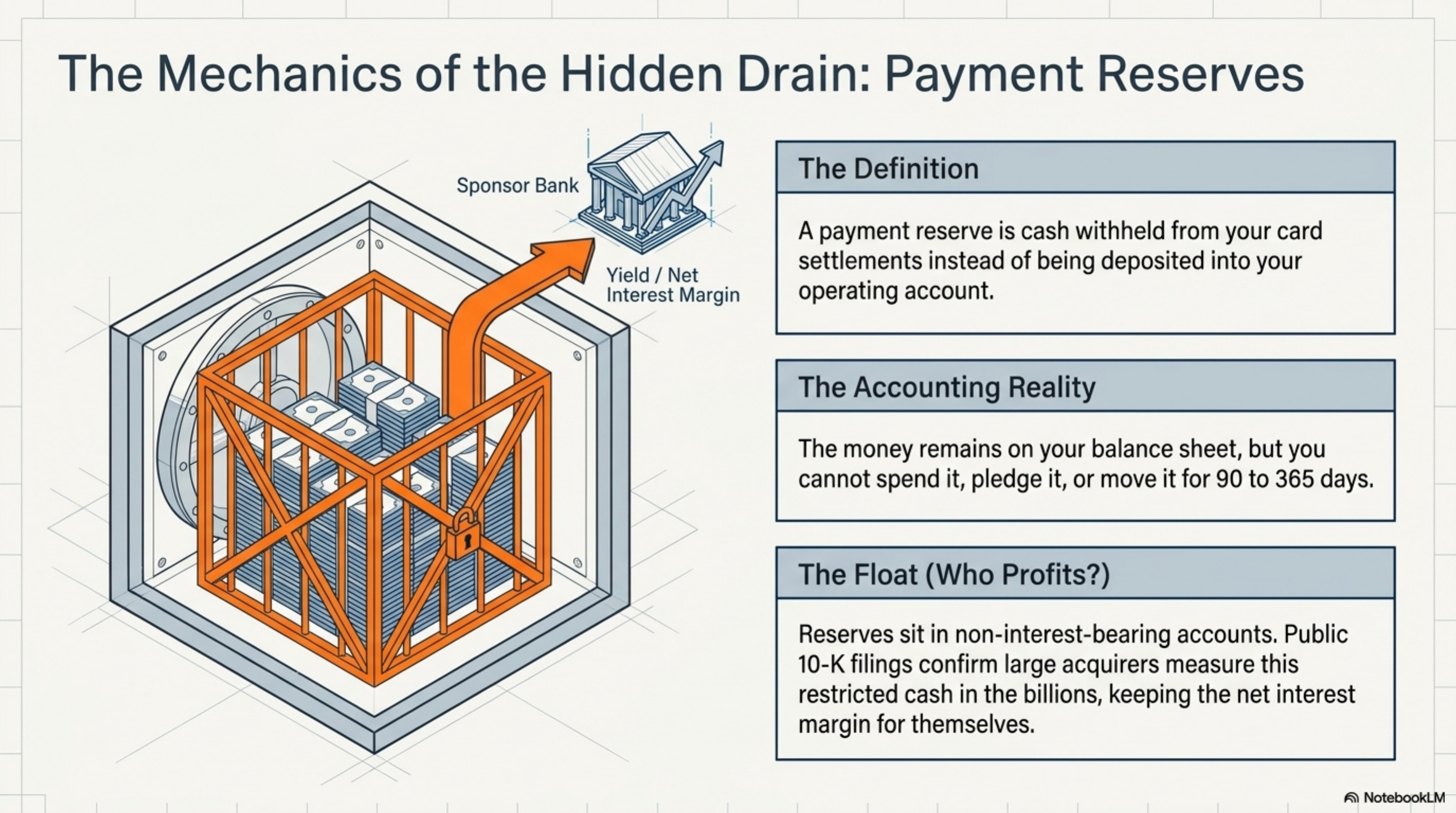
A payment reserve is cash from your card settlements that the processor withholds instead of depositing into your bank account. The money still belongs to you on the balance sheet, but you cannot spend it, pledge it, or move it. Processors hold reserves to cover their exposure when a chargeback, refund, or fraud loss hits after the original settlement and your operating account cannot fund the debit.
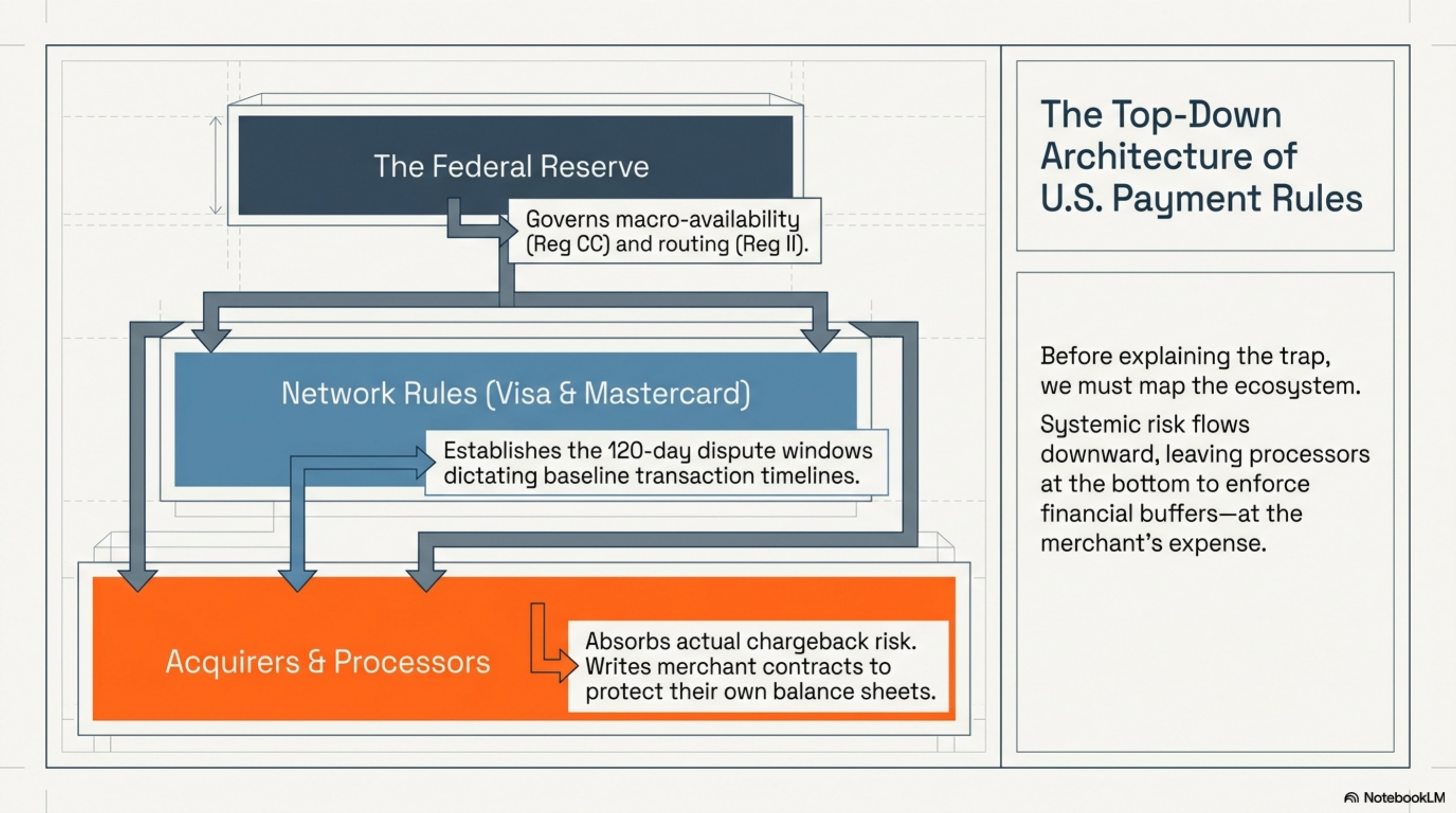
The Federal Reserve Payments Study tracks the underlying chargeback and dispute economics across the U.S. card system, documenting non-cash payment volumes and unauthorized transaction rates that drive how much exposure processors carry. Card network rules, published by Visa in its Core Rules and by Mastercard in its interchange and chargeback documentation, set the dispute windows that drive how long reserves sit. A Visa chargeback can be filed up to 120 days from the transaction date for most reason codes, and Mastercard's window is similar, which is why 180 day reserve periods are the industry default.
Three structures show up in merchant contracts. Rolling reserves withhold a fixed percentage of every settlement batch. Capped reserves build up to a fixed dollar ceiling and then stop withholding new funds. Upfront reserves are taken as a lump sum, either deducted from early settlements or wired in from your operating account when the account is boarded.
What you rarely see in the contract is a hard release date. Most agreements give the processor discretion to extend the hold based on dispute trends, volume changes, or underwriting review, which turns a stated 180 day period into an open-ended commitment in practice.
A payment reserve is processor-withheld merchant funds, typically 5 to 20 percent of card volume held for 90 to 365 days, to cover potential chargebacks, refunds, and fraud losses.
How it works under the hood
Here is how the cash actually moves. The customer pays, the issuing bank authorizes, and Visa or Mastercard routes the transaction to your acquirer. The acquirer receives funded settlements from the networks. Before pushing those settlements to your bank account, the processor applies the reserve formula written into your contract.
For a rolling reserve, the processor splits each settlement batch. A 10 percent reserve on a $20,000 batch sends $18,000 to your operating account and parks $2,000 in a reserve ledger. After the agreed hold period, often 180 days, that $2,000 releases back to you on a rolling basis as older funds age out.
For a capped reserve, the processor follows the same withhold logic until the reserve ledger hits a dollar ceiling, then deposits 100 percent of each batch until the cap is breached again by refund or chargeback debits. Caps are typically set as a multiple of monthly chargeback exposure, not a percentage of volume.
For an upfront reserve, the processor either deducts a flat amount from early settlements until the target is funded, or wires the amount from your operating account at contract signing. Upfront reserves usually persist for the full contract term plus a tail of 90 to 180 days after closure.
The flow in numbered form:
- Card transaction clears the network and the processor receives the settlement.
- The processor applies your contract's reserve percentage to the batch.
- Reserved funds move into a segregated ledger under the processor's control.
- Your bank account receives the net amount, less interchange, processor markup, and the reserve.
- Chargebacks and refunds during the hold period are debited from the reserve first, before touching your operating account.
- Funds release back to you on the schedule specified in the contract, typically starting after 90 to 180 days.
Reserves sit in a non-interest-bearing account controlled by the processor or its sponsor bank. The processor's own 10-K filings disclose this practice. Public filings from Block, PayPal, and other large acquirers describe restricted cash and reserves measured in the billions. You earn nothing on the balance. The processor or sponsor bank earns the net interest margin or float.
The Nilson Report ranks the largest U.S. merchant acquirers by purchase volume. The same firms holding the most reserves are also the largest by Nilson's rankings, which means restricted cash is a meaningful component of their balance sheet, not a pass-through bookkeeping entry.
Where it goes wrong for operators
Pattern 1: The reserve compounds with growth. A 10 percent rolling reserve at $300K monthly volume locks $180K when fully ramped. At $600K monthly volume, it locks $360K. Every dollar of new sales contributes 10 cents to a pool that takes six months to release. Growth multiplies the locked balance one to one with revenue.
Pattern 2: Open-ended release language. Most contracts state a 180 day release period, then add a clause giving the processor the right to extend the hold if dispute rates rise, the merchant's risk profile changes, or the underwriting committee requests review. Operators read the 180 day number, miss the clause, and discover later that the hold is indefinite in practice.
At $1M monthly volume, a 10 percent rolling reserve indefinitely locks roughly $600K of cash. That equals 60 days of working capital that cannot fund inventory or payroll.
Pattern 3: Reserve increases triggered by chargeback ratios. Visa's Dispute Monitoring Program and Mastercard's Excessive Chargeback Program identify merchants whose dispute count or ratio crosses published thresholds, generally a 0.9 to 1.5 percent dispute ratio with 100 or more disputes per month. Once flagged, processors raise reserves, often doubling the percentage or extending the period to 365 days. The contract gives them unilateral authority. You find out by email or by watching your settlement amount drop overnight.
Pattern 4: Reserves on top of MATCH risk. If your account is terminated for cause and you land on the MATCH list, the original processor can hold the reserve for the full chargeback window before releasing, even though the account is closed and producing no revenue. Your money sits while you are also paying setup, monthly minimums, and statement fees at a new high-risk processor.
Pattern 5: Layered fees on reserve activity. Some processors charge a monthly reserve maintenance fee, a chargeback fee debited from the reserve, and a release fee when funds return. None of these appear in the headline rate. They show up as line items in the reserve sub-statement most operators never pull.
Read the clause that defines when the processor may modify the reserve. If it says "in its sole discretion" or "based on changes in risk profile" with no objective threshold, your stated 180 day hold is functionally open-ended.
Worked example with real numbers
Operator profile: a direct-to-consumer supplement brand. Monthly card volume $400,000. Average order value $58. Roughly 6,900 transactions per month. Current processor: a payment facilitator on a flat-rate contract at 2.9 percent plus 30 cents per transaction. Reserve terms: 10 percent rolling reserve, 180 day hold, applied after the underwriting team flagged the supplement vertical as elevated risk.
Step 1. Locked reserve balance at steady state. Monthly volume $400,000 multiplied by 10 percent equals $40,000 withheld per month. Six months of withholds, all sitting until the first month's batch releases, equals $240,000 of locked cash at steady state.
Step 2. Working capital cost. If the operator's cost of capital is 12 percent, the carrying cost of $240,000 is $28,800 per year. If the operator instead draws on a working capital line at 16 percent to replace the locked cash, the annual cost is $38,400.
Step 3. Growth scenario. The brand projects 25 percent year-over-year growth, taking monthly volume to $500,000 by month 12. Steady-state reserve balance grows to $300,000. The incremental locked capital of $60,000 is financed at the same 12 to 16 percent, adding $7,200 to $9,600 in annual carry.
Step 4. Total annual processing cost. Headline processing fees: $400,000 multiplied by 2.9 percent equals $11,600 per month in percentage fees, plus 6,900 transactions multiplied by $0.30 equals $2,070 per month in per-item fees, totaling $13,670 monthly or $164,040 annually. Reserve carrying cost: $28,800 to $38,400 annually. Effective all-in cost: 3.36 to 3.45 percent of volume, depending on how the operator finances the reserve.
The reserve adds 46 to 55 basis points to the true cost of processing, none of which appears in any rate quote, statement summary, or pricing comparison tool.
Step 5. The alternative. At roughly 1.7 percent interchange-plus markup with no reserve from a direct acquirer, processing cost falls to about $108,000 annually. Removing the $240,000 reserve frees that working capital. Total annual cash improvement at this volume: $56,000 to $94,000, depending on the financing rate used to price the reserve.
A $400K-per-month supplement brand on a 2.9 percent flat-rate plan with a 10 percent rolling reserve runs an effective all-in cost of 3.36 to 3.45 percent. Moving to a direct acquirer at 1.7 percent interchange-plus with no reserve saves $56,000 to $94,000 annually and returns $240,000 to operating cash.
"Most merchants on flat-rate plans with reserves underestimate the true cost of processing by 40 to 60 basis points."
Operator playbook
- Pull the reserve clause verbatim from your merchant agreement. Look for the section labeled Reserve, Security, or Holdback. Print the exact language, including any sub-paragraph that gives the processor discretion to modify the percentage or period.
- Calculate steady-state locked capital at three volumes. Use current monthly volume, the 12 month projection, and the 24 month projection. Formula: monthly volume multiplied by reserve percentage, multiplied by hold period in months.
- Price the locked capital at your true cost of capital. Use your weighted average cost of capital or your working capital line rate, whichever you would actually draw on to replace the cash. Convert the carrying cost to basis points of volume so it compares directly to your rate.
- Request a written release schedule. Ask the processor to provide dated release amounts for each month's withholds. If they will not put dates in writing, that is the answer about whether the 180 day period is real.
- Pull the reserve sub-statement for the last six months. Identify every fee charged against the reserve: maintenance, chargeback, release, statement. Add these to your effective processing cost calculation.
- Negotiate three levers in this order. Reduce the percentage withheld, shorten the hold period, then tighten the trigger language for increases. A reduction from 10 percent to 5 percent on $500,000 monthly volume frees $150,000 of working capital at full ramp.
- Replace discretion clauses with objective triggers. Ask for chargeback ratio, dispute count, or volume change thresholds spelled out as numbers. Get them into a contract amendment, not an email.
- Treat the reserve as a financing cost when shopping processors. A direct acquirer with no reserve at a slightly higher headline rate often wins on total annual cash impact.
"If you cannot model the reserve as a financing cost on one spreadsheet row, you are guessing on six figures of cash."