TL;DR
Of the eight processors most U.S. operators consider, only Worldpay runs a dedicated high-risk underwriting desk with custom rolling-reserve and chargeback-management programs. Stripe, Square, and PayPal publish prohibited-business lists that exclude most high-risk MCCs at signup. Helcim, Stax, Payment Depot, and Clover sit in the middle: they accept mid-risk verticals but close accounts when chargeback ratios push above one percent. For CBD, firearms, nutraceuticals, adult, or continuity-billing merchants, Worldpay is the closest mainstream option in this set.
How we ranked
High-risk-friendly is not a marketing label; it is an underwriting posture. We weighted six criteria against the public risk programs published by the card networks.
- MCC acceptance. Does the processor accept high-risk MCCs (CBD 5912 or 5499, firearms 5999, adult 5967, nutraceuticals 5122, online gambling 7995, dating 7273)?
- Rolling reserve terms. Reserve percentage held back and the release schedule (90, 180, or 270 days).
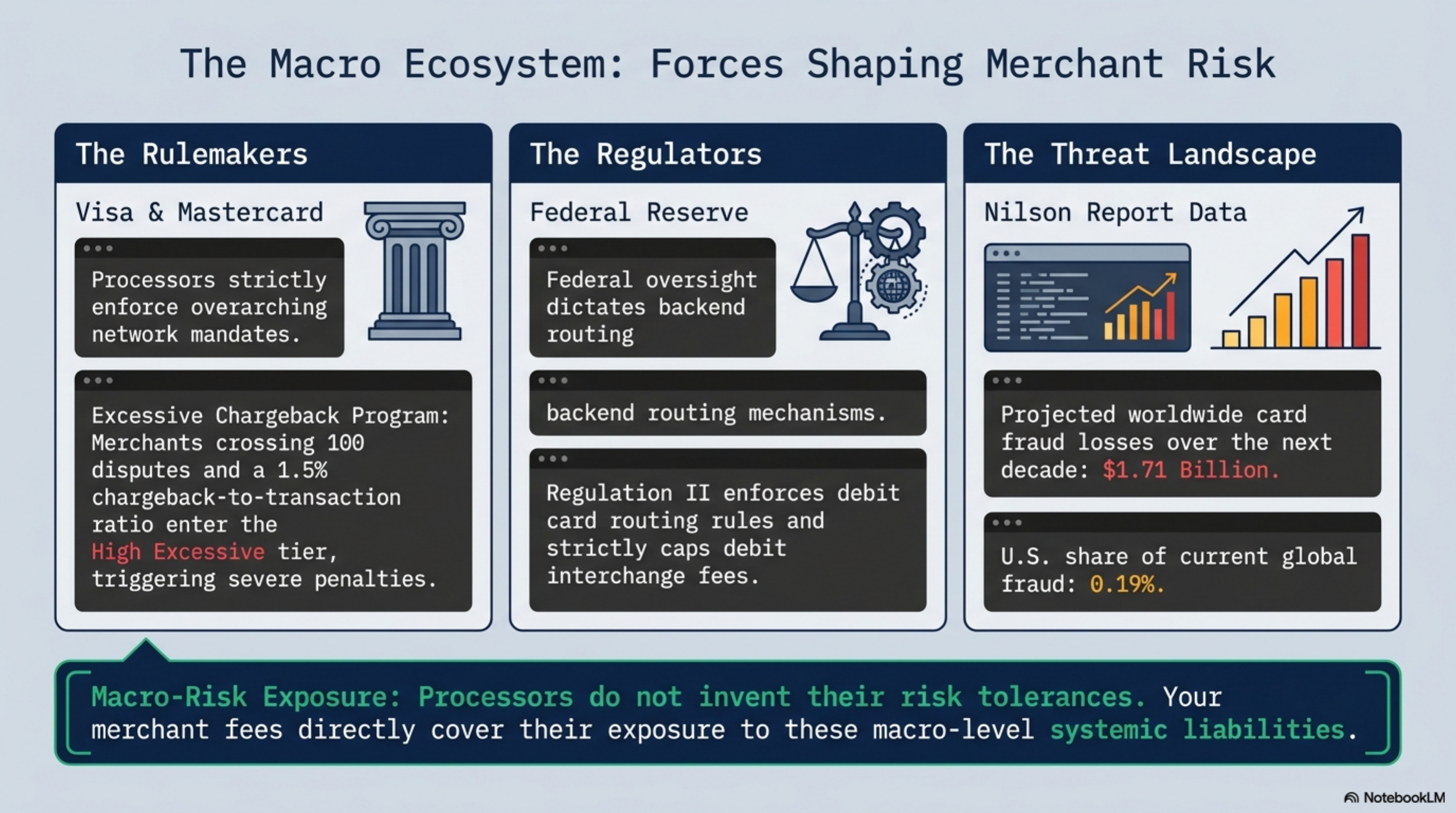
- Chargeback tolerance. Basis-point threshold before account review or termination, measured against Visa's published dispute and acquirer monitoring rules.
- Funding hold policy. How quickly the processor freezes settlements after a dispute spike.
- Underwriting timeline. Same-day signup versus multi-week underwriting for high-risk MIDs.
- Settlement speed. Funds availability for approved accounts.
At a glance
Eight providers, ordered by how willing they are to underwrite a high-risk MID, not by headline pricing alone.
| Provider | Headline pricing | Contract | Settlement | Best for | Watch out for |
|---|---|---|---|---|---|
| Worldpay | Custom IC+, contact sales | 1 to 3 year | 1 day | High-risk over $100K/mo | 7 to 14 day underwriting; rolling reserves |
| Helcim | IC + 0.50% + $0.25 online | None | 2 days | Mid-risk B2B and retail | Declines most high-risk MCCs |
| Stax | $99/mo + IC + $0.08 in-person | Month-to-month | 2 days | $50K+ low-risk volume | Standard underwriting; no high-risk desk |
| Payment Depot | $79 to $199/mo + IC + $0.05 to $0.15 | Month-to-month | 2 days | $25K+ low-risk volume | Same underwriting posture as Stax |
| Clover | $14.95 to $54.95/mo + 2.3 to 2.6% | 1 to 3 year hardware | 1 day | Brick-and-mortar low-risk retail | Hardware lock; Fiserv backend declines high-risk |
| Stripe | 2.9% + $0.30 online | None | 2 days | Low-risk SaaS and e-commerce | Published restricted-business list |
| Square | 2.6% + $0.10 in-person | None | 1 day | Retail and food service | 180-day fund holds on flagged accounts |
| PayPal | 3.49% + $0.49 standard | None | 1 day | Consumer checkout button | Acceptable Use Policy excludes high-risk verticals |
Worldpay
Worldpay is the only processor on this list with a dedicated high-risk merchant program. Pricing is custom interchange-plus, with no public flat rate; per the Worldpay public site, the standard motion is a sales-led quote. Contracts run one to three years with an early termination fee that scales by remaining months.
For high-risk accounts, Worldpay typically requires a rolling reserve of 5 to 10 percent held for six months, plus monthly financial reviews above $250K monthly volume. Approved MCCs include nutraceuticals, online dating, subscription-billing models with auto-renewals, firearms retail, and certain CBD merchants where state and federal compliance is documented. Underwriting takes 7 to 14 business days, sometimes longer for newly formed entities or thin banking history.
Who it's for: high-risk merchants doing $100K+ monthly with documented compliance and chargeback ratios under 1.5 percent.
Who should avoid it: sub-$25K volume operators who want same-day signup, or low-risk merchants who can sign with a flat-rate processor at half the friction.
Helcim
Helcim runs interchange-plus pricing with automatic volume discounts, publicly listed at IC + 0.50% + $0.25 online and IC + 0.40% + $0.08 in-person on its pricing page. No monthly fee, no contract, no early termination charge.
Helcim's underwriting is friendly to most mid-risk verticals, including some travel, ticketing, and B2B subscription billing. It declines the higher-risk MCCs (firearms, adult, online gambling, nutraceuticals with negative-option billing) at signup. If chargeback ratios exceed roughly one percent on an active account, Helcim moves the merchant to a 90-day rolling reserve and reviews termination at the next cycle.
Who it's for: mid-risk B2B and consumer e-commerce under 0.75 percent chargebacks, $25K to $500K monthly volume.
Who should avoid it: any prohibited-vertical operator, or any merchant with sustained chargebacks above one percent who needs a high-risk underwriter rather than a low-risk processor with elastic reserves.
Stax
Stax sells subscription pricing at $99 monthly plus IC + $0.08 in-person or IC + $0.18 online, per its published rates. The subscription model wins over flat-rate at roughly $50K monthly volume on a typical card mix.
Stax underwriting is standard low-risk; it routes through Fiserv and follows that platform's risk rules. There is no high-risk desk and no dedicated chargeback-management program. Stax accepts most mid-risk B2B and retail; it declines firearms, adult, nutraceuticals with auto-bill, and similar verticals at signup.
Who it's for: $50K to $500K monthly low-risk volume that benefits from interchange-plus and wants a subscription cost model.
Who should avoid it: high-risk MCCs or chargeback histories above one percent.
Payment Depot
Payment Depot, owned by the same parent as Stax, charges a monthly membership of $79 to $199 plus interchange plus $0.05 to $0.15 per transaction, per its pricing page. The wholesale-rate pitch is real for $25K+ monthly volume.
Underwriting is the same Fiserv-backed posture as Stax. Payment Depot does not market a high-risk program. Mid-risk B2B and retail clear underwriting; high-risk MCCs do not. Chargeback policy follows the standard processor playbook: reviews near 0.9 percent, reserves at one percent, termination above 1.5 percent.
Who it's for: mid-risk and low-risk merchants doing $25K to $300K monthly who want a membership-style cost structure.
Who should avoid it: any high-risk vertical operator, anyone needing custom dispute SLAs, or any merchant who wants enterprise account management.
Clover
Clover sells plan-based pricing at $14.95 to $54.95 monthly, with card rates of 2.3 to 2.6 percent plus $0.10 in-person and 3.5 percent plus $0.10 keyed, per the Clover product site. Hardware is bundled at one to three year terms with an early termination charge if you exit early.
Clover runs on Fiserv merchant accounts. Some Fiserv ISOs offer high-risk underwriting separately, but the direct Clover signup flow declines high-risk MCCs. Even mid-risk accounts can hit settlement holds when chargeback ratios cross 0.9 percent, and the hardware lock-in means migration costs are not just contractual but physical.
Who it's for: brick-and-mortar retail, restaurants, and service businesses doing $10K to $500K monthly with sub-0.5 percent chargebacks.
Who should avoid it: card-not-present heavy operators, high-risk MCCs, or anyone who does not want hardware lock-in tied to a multi-year agreement.
Stripe
Stripe charges 2.9 percent plus $0.30 online and 2.7 percent plus $0.05 in-person, with no monthly fee, per its public pricing. Above $80K monthly volume the flat rate typically runs 0.40 to 0.55 percent above interchange-plus on a standard card mix.
Stripe publishes one of the longest restricted-business lists in the industry, covering adult content, firearms, drug paraphernalia, multi-level marketing, nutraceuticals with auto-bill, escort services, and a dozen more categories. Accounts in these MCCs are denied at signup or terminated at the next review. Stripe is documented to impose sudden settlement holds when chargebacks exceed 0.75 percent.
Who it's for: low-risk SaaS, e-commerce, and marketplaces using Stripe Connect.
Who should avoid it: any prohibited-MCC operator, any high-chargeback business model.
Square
Square charges 2.6 percent plus $0.10 in-person, 2.9 percent plus $0.30 online, and 3.5 percent plus $0.15 keyed, per the Square pricing page. No monthly fee on the base plan.
Square's Seller Agreement and prohibited goods list exclude firearms, adult content, online gambling, certain nutraceuticals, and other high-risk verticals. Square is documented to impose 180-day fund holds on flagged accounts, with limited path to appeal. Same-day signup is the upside; sudden termination without recourse is the downside.
Who it's for: retail, food service, mobile services, and other in-person merchants doing under $300K monthly with low chargebacks.
Who should avoid it: any high-risk MCC, any merchant who needs predictable settlement on a card-not-present model, or any operator who cannot tolerate a 180-day capital freeze if Square's algorithm flags the account.
PayPal
PayPal Standard charges 3.49 percent plus $0.49, Advanced Card 2.59 percent plus $0.49, and in-person 2.29 percent plus $0.09, per the PayPal merchant fees page. The 3.49 percent plus $0.49 rate is the highest headline price in this comparison.
PayPal's Acceptable Use Policy prohibits firearms, ammunition, certain regulated products, adult content, and online gambling. PayPal is documented to hold funds for up to 180 days on accounts flagged by its risk engine. Even within accepted verticals, holds and reserves are common on new merchants without a multi-month payment history.
Who it's for: consumer checkout where the PayPal wallet button is worth the markup, and small-volume sellers under $25K monthly.
Who should avoid it: any high-risk MCC, B2B card-not-present at scale, or anyone running on tight cash conversion cycles who cannot absorb a 180-day hold.
Verdict
For high-risk merchants doing $100K+ monthly with documented compliance, Worldpay is the only processor in this set with a dedicated underwriting and reserve framework built for chargeback ratios above one percent. The trade-off is enterprise pricing, custom contracts, and rolling reserves of 5 to 10 percent.
For mid-risk verticals near the edge of a flat-rate processor's restricted list, Helcim's interchange-plus is the cleanest fit: no contract, no monthly fee, and a clear cost line item to budget against. Above $50K monthly low-risk volume, Stax wins on subscription pricing if your card mix favors larger ticket sizes.
For truly prohibited categories such as adult, firearms, online gambling, or continuity-billing nutraceuticals, none of the eight providers here will keep your account on a public price sheet. Specialty high-risk acquirers outside this comparison set are the working path, and a broker that runs your file across two or three of them usually returns a better rate than going direct to one.