TL;DR
For restaurants processing $25K to $500K monthly, Square wins on out-of-the-box restaurant POS, tip workflow, and zero setup cost. Between $250K and $1M monthly, Helcim wins on interchange-plus pricing with no contract or hardware lock. Above $1M monthly, Stax's $99 monthly subscription with pass-through interchange beats both. Clover wins only when a merchant services partner has already sold you the hardware. Avoid flat-rate Stripe and PayPal for in-store volume above $50K per month.
How we ranked
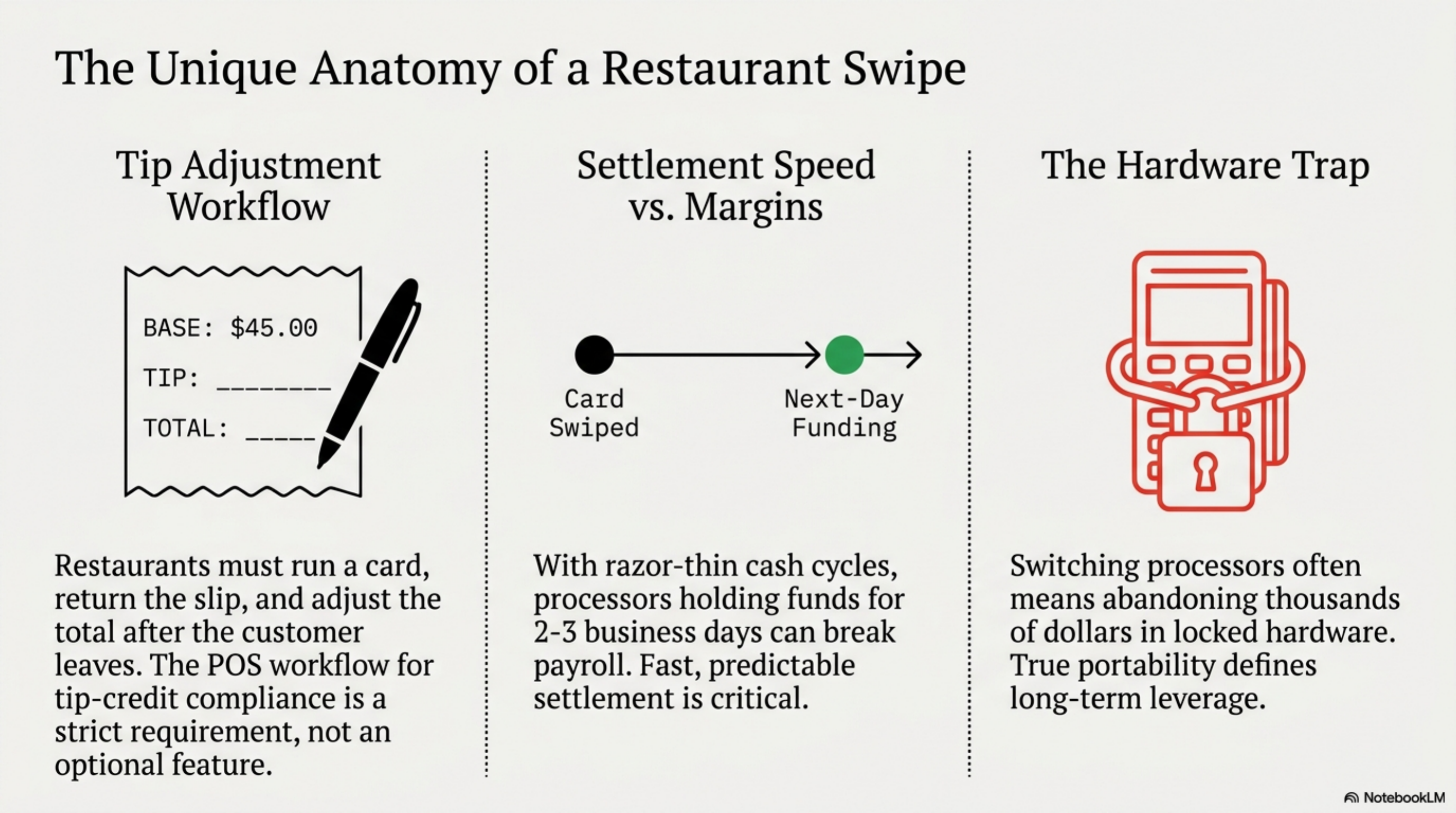
Restaurants are a payment vertical with quirks that do not appear in retail. Three matter most: tip adjustment after the card runs, settlement speed against thin cash cycles, and the cost of a hardware swap when you switch processors.
Six criteria, in order of weight:
- Effective rate at $80K monthly (quick service) and $250K monthly (full service), modeled on a 70 percent debit and 30 percent credit mix using Federal Reserve payments data.
- Contract length and early termination fee. Below 12 months at zero ETF earns full marks.
- Hardware portability. Can you reprogram the POS to a new processor? Clover and Stripe Terminal are locked. Square hardware works only with Square.
- Tip adjustment workflow for sit-down service.
- Online ordering integration. Native or one-click to Toast, Olo, Square Online, or Stripe Checkout.
- Surcharge and cash-discount compliance with state law and Visa or Mastercard rules.
Feature counts were not weighted. What shows up on the monthly statement was.
At a glance
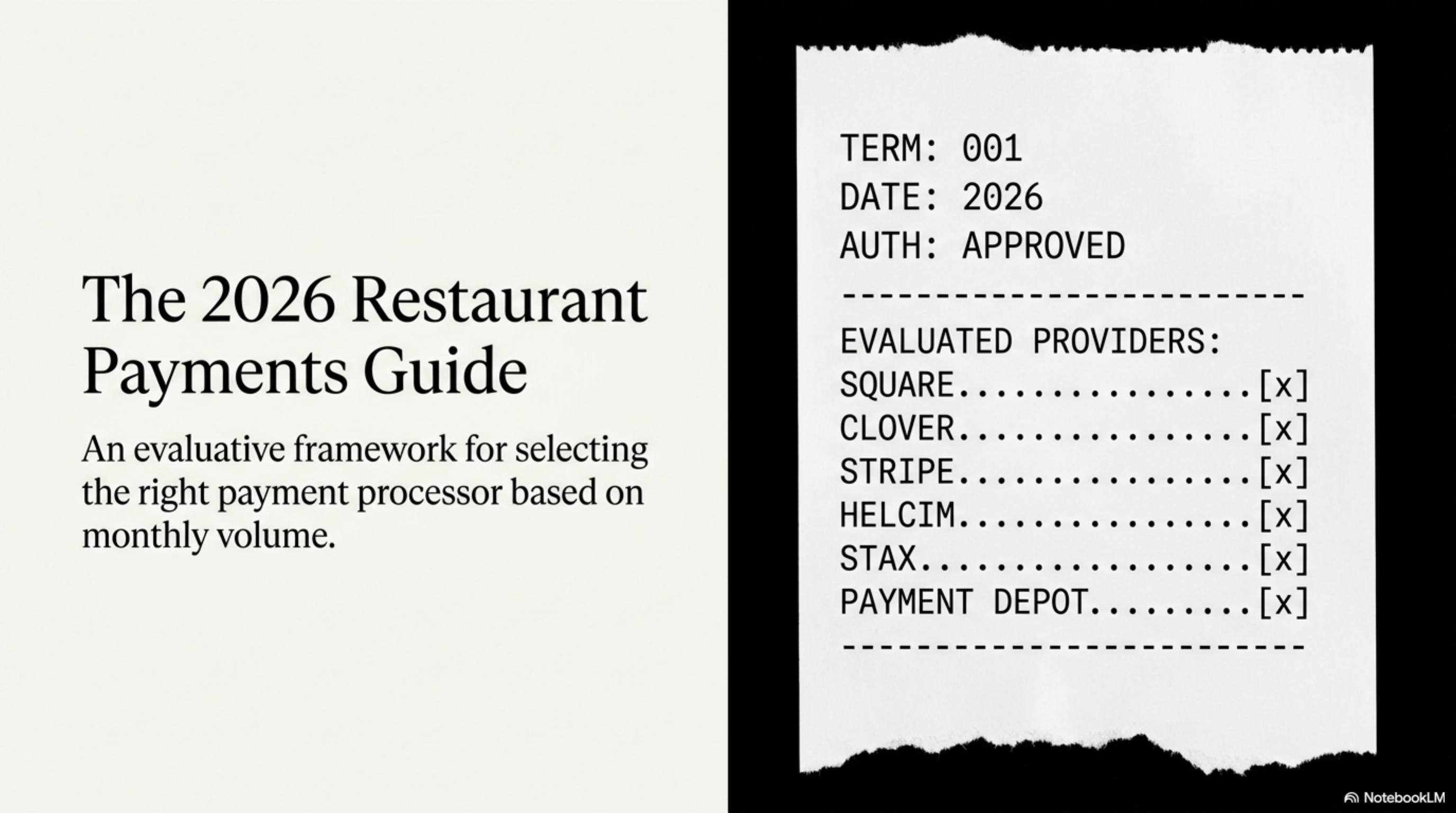
Six providers, ordered from smallest to largest volume fit. Pricing pulled from each provider's public page in May 2026.
| Provider | Headline pricing | Contract | Settlement | Best for | Watch out for |
|---|---|---|---|---|---|
| Square | 2.6% + $0.10 in-person | None | Next day free | $25K to $500K QSR and full-service | Hardware locked to Square |
| Clover | 2.3-2.6% + $0.10 plus $14.95-$54.95/mo plan | Often 36 months via reseller | Next day | Operators who already own the hardware | Reseller markup; device lock |
| Stripe | 2.7% + $0.05 in-person; 2.9% + $0.30 online | None | 2 business days | Online ordering, ghost kitchens | No native restaurant POS |
| Helcim | IC + 0.40% + $0.08 in-person | None | 2 business days | $250K to $1M monthly | No restaurant-specific POS software |
| Stax | $99/mo + IC + $0.08 in-person | Month-to-month (self-serve) | 2 business days | $1M+ monthly | $99 fee hurts under $50K |
| Payment Depot | $79-$199/mo + IC + $0.05-$0.15 | None advertised | 2 business days | $500K to $2M monthly | Owned by Stax; tier pricing varies |
Square
Square charges 2.6 percent plus 10 cents per in-person transaction and 2.9 percent plus 30 cents online, per Square's pricing page. Keyed card-not-present runs 3.5 percent plus 15 cents. The free POS app handles tips, splits, and items; Square for Restaurants Plus adds course firing, table maps, and 86 lists for $69 per month per location.
What a restaurant gets for the 2.6 percent rate: next-business-day funding at no extra cost, no monthly fee on the base plan, no contract, and no ETF. Tip adjustment is built into the POS and handles cash tip declaration for tip-credit compliance.
Square hardware runs only on Square. A Square Register has no resale value to a competing processor. If you outgrow the flat rate past $500K monthly, you write off the hardware when you switch.
Best for: Quick-service, fast-casual, and single-location full-service from $25K to $500K monthly.
Avoid if: You process more than $80K monthly in high-rewards credit volume. At that mix, the 2.6 percent flat rate runs 0.45 to 0.65 percent above interchange-plus.
Clover
Clover is a POS platform owned by Fiserv. Card-processing rates are not standardized because Clover is resold by hundreds of merchant services agents. Rates posted on Clover's site show 2.3 to 2.6 percent plus 10 cents in-person and 3.5 percent plus 10 cents keyed, with software plans from $14.95 to $54.95 per month. What a reseller bills you against those rates is a different number.
Hardware: Clover Station Duo at $1,799, Mini at $799, Flex at $599. The devices are typically locked to the processor that sold them. A Clover Station purchased through one bank channel will not work on another ISO without a reflash, which most resellers will not perform.
A four-station Clover deployment costs roughly $4,000 to $5,000 at list. If a switch later saves 0.30 percent on $250K monthly volume, that is $9,000 a year. The hardware write-off is the first-year cost of being locked in.
Best for: A merchant who already has Clover hardware on the floor and a reasonable processing contract.
Avoid if: You are shopping for a new POS. Always read the contract: 36-month terms with $295 ETFs are common in the Clover reseller channel.
Stripe
Stripe charges 2.9 percent plus 30 cents online and 2.7 percent plus 5 cents in-person on Terminal, per Stripe's pricing page. There is no monthly fee and no contract. Funding runs on a 2-business-day rolling schedule by default.
Where Stripe wins for restaurants: online ordering for ghost kitchens, multi-brand virtual concepts, and direct-to-consumer subscription meal kits. Stripe Checkout and Stripe Connect are the cleanest API for splitting payouts across multiple vendors or kitchens out of one ordering domain. If you run a delivery-first operation and want to skip Toast or Olo, Stripe is the toolchain.
Where Stripe loses: in-store dine-in. Stripe Terminal hardware does not run a native restaurant POS. You bolt it to a third-party POS (Lightspeed, Square, Owner.com) and pay Stripe's processing rate on top. At $250K monthly with a debit-heavy mix, 2.7 percent in-store runs 0.30 to 0.45 percent above interchange-plus.
Best for: Online-only restaurants, ghost kitchens, and multi-tenant ordering platforms that need programmable payouts.
Avoid if: You run a sit-down dining room and want one POS vendor for front-of-house and back-of-house.
Helcim
Helcim publishes the cleanest pricing of any U.S. processor that accepts restaurants. In-person runs interchange plus 0.40 percent plus 8 cents; online runs interchange plus 0.50 percent plus 25 cents, per Helcim's pricing page. Volume discounts apply automatically above $25K monthly, with no contract, no monthly fee, and no ETF.
At $250K monthly with a 70/30 debit/credit mix, Helcim's effective rate lands around 1.85 to 2.00 percent. Square at 2.6 percent on the same volume runs about $1,500 a month higher, which clears $54,000 over a 36-month POS cycle.
The catch: no native restaurant POS. Helcim's Smart Terminal handles card-present and tip adjustment, but the front-of-house workflow (table maps, course firing, 86 lists) requires a third-party POS connected by API. Helcim hardware is portable across Helcim-processed locations.
Best for: Restaurants from $250K to $1M monthly that already run a POS they like and want to drop the processing rate.
Avoid if: You want POS software from the same vendor as the processor. Helcim does not sell that.
Stax
Stax (formerly Fattmerchant) charges $99 per month plus interchange plus 8 cents in-person and 18 cents online, per Stax's pricing page. There is no percentage markup over interchange. The model only works above roughly $50K monthly volume, where the $99 fee dilutes against transaction count.
At $250K monthly on a 70/30 debit/credit mix, a Stax account runs an effective rate around 1.70 to 1.85 percent including the subscription. That is 0.10 to 0.20 percent below Helcim at the same volume, with the gap widening as you grow. The Stax Pay POS app supports tip adjustment, item modifiers, and tableside workflows; integrations cover Lightspeed and Clover hardware on the Stax processing rail.
Stax's self-serve page is month-to-month, but its sales channel offers tiered subscriptions at $199 and $399 per month with different per-transaction add-ons. Read what you sign before assuming the public rate applies.
Best for: $500K to $5M monthly volume restaurants, multi-location operators, banquet and event venues with high ticket sizes.
Avoid if: You process under $50K monthly. The $99 fee will not recover from the transaction-count savings.
Payment Depot
Payment Depot is owned by Stax Payments and runs on the same wholesale-membership model: a monthly fee from $79 to $199 plus interchange plus 5 to 15 cents per transaction, per Payment Depot's pricing page. There is no percentage markup.
The differences from Stax are positioning and POS support. Payment Depot is sold as a smaller-volume membership starting at $79, where Stax starts at $99. The transaction add-on can be lower (5 cents on higher-tier memberships) but the tier you qualify for depends on volume. Hardware is bring-your-own through approved terminals (Dejavoo, Pax, certain Clover devices reflashed for Payment Depot).
Settlement is 2 business days. Contract terms are not advertised on the public site, which has produced confusion: the membership renews monthly but agent-channel paperwork has included 12-month terms in some cases. Read the agreement before signing.
Best for: $50K to $1M monthly volume restaurants that want pass-through interchange and do not want the Stax-branded POS app.
Avoid if: You want a single-vendor stack (processor plus POS plus hardware). Payment Depot sells processing only.
Verdict
Three pricing models compete for restaurants in 2026: flat-rate (Square, Stripe, PayPal), interchange-plus with no monthly fee (Helcim), and subscription with pass-through interchange (Stax, Payment Depot). The right answer is volume.
Below $80K monthly, Square wins on simplicity, restaurant POS, and the absence of a monthly fee. From $250K to $1M monthly, Helcim wins by 0.40 to 0.60 percent against flat-rate competitors with no contract or hardware penalty. Above $1M monthly, Stax beats Helcim by 0.10 to 0.20 percent because the $99 subscription dilutes faster than Helcim's per-transaction markup.
Clover is the right answer only when a reseller has already sold you the device and the contract is reasonable. Stripe is the right answer for delivery-only and multi-tenant ordering platforms. Payment Depot competes with Stax in the same band and is worth the call when the Stax POS app is a poor fit for your menu structure.