TL;DR
Square wins for restaurants under $50K monthly volume, hybrid retail and food operations, and operators who need to be running cards today. Toast wins for full-service and multi-location restaurants doing $50K to $5M monthly, where kitchen display depth and online ordering integration justify the contract. Both publish similar headline rates, inside 15 basis points of each other at typical volumes. The decision turns on hardware lock-in, monthly software fees, and whether your kitchen workflow needs Toast's restaurant-specific depth or runs fine on Square's lighter stack.
How we ranked
We weight five criteria for operators choosing between Square and Toast.
Effective rate at $250K monthly volume (35 percent of score). Includes processing markup plus monthly software fees divided by volume.
Hardware and software lock-in (20 percent). Whether the POS works with third-party hardware and whether contracts force multi-year commitments.
Restaurant feature depth (20 percent). Kitchen display systems, coursing, modifier handling, multi-location reporting, online ordering, and gift cards.
Settlement speed (10 percent). When deposits hit the operating account.
Total contract cost over 36 months (15 percent). Hardware, monthly fees, processing, and any early termination fee.
We pulled pricing from Square's public pricing page and Toast's public pricing page. We did not call sales for a custom quote. Custom enterprise pricing changes the math, but most operators in the $25K to $500K monthly range are paying published rates.
At a glance
| Provider | Headline pricing | Contract | Settlement | Best for | Watch out for |
|---|---|---|---|---|---|
| Square | 2.6% + $0.10 in-person, 2.9% + $0.30 online | Month-to-month, no ETF | Next business day (free) or instant 1.75% | Retail under $50K, hybrid food/retail, food trucks | Keyed 3.5% + $0.15, KDS only on Plus plan |
| Toast | 2.49% + $0.15 in-person (Starter Kit) | 24 to 36 month standard term | Next business day | Full-service and multi-location restaurants $50K+ | Proprietary hardware, $69+/mo per terminal on POS plan |
Square
Square's published rate is 2.6 percent plus $0.10 per in-person transaction, 2.9 percent plus $0.30 online, and 3.5 percent plus $0.15 on keyed entries (Square pricing). The free Square for Restaurants plan covers a single location with basic table management. The Plus plan runs $60 per month per location and adds kitchen display support, course management, automatic gratuity, and offline mode.
Square's strength is speed of setup and the absence of a contract. A Square Reader costs $59 and plugs into any tablet. Setup takes under an hour. There is no early termination fee because there is no term. Funds settle next business day at no charge, or instantly at a 1.75 percent fee on the transfer.
The weaknesses for a restaurant operator are real. Square does not natively integrate with most third-party kitchen hardware. The platform's online ordering is functional but lacks the depth of Toast's direct-to-KDS routing. Once monthly volume crosses $50K, the 2.6 percent rate with no published volume discount runs more expensive than an interchange-plus quote from a wholesale processor.
Who Square fits: shops doing under $50K monthly, mixed retail and food, pop-ups, food trucks, single-location quick-service. Who should avoid: full-service restaurants with multiple stations, multi-location chains, or operators with the volume to negotiate interchange-plus pricing.
Toast
Toast charges 2.49 percent plus $0.15 per card-present transaction on the Starter Kit plan (Toast pricing). Online orders process at card-not-present rates, which run higher than card-present. Software starts at $0 per month on Starter Kit, where hardware is financed into the processing rate, and runs $69 per month per terminal on the Point of Sale plan.
Toast is built specifically for restaurants. Kitchen display systems, coursing logic, modifier trees, tableside ordering on a handheld, and integrated online ordering all live in one stack. Toast Capital offers merchant cash advances against future processing volume. Toast Payroll ties tip distribution directly into payroll runs.
The trade-offs are concrete. Toast hardware is proprietary. A Toast Flex terminal lists around $799 paid upfront, a handheld around $499, a kitchen display around $799, and a guest-facing display around $329. The $0 software plan ties you to higher processing rates that repay the financed hardware over time.
Toast's standard agreement runs 24 to 36 months. Early termination triggers a fee based on remaining contract value plus any unpaid hardware balance. Toast does not publish a flat ETF figure on its pricing page. Request the ETF formula in writing before signing, and read the Master Services Agreement, especially the rate-change and hardware-return clauses.
Who Toast fits: full-service restaurants, quick-service chains, and multi-location operators doing $50K to $5M monthly where restaurant-specific feature depth offsets the monthly fees. Who should avoid: single-location cafes under $30K monthly, retail-leaning concepts, and any operator unwilling to sign a multi-year contract.
Online ordering and delivery
Toast bundles online ordering into the Point of Sale plan at no additional software cost. Orders flow directly into the kitchen display system, modifiers and special instructions carry over, and tip prompts are configured per channel. Toast operates direct integrations with DoorDash, Uber Eats, and Grubhub through Toast Delivery Services. Third-party delivery orders route through the POS instead of arriving on a separate aggregator tablet.
Square Online is free to set up. The processing rate is 2.9 percent plus $0.30 for card-not-present transactions. Order routing to KDS works on Square for Restaurants Plus but requires Square hardware. Square's third-party delivery integration is more limited than Toast's. Multi-channel operators typically end up running an aggregator (Ordermark, Otter, Cuboh) to consolidate orders from delivery platforms.
For a single-location cafe with light delivery, Square Online is sufficient. For a restaurant where online ordering represents 30 percent or more of revenue, Toast's deeper integration removes the dual-tablet problem and reduces order errors. The processing rate difference is small compared to the labor saved on ticket reconciliation.
Effective rate at $250K monthly
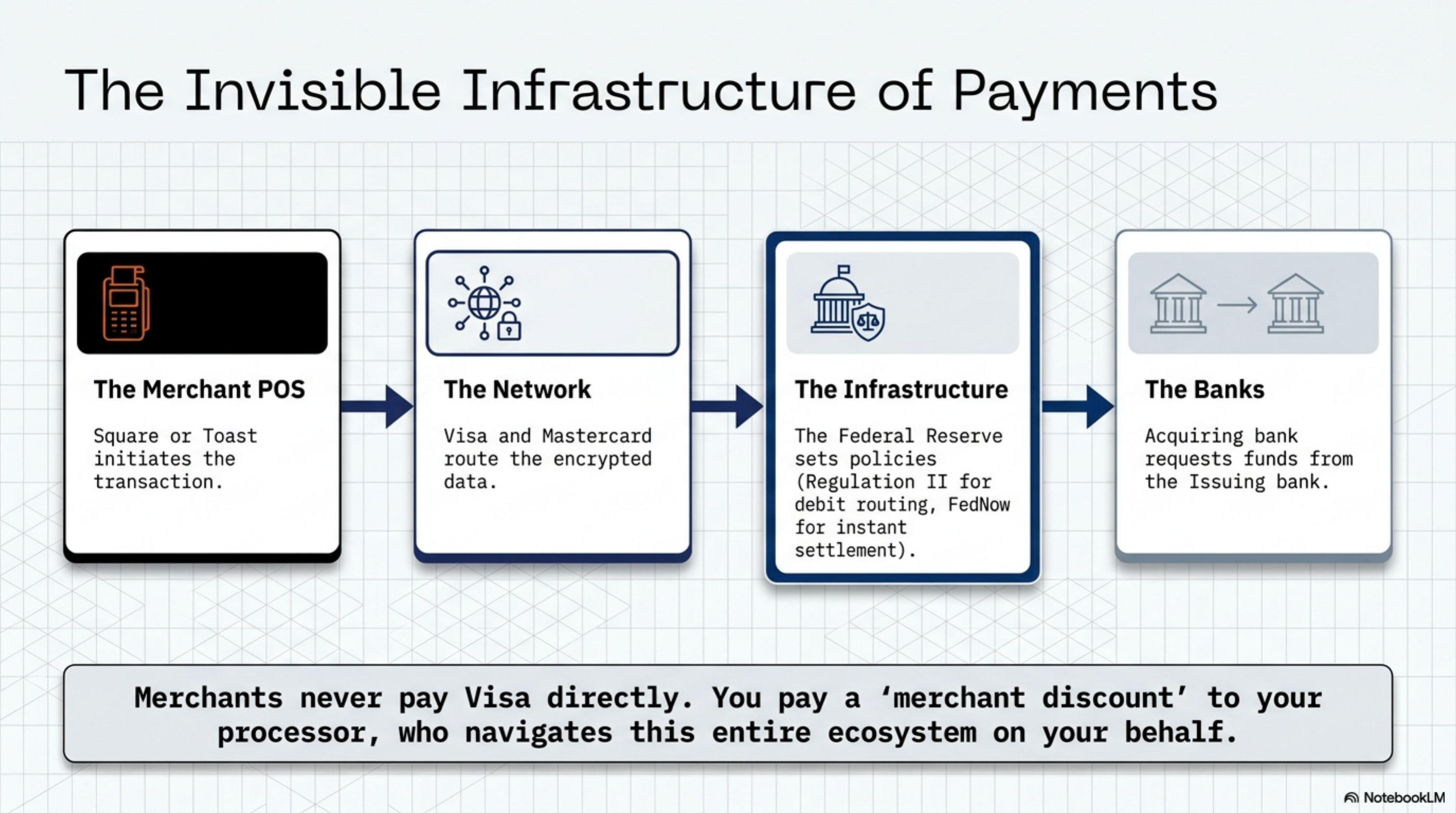
Visa and Mastercard publish quarterly interchange schedules (Visa Interchange, Mastercard Interchange). A typical full-service restaurant card mix runs roughly 1.85 percent weighted-average interchange. The processor markup is what differs between Square and Toast.
Hypothetical operator at $250K monthly card volume, average ticket $42 (5,950 transactions).
Square at 2.6% + $0.10: $6,500 in percentage fees + $595 in per-transaction fees = $7,095 monthly. Effective rate 2.84 percent.
Toast Starter Kit at 2.49% + $0.15: $6,225 + $893 = $7,118 monthly, $0 software. Effective rate 2.85 percent.
Toast Point of Sale at 2.49% + $0.15, with $69/mo for four terminals: $7,118 + $276 software = $7,394 monthly. Effective rate 2.96 percent.
Inside 12 basis points across the three. The Starter Kit hides hardware financing inside the processing rate, so the comparison is not apples to apples once you amortize hardware over 36 months. Operators above $400K monthly should request a custom interchange-plus quote from both vendors before signing. The Federal Reserve Payments Studies show U.S. card processing costs have risen over the past decade despite published interchange staying flat, which means processor markup is where the savings hide.
Contract and hardware lock-in
Square sells hardware outright with no contract attached. The Square Reader is $59. The Square Stand for iPad is $149. The Square Terminal is $299. The Square Register is $799. Buy once, plug in, run cards. If you stop processing with Square, the hardware loses most of its resale value but you owe nothing else.
Toast finances hardware on most plans. The Starter Kit charges $0 upfront for a Toast Flex but ties you to a higher processing rate that repays the hardware over time. Paid upfront, a typical four-station deployment with two handhelds runs roughly $3,800 in hardware before software fees.
The contract is the larger commitment. Toast's standard agreement runs 24 to 36 months. Square has no equivalent commitment. For an operator unsure whether the concept will survive 24 months, the contract risk on Toast is the dominant factor, not the rate. For an operator already at three or more years of stable revenue, the contract risk is minimal and the feature set matters more.
Above $100K monthly volume, Toast's rate sheet, ETF formula, and hardware return clauses are negotiable, but only if you ask in writing before signing. Get any verbal commitment redlined into the contract itself.
Verdict
For restaurants under $50K monthly volume or hybrid retail and food operations, Square wins. The lack of a monthly fee, no contract, and same-day setup make it the lower-risk choice when the concept's revenue ceiling is not yet known.
For full-service or multi-location restaurants doing $50K to $5M monthly, Toast wins. KDS depth, online ordering integration, and labor tooling justify the monthly software fee and hardware contract. Once you have three or more stations and a real back-of-house workflow, Square's lighter restaurant stack becomes a daily friction tax.
Both processors publish their rates. Either will run your cards. The decision turns on whether you need restaurant-specific operational depth (Toast) or hardware flexibility with no commitment (Square). Operators above $400K monthly should request custom interchange-plus pricing from both, plus a third quote from an independent processor, before signing anything.