TL;DR
Card-not-present transactions cost 0.20 to 0.50 percent more than card-present transactions at the network interchange level, and processors typically stack another 0.40 to 0.80 percent on top through tiered pricing, downgrades, and risk surcharges. Most operators on flat-rate plans pay 2.9 percent plus 30 cents on every CNP charge and never see the breakdown. The fix is an interchange-plus statement audit, AVS and CVV hygiene, level 2 data on the B2B portion of your volume, and a flat per-transaction processor markup instead of a percentage spread.
What this actually is
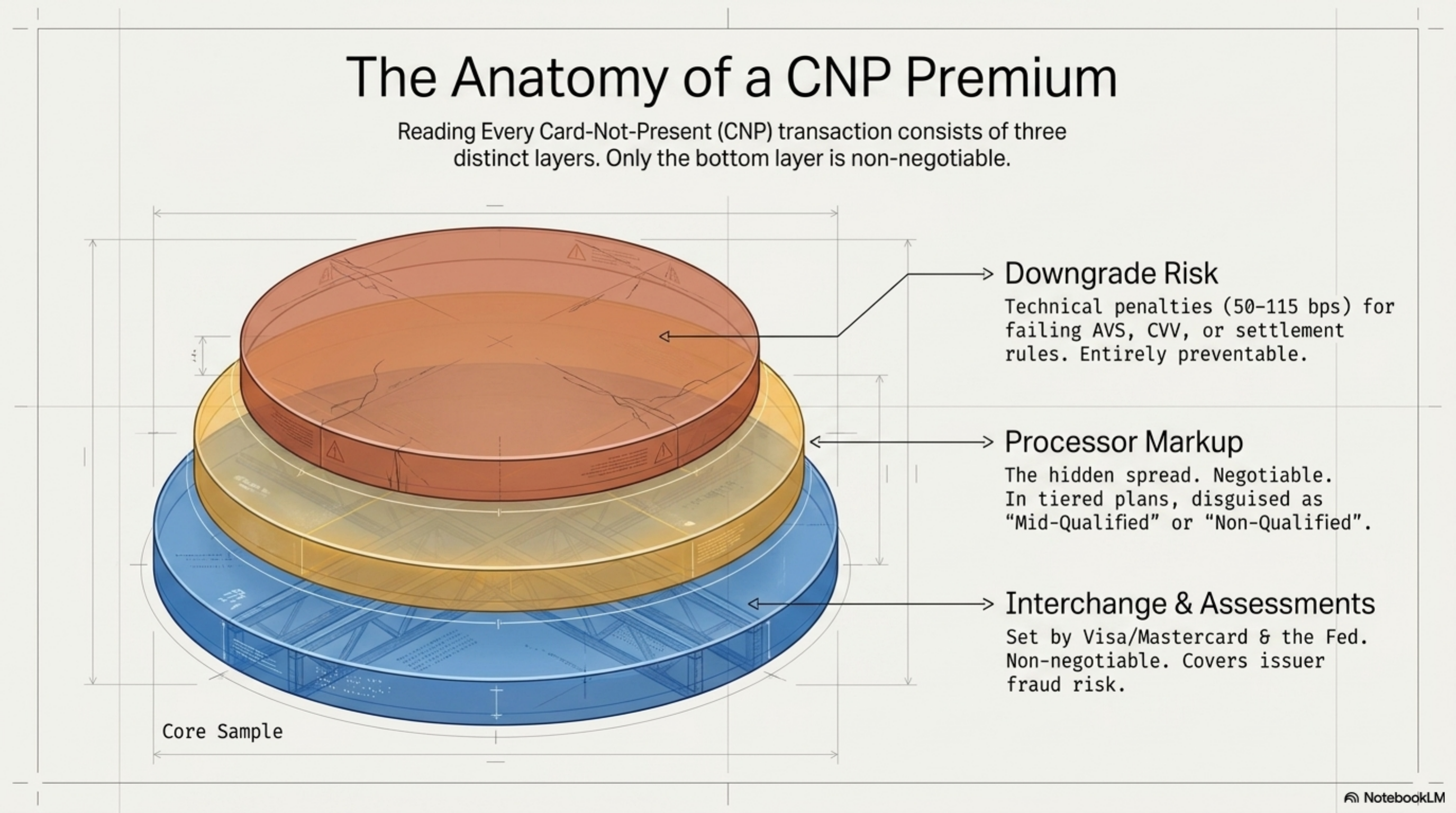
Card-not-present surcharges are the cumulative extra fees you pay on transactions where the card is not physically swiped, dipped, or tapped. The premium has three layers, and each layer is set by a different counterparty in the payment chain.
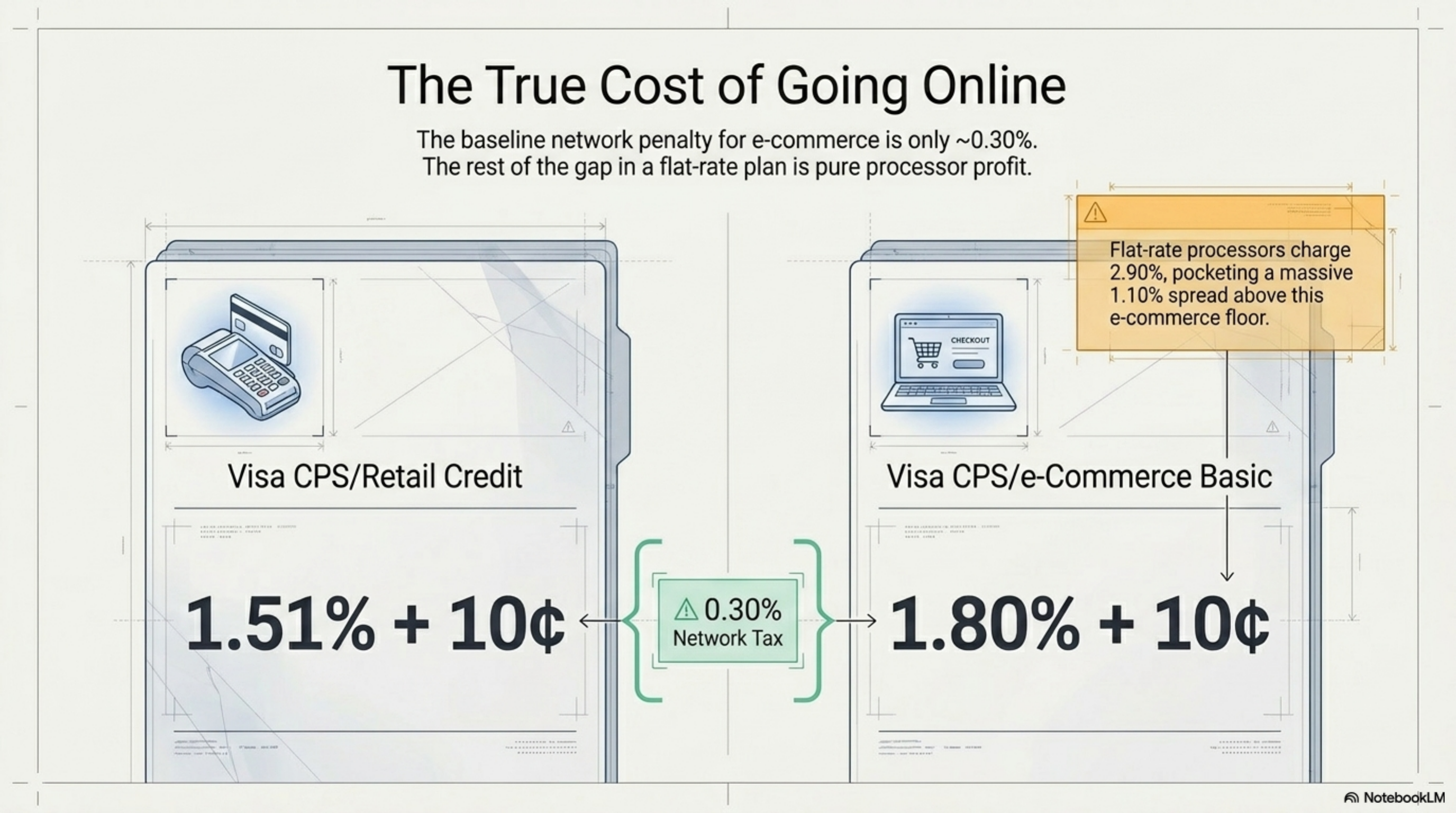
The first layer is interchange. Visa and Mastercard publish higher interchange rates for keyed, e-commerce, and mail-order transactions because issuer fraud losses are several multiples higher than in face-to-face settings. The Federal Reserve's payments studies show card-not-present fraud accounts for the majority of card fraud losses in the United States despite representing a smaller share of transaction count. Visa's published CPS/e-Commerce Basic rate for consumer credit is 1.80 percent plus 10 cents, against 1.51 percent plus 10 cents for CPS/Retail Credit, per the Visa USA Interchange Reimbursement Fee schedule.
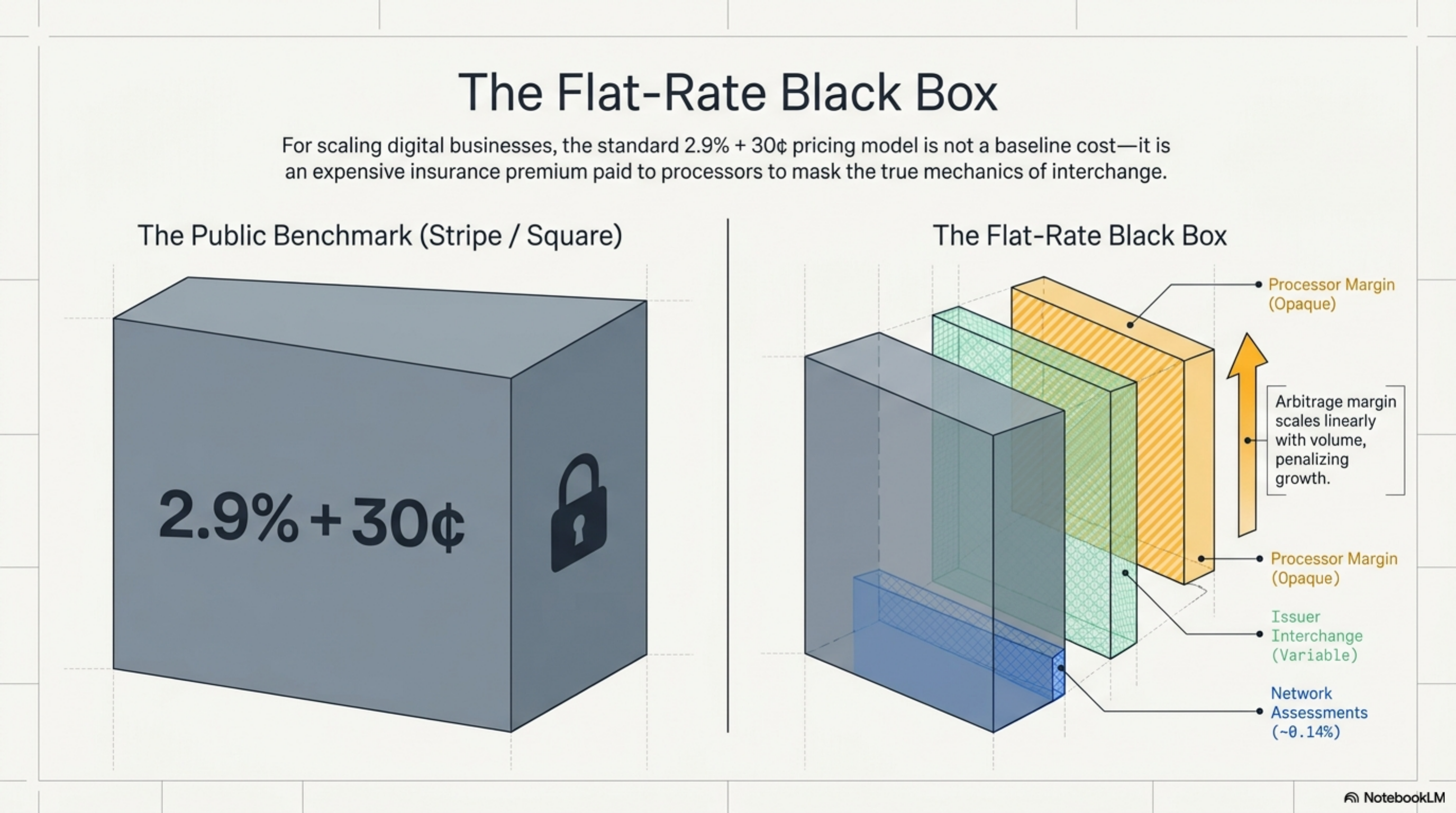
The second layer is processor markup. On a tiered plan, the processor classifies CNP transactions as mid-qualified or non-qualified and adds its own surcharge on top of interchange. The merchant rarely sees the underlying interchange cost, only the marked-up rate. Public flat-rate disclosures from Stripe and Square show 2.9 percent plus 30 cents as the de facto online benchmark.
The third layer is downgrade risk. A CNP transaction that misses AVS, CVV, electronic clearing, or settlement timing rules can drop to EIRF or Standard interchange, adding 50 to 115 basis points. Some downgrades are silent: the transaction approves and settles, but at a higher rate that surfaces only on the statement weeks later.
A card-not-present surcharge is the extra fee charged by the card networks and the processor for transactions where the card is not physically swiped, dipped, or tapped at a terminal.
How it works under the hood
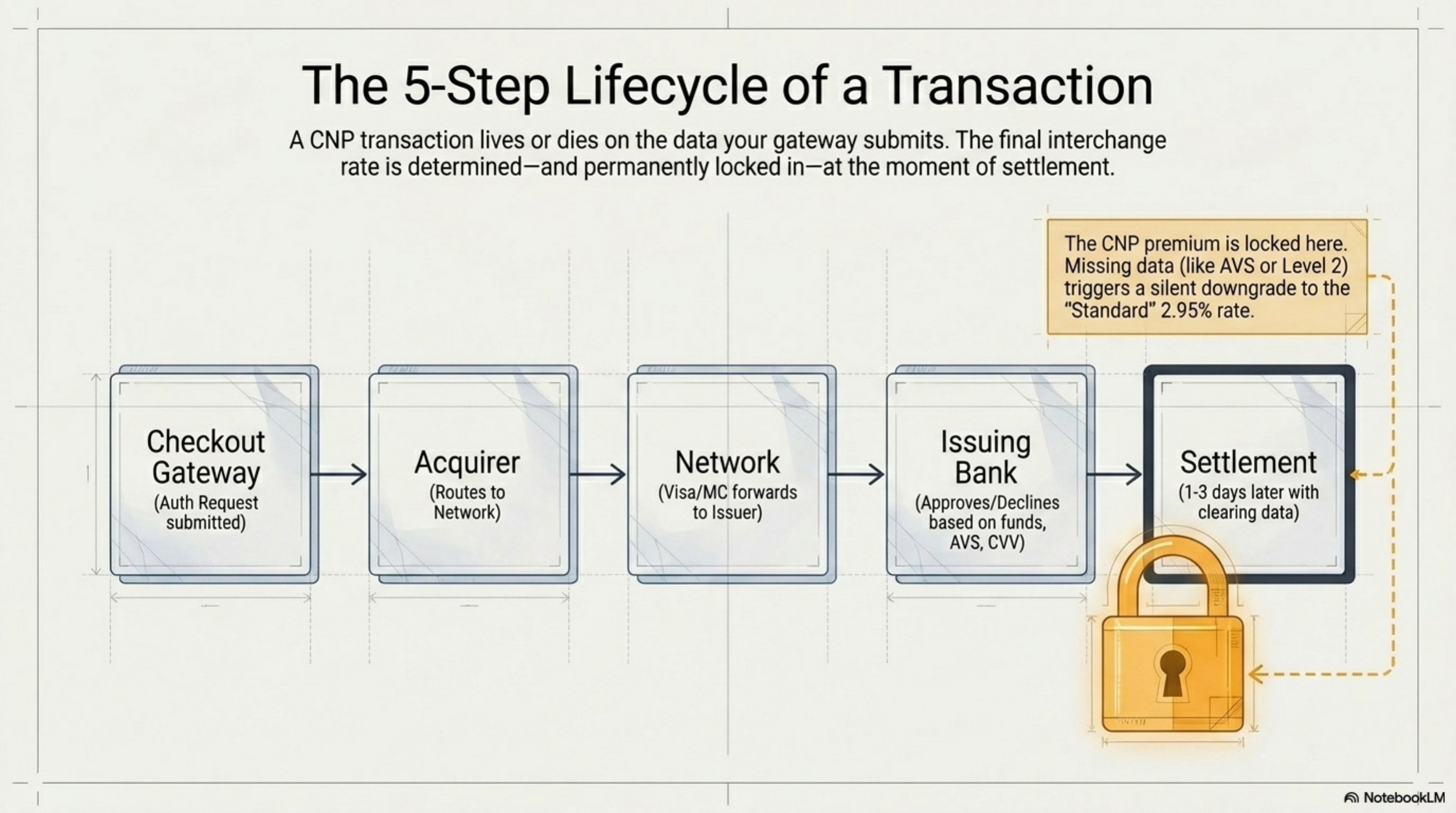
A card-not-present transaction lives or dies on the data your gateway submits. The interchange category, and therefore the rate, is determined by the data fields that flow through authorization and clearing.
The flow:
- Customer enters card data on your checkout page, mobile app, or via phone to your agent.
- Your gateway sends an authorization request to the acquirer, which routes it to Visa or Mastercard.
- The network forwards the auth to the issuing bank, which approves or declines based on available funds, fraud signals, and AVS or CVV match.
- Your batch settles 1 to 3 days later, with clearing data attached to each transaction.
- The network applies an interchange category based on auth data, clearing data, merchant category code, and timing.
- Your acquirer charges you that interchange plus its markup, plus any network assessments, on the next monthly statement.
The CNP premium is locked in at step 5. Visa's main CNP categories for consumer credit, per the published Visa Interchange Reimbursement Fees, are CPS/e-Commerce Basic at 1.80 percent plus 10 cents, CPS/e-Commerce Preferred Retail at 1.80 percent plus 10 cents (with 3DS authentication and merchant category code requirements met), and EIRF at 2.30 percent plus 10 cents for downgrades. Standard, the catchall for transactions that miss every qualification, is 2.95 percent plus 10 cents.
Mastercard mirrors the structure, per the Mastercard US Interchange schedule. Merit I covers CNP consumer credit at 1.89 percent plus 10 cents. World Elite Merit I, for premium consumer cards, is 2.50 percent plus 10 cents. The same Standard rate of 2.95 percent plus 10 cents catches downgrades.
The 30 basis point gap between Visa CPS/Retail at 1.51 percent and CPS/e-Commerce at 1.80 percent is the entire network surcharge for going online.
Above interchange, two more fee layers apply. Network assessments run roughly 0.14 percent on Visa volume and 0.1375 percent on Mastercard volume, plus per-transaction fees like the Visa Acquirer Processing Fee at 1.95 cents and the Mastercard NABU at 2.05 cents, as set out in the Visa Core Rules and Visa Product and Service Rules and the Mastercard US interchange and assessments schedule. These are pass-through and identical for every merchant. Anything else above interchange and assessments is processor margin.
Where it goes wrong for operators
Five patterns account for the majority of CNP overcharges in the field.
Tiered pricing hides the markup. Tiered plans label CNP transactions as 'mid-qualified' or 'non-qualified' and charge a single marked-up rate. A transaction that runs at 1.80 percent interchange under interchange-plus might appear on a tiered statement as a 2.50 percent mid-qualified charge. The 70 basis point gap is processor margin, not network cost. On $300,000 monthly CNP volume, that is $2,100 per month, or $25,200 per year. The same gap is visible against published flat-rate cards from Stripe and Square, where 2.9 percent plus 30 cents sits 0.40 to 0.80 percent above what an equivalent card mix costs on interchange-plus once the underlying Visa and Mastercard categories are netted out.
AVS and CVV mismatches downgrade transactions. If your gateway does not pass full address verification data and the CVV result code, Visa can downgrade the transaction from CPS/e-Commerce Basic to EIRF, a 50 basis point jump. On $200,000 monthly volume with even a 10 percent downgrade rate, that is $100 per month, or $1,200 per year, in avoidable cost. International cards do not return AVS, which is a structural issue, but domestic transactions should hit 95 percent or better.
Late settlement drops you to Standard. Visa requires e-commerce transactions to clear within specific windows, typically authorization to settlement within 1 to 3 days depending on the merchant category code. Batches that settle late drop to Standard at 2.95 percent plus 10 cents. A single missed settlement window on a $50,000 batch costs an extra $475 in fees compared to CPS/e-Commerce Basic. Subscription billing engines that delay capture for retry logic are the most common cause.
Level 2 and level 3 data is left on the table. B2B and government commercial cards qualify for reduced interchange when line-item, tax, and customer code data flows through clearing. Most e-commerce gateways do not submit level 2 fields by default. The savings on commercial card volume is typically 50 to 100 basis points, depending on the network and the level submitted. A merchant with 30 percent corporate card volume on $200,000 monthly is leaving roughly $300 per month on the table.
Surcharging compliance gets misread. Merchants who pass a credit card surcharge to customers must register with Visa and Mastercard 30 days in advance, cap the surcharge at the merchant discount rate, and disclose the surcharge at the point of entry and on the receipt. Under the Visa Core Rules updated in April 2023, the Visa surcharge cap is 3 percent; Mastercard's published cap is 4 percent. Surcharging debit cards is prohibited under the Durbin Amendment regardless of how the merchant labels the charge. Several states, including Connecticut and Massachusetts, ban surcharging on credit cards entirely. Compliance failures can trigger network fines and acquirer termination on short notice.
Tiered pricing on card-not-present volume runs 0.40 to 0.80 percent above interchange-plus on the same card mix. The gap is processor margin disguised as a tier label.
Worked example with real numbers
Consider a SaaS company billing $200,000 in monthly volume across 500 transactions, average ticket of $400, on a flat-rate plan at 2.9 percent plus 30 cents per transaction (the published Stripe and Square online card rate). Card mix is 70 percent consumer credit, 20 percent corporate credit, 10 percent debit. All transactions are card-not-present, processed through a hosted checkout integration.
Current cost on flat-rate:
- Volume fee: $200,000 times 2.9 percent equals $5,800
- Per-transaction fee: 500 times $0.30 equals $150
- Monthly total: $5,950
- Effective rate: 2.98 percent
Estimated true cost of acceptance:
- Consumer credit (70 percent of volume): $140,000 at blended CPS/e-Commerce Basic of 1.85 percent plus 10 cents equals $2,640
- Corporate credit (20 percent): $40,000 at Commercial Card Data Rate I of 2.50 percent plus 10 cents equals $1,015
- Debit (10 percent): $20,000 at regulated debit of 0.05 percent plus 22 cents equals $33
- Total interchange: $3,688
- Network assessments at roughly 0.14 percent on Visa and 0.1375 percent on Mastercard volume per the Visa Core Rules and Mastercard schedule: $260
- True cost of acceptance: $3,948
Cost on interchange-plus at 0.30 percent plus 10 cents (a typical sub-1 percent markup published by transparent processors as an alternative to flat-rate 2.9 percent plus 30 cents):
- Interchange plus assessments: $3,948
- Processor markup: 0.30 percent times $200,000 equals $600, plus 500 times $0.10 equals $50, total $650
- Monthly total: $4,598
- Effective rate: 2.30 percent
Savings: $1,352 per month, or $16,224 per year. Over a 60-month review window, savings clear $81,000.
Adding level 2 data submission on the corporate card portion drops Commercial Card Data Rate I to Data Rate II at roughly 2.05 percent plus 10 cents, a 45 basis point reduction on $40,000 in monthly commercial volume. That is another $180 per month, or $2,160 per year, on top of the interchange-plus savings.
Enabling 3D Secure on the consumer credit portion can shift a fraction of volume into CPS/e-Commerce Preferred Retail at the same 1.80 percent plus 10 cents, but with chargeback liability shifted back to the issuer for fraud claims. The rate benefit is small, often under 5 basis points, but the chargeback expense reduction at scale can reach $400 per month for a SaaS merchant with elevated friendly fraud.
Operator playbook
- Pull your last three statements and flag every line item labeled non-qualified, mid-qualified, EIRF, Standard, or any tier label. These are your downgraded CNP transactions. Sum the dollar volume in each category and calculate what the same volume would cost at the published CPS/e-Commerce Basic or Merit I rate.
- Calculate your effective CNP rate. Divide total CNP fees, including assessments and processor surcharges, by total CNP volume. If the result is above 2.5 percent on a consumer-credit-heavy mix, you are paying 0.50 percent or more above benchmark. The Nilson Report tracks aggregate processor pricing trends, but your statement is the authoritative source.
- Request an interchange-plus quote from at least three processors. Ask each for a sample statement that itemizes interchange, assessments, and the processor markup as separate line items. Walk away from anyone who refuses to provide an itemized statement or who insists on tiered pricing for CNP volume.
- Audit AVS and CVV pass rates in your gateway dashboard. If pass rates are below 95 percent on domestic volume, you are losing transactions to EIRF or Standard downgrades. Most modern gateways expose this metric in a transactions report. Fix gateway configuration before negotiating rate.
- Enable level 2 and level 3 data submission if you process B2B or government cards. Confirm with your gateway and processor that the line-item, tax amount, and customer code fields are populated and flowing through clearing. The interchange savings on commercial card volume is 45 to 100 basis points.
- Negotiate a flat per-transaction markup, not a percentage spread, on the processor margin. A flat 10 cents per transaction at $200,000 monthly volume across 500 transactions is materially cheaper than 0.30 percent plus 5 cents on the same volume.
- Reject early-termination fees longer than 12 months. The market standard for interchange-plus is month-to-month or 12-month with no liquidated damages. Anything longer is a contract trap, with future rate increases locked in for the duration.
- Re-quote every 18 to 24 months. Effective rates drift up after onboarding through silent fee increases buried in monthly notices, new network fees passed at a markup, and category drift in your card mix. Compare the current effective rate to the rate at signing and renegotiate before the gap exceeds 25 basis points.