TL;DR
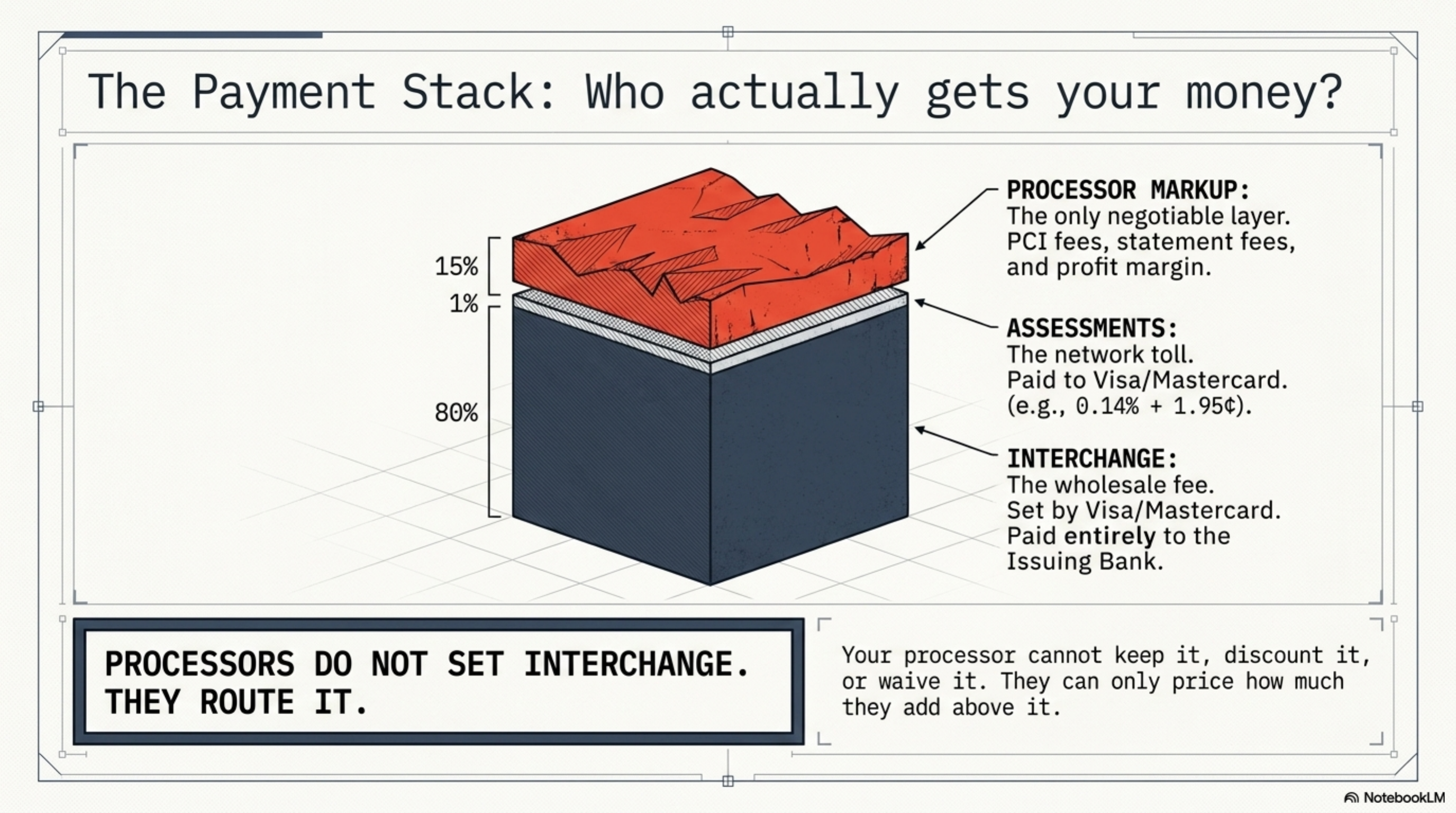
Interchange is the wholesale fee the cardholder's issuing bank deducts from every Visa or Mastercard transaction before the funds pass to your processor. It is set by the card brands, not your processor, and it usually accounts for 70 to 90 percent of total card-fee spend on a merchant statement. Flat-rate plans hide it; interchange-plus exposes it. The first move for any operator paying more than 2.4 percent effective rate is to pull the last statement and separate interchange from processor markup.
What this actually is
Interchange is a wholesale fee buried inside every card transaction. Four parties touch the money on a typical card sale: the cardholder, the merchant, the merchant's acquiring bank (the processor), and the cardholder's issuing bank. The issuing bank takes the first cut. It funds the transaction, carries the fraud and chargeback risk, and pays for the rewards program attached to the card. That cut is interchange.
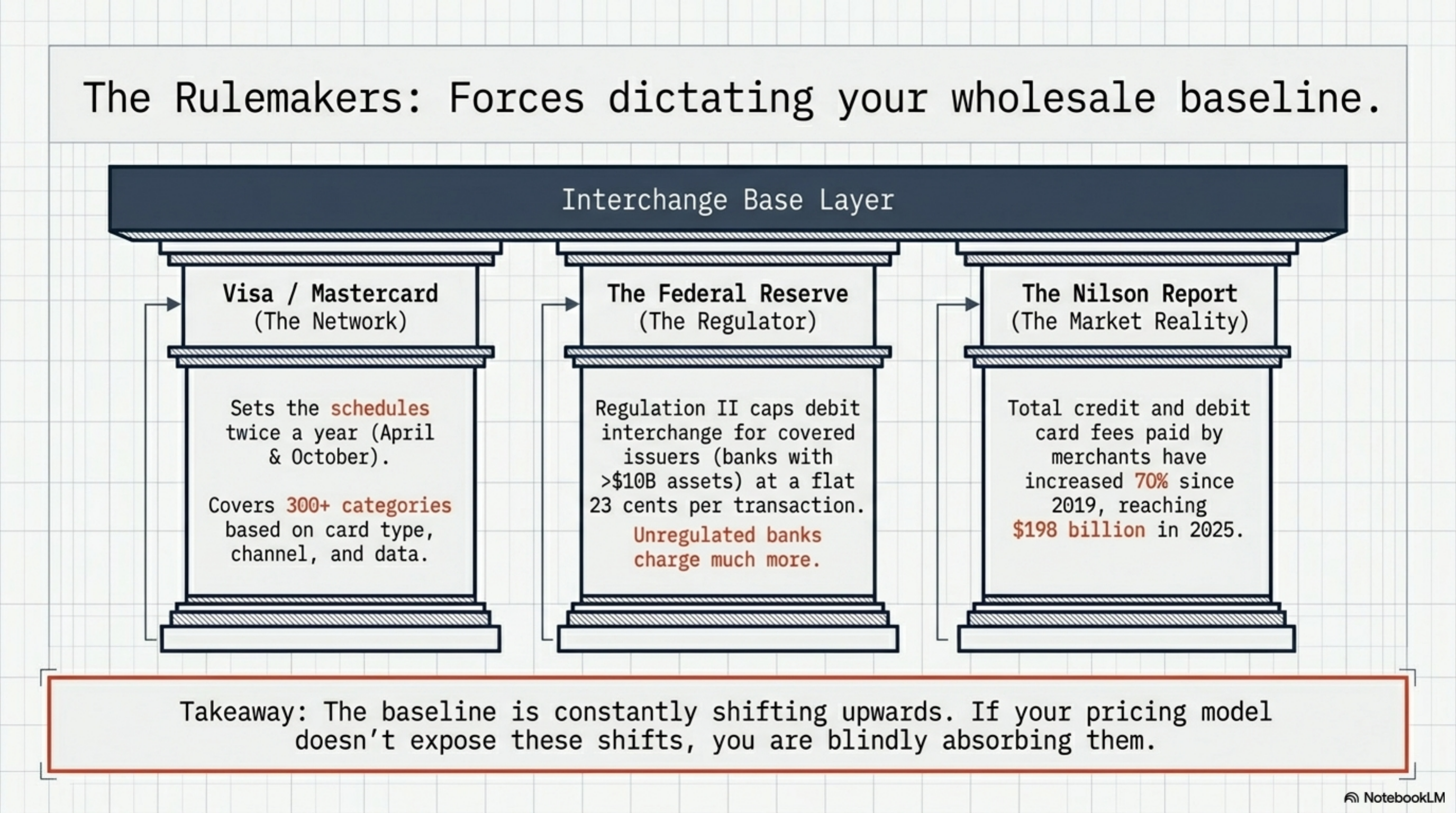
Visa publishes its U.S. interchange schedule twice a year, in April and October. Mastercard publishes its own. Between them, the schedules cover more than 300 categories. Rates range from roughly 0.05 percent plus 22 cents on a regulated debit transaction at a large issuer to over 3.00 percent on certain corporate and international cards.
Category placement depends on four variables: your merchant category code (MCC), the card product (consumer credit, business credit, debit, rewards, corporate, prepaid), the channel (card-present, e-commerce, keyed, recurring), and whether your terminal or gateway transmits enhanced commercial-card data (Level 2 or Level 3).
Your processor does not set interchange. They route it. Visa or Mastercard sets it; the issuing bank receives it. Everything your processor adds on top, the network assessment fees, the markup, the monthly minimum, the PCI fee, the gateway fee, the statement fee, sits above interchange in the stack.
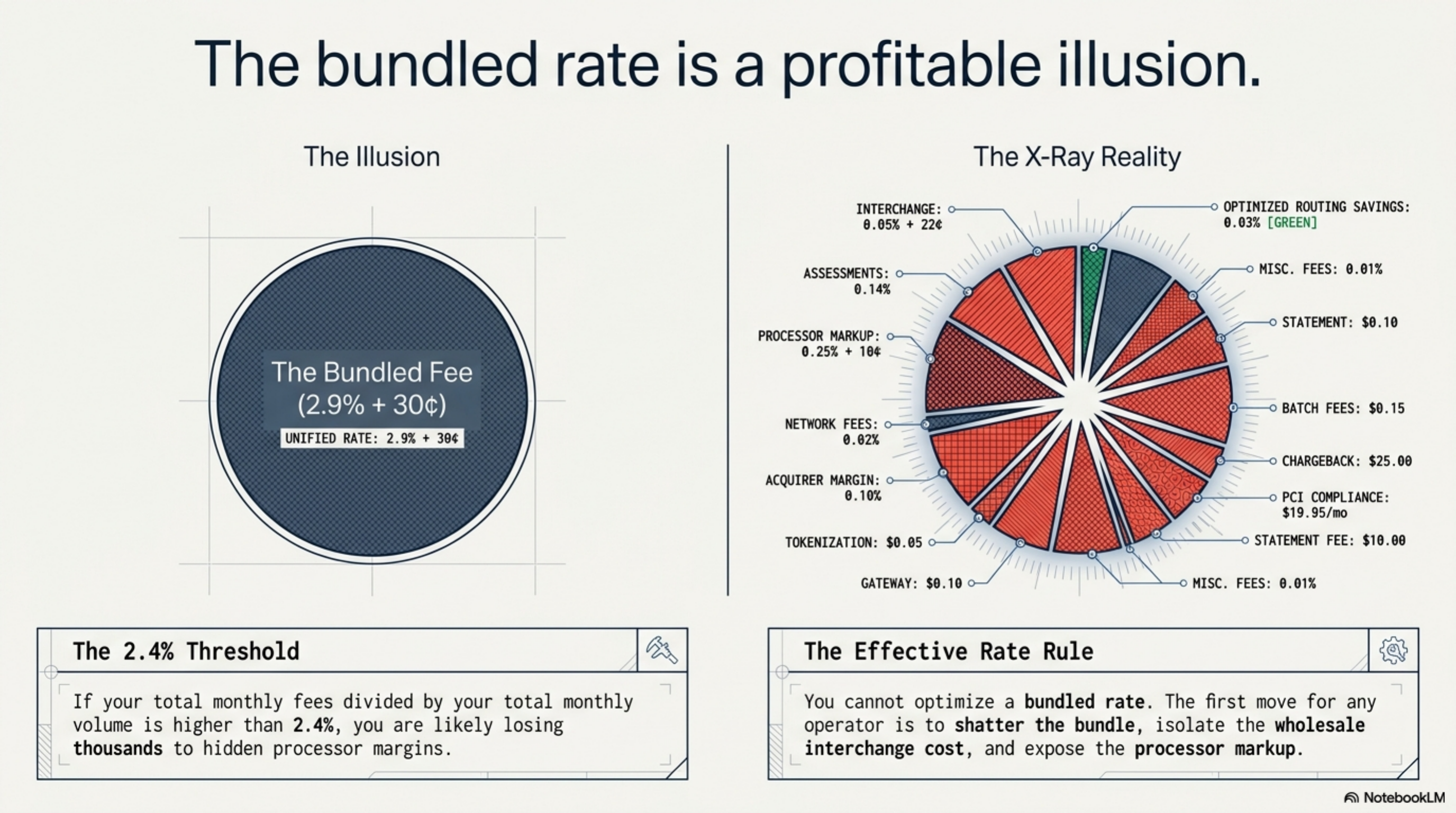
If your statement does not show interchange as a separate line item, you are not on interchange-plus pricing. You are paying a bundled rate that includes interchange, assessments, and an undisclosed processor markup.
Interchange is the wholesale fee Visa or Mastercard sets and that your processor passes to the cardholder's issuing bank on every card transaction.
How it works under the hood
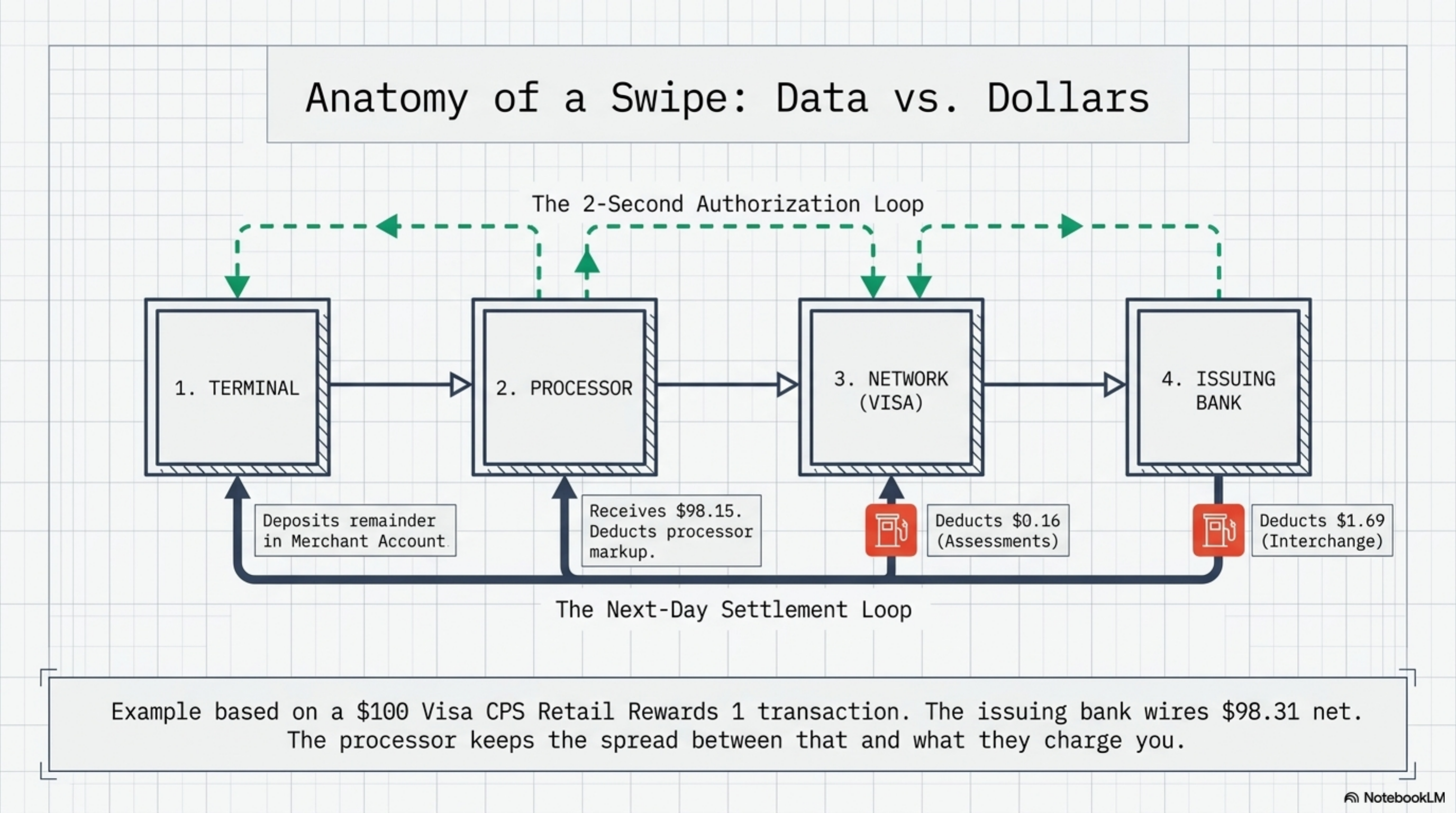
Walk through a single $100 sale paid on a consumer rewards Visa at a retail store. The full sequence runs in roughly two seconds:
- The customer taps the card. The terminal sends an authorization request to your processor.
- The processor forwards the request to Visa's network.
- Visa routes the request to the issuing bank.
- The issuing bank approves or declines based on available funds, fraud signals, and velocity rules.
- The approval flows back through Visa, to the processor, to the terminal.
- At settlement, usually the next business day, the issuing bank funds the transaction minus its interchange fee. On a Visa CPS Retail Rewards 1 transaction, that fee runs 1.65 percent plus 4 cents, so the issuing bank wires $98.31 net.
- Visa keeps an assessment fee, about 0.14 percent of volume plus a per-transaction network access fee (currently 1.95 cents on credit).
- Your processor receives the net amount, subtracts its own markup, and credits your merchant account, usually within one to two business days of the sale.
The processor never collects interchange. They cannot keep it, cannot discount it, and cannot waive it. They can only price how much they add above it.
This is why pricing models matter. There are three live pricing structures on the market:
- Interchange-plus (IC+). Your statement shows interchange as a separate line item, assessments as another line item, and the processor markup as a third. You see the wholesale cost on every transaction category. The processor markup is fixed as a percentage of volume plus a per-transaction fee, for example IC + 0.20 percent + 8 cents.
- Flat-rate (blended). The processor bundles interchange, assessments, and markup into one rate, usually 2.6 to 2.9 percent plus 10 to 30 cents. Stripe, Square, and PayPal use this model. You never see the underlying interchange, so you cannot tell whether a debit card (low interchange) is subsidizing a corporate card (high interchange) on your bill.
- Tiered pricing. The processor sorts your transactions into qualified, mid-qualified, and non-qualified buckets, with separate rates for each. Rewards cards and commercial cards almost always land in the non-qualified bucket at 3.49 percent or higher, even when their real interchange is 1.95 percent. The processor keeps the spread.
Federal Reserve Reg II data shows that for covered debit issuers (banks with $10 billion or more in assets), the average interchange fee per transaction in 2023 was 23 cents. For unregulated debit and credit, average rates run much higher because issuers price in rewards costs and fraud risk.
Most merchants on flat-rate plans run 0.30 to 0.55 percent above their tier benchmark. The gap shows up on the statement, never in the contract.
Where it goes wrong for operators
Five patterns drain money quietly from merchant accounts. Each one is detectable from a statement, but only if you know which line to read.
1. Flat-rate plans subsidize the expensive cards on your back
Stripe and Square charge 2.9 percent plus 30 cents on every transaction, online or in person. On a regulated debit card with interchange of 0.05 percent plus 22 cents, you are paying roughly 2.85 percent of pure markup. On a B2B commercial credit card running 2.50 percent interchange, you are paying about 0.40 percent of markup. A merchant with a debit-heavy mix is funding the rewards-card user across the counter. At $300,000 monthly volume with a 30 percent debit mix, the overpay on debit alone runs $7,200 to $9,000 per year.
2. Tiered pricing downgrades your rewards cards on purpose
Tiered processors quote a teaser qualified rate of 1.59 percent and put almost nothing in that bucket. Rewards cards, business cards, corporate cards, and keyed-in transactions land in the non-qualified bucket at 3.49 percent or higher. The processor keeps the spread between actual interchange and the non-qualified rate. On $500,000 monthly volume with 60 percent rewards cards, the tier markup typically runs 0.60 to 1.10 percent above what an interchange-plus contract would cost, or $36,000 to $66,000 per year.
3. Missed Level 2 and Level 3 data on B2B transactions
Commercial cards qualify for lower interchange when the merchant transmits enhanced data: tax amount, customer code, line-item description, quantity, unit price. Without enhanced data, a commercial card transaction falls into the EIRF (Electronic Interchange Reimbursement Fee) tier or the Standard tier, often 2.95 percent plus 10 cents. With Level 3 data on the same transaction, the rate drops as low as 1.90 percent plus 10 cents. The gap is 1.05 percent on every B2B card swipe. A B2B merchant at $400,000 monthly volume with 70 percent commercial cards loses about $35,000 per year by not enabling Level 3.
4. Card brand fee increases pass through silently
Visa and Mastercard adjust interchange and assessment fees twice a year, in April and October. Processors pass these changes through automatically. Unless you compare statements month over month, you never see them. According to the Nilson Report, U.S. card brands raised assessments and certain interchange categories in 2023 and 2024 in ways that lifted total merchant fees by an estimated 0.10 to 0.15 percent on affected volume. Most merchants found out from the statement, after the fact.
The rate guarantee clause in many processor contracts protects only the disclosed markup. Interchange and assessment increases are explicitly excluded. A processor can hold its 0.25 percent markup steady while your effective rate climbs every six months from card-brand changes you never approved.
5. Wrong MCC code overcharges every transaction
Your merchant category code (MCC) drives interchange placement. A jewelry store coded as 5999 Miscellaneous Retail pays higher interchange than one coded correctly to 5944 Jewelry. A SaaS vendor coded as 5734 Computer Software Stores pays a different rate than one coded as 7372 Prepackaged Software. The MCC also determines whether you qualify for the lower interchange categories on debit, supermarket, gas, utility, and recurring transactions. Most MCC errors are set on boarding and never reviewed.
Worked example with real numbers
Profile: a B2B accounting-software vendor based in Texas, charging recurring monthly subscriptions to small-business customers. Monthly card volume of $300,000. Average ticket of $850 across roughly 350 transactions per month. Card mix: 65 percent commercial credit, 25 percent consumer credit, 10 percent debit. All transactions are card-not-present (online checkout). Current processor: Stripe, on the standard 2.9 percent plus 30 cents rate.
Monthly fees on Stripe:
- Volume fee: $300,000 multiplied by 2.9 percent equals $8,700
- Per-transaction fee: 350 transactions multiplied by $0.30 equals $105
- Total: $8,805
- Effective rate: 2.94 percent
The same merchant on a true interchange-plus plan, with Level 2 data enabled for the 65 percent commercial card mix, would see this breakdown:
- Weighted interchange: roughly 2.10 percent (commercial credit at Level 2 averages 2.05 percent card-not-present, consumer credit averages 1.95 percent, debit averages 0.30 percent)
- Network assessments: 0.14 percent
- Processor markup at IC + 0.25 percent: 0.25 percent
- Per-transaction fee: $0.10
- Effective rate: approximately 2.50 percent
- Monthly total: about $7,535
Annual savings on the move: $15,240. Over a 60-month review window: $76,200.
If the same merchant also enables Level 3 data on its commercial card transactions, weighted interchange falls another 0.20 to 0.30 percent on the commercial-card slice. That adds $7,200 to $10,800 per year. The combined annual savings against the original Stripe baseline reach $22,000 to $26,000.
The math does not require any volume growth, any change to the product, or any pricing change to the customer. It requires reading the statement, asking the right questions, and signing a different contract.
At $300,000 a month with a B2B card mix, moving from flat-rate to interchange-plus with Level 3 data clears $22,000 per year. The cost of moving is one afternoon of statement work.
Operator playbook
Seven moves any merchant doing $50,000 a month or more can finish inside two weeks.
- Pull the last three monthly statements. Add up every line: volume fees, per-transaction fees, monthly fees, PCI fees, assessment fees, statement fees, gateway fees. Divide total fees by total volume. That number is your effective rate. Most operators have never calculated this number for themselves.
- Identify your pricing model. If the statement shows one rate (2.9 percent plus 30 cents on every transaction), you are on flat-rate. If it shows three tiers (qualified, mid-qual, non-qual), you are on tiered. If it shows interchange as a separate line item, you are on interchange-plus. The first two are usually overpriced for any merchant above $50,000 monthly; the third can still be overpriced if the disclosed markup is above 0.35 percent.
- Request a fee summary from your current processor in writing. Ask for the effective rate, the markup over interchange, the monthly minimum, the PCI fee, the early-termination clause, and every recurring fee. A processor that will not put numbers in an email is telling you something about the contract.
- Get three competing quotes on interchange-plus pricing. Target IC + 0.10 percent to 0.25 percent for retail and IC + 0.20 percent to 0.40 percent for card-not-present. Above $250,000 monthly volume, the lower end of those ranges is achievable. Below $100,000, expect the higher end. Always quote on volume; never accept a flat per-transaction price without the percentage attached.
- Enable Level 2 and Level 3 data if you accept commercial cards. Confirm with the gateway and the processor that tax amount, customer code, and line-item detail are being transmitted on every transaction. Pull a sample transaction and verify in the processor's reporting portal that the enhanced data fields populated.
- Audit your MCC code. Your merchant category code drives interchange placement. Ask the processor to confirm the four-digit code on file and dispute it if wrong. A correction to the right MCC can drop interchange by 0.10 to 0.30 percent on every transaction.
- Renegotiate every twelve months and after every card-brand update. Card brand fees rise twice a year, in April and October. Processor markups creep over time. Put a calendar reminder on April 1 and October 1 to compare your statement to the previous quarter.
The first three actions cost nothing and take an afternoon. They usually unlock more savings than any contract negotiation that follows.