TL;DR
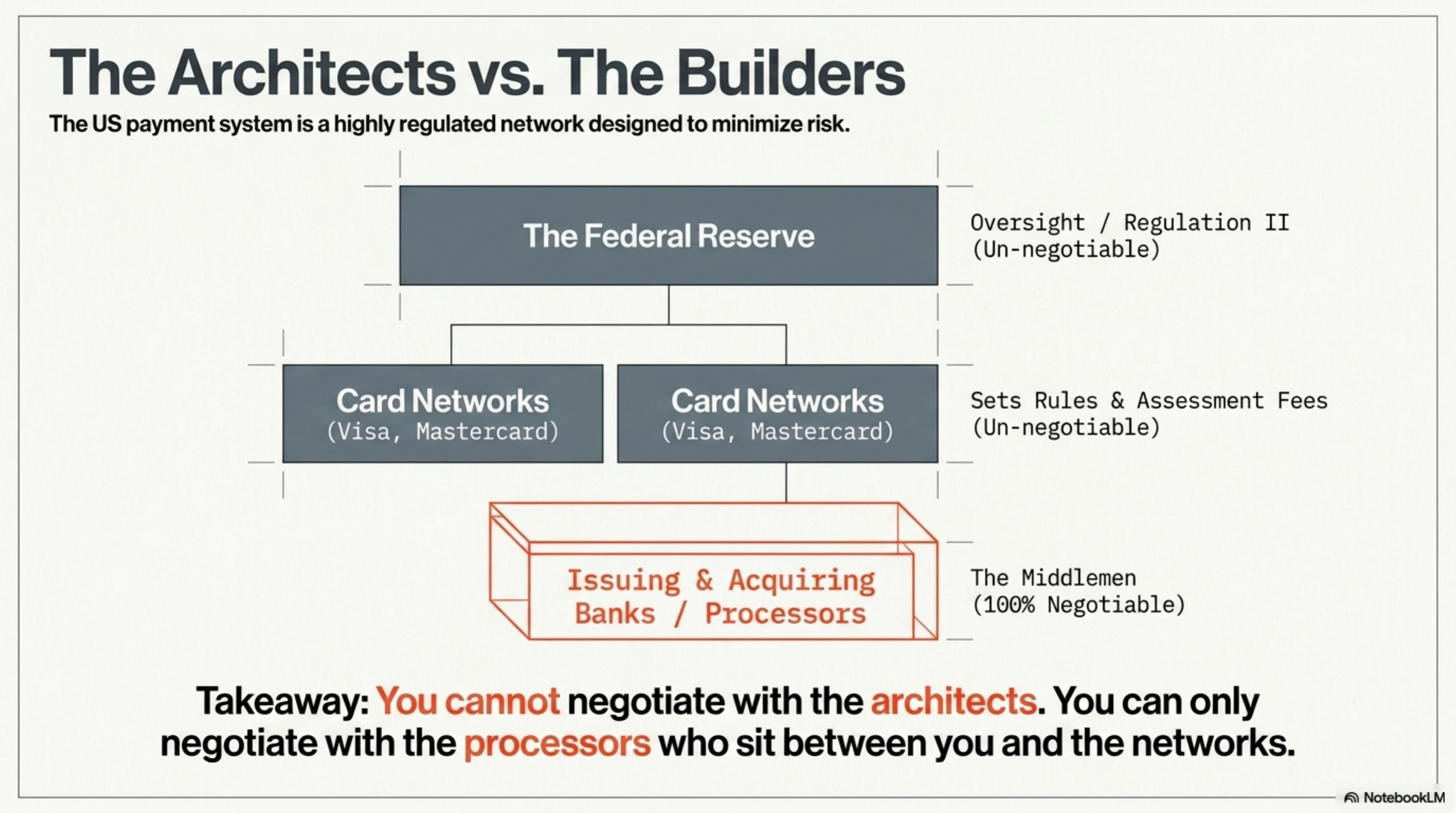
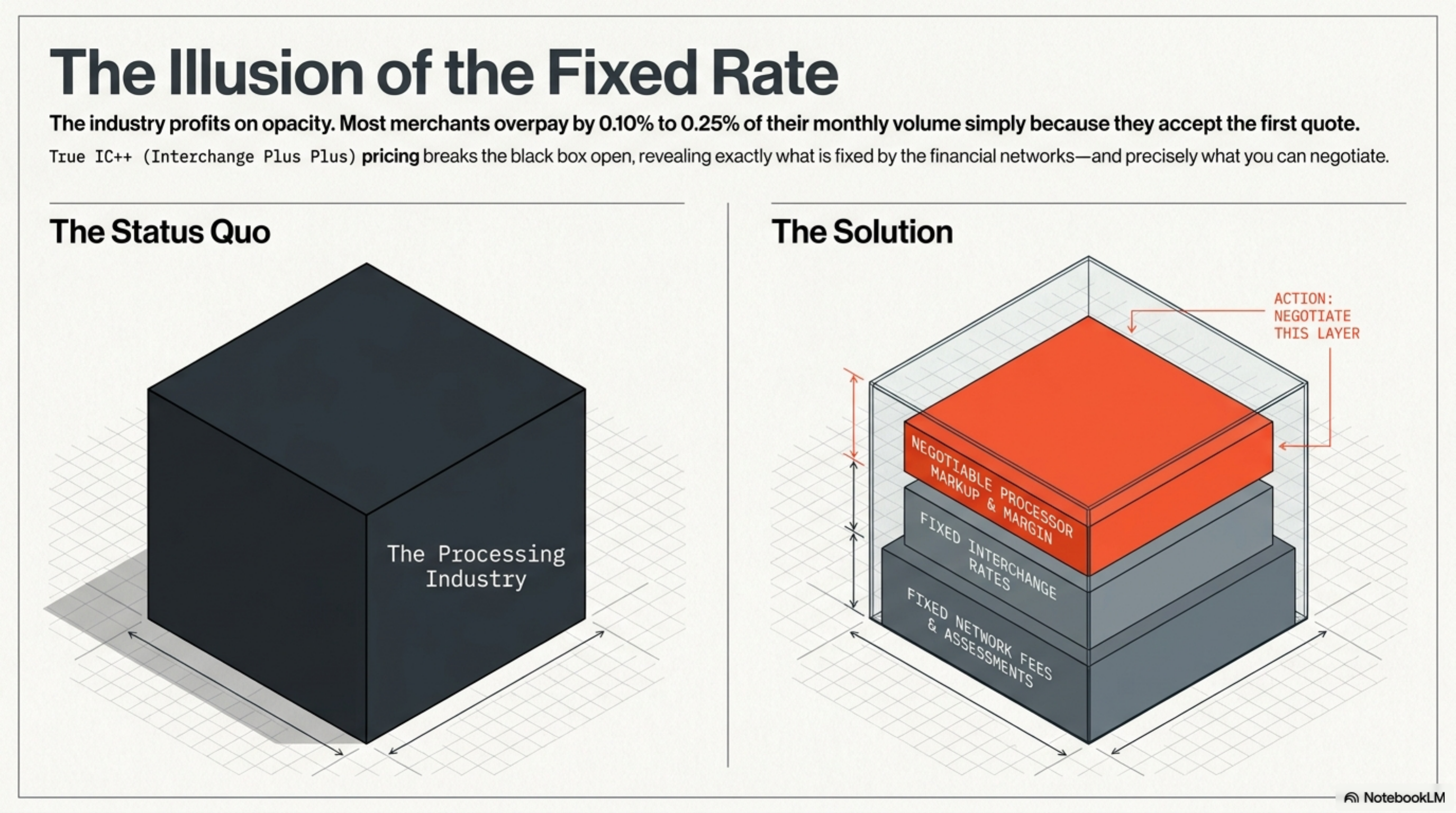
IC++ pricing passes the card network's interchange and assessments through at cost, then adds a separate processor markup quoted in basis points plus per-transaction cents. The interchange and assessments are not negotiable. The markup is. Most merchants accept the first quote and overpay 0.10 to 0.25 percent of monthly volume. Pull last month's statement, calculate processor margin as a percentage of volume, get three competing IC++ quotes in writing, and counter your current processor with the lowest one.
What this actually is
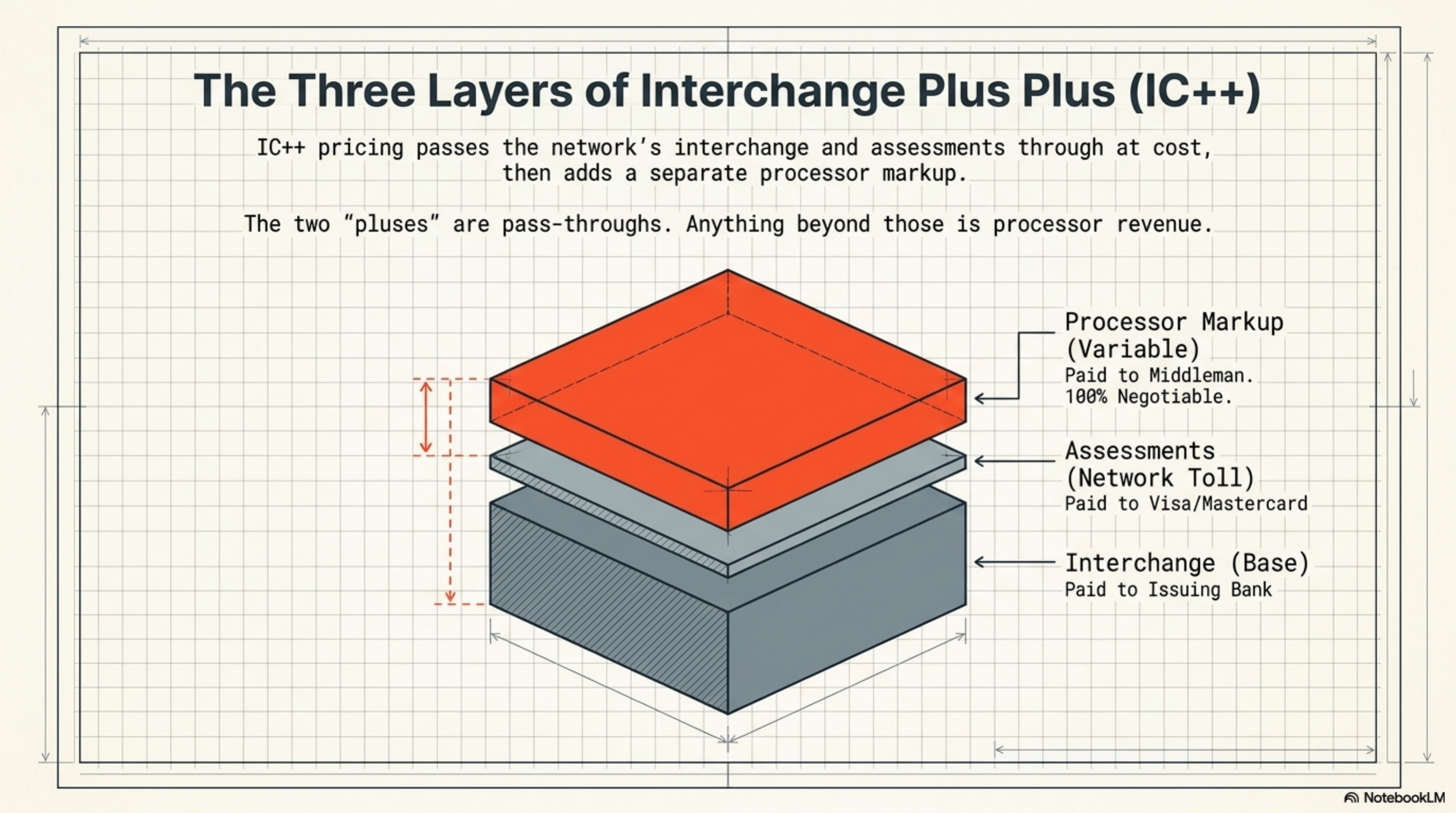
IC++ stands for interchange plus plus. It is the pricing structure that breaks each card transaction into three stacked costs and shows them as separate line items on your statement.
The first cost is interchange, paid to the card-issuing bank and set by Visa, Mastercard, Discover, and American Express. The Visa US interchange schedule publishes rates that run from roughly 0.05 percent for regulated debit to over 3.15 percent for some commercial and rewards credit cards. Mastercard publishes a similar schedule covering its US consumer and commercial card categories.
The second cost is assessments and network fees. The specific rates and per-authorization items below are not published by Visa or Mastercard on a single public consumer page; they are documented in the network operating rules and the acquirer-bulletin updates the networks distribute to member banks twice yearly. The figures here reflect myPayAdvisor's review of recent acquirer fee schedules and merchant settlement statements (April 2026 update); the network reference pages are linked for context, not for the exact numbers. Per the Visa US fee resource, Visa currently charges approximately 0.14 percent assessment on credit volume plus an Acquirer Processing Fee (APF) of roughly 1.95 cents per credit authorization. Per the Mastercard US fee resource, Mastercard currently charges approximately 0.1375 percent on consumer credit under $1,000 and 0.1475 percent above, plus a Network Access and Brand Usage (NABU) fee of roughly 1.95 cents per authorization. Verify the exact figures against your current month's settlement detail before negotiating, since the networks adjust these schedules in April and October.
The third cost is the processor's markup. This is the only piece you can negotiate. It usually appears as a basis-point markup plus a per-item fee. According to Federal Reserve payments studies, interchange accounts for the bulk of card-acceptance cost across the US merchant base, but processor markup is where the dispersion across merchants of similar volume is largest.
IC++ pricing passes interchange and network assessments through at cost, then adds a separate, negotiable processor markup quoted in basis points and per-transaction cents.
How it works under the hood
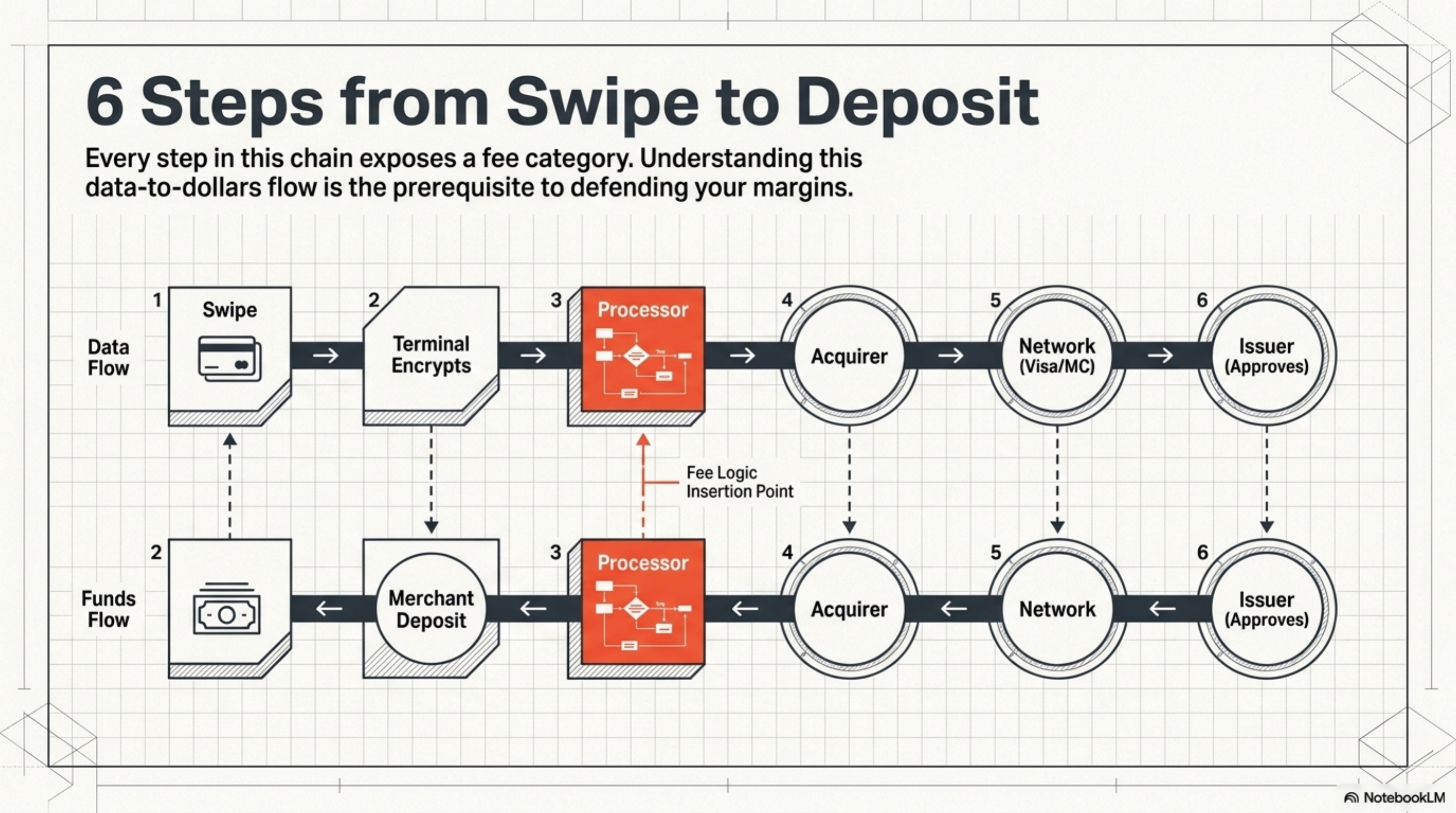
An IC++ transaction has six steps from swipe to deposit. Each step exposes a fee category that ends up on your statement.
- The customer presents a card. The terminal or gateway encrypts the card data and sends an authorization request to your processor.
- Your processor routes the request through the acquiring bank to the card network (Visa, Mastercard, Discover).
- The network forwards the request to the card-issuing bank, which approves or declines based on funds, fraud rules, and 3DS signals.
- The approval returns. The terminal completes the sale and stores the transaction in the open batch.
- At end of day the batch settles. The processor sends the file to the acquirer, the acquirer to the network, the network to each issuer.
- Funds move back the same path within one or two business days. Fees pull either daily from gross deposits (daily discount) or monthly via invoice (monthly discount).
Interchange category is assigned at authorization based on card type, environment (card present vs card not present), data level (level 1 retail, level 2 for purchase cards, level 3 for B2B and government), and ticket size. Submitting level 2 or level 3 data on commercial cards reduces interchange on qualifying transactions; the commonly cited 50 to 90 basis point range is a myPayAdvisor field estimate derived from comparing the commercial card categories in the Visa and Mastercard published schedules to their corresponding level 2 and level 3 buckets. The exact savings depend on brand, ticket size, and which data fields you transmit. Verify against your processor's interchange detail report before relying on the figure.
Assessments are flat percentages plus per-transaction items applied to every settled sale. They do not change with negotiation. The processor markup is the only contractually variable line on an IC++ contract.
The two pluses in IC++ refer to the two pass-through layers: interchange and assessments. Anything beyond those, no matter the label, is processor revenue. If you cannot identify the markup as a single basis-point number, you are not on true IC++.
Where it goes wrong for operators
True IC++ is the cleanest pricing model available, but five patterns reliably erode the savings merchants expect when they switch to it. The dollar figures in this section are illustrative myPayAdvisor estimates calculated against the volume profile in each example, not survey data.
1. Quiet markup creep. Processors add 2 to 5 basis points per year through compliance updates, network fee adjustments, or annual rate reviews. The notice arrives in a 16-page statement insert. At $400,000 monthly volume, 3 bps is $144 a month, $1,728 a year (illustrative calculation: $400,000 x 0.0003 x 12).
2. Padded assessments. Some processors quote IC++ but pass through Visa's roughly 0.14 percent assessment as 0.17 percent. Mastercard's 0.1375 percent shows up as 0.16. The difference is rebranded processor markup. At $250,000 monthly volume on a 70 percent Visa and Mastercard mix, a 2.5 bp pad is roughly $52 a month of pure surcharge (illustrative calculation: $250,000 x 0.70 x 0.00025 ≈ $43.75, rounded up to account for the higher Visa weighting in most mixes).
3. Stacked junk fees. PCI non-compliance fees ($19 to $39 monthly), statement fees ($10 to $25), batch fees (5 to 25 cents per batch), gateway fees ($10 to $35 monthly), monthly minimums, IRS reporting fees, annual fees. A merchant at $180,000 monthly volume can pay $1,000 to $1,800 a year in line items unrelated to the IC++ rate (myPayAdvisor field estimate from statement reviews).
4. Tiered pricing dressed as IC++. Some processors quote interchange plus on the sales sheet, then rebucket actual interchange into qualified, mid-qualified, and non-qualified tiers on the statement. If the interchange line on your statement is a flat 1.65 percent and not a list of category codes, you are on tiered, not IC++.
5. Cancellation and ETF clauses. Early termination fees of $295 to $595, liquidated damages clauses calculating expected future profit, equipment lease lock-ins of 36 to 48 months. Read the contract before you sign, not after the first statement arrives.
Most merchants on flat-rate plans run 0.30 to 0.45 percent above their tier benchmark (myPayAdvisor field estimate). The gap shows up only on the statement, never in the contract.
If your processor refuses to commit the markup in basis points and the per-item fee in cents in writing, you do not have an IC++ contract. You have a discretionary rate the processor can change at any time.
Worked example with real numbers
The dollar figures below are an illustrative myPayAdvisor calculation built from one merchant's stated card mix; they are not survey data and are not drawn from a third-party benchmark. Use them to follow the math, then plug in the actual numbers from your own statement.
Profile: specialty retailer, brick-and-mortar plus a small Shopify store, $180,000 in monthly card volume across roughly 2,900 transactions. Average ticket $62. Card mix runs 68 percent Visa and Mastercard credit, 22 percent Visa and Mastercard debit, 7 percent Amex, 3 percent Discover. Current contract: IC++ at 35 bps plus 12 cents per transaction. Daily discount, no monthly minimum, $25 statement fee, $9.95 PCI service fee, $39 PCI non-compliance fee currently triggered.
Monthly cost breakdown at this profile:
- Interchange: blended at roughly 1.78 percent of volume, or $3,204. The 1.78 percent figure is a myPayAdvisor illustrative blend computed by weighting the stated 68/22/7/3 card mix against the rate ranges in the Visa and Mastercard published schedules plus typical Amex OptBlue and Discover acquirer rates. Your blended rate will differ; use your statement's interchange detail.
- Assessments: roughly 0.14 percent, or $252, plus 1.95 cents per Visa and Mastercard credit auth, roughly $48 (per the assessment figures sourced from the Visa and Mastercard fee references above).
- Processor markup: 0.35 percent of $180,000 plus 12 cents times 2,900 transactions = $630 plus $348 = $978
- Statement and PCI fees: $25 plus $9.95 plus $39 = $73.95
- Total monthly cost: roughly $4,556
- Effective rate: 2.53 percent of $180,000
The processor markup line is $978 a month, or 0.54 percent of volume once the per-item fee is included on a $62 average ticket. The 15 to 22 bps plus 7 to 10 cents benchmark used for comparison below is a myPayAdvisor field estimate drawn from recent ISO and bank-direct proposals we have reviewed for $1.5M to $3M annual volume retail accounts. It is not published by Visa, Mastercard, the Nilson Report, or any other public source. Treat it as a starting point, then validate with your own three competing quotes.
Renegotiating to 18 bps plus 8 cents drops processor markup to $324 plus $232 = $556 a month. Annual savings: $5,064. Removing the PCI non-compliance trigger by completing the SAQ saves another $468 a year. Total: $5,532 a year on a profile that did not change a single processor.
The retailer above kept the same merchant ID, the same terminal, the same processor. The change was a single email exchange and a one-page amendment lowering markup to 20 bps plus 8 cents, after the merchant attached three competing IC++ quotes from independent ISOs. The processor matched at 19 bps plus 8 cents to retain the account.
Operator playbook
Run this sequence over a single billing cycle. Most accounts close the loop in 14 to 21 days.
- Pull three months of statements. Save the full PDFs, not the summary email. You need every line item, including the interchange detail report most processors append at the back.
- Calculate your effective rate. Total fees divided by gross sales, expressed as a percentage. Then calculate processor margin separately: total fees minus interchange minus assessments, divided by gross sales. That second number is what you negotiate.
- Confirm you are on true IC++. Look for a list of interchange categories on the statement (CPS/Retail, EIRF, Standard, Commercial Card). If you see Qualified or Non-Qualified as line items, you are on tiered pricing dressed up as IC++.
- Get three competing IC++ quotes in writing. Approach two independent ISOs and one bank-direct processor. Ask each for basis-point markup, per-item fee, all monthly fees, and the contract term in a single PDF. Reject verbal quotes.
- Counter your current processor. Send the lowest competing quote with a one-line message: match this within 10 business days or the account moves at the end of the billing cycle. Most retention teams come back within 48 hours.
- Cap the junk fees in the amendment. Statement fee, PCI service fee, batch fee, monthly minimum, annual fee. Get each capped or removed in the same written amendment that fixes the markup.
- Ask for interchange optimization. If you process B2B or government cards, demand level 2 and level 3 data submission. Any interchange reduction on qualifying transactions belongs to you, not the processor.
- Set a review every 12 months. Put it on the calendar. Markup creeps. Quotes age. The 18 bps you signed today drifts to 24 bps inside three years if you do not pull the statement and check.