TL;DR
Most merchants "shop the market" by collecting one quote and comparing it to their current rate. That comparison is noise. A real rate pull prices the same statement at three or more processors using the same pricing structure on the same volume, then normalizes for fees the processor buried. Done right, the spread between cheapest and most expensive quote on a $250,000 monthly statement runs $1,800 to $4,500 per month. The work is process, not luck.
What this actually is
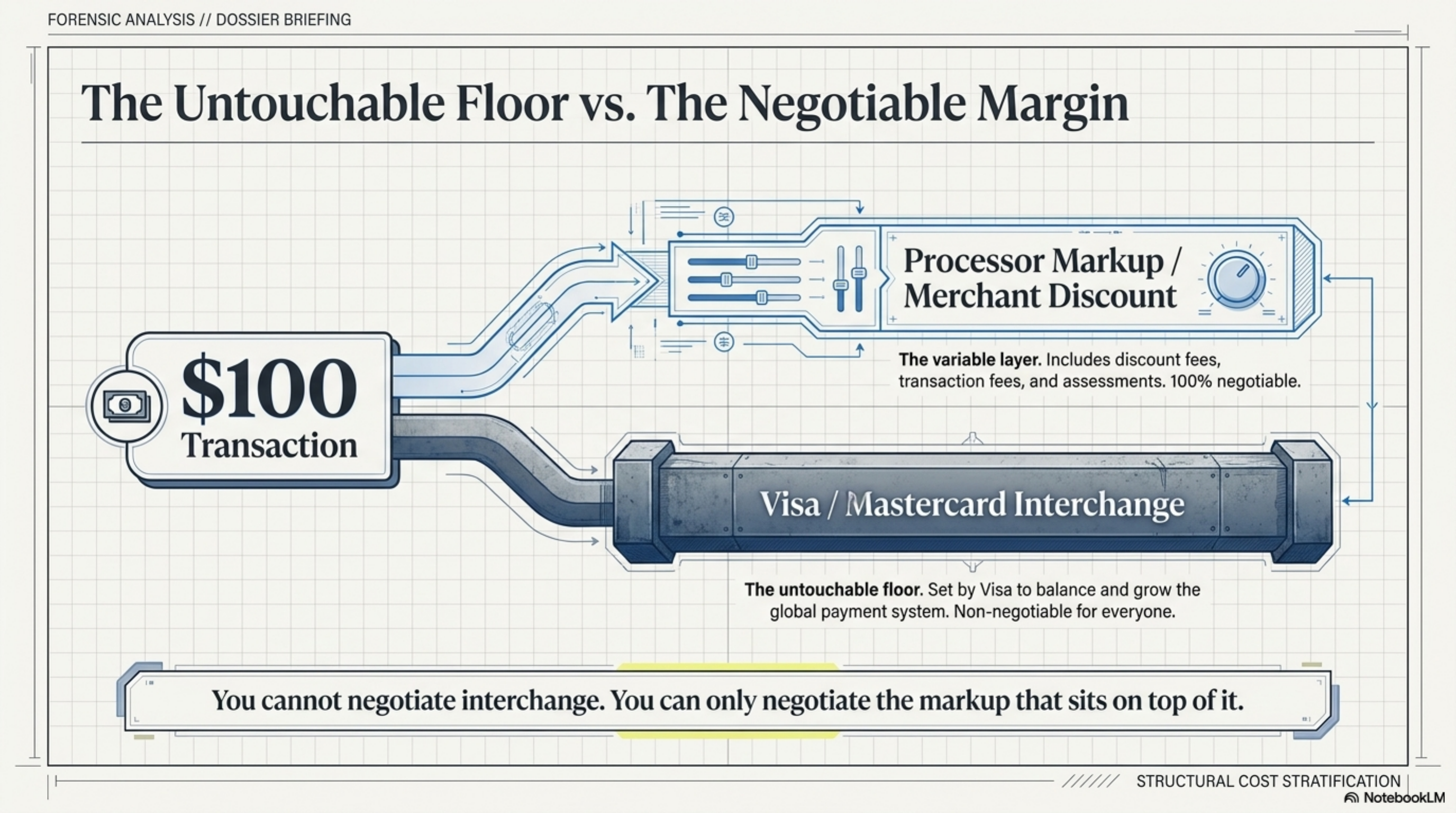
Rate quote shopping is the process of requesting matched pricing from multiple processors against the same merchant statement. The basic premise is straightforward: interchange is set by Visa and Mastercard, and is the same for every processor (see Visa's published interchange schedules and Mastercard's posted interchange rates). What varies between processors is the markup over interchange, the fee schedule that sits underneath the headline rate, and the equipment costs.
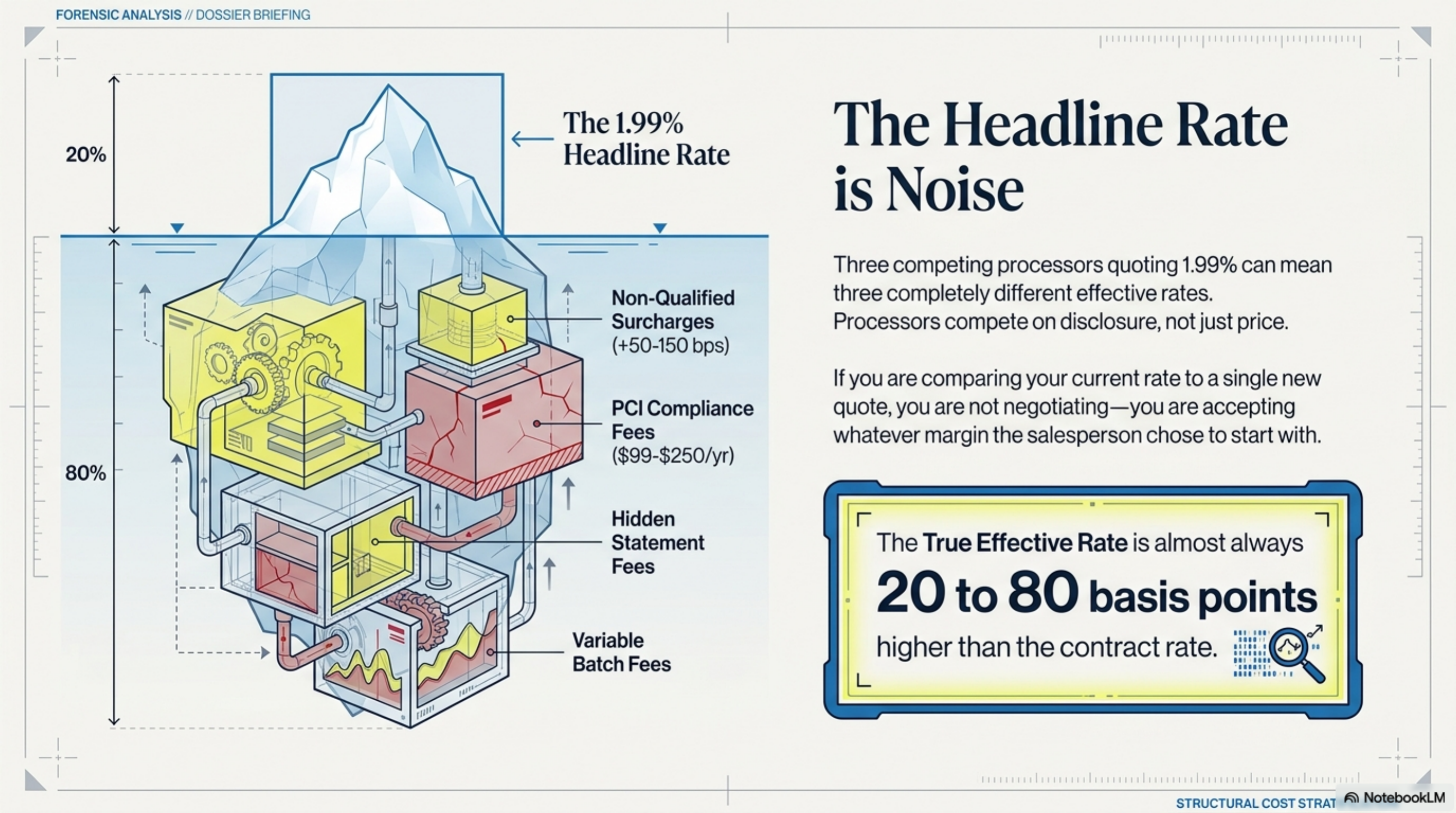
The work is harder than it sounds because processors compete on disclosure, not just price. Three processors quoting 1.99 percent can mean three completely different things, depending on what fees sit underneath that headline rate, which discount program the merchant is enrolled in, and which card categories that 1.99 percent actually covers.
Industry pricing surveys consistently show effective rates for U.S. card-present merchants in the low 2 percent range, with card-not-present merchants running noticeably higher. Treat any specific range you read in industry reporting as illustrative, not absolute, since methodology and card mix vary. The directional point holds: the gap between a merchant who shops properly and one who signs the first quote is typically 30 to 60 basis points.
Three processors quoting 1.99 percent can mean three different effective rates. The headline number alone tells you nothing.
Pulling rate quotes is the practice of sending two to three recent processing statements to multiple processors and requesting matched, line-item quotes on the same pricing structure.
How it works under the hood
The mechanics of a real rate pull have six discrete steps. Skip any one and the comparison collapses.
- Collect the inputs. You need the last three statements from your current processor as PDFs, with full transaction detail. Two months is the floor because card mix shifts month to month. Three months smooths out seasonality and weekend versus weekday variations.
- Calculate your current effective rate. Sum every line item on the statement: discount fees, transaction fees, assessments, monthly fees, PCI fees, batch fees, statement fees, gateway fees, chargeback fees, and any miscellaneous charges. Divide that total by gross processing volume. The result is your effective rate. It is almost always 20 to 80 basis points higher than the rate written in your contract.
- Build a standardized request. The request should specify five things: interchange-plus pricing only, markup quoted in basis points plus cents per transaction, every monthly fee itemized, a 36-month term with a capped or zero early termination fee, and equipment purchased outright or rented at a stated monthly cost.
- Send the request to three to five processors. Mix the channels. Include one bank-owned acquirer such as Chase Payment Solutions or Bank of America Merchant Services, one direct acquirer such as Worldpay or Elavon, one ISO, and one flat-rate aggregator like Stripe or Square. Use the flat-rate quote as a benchmark only, never as a finalist.
- Receive the quotes as written proposals. Phone conversations do not count. Every fee must be on the proposal in writing. If a fee is not listed, ask in writing whether it exists and at what rate, and get the answer on email.
- Normalize in a single spreadsheet. Plug each quote into the same monthly volume and card mix from your statement. Calculate the projected effective rate under each. The cheapest quote is usually not the lowest headline rate.
Where it goes wrong for operators
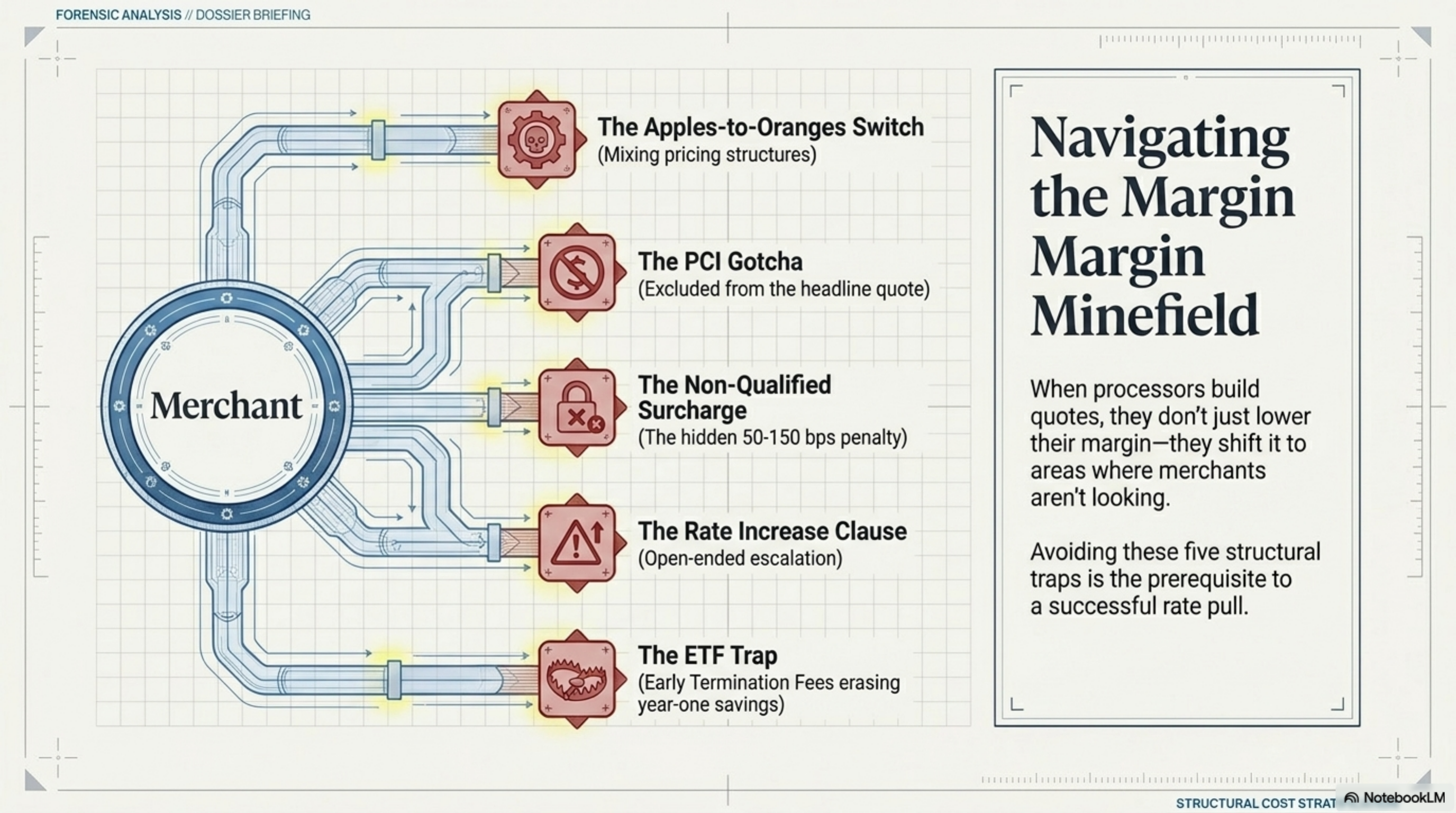
Five patterns cause merchants to leave money on the table during a rate pull.
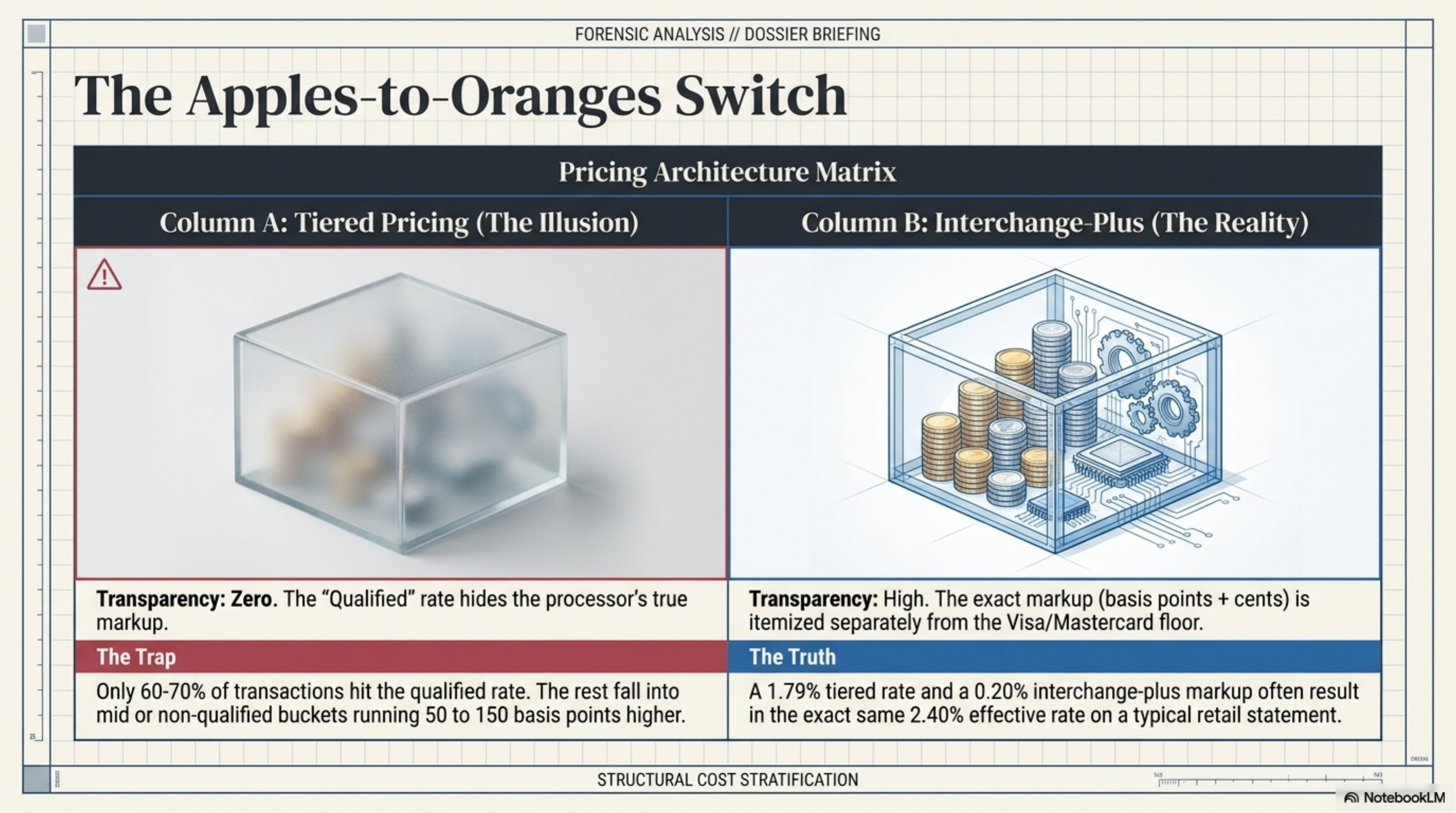
The apples-to-oranges switch. The merchant is on tiered pricing, the new processor quotes interchange-plus, and the math looks dramatically better. Under tiered, the qualified rate hides the markup. Under interchange-plus, the markup is transparent. On a $150,000 monthly merchant with a typical retail card mix, the same processor margin can show as 1.79 percent qualified or 0.20 percent over interchange. Both translate to roughly 2.40 percent effective. The merchant thinks they saved 1.6 percent. They saved zero.
The PCI gotcha. Most quotes show a small statement fee and skip PCI compliance fees on the headline. PCI compliance is typically billed as a separate annual or monthly charge, and the dollar amount varies widely by processor and plan tier. Always require the exact PCI fee in the written proposal and confirm it against the processor's published fee schedule or your draft merchant agreement before signing.
The non-qualified surcharge. On a tiered quote, the qualified rate covers maybe 60 to 70 percent of transactions. The rest hit a mid-qualified or non-qualified bucket that runs 50 to 150 basis points higher. A merchant who anchors on the qualified rate sees 1.69 percent on the contract and 2.75 percent on the statement.
The rate increase clause. Most processor contracts allow the processor to raise rates with 30 to 60 days written notice. The exact cadence and magnitude is set by the merchant agreement, not by industry norm, so read the rate-change clause word for word and confirm whether annual increases are capped or open-ended. The Nilson Report tracks acquirer rankings and aggregate pricing patterns for additional context.
The merchant who calls one processor and signs is not negotiating. They are accepting whatever margin the salesperson chose to start with.
Worked example with real numbers
Take a quick-service restaurant in suburban Ohio doing $185,000 in monthly card volume. Average ticket is $42. Card mix is 78 percent debit, 22 percent credit. Current processor is a regional ISO. Current pricing is tiered: 1.69 percent qualified, 2.39 percent mid-qualified, 2.99 percent non-qualified, $0.15 per transaction, $25 monthly minimum, $19.95 monthly statement fee, $99 annual PCI fee.
The owner pulls three statements and totals every line item. Current effective rate: 2.61 percent. Current total monthly cost: $4,828.
The owner sends a standardized request to three processors and receives written proposals. After normalizing each to the same volume and card mix on interchange-plus:
- Processor A (national ISO): interchange plus 0.30 percent, $0.10 per transaction, $25 monthly fee, $129 annual PCI. Projected effective rate: 2.12 percent. Projected monthly cost: $3,922.
- Processor B (bank-owned acquirer): interchange plus 0.22 percent, $0.10 per transaction, $40 monthly fee, $99 annual PCI. Projected effective rate: 2.05 percent. Projected monthly cost: $3,792.
- Processor C (direct acquirer): interchange plus 0.18 percent, $0.08 per transaction, $50 monthly fee, $0 PCI bundled. Projected effective rate: 2.00 percent. Projected monthly cost: $3,700.
Processor C wins on price. Monthly savings versus current: $1,128. Annual savings: $13,536. Over a 36-month term: $40,608.
The owner then takes Processor C's written quote back to Processor B and asks for a match. Processor B drops the markup to 0.16 percent and waives the monthly fee for the first 12 months. New monthly cost from B: $3,545. The owner signs B because the bank-owned acquirer offers a 30-day written rate-lock and no pass-through markup on Visa or Mastercard fee increases for the life of the contract.
Operator playbook
- Pull the last three months of merchant statements as PDFs. Do not accept screenshots, summary emails, or "we'll send the statement analysis after you sign" answers. You own the statements. Download them yourself from the processor portal.
- Calculate the current effective rate on each statement. Total fees divided by gross processing volume. Write the number down. Most merchants do not know their effective rate, and processors quote against that ignorance.
- Build a one-page written request. State the volume, card mix, average ticket, and channel mix. Require interchange-plus pricing in basis points plus cents per transaction. Itemize every monthly fee. Demand a stated equipment cost. Cap or zero the ETF.
- Send to three to five processors of different types. Include one bank-owned acquirer (Chase, Wells, BofA Merchant), one direct acquirer (Worldpay, Elavon, Global Payments), one ISO, and one flat-rate aggregator (Stripe or Square) used purely as a benchmark.
- Require written proposals. No phone calls until the spreadsheet is built. If a fee is not on the proposal in writing, get an email confirming the fee does not exist.
- Normalize in a spreadsheet. Plug each quote into your actual statement volume and card mix. Calculate the projected effective rate. The cheapest headline number is rarely the cheapest effective rate.
- Run the cheapest competing quote back to the second-cheapest processor. Most merchants skip this step. A bank-owned acquirer or direct acquirer holding a competing written offer in hand will typically drop 6 to 15 more basis points and waive 6 to 12 months of monthly fees.
- Get the rate lock in writing. The contract should state either no rate increase for the term, or rate increases capped at documented Visa and Mastercard pass-throughs. Anything broader is a free option the processor will exercise.