TL;DR
Most processor contracts hide a 12-month teaser. In months 13 to 18, the processor raises margin, layers in a PCI fee bump, and reclassifies card types into higher-cost buckets. Operators who pull 12 statements, calculate effective rate, and bring a competing quote to month 13 usually recover 0.20 to 0.45 percent of volume. For a $500K monthly merchant, that is $12,000 to $27,000 a year, without changing processors.
What this actually is
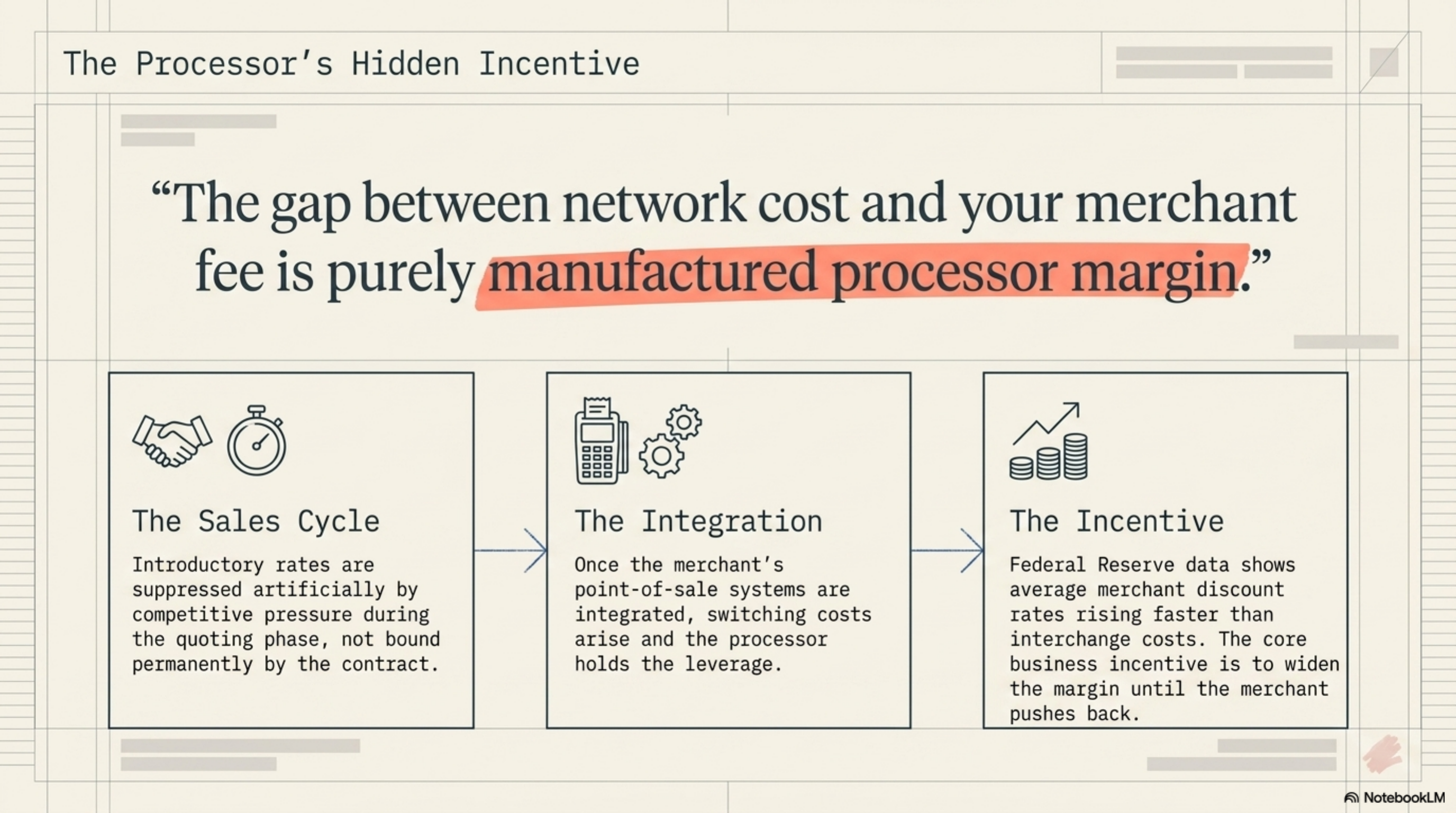
Renegotiating after year one is the practice of resetting your processing contract terms at month 12 to 13, before the second-year rate adjustments compound. Most ISO and processor agreements include language permitting price changes with 30 to 60 days written notice. The introductory rate quoted in year one is held in place by competitive pressure during the sales cycle, not by the contract. Once the merchant is integrated, the processor's incentive is to widen margin until the merchant pushes back.
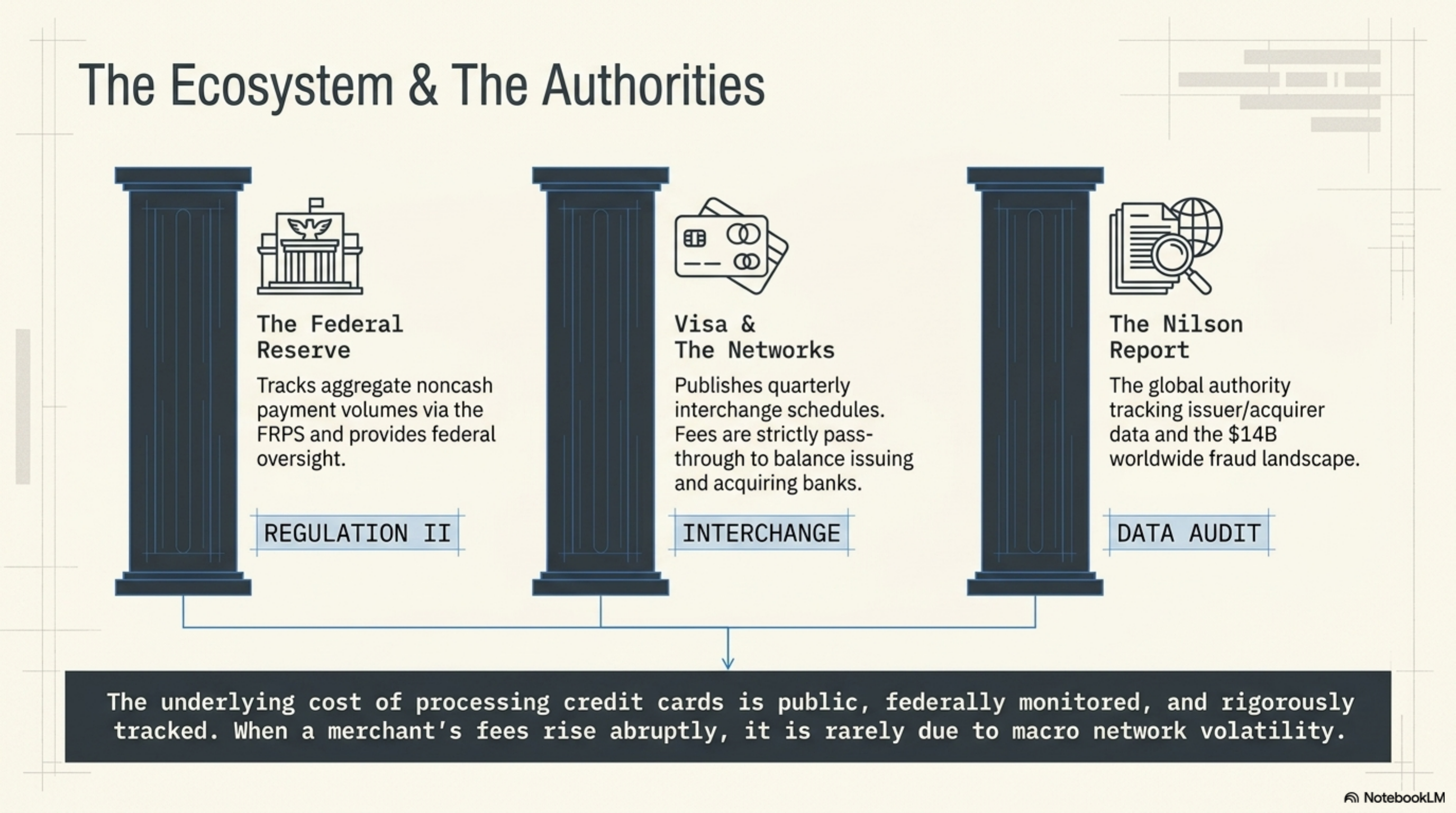
The Federal Reserve's payments studies document a pattern in which average merchant discount rates have risen faster than network interchange costs over the past decade. The gap is processor margin, not network cost.
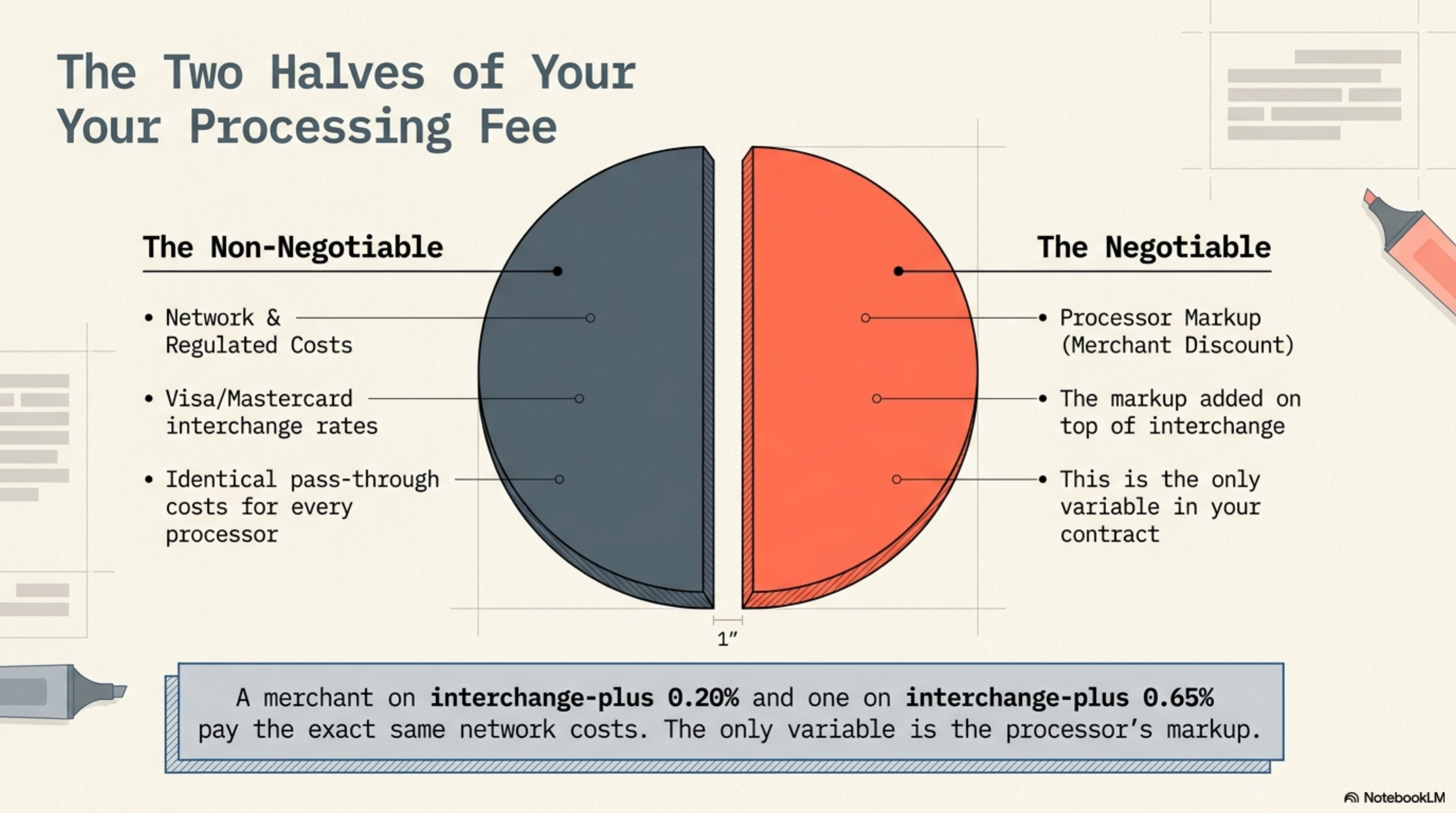
Visa and Mastercard publish interchange schedules quarterly. Those rates are pass-through and identical for every processor. What varies is the markup the processor adds on top. A merchant on interchange-plus 0.20 percent and a merchant on interchange-plus 0.65 percent pay the same interchange but very different effective rates.
Renegotiating is not switching processors. It is using a competing quote, a clean statement audit, and the cost of the processor losing your file as the three tools to compress markup back to the original quote or below.
Renegotiating after year one means resetting your processor's markup at month 12 using a statement audit, a competing quote, and the threat of switching as your negotiation tools.
How it works under the hood
Three mechanics drive the year-two price walk:
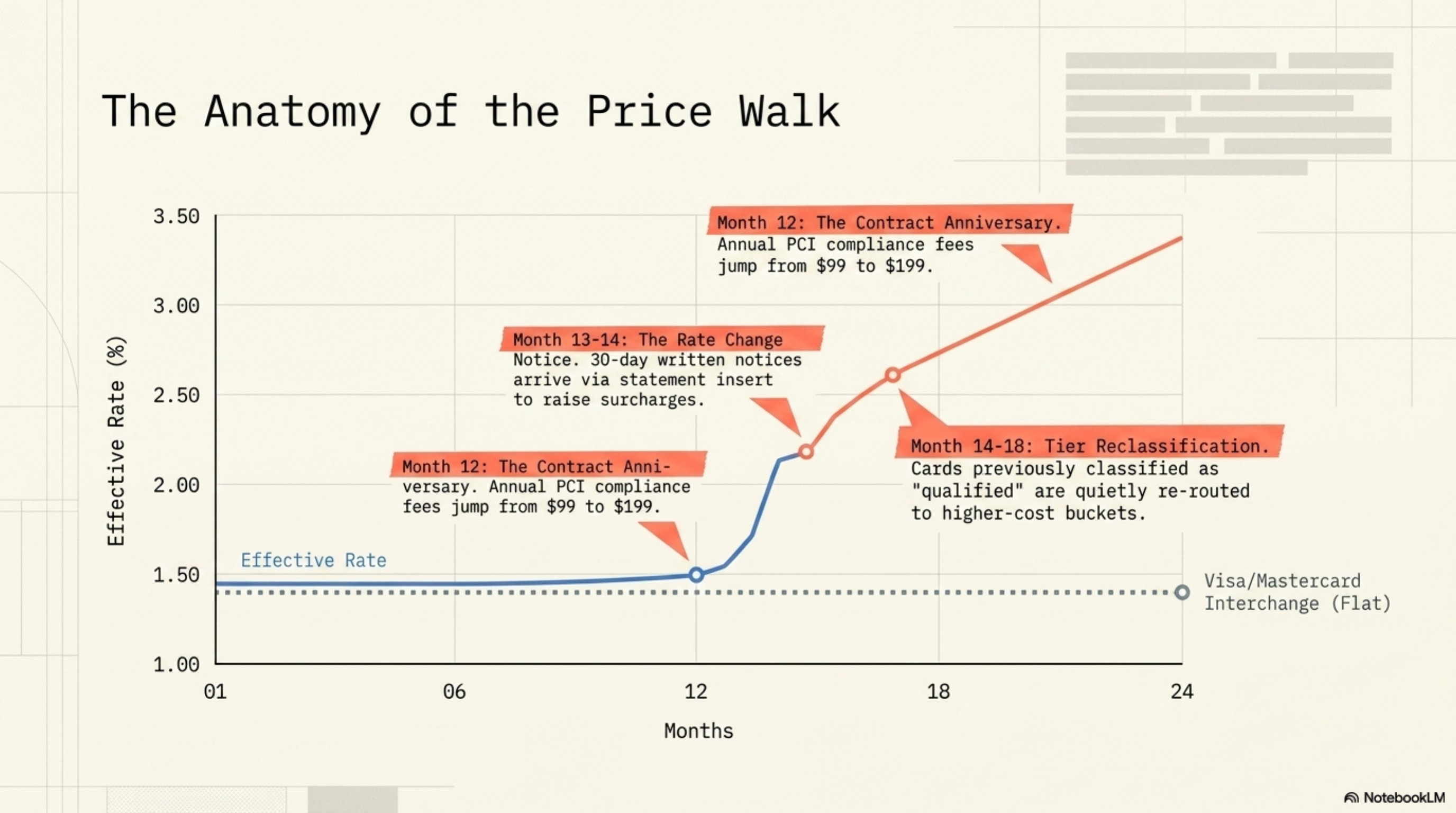
- Margin creep on tiered and bundled plans. Most processor contracts include language allowing rate adjustments with 30-day notice. The processor sends a notice in months 13 to 16 that mid-qualified and non-qualified surcharges are rising 0.10 to 0.20 percent each. Cards classified as qualified in month 6 route to mid-qualified in month 14. The contract permits it.
- PCI compliance fees. The annual PCI fee renews on the contract anniversary. Many processors raise it from $99 to $149 or $199 in year two. PCI non-compliance fees, charged monthly when a merchant misses a questionnaire deadline, run $19.95 to $49.95 per month and rarely get refunded retroactively.
- Network pass-throughs. Visa and Mastercard publish interchange updates in April and October each year. Processors pass these through, sometimes rounding up by 0.05 to 0.10 percent. On a clean interchange-plus contract the change should be neutral. On a tiered or bundled plan, the processor pockets the rounding.
The flow looks like this:
- Month 12: contract anniversary. PCI fee renews.
- Months 13 to 14: processor sends rate-change notice via statement insert or email.
- Months 14 to 18: new rates phase in across card types.
- Month 24: effective rate has typically climbed 0.20 to 0.45 percent versus year one.
The Nilson Report's data on U.S. merchant processing fees shows that a substantial portion of total fees represents processor margin above network costs. That margin is where renegotiation lives.
The introductory rate is competitive. The year-two rate is what the processor actually priced for. The 12-month gap is the renegotiation window.
Where it goes wrong for operators
Pattern 1: The merchant never opens the statements. The rate notice arrives in month 14 buried on page 6 of a 12-page PDF. By month 18, the effective rate is 0.35 percent higher and no one inside the company noticed. Most CFOs review the statement total, not the rate schedule.
Pattern 2: The merchant calls the processor first, before getting a competing quote. With no alternative on the table, the processor offers a $50 monthly credit or waives one PCI fee. The structural margin walk stays in place. The credit ends in 90 days.
Pattern 3: The merchant accepts "interchange-plus" branding without checking the plus. Some processors quote interchange-plus 0.30 percent in year one and quietly move it to interchange-plus 0.65 percent by month 18 under the rate-change clause. The contract still says interchange-plus.
Pattern 4: The merchant switches processors instead of renegotiating. The new processor offers an introductory rate identical to what the original processor would have matched. Twelve months later, the cycle repeats. Switching costs include integration time, gateway fees, and reserve releases that can take 90 to 180 days.
Pattern 5: The merchant misses the early-termination window. Many contracts include a 30 to 60 day window after rate-change notices in which the merchant can exit without an ETF. Missing it locks the merchant in for another 12 to 36 months at the new rate.
Dollar examples by volume tier:
- $50K monthly volume merchant on a 0.30 percent margin walk: $1,800 per year in added cost.
- $250K monthly merchant: $9,000 per year.
- $1M monthly merchant: $36,000 per year.
- $5M monthly merchant: $180,000 per year.
Worked example with real numbers
Profile: quick-service restaurant group, three locations, $420,000 monthly card volume, $14.50 average ticket, 65 percent debit and 35 percent credit mix.
Year-one contract: interchange-plus 0.25 percent plus $0.08 per transaction, $99 annual PCI fee, no monthly minimum.
Month 1 effective rate: 1.95 percent. This breaks down as roughly 1.62 percent in blended interchange, 0.25 percent processor margin, and 0.08 percent equivalent in per-transaction fees at the $14.50 average ticket.
Month 18 effective rate after the walk: 2.42 percent. The processor pushed margin to 0.55 percent, raised PCI to $199, added a $14.95 monthly statement fee, and reclassified business-card transactions into a higher tier worth roughly 0.12 percent on 8 percent of volume.
Annual delta: 2.42 minus 1.95 equals 0.47 percent on $5.04 million annual volume equals $23,688 in added cost.
Renegotiation move at month 13: the operator pulled 12 months of statements, calculated the effective rate trend, obtained a competing interchange-plus 0.18 percent quote from a competing ISO, and sent both to the original processor's account manager with a 14-day deadline. The original processor matched at interchange-plus 0.20 percent, dropped the statement fee, and restored PCI to $99.
Annual savings versus the walked rate: $21,168. Versus the original year-one rate: a $4,200 improvement on top.
Operator time invested: approximately 4 hours of statement review and email drafting.
Four hours of statement work at month 13 saved a three-location restaurant $21,000 over the next 12 months. The processor did not quit; they stopped raising margin.
Operator playbook
- Pull 12 months of statements as PDFs. Open page 2 of each. The fees summary or rate schedule section is where the walk shows up. Save them in a single folder named by month.
- Calculate effective rate per month. Total fees divided by total gross volume, expressed as a percentage. Plot the 12 months. If month 12 is more than 0.15 percent above month 1, the processor walked you.
- Pull the original signed contract or proposal. Compare the rate schedule to current statements line by line. Flag every rate, fee, or surcharge that did not appear in the original document.
- Get two competing quotes. Ask for interchange-plus, all-in. Specify your monthly volume, average ticket, card-present versus card-not-present mix, and MCC code. Require a fee schedule in writing.
- Email your processor's account manager. Attach the 12-month effective rate analysis, the competing quote, and set a 14-day deadline to match or beat. Do not call first. Email creates a paper trail you can reference later.
- Ask three written questions. What is your current margin over interchange in basis points? What is your PCI fee for year two? What other monthly fees apply? Their answers, in writing, become the baseline for negotiation.
- If the processor matches, get the new schedule in writing with a 12-month price-hold clause. If they do not, switch within the rate-change exit window. Either outcome is acceptable; doing nothing is not.
- Set a calendar reminder for month 11 of every contract year. Renegotiation is annual, not one-time. The processor will rebuild margin as soon as the price-hold expires.