TL;DR
At under $30,000 monthly card volume in retail or food service, Square costs less than Clover. Square's Free plan carries no monthly software fee and its starter contactless reader is $59, while Clover's lowest in-person rate of 2.3 percent plus 10 cents requires the $54.95 per month Plus plan and hardware that lists at $799 and up. Above roughly $50,000 monthly volume, Clover's rate edge can flip the math, but only if you buy direct from Clover rather than from a Fiserv reseller.
How we ranked
We score Square against Clover on six criteria that move the needle for a $25K to $5M monthly volume merchant.
- Effective rate at $250,000 monthly volume. Weight 30 percent. We model a 60 percent in-person, 30 percent online, 10 percent keyed card mix using each provider's public rate card.
- Software and hardware fixed cost. Weight 20 percent. Monthly plan fees plus first-terminal hardware cost.
- Contract length and early termination fee. Weight 15 percent. Direct accounts versus reseller agreements.
- Settlement speed. Weight 10 percent. Next-day funding versus same-day for an extra fee.
- Hardware portability. Weight 15 percent. Can you switch processors and keep the terminal.
- Dispute and chargeback support. Weight 10 percent. Public response window and per-case fee.
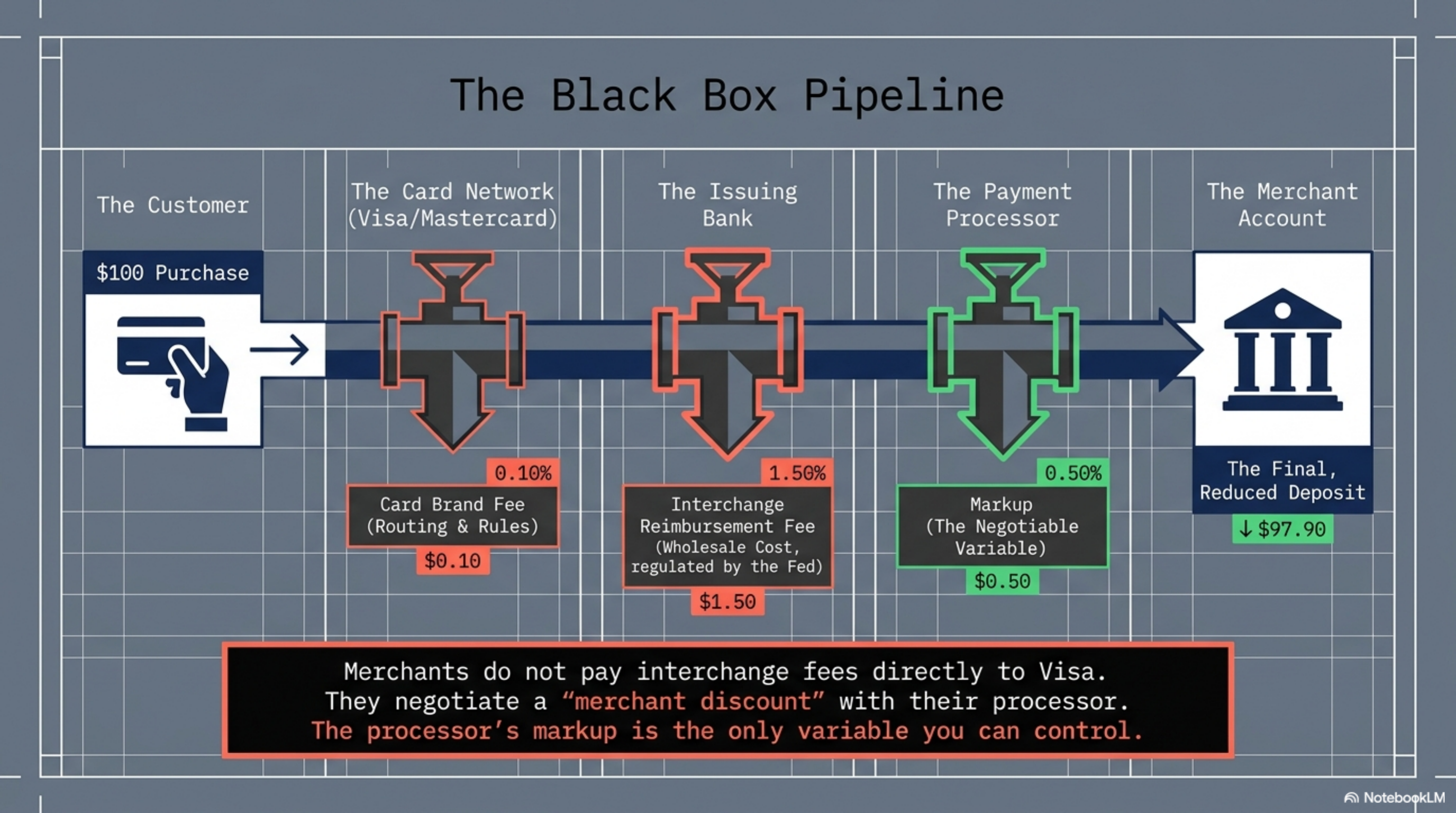
Pricing is pulled directly from Square's pricing page and Clover's POS pricing. Interchange components are sourced from Visa's published U.S. interchange schedule and Mastercard's interchange rates.
At a glance
| Provider | Headline pricing | Contract | Settlement | Best for | Watch out for |
|---|---|---|---|---|---|
| Square | 2.6% + $0.10 in person, $0/mo Free plan | Month to month | Next day standard, instant 1.75% fee | Retail and food under $50K/mo | Account holds on risk-flagged activity |
| Clover | 2.3 to 2.6% + $0.10 in person, $14.95 to $54.95/mo plan | Direct: month to month. Reseller: up to 3 years | Next day standard | Multi-station QSR and full-service restaurants | Hardware locked to issuing processor |
| Helcim | IC + 0.40% + $0.08 in person | Month to month | 2 business days | $50K+/mo with mixed card brands | No proprietary kitchen POS stack |
| Stax | $99/mo + IC + $0.08 in person | Month to month | 2 business days | $80K+/mo retail and services | Subscription only pays back above ~$50K/mo |
Square
Square publishes one rate card that applies to every merchant: 2.6 percent plus 10 cents in person, 2.9 percent plus 30 cents online, and 3.5 percent plus 15 cents keyed, per Square's pricing page. The Free plan carries no monthly software fee. Paid Plus tiers for retail and restaurants add a per-location monthly fee that includes inventory, shift, and reporting features Clover puts behind its mid-tier plans.
Hardware starts with a $0 magstripe reader for new accounts and a $59 contactless and chip reader. Square Terminal lists at $299 and Square Register at $799 on Square's site. The account is month to month with no early termination fee. Processing is integrated, meaning you cannot route Visa or Mastercard volume to a different acquirer while keeping the Square POS.
Who it is for: retail and food service operators under $50,000 monthly card volume who want zero fixed cost, same-day onboarding, and a unified app. Who should avoid: B2B sellers with average tickets above $500, since flat pricing forfeits level 2 and level 3 interchange savings, and any merchant who has already been hit with a Square hold and lost trust.
Clover
Clover is a POS brand owned by Fiserv. Pricing varies more than Square's because Clover sells through both a direct Clover account and through hundreds of Fiserv-affiliated resellers. Clover's direct pricing lists in-person rates from 2.3 percent plus 10 cents on the Plus or Service plans down through 2.6 percent plus 10 cents on the entry plans. Keyed transactions sit at 3.5 percent plus 10 cents on default plans.
Software plans run from Starter at $14.95 per month through Standard around $44.95 and Plus or Service around $54.95. Hardware is where Clover differs most from Square: Clover Mini lists around $799, Clover Station Solo around $1,499, and Station Duo around $1,799 on Clover's site.
Who it is for: multi-station restaurants and quick-service operators who want a dedicated POS stack with kitchen printers, online ordering, and labor reporting in one bundle, and who plan to stay with one processor for three or more years. Who should avoid: any operator buying hardware from a reseller without confirming in writing that the contract is month to month and the device can be reprovisioned. The same Clover model can carry very different monthly totals depending on who sold it.
Helcim, the interchange-plus alternative
For operators above $50,000 in monthly card volume, interchange-plus pricing usually beats both Square and Clover. Helcim's published rate is interchange plus 0.40 percent plus 8 cents in person and interchange plus 0.50 percent plus 25 cents online, with no monthly fee and automatic volume discounts that drop the markup further above the $50K, $100K, and $250K monthly volume tiers.
The trade is that Helcim does not sell a proprietary POS stack with kitchen printer integration the way Clover does. Helcim ships smart terminals and a web POS that work for retail, services, and small food operations, but a full-service restaurant with table management and a kitchen display system needs a third-party POS routed through Helcim. For online-only sellers, Helcim is often the cheapest of the four providers in this comparison at the $100K+ volume level.
Stax, the subscription alternative
Stax, formerly Fattmerchant, charges a flat subscription of $99 per month plus interchange plus 8 cents in person or 18 cents online, with no percentage markup above interchange. The math only works above roughly $50,000 monthly volume. Below that, the $99 subscription erases any savings versus Square or Clover Plus.
At $250,000 monthly volume across a 60 percent in-person, 30 percent online, 10 percent keyed mix, Stax routinely lands at an effective rate 0.35 to 0.55 percent below Square's flat rate. That gap, traceable to interchange tables published by Visa and Mastercard, is what funds the $99 monthly fee and still leaves four-figure annual savings on the table.
Verdict
For most operators reading this comparison, Square costs less than Clover. The reason is fixed cost. Square's Free plan adds no software fee and ships a $59 contactless reader, while Clover's lowest 2.3 percent in-person rate requires the $54.95 per month Plus plan and hardware that lists at $799 and up. Below about $40,000 monthly card volume, the rate gap does not pay back the plan fee or the hardware spread.
Clover wins in one specific case: a multi-terminal restaurant doing $50,000 or more per month that buys direct from Clover, not from a Fiserv reseller, and uses the bundled kitchen, online ordering, and labor features. Above $80,000 monthly volume in any vertical, the operator should price-check both against Helcim's interchange-plus rate before signing either.
 Square vs Clover vs interchange-plus alternatives." loading="lazy" />