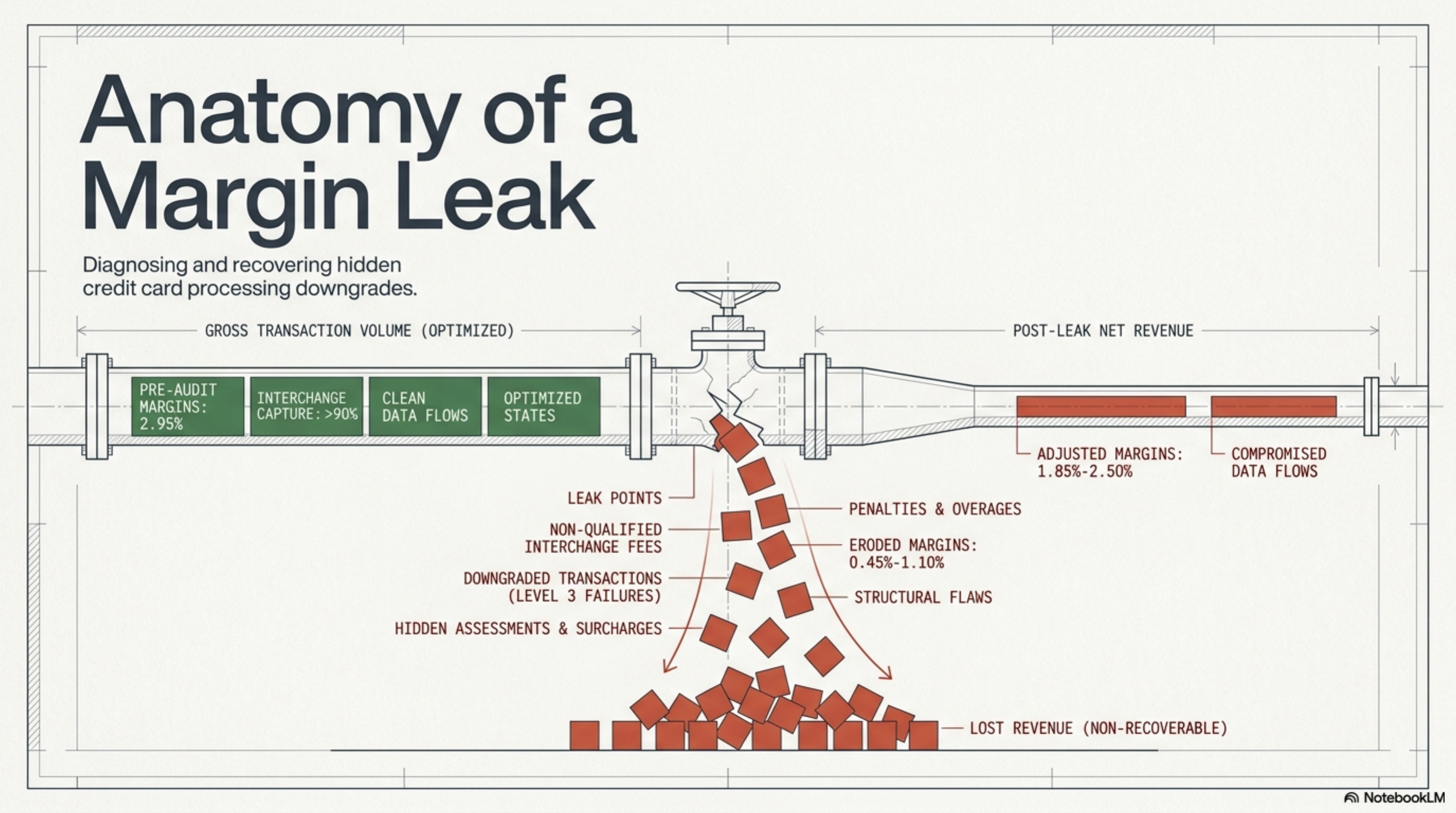
A downgrade is what happens when a card transaction misses the requirements for the interchange category your processor quoted, so the transaction settles at a more expensive bucket. On tiered pricing, this shows up as mid-qualified or non-qualified. On interchange-plus, it lands as a higher Visa or Mastercard category like EIRF or Standard. The cost gap is 0.50 to 1.50 percent per transaction. Most merchants leak 0.30 to 0.80 percent of monthly volume to downgrades that fixes to data, timing, or pricing model would prevent.
What this actually is
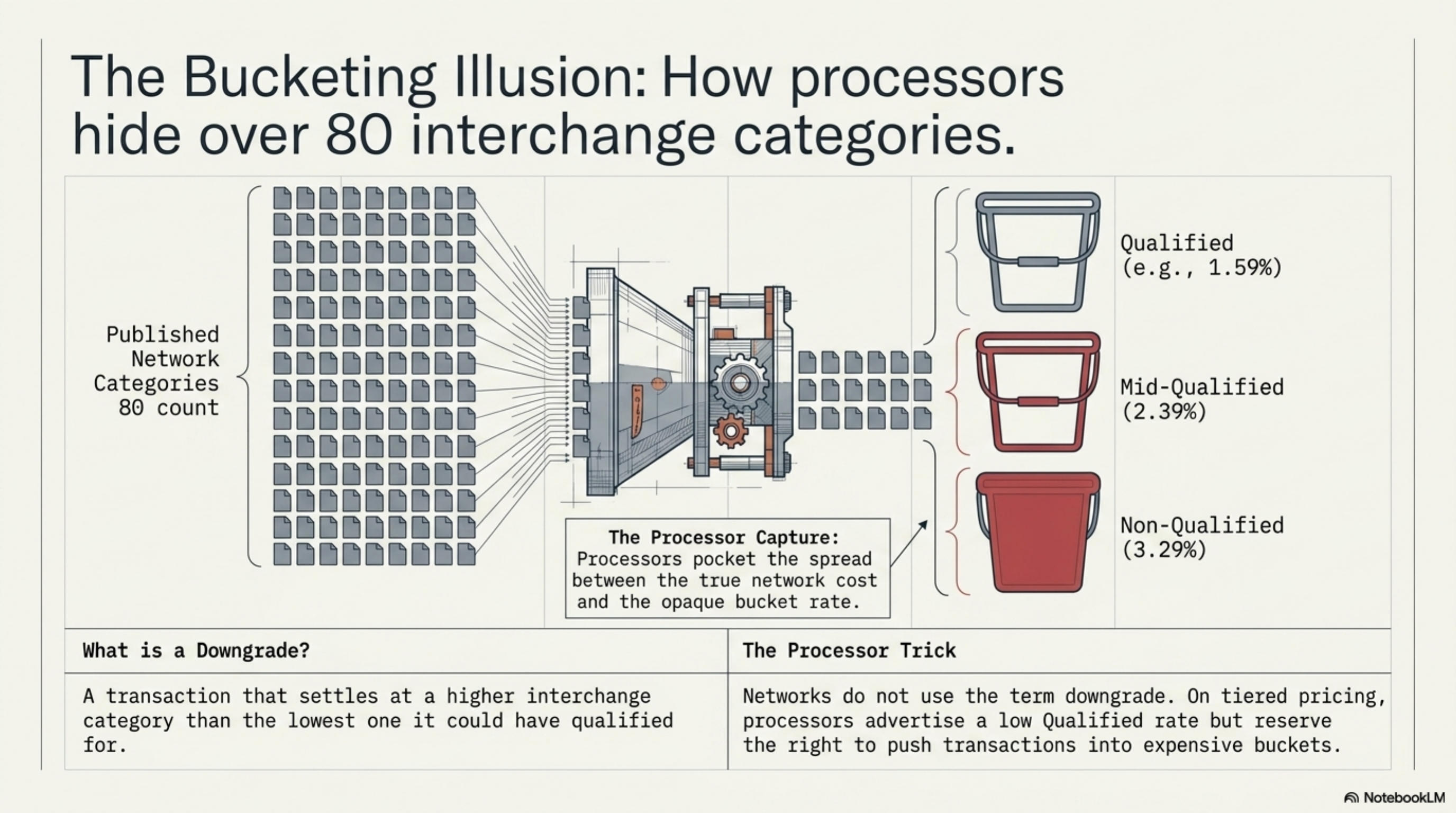
Card networks publish hundreds of interchange categories. Visa's published schedule lists more than 80 categories on the consumer side alone, and Mastercard maintains a comparable count, broken out by card product (consumer credit, rewards, signature, corporate, debit), merchant category code (MCC), and transaction conditions (data submitted, settlement timing, card-present versus card-not-present). Each category has its own rate.
A downgrade is industry shorthand for a transaction that does not qualify for the lowest available category and instead settles at a higher-priced one. The networks themselves do not use the word downgrade; they assign each transaction to the category that matches the data they receive. Processors invented the term because tiered pricing buckets the network categories into 3 simplified tiers (qualified, mid-qualified, non-qualified), and downgrade describes when a transaction falls from tier 1 to tier 2 or 3.
The dollar impact is real on every pricing model. On a tiered plan, the contract spells out a low qualified rate (often 1.59 percent) and includes language that pushes most transactions into mid-qualified (often 2.39 percent) and non-qualified (often 3.29 percent or higher). On interchange-plus, the merchant sees the actual interchange category on the statement, but the cost still rises when a transaction lands at EIRF (Electronic Interchange Reimbursement Fee) or Standard rather than CPS/Retail. The Federal Reserve payments studies document the system-level cost shift this creates across the merchant base.
A downgrade is a card transaction that settles at a higher interchange category than the lowest one it could have qualified for, costing the merchant 0.50 to 1.50 percent more per transaction.
How it works under the hood
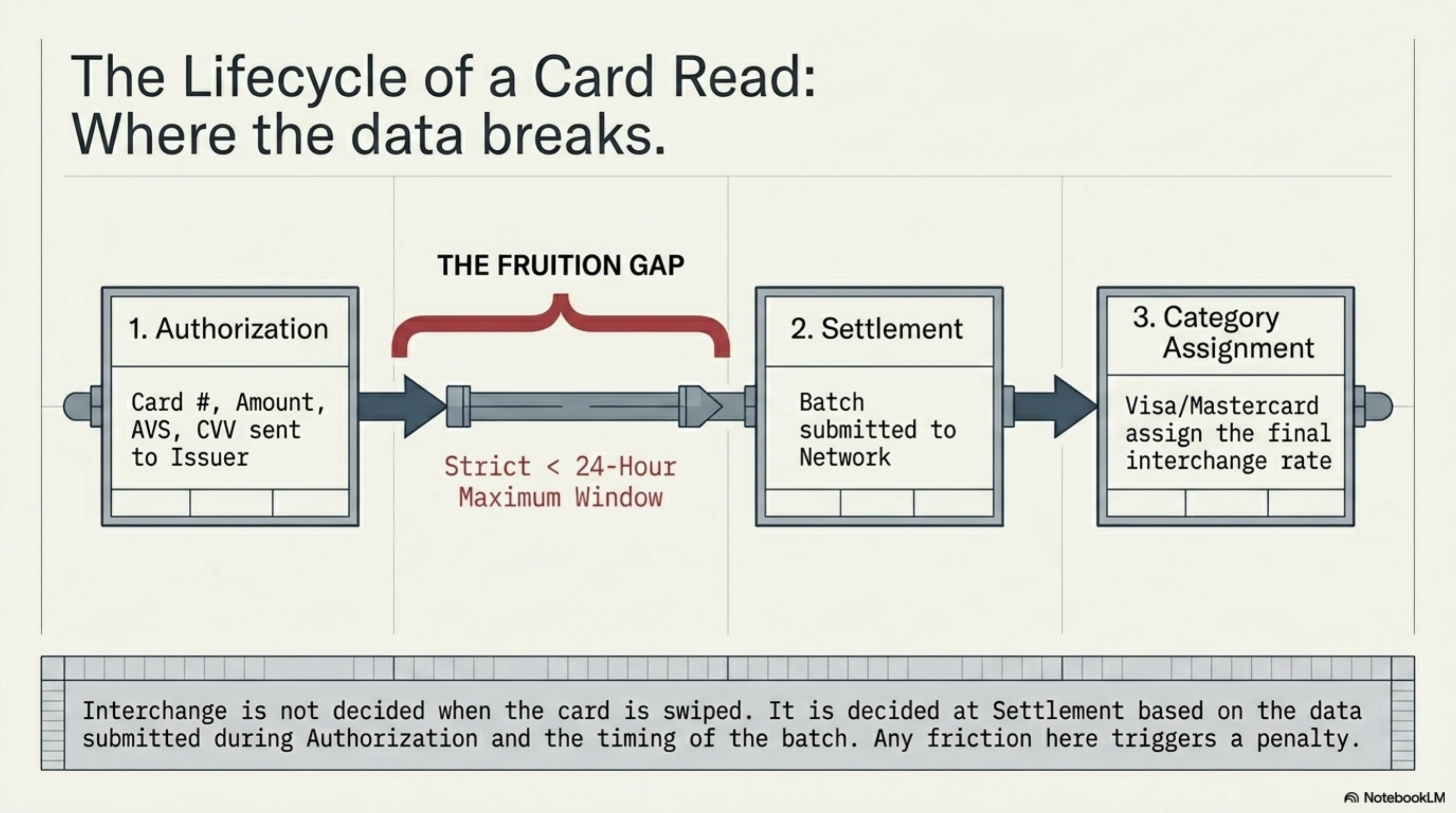
Every card transaction goes through two stages: authorization and settlement. The interchange category is decided at settlement based on the data submitted in the authorization message and the timing of the batch.
- Cardholder presents card. The card has a BIN (the first 6 digits) that identifies the issuer, the card product, and the rewards level. A Visa Signature card has a different BIN range than a Visa Traditional card, and they price at different interchange.
- Terminal or gateway sends auth request. The auth message carries the card number, amount, AVS data (if requested), CVV result (if requested), MCC, and other fields.
- Issuer approves or declines. If approved, the merchant has captured an authorization, but no funds have moved.
- Merchant batches out. Most processors require the batch to settle within 24 hours of authorization. If the batch is late, every transaction in it can fall to a higher category.
- Processor submits to network. The settlement file carries the final amount, timestamp, and any enhanced data (Level 2 or Level 3 fields for B2B transactions).
- Network assigns interchange category. Visa and Mastercard run the transaction against their published schedules and pick the category that matches the data and timing. The processor pays interchange to the issuer at that rate.
- Processor bills the merchant. On interchange-plus, the merchant sees the exact category. On tiered, the merchant sees a tier label and the underlying category is hidden.
The published rates are public. Visa lists current US interchange on its small business regulations and fees page. Mastercard publishes its schedule on its interchange rates and criteria page.
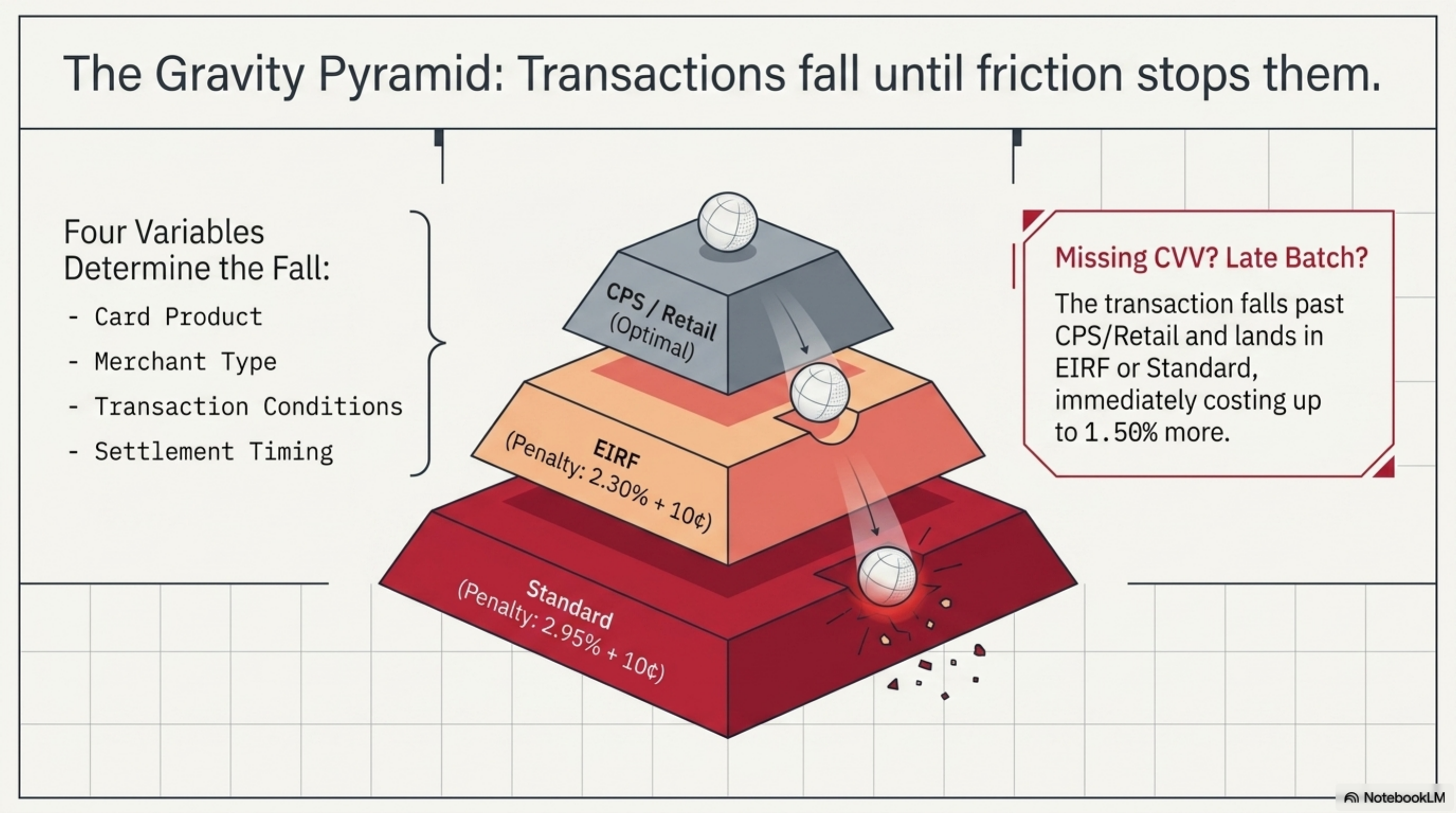
The conditions that decide which category a transaction lands in fall into 4 buckets: card product (consumer versus rewards versus corporate versus debit), merchant type (retail, restaurant, lodging, B2B), transaction conditions (card-present versus keyed, AVS submitted, CVV submitted), and timing (settled within 24 hours, contains required data fields).
Where it goes wrong for operators
There are 5 patterns we see most often.
Tiered pricing buries the downgrades
On a tiered plan, the contract advertises a qualified rate. Buried in the merchant agreement, the processor reserves the right to assign any transaction to mid-qualified or non-qualified at its discretion. Rewards cards almost always go to mid-qualified. Corporate cards almost always go to non-qualified. A merchant whose card mix includes 30 percent rewards cards (consistent with US issuer mix data published in the Nilson Report) sees roughly 30 percent of volume billed at the higher tier even with no operational mistakes.
At $250,000 monthly volume with 30 percent of charges flowing to mid-qualified at a 0.80 percent gap, the cost is $600 per month, or $7,200 per year, that disappears into the tier structure.
Late batch settlement
If a merchant's terminal does not settle the batch within 24 hours of authorization, every Visa transaction in that batch can fall to EIRF or Standard. The gap is 0.50 to 1.00 percent depending on card type. A restaurant that batches out Monday morning for the Friday and Saturday transactions has paid this cost on every weekend transaction since the system was set up.
Missing AVS or CVV on keyed transactions
For card-not-present transactions (e-commerce or phone orders), the network expects AVS (address verification) and CVV submission. If the gateway does not send the AVS request or the CVV is not captured, the transaction can fall to EIRF or Standard. The Visa CPS/Card Not Present rate is around 1.80 percent plus 10 cents; EIRF runs around 2.30 percent plus 10 cents.
A 0.50 percent gap on $300,000 of monthly e-commerce volume is $1,500 per month, or $18,000 per year.
B2B not submitting Level 2 or Level 3 data
Commercial and corporate cards run at high interchange by default (often 2.50 to 2.95 percent). Visa and Mastercard offer interchange discounts of 0.50 to 1.00 percent if the merchant submits Level 2 (tax amount, customer code) or Level 3 (line-item detail, freight, duty, ship-from and ship-to) data. Most B2B processors do not enable this by default. A B2B merchant on a standard processor pays full corporate interchange on every transaction.
Card-present transactions keyed instead of swiped or dipped
If a card-present terminal is offline or a chip read fails and the cashier keys the card number, the transaction loses CPS/Retail eligibility and falls to a higher category. A small percentage of keyed transactions per month is normal; consistent rates above 5 percent suggest a hardware or training problem.
A worked example with real numbers
Consider a B2B industrial parts distributor.
- Vertical: Wholesale industrial supply (MCC 5085)
- Monthly card volume: $400,000
- Average ticket: $850
- Transaction count: approximately 470 per month
- Card mix: 75 percent commercial credit, 20 percent corporate purchasing, 5 percent consumer
- Current pricing: Tiered, with qualified at 1.79 percent, mid-qualified at 2.49 percent, non-qualified at 3.39 percent
- Current effective rate: 3.05 percent plus 18 cents per transaction
Current monthly cost: 0.0305 times $400,000 plus $0.18 times 470 = $12,200 plus $84.60 = $12,284.60.
On the statement, the bulk of volume is being billed at non-qualified. The merchant believes this is normal because the processor told them at signing that B2B always runs higher.
What changes when this is fixed:
- Switch to interchange-plus. Move to a 0.30 percent plus 10 cent processor markup over true interchange. At the merchant's card mix, the underlying interchange is roughly 2.50 percent plus 10 cents (commercial card rate without Level 2 or 3 data).
- Enable Level 2 data. The gateway is updated to pass tax amount and customer code on every transaction. Commercial card interchange falls about 0.45 percent. New blended interchange is roughly 2.05 percent plus 10 cents.
- Enable Level 3 where supported. For the share of transactions over $1,000 with line-item detail available, Level 3 saves another 0.10 percent on a blended basis. Blended interchange falls to roughly 1.95 percent plus 10 cents.
- New effective rate: 1.95 percent plus 0.30 percent markup = 2.25 percent plus 20 cents per transaction. New monthly cost: $9,000 plus $94 = $9,094.
Monthly savings: $3,190.60. Annual savings: roughly $38,287. The fix is technical and contractual, not operational. Volume, ticket size, and customer count are unchanged.
Operator playbook
- Pull the last 3 statements in their full detail format. Most processors generate a summary statement and a merchant detail statement. Get the detail. It lists every interchange category by name and dollar volume.
- Build a category mix table. Sort transactions by category. Calculate the percentage of volume in CPS/Retail, EIRF, Standard, and any commercial categories. If more than 15 percent of volume is in EIRF or Standard, you have an unsolved downgrade problem.
- Check your batch timing report. Pull the batch report from your terminal or gateway and compare authorization timestamps to settlement timestamps. Anything beyond 24 hours is leaking money.
- Verify AVS and CVV are enabled and passing. Run a test transaction through your gateway and confirm the auth response carries an AVS code (Y, N, A, etc.) and a CVV result (M, N). If the codes are blank, the data is not being sent.
- Ask the processor for a card-mix report. This is usually called a BIN analysis or card-type breakdown. It tells you what percentage of your volume is consumer, rewards, corporate, or debit. If you are on tiered pricing, this is the report that proves how much rewards card volume is being billed at mid-qualified.
- For B2B, demand Level 2 and Level 3 enablement. Not every gateway supports Level 3, since it requires line-item data submission. Confirm capability before signing. Authorize.net, NMI, Cybersource, and Worldpay support it; many smaller gateways do not.
- Move from tiered to interchange-plus. Tiered pricing is the single largest source of unexplained downgrade cost for merchants under $1M monthly volume. Interchange-plus exposes the actual category and lets you fight downgrades that are operational rather than structural.
- Negotiate the markup, not the qualified rate. On interchange-plus, only the processor's markup is negotiable; interchange is set by Visa and Mastercard. A fair markup at $200K to $1M monthly volume is 0.20 to 0.40 percent plus 8 to 12 cents per transaction. Anything above 0.50 percent in markup is overpriced for that volume tier.
Anything above 0.50 percent in processor markup is overpriced at $200,000 monthly volume or higher.
For deeper background on the pricing model choice, see . For the technical setup of enhanced data, see . For statement reading conventions, see .
FAQ
Why did my transaction downgrade?
A transaction downgrades when it misses the data or timing conditions for the lowest interchange category that applies to that card. The most common causes are late batch settlement (over 24 hours from authorization), missing AVS or CVV on a keyed or e-commerce transaction, a rewards or commercial card that prices at a higher category by default, or B2B transactions submitted without Level 2 or Level 3 data. On tiered pricing, downgrades also include any card the processor decides to bucket into mid-qualified or non-qualified per its merchant agreement. Pull your detailed statement to see the actual category for each transaction.
What is the difference between mid-qualified and non-qualified?
Mid-qualified and non-qualified are tiers invented by processors, not card networks. Mid-qualified usually catches rewards cards, signature debit, and some keyed transactions; the rate is 0.60 to 0.90 percent above the qualified tier. Non-qualified catches corporate cards, government cards, international cards, and transactions that fail data or timing requirements; the rate is 1.30 to 1.80 percent above qualified. Neither tier corresponds to a single Visa or Mastercard interchange category. Processors group dozens of network categories into these 2 buckets, set their own pricing, and bill the difference. On interchange-plus pricing, the tier labels do not exist.
Can I avoid downgrades on rewards cards?
No. Rewards cards (Visa Signature, World Mastercard, and similar products) price at higher interchange by network rule, regardless of how the transaction is submitted. The networks set this premium because rewards cards generate more issuer cost. On tiered pricing, every rewards card bills at mid-qualified or non-qualified. On interchange-plus, the merchant sees the actual rewards category and pays the published rate, but the absolute cost is still higher than a non-rewards consumer card. The only way to reduce rewards card cost is to surcharge or apply a cash discount, which the networks permit in most US states under defined rules.
How do I see downgrades on my statement?
Look for the merchant detail or interchange detail section of the statement. On tiered pricing, you will see line items labeled Qualified, Mid-Qualified, and Non-Qualified, each with a transaction count and dollar volume. Anything outside qualified is a downgrade in the tiered sense. On interchange-plus, you will see Visa and Mastercard category names: CPS/Retail, CPS/Card Not Present, EIRF, Standard, Commercial Card, and others. EIRF and Standard are the most expensive non-rewards categories and indicate operational downgrades. If the statement does not show category-level detail, request the full merchant report.
What is EIRF and Standard interchange?
EIRF (Electronic Interchange Reimbursement Fee) and Standard are Visa interchange categories that catch transactions failing to qualify for CPS (Custom Payment Service) categories. EIRF runs about 2.30 percent plus 10 cents on consumer credit; Standard runs about 2.95 percent plus 10 cents. A transaction can land in EIRF or Standard for many reasons: late batch, missing magnetic stripe data on a card-present transaction, missing AVS on a keyed transaction, or insufficient transaction data on a corporate card. Mastercard has equivalent buckets called Merit I and Standard. Both are the destination for operational downgrades on interchange-plus pricing.
Does interchange-plus eliminate downgrades?
No, interchange-plus exposes them. The transaction still hits whatever interchange category the network assigns based on data and timing. The difference is that on interchange-plus you see the category by name and pay only the published rate plus a fixed markup. On tiered pricing, the processor takes the same downgrade and bills it at a markup that often doubles the network cost. Interchange-plus is more honest, not cheaper by default. The cost reduction comes from being able to identify which transactions are downgrading and fix them, rather than fighting a tier label that lumps unrelated categories together.